How to Buy Solar Leads in 2026: Types, Prices, Vetting and ROI
How to buy solar leads in 2026: exclusive, shared, aged, live transfer and appointments compared, with cost-per-sale math, TCPA checks and a vendor checklist.
Updated · 84 min read
In this guide (27 sections)
- What it means to buy solar leads
- The solar lead market in 2026
- Types of solar leads compared
- Exclusive vs shared leads
- Solar lead pricing: what you will actually pay
- Cost per sale: the only number that matters
- Where to buy solar leads
- How to vet a solar lead provider
- What makes a lead qualified
- Compliance basics for lead buyers
- Speed to lead and follow-up operations
- Residential solar leads
- Commercial solar leads
- Solar appointments and live transfers
- Aged leads: when they work and when they do not
- Build a buying program
- Buy vs build: bought leads and owned channels
- Common mistakes and red flags
- Which lead type fits your company
- Buyer checklist and sample brief
- Worked scenarios by installer size
- Negotiating with lead vendors
- Your lead-handling tech stack
- Your first 30 days with a new lead vendor
- First-call scripts and common objections
- FAQ
- Sources, methodology and last updated
To buy solar leads well, you need to answer three questions before you spend a dollar: which lead type fits how fast your team can respond, what each lead will cost you per closed job (not per lead), and whether the seller can prove where the lead came from and that the homeowner agreed to be contacted. This guide walks through all three, as of October 2026, for residential and commercial installers in the United States.

A quick disclosure before we start. We sell solar leads. That gives us an obvious interest in you buying them, so this guide tries to make up for it by showing the method rather than the pitch: the formulas, the questions to ask any vendor (including us), the contract terms that matter, and the situations where buying leads is the wrong move. Where we quote a number from a third party, we name the source and the date. Where we use numbers to show how the math works, we label them as illustrative examples. We do not publish our own prices on this page, because lead pricing changes by ZIP code, lead type and volume; pricing is confirmed by ZIP on your call.
Key takeaways
- The price per lead is the least useful number in a lead deal. Cost per closed sale, which folds in contact rate, appointment rate, sit rate and close rate, is the number that decides whether a source is profitable.
- Your team's speed to lead and setter capacity should decide the lead type you buy. Slow or thin teams usually do better buying appointments or live transfers than raw leads.
- Every lead you buy should come with a consent record you can produce on demand, a written definition of what counts as a bad lead, and a replacement window.
- The federal 25D homeowner tax credit ended for systems placed in service after 2025, which changes how residential buyers pay and what you need to qualify for. Talk to your tax advisor about specific projects.
- Start every new vendor with a controlled test batch and a scorecard. Scale on measured cost per sale, cut on measured cost per sale.
What it means to buy solar leads
Buying solar leads means paying a third party for the contact details, and documented permission to call, of a homeowner or business that has asked about going solar. You can buy raw leads (a form record), live transfers (a screened caller connected to you), inbound calls, or booked appointments. Each moves a different share of the sales work from your team to the seller.
The word "lead" covers a lot of ground in this industry, and most disputes between buyers and sellers start with a mismatch in definitions. A seller who says "lead" may mean a form fill that hit their server ten seconds ago, a phone number pulled from a list two years ago, or a homeowner a setter has already spoken with. Before comparing prices, pin down what is actually being sold.
Raw lead vs appointment vs live transfer vs inbound call
| Product | What you receive | Who does the first conversation | Main risk to you |
|---|---|---|---|
| Raw web lead (exclusive or shared) | A record: name, phone, email, address, answers to qualifying questions, timestamp, consent record | Your team | Low contact rate if you are slow; wasted dials |
| Aged lead | An older record, often 30 days to a year or more past its first sale | Your team | Stale intent, consent questions, heavy dialing |
| Live transfer | A phone call from a homeowner who has just been screened by the seller's agent | Seller screens, your closer talks next | Paying for short or poorly screened calls |
| Inbound call (pay per call) | A call from a homeowner responding to an ad, routed to your line | Your team answers live | Missed calls you still pay for; call duration rules |
| Booked appointment | A time on your calendar with a homeowner who agreed to meet | Seller sets, your closer runs the meeting | No-shows, loose "qualified" definitions |
A raw lead is the cheapest unit and the most work. An appointment is the most expensive unit and the least work. The right choice depends less on the price tag than on what your team is good at, which we cover in detail under which lead type fits your company.
What a lead record contains
A complete solar lead record should let you call, qualify and defend the call. At minimum, expect:
- Contact fields: first and last name, phone, email, street address, city, state, ZIP.
- Qualifying answers: homeowner or renter, property type, average monthly electric bill or bill range, utility provider, roof shade, and the homeowner's stated timeline. Some sellers add a self-reported credit band, roof age or interest in batteries.
- Timestamps: when the form was submitted and when the lead was delivered to you. The gap between the two tells you how fresh the lead is.
- Source data: the website or campaign where the homeowner filled out the form. Some sellers share the exact URL, others share a site ID.
- Consent record: a certificate or session record showing the disclosure language the homeowner saw, the button they clicked, the time, and their IP address or device information. Services such as ActiveProspect TrustedForm and Jornaya are commonly used to capture this.
- Lead ID: a unique identifier you can quote when you request a replacement or audit a call.
If any of these are missing, ask why. A missing consent record is a compliance problem. A missing timestamp makes it impossible to judge freshness or check exclusivity claims. Missing source data makes it hard to understand why one batch performs worse than another.
Our own leads include a consent record for each lead: every lead carries a timestamped consent record (certificate) whose disclosure names your company, and we send it to you on request. Before delivery, each lead goes through these checks: phone number validated before delivery; homeowner status self-reported, then checked against property records; duplicate-checked against leads already sent to you; and scrubbed against the National Do Not Call Registry.
Who sells solar leads and who buys them
Sellers fall into a few groups. Lead generators run their own ads and landing pages and sell what they collect. Marketplaces and aggregators buy from many generators and resell, often through a "ping post" auction where buyers bid on each lead in real time. Pay-per-call networks route inbound calls from homeowners to buyers. Appointment-setting firms call leads (theirs or yours) and book meetings. List brokers sell data files, including aged leads.
Buyers include local and regional residential installers, national installers and sales organizations, independent sales dealers who sell for an installer or financier, commercial and industrial (C&I) developers, and companies selling adjacent products such as batteries, roofing or energy efficiency upgrades. Each buyer type needs different filters. A two-crew installer in one metro needs tight ZIP code coverage and a modest daily cap. A dealer network covering several states needs volume, routing rules and clean CRM attribution.
The solar lead market in 2026
As of October 2026, the residential solar lead market is adjusting to the end of the federal 25D homeowner tax credit, which no longer applies to systems placed in service after 2025. Third-party-owned systems (leases and PPAs) and commercial projects can still draw on business credits such as 48E, subject to deadlines and rules that keep changing. Lead specs, pitches and qualifying questions are shifting to match.
This section is context, not a forecast. Nobody can tell you exactly how much lead prices or conversion rates will move in 2026. What we can do is explain the mechanics, so you can set up your buying program to measure the effect in your own market rather than guessing.
The 25D homeowner credit ended after 2025: what changed
For years, the residential clean energy credit under Section 25D of the tax code let homeowners who bought a system (with cash or a loan) claim a credit against their federal income tax. Many solar pitches leaned on that credit as a headline number. Under the 2025 federal budget law, the credit no longer applies to systems placed in service after December 31, 2025. The IRS maintains a page on the residential clean energy credit that describes the rules; check it, and talk to your tax advisor about specific projects.
For lead buyers, this has a few practical consequences:
- The cash and loan pitch changed. A homeowner who buys a system in 2026 no longer gets the federal homeowner credit, so the payback math your closers present has to stand on utility savings, state and utility incentives where they exist, and financing terms.
- Old lead copy can mislead. Some lead generators still run ads and landing pages promising a federal tax credit to homeowners. A lead that came in through a page like that can arrive with expectations your closer cannot meet, which hurts sit and close rates and can create consumer protection exposure. Ask sellers to show you the current landing pages behind your leads.
- Qualifying questions matter more. When a federal credit was doing much of the persuading, a loose lead could still close. Without it, bill size, utility rate structure, roof suitability and the homeowner's financing profile carry more weight.
We cover the residential pitch after 25D in more depth in our guide to solar leads after the 25D credit.
Why TPO (lease and PPA) now drives more residential demand
Third-party ownership (TPO) means a company other than the homeowner owns the system and the homeowner pays for the power or for the use of the equipment, through a lease or a power purchase agreement (PPA). Because the system owner is a business, the business tax credits (such as the clean electricity investment credit under Section 48E) can still apply to TPO systems, subject to start-of-construction and placed-in-service deadlines and other rules that tax counsel should confirm for each project. Talk to your tax advisor about specific projects.
That shifts the sales math in favor of TPO offers for many households, which in turn changes what a good lead looks like:
| Lead attribute | Matters more for cash/loan | Matters more for TPO |
|---|---|---|
| Self-reported credit band | Yes, for loan approval | Yes, TPO providers also run credit checks |
| Monthly bill size | Yes | Yes, drives savings case and system size |
| Homeowner's tax appetite | Mattered under 25D, much less now | Not relevant to the homeowner |
| Interest in owning the system | High | Low or neutral |
| Utility territory | Yes | Yes, TPO availability varies by state and utility |
| Roof age and condition | Yes | Yes, TPO providers often have roof requirements |
If your company sells TPO through a partner, tell your lead seller. Ask for filters that match your TPO partner's approved states, utilities and credit requirements so you are not paying for leads you cannot place.
Customer acquisition cost outlook
Customer acquisition cost (CAC) is the total sales and marketing spend divided by the number of systems sold. In residential solar it has long been one of the largest "soft cost" items. The National Renewable Energy Laboratory (NREL) publishes cost benchmarks for residential PV that break out soft costs, including customer acquisition; see the NREL solar installed system cost analysis for its current methodology and figures. Industry analysts such as Wood Mackenzie and SEIA publish market outlooks; at the time of writing we have not confirmed a current, public CAC figure from those sources to quote here, so we are not printing one.
What the mechanics suggest, without a number attached: if fewer homeowners buy outright and more choose TPO, the margin an installer earns per job can change, and the amount the installer can afford to spend acquiring a customer changes with it. That is why we push the cost-per-sale model so hard in this guide. A lead price that worked in 2024 may or may not work in 2026, and only your own funnel numbers can tell you.
What this means for lead prices and conversion
We do not know how solar lead prices will move through 2026, and we would be suspicious of anyone who claims to. Here are hypotheses worth testing in your own data instead:
- Hypothesis: close rates on cash and loan leads fall, and close rates on TPO-qualified leads hold up better. Test it by tagging every lead in your CRM with the financing path the homeowner chose, then comparing close rates by source and by path each month.
- Hypothesis: leads with higher stated bills and good credit bands become more valuable relative to other leads. Test it by asking your seller for bill-range and credit-band filters on a portion of your volume and comparing cost per sale.
- Hypothesis: some lower-quality generators exit the market, and others drop prices to keep volume. Test it by tracking contact rate and disposition reasons by vendor. A sudden fall in contact rate at a "cheaper" vendor usually means quality slipped.
- Hypothesis: appointments and live transfers become more attractive for teams with thin setter capacity, because every wasted dial costs more when each sale earns less. Test it with a side-by-side pilot, as described in build a buying program.
The point is not to predict. The point is to set up your tracking so that you see changes in your own market within weeks, not quarters.
Types of solar leads compared
Solar leads come in five main types: real-time exclusive leads sold to one installer, shared leads sold to several, aged leads resold after their first sale window, live transfers and inbound calls that put a homeowner on the phone with you, and booked appointments placed on your calendar. They differ in price, in how much selling the seller does for you, and in how many competitors you face.
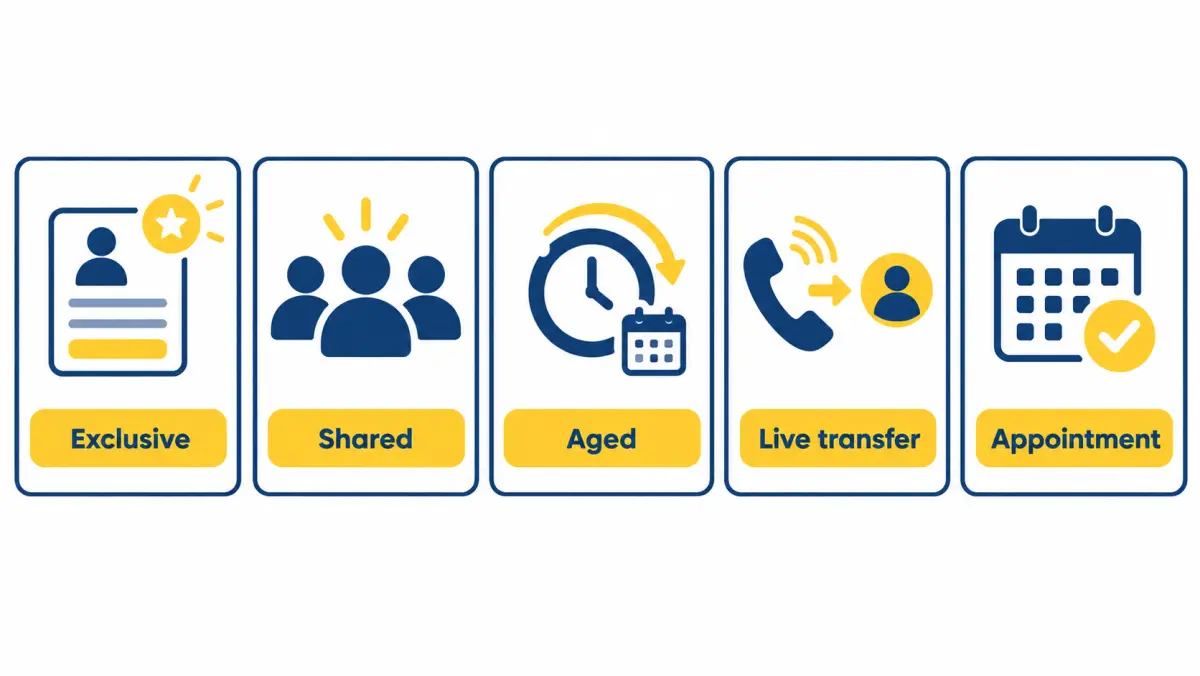
Each type has a place. Installers get into trouble when they buy a type that does not match their operation: raw leads for a team that cannot call within minutes, or appointments for a team that already has strong setters sitting idle.
Real-time exclusive leads
A real-time exclusive lead is a fresh form submission delivered to one buyer within seconds or minutes of the homeowner submitting it, and never sold to anyone else. "Exclusive" should mean exactly that: one buyer, no resale later, no recycling into an aged list. Our definition reads: each exclusive lead is sold to one company. It is never resold, recycled or sold later as an aged lead.
Exclusive leads cost more per unit than shared leads because the seller gives up the revenue from selling the same record several times. In return, you get a homeowner who has only heard from you, which usually means a higher contact rate and less price pressure in the first conversation. Exclusive leads reward speed. If your team calls within a few minutes, you are often the first and only voice the homeowner hears that day.
Exclusive leads fit installers who:
- Have setters or closers available to call during the hours leads arrive.
- Want to control the first impression and the pitch.
- Prefer to pay for a lead rather than for a seller's setter's time.
For a full product spec, see our page on exclusive solar leads.
Shared (multi-installer) leads
A shared lead is sold to more than one buyer, commonly two to four, sometimes more. The homeowner may receive calls from several installers within minutes. Shared leads cost less per unit, and the seller's disclosure should tell the homeowner that several companies may contact them.
Shared leads turn every lead into a race. The first installer to reach the homeowner and book a meeting has a large advantage. Teams with an auto-dialer, round-the-clock setters and a sharp opening script can do well with shared leads. Teams that call back an hour later often find the homeowner has already booked with someone else, or is tired of phone calls and stops answering.
Shared leads fit installers who:
- Have a fast, disciplined calling operation and can measure it.
- Sell in markets where price competition is normal and they win on price or speed.
- Want volume at a lower unit cost and accept a lower contact and close rate.
Aged leads
An aged lead is a record that is past its first sale window, often 30, 60 or 90 days old, sometimes a year or more. Sellers price aged leads far below fresh leads because most of the original intent has faded and the record may have been called many times already. Some homeowners in an aged list did not buy and still want solar; finding them takes volume and patience.
Aged leads raise two questions you must answer before buying. First, is the consent still valid for your company? Consent captured for one company or a short list of companies does not automatically transfer to you a year later. Second, has the list been scrubbed against the National Do Not Call Registry and your internal do-not-call list recently? We cover use cases and limits in aged leads: when they work and when they do not, and in depth on our aged solar leads page. Availability of aged leads for your territory is confirmed on the call.
Live transfers and inbound calls
A live transfer is a phone call. The seller's agent speaks with a homeowner, asks screening questions, and then transfers the call, with the homeowner still on the line, to your closer or setter. An inbound call (pay per call) is similar, except the homeowner dials a number from an ad and the call is routed to you, sometimes after an automated screening step.
Both products remove the dialing problem. You do not have to reach anyone; the homeowner reaches you. You pay for that. Live transfers and calls are usually billed per qualified call, where "qualified" is defined by a minimum call duration and a set of screening criteria. Read those definitions carefully: a 60-second minimum may bill you for a call where the homeowner hung up after hearing the price of a site visit.
Live transfers fit installers who:
- Have closers or senior setters who can take calls live during set hours.
- Lose too many raw leads to slow follow-up.
- Want a conversation, not a record.
See our page on solar live transfer leads for how the screening and billing rules work. Availability of live transfers for your territory is confirmed on the call.
Booked appointments
A booked appointment is a scheduled meeting, in home or virtual, with a homeowner who has been screened and agreed to a time. The seller does the contacting, qualifying and scheduling, and often confirms the appointment a day ahead. You send a closer.
Appointments cost the most per unit. They make sense when your closers are your scarce resource and you want them spending time in front of homeowners rather than on the phone. The key terms are what counts as a "qualified" appointment, what happens when the homeowner does not show, and how fast you must report a no-show. Our appointment terms read: if a confirmed appointment doesn't sit because the prospect no-shows or doesn't match your filters, report it within 7 days of the scheduled time and we replace it.
Read more on our solar appointments page.
Residential vs commercial leads
Residential leads are homeowners asking about systems for their own home. The sale is a consumer sale, usually decided by one or two people in a few weeks. Commercial and industrial (C&I) leads are businesses, nonprofits, farms, multifamily owners and public entities. The sale is a B2B sale with several decision-makers, site data requirements (interval load data, roof drawings, structural reports, interconnection questions), and a cycle that can run months.
Because the sales motion is so different, the lead product is too. A commercial "lead" that is just a name and a phone number is rarely enough. You want company name, the inquirer's role, the property type, approximate monthly energy spend, whether they own or lease the building, and the timeline. Our commercial leads are filtered by self-reported role. We cover both in their own sections below: residential solar leads and commercial solar leads.
Side-by-side comparison
| Lead type | Relative unit price | Who you compete with | What drives contact rate | Work left for your team | Best fit |
|---|---|---|---|---|---|
| Real-time exclusive | Medium to high | Nobody else bought this lead | Your speed to call, time of day, phone validity | Contact, qualify, set, close | Teams with fast setters or closers on the phone |
| Shared | Low to medium | Two or more other buyers | Being first, persistence, dialer use | Contact (race), qualify, set, close | High-speed call centers, price-competitive markets |
| Aged | Lowest | Possibly many past buyers | List freshness, scrub quality, volume of dials | Heavy dialing, re-qualify, set, close | Setter teams with spare capacity, nurture programs |
| Live transfer / inbound call | High per call | Usually nobody during the call | Already connected; billing rules matter | Qualify, set or close on the call | Closers who can take live calls during set hours |
| Booked appointment | Highest per unit | Depends on exclusivity terms | Already scheduled; show rate matters | Run the meeting, close | Closer-heavy teams with thin setter capacity |
"Relative unit price" is a ranking, not a price list. Actual prices depend on state, ZIP code, filters, volume and the seller. For a full breakdown see how much solar leads cost.
Exclusive vs shared leads
Exclusive solar leads go to one buyer; shared leads go to several. Exclusive leads cost more per lead but usually contact and close at higher rates because you are not racing other installers. Shared leads cost less per lead but reward only the fastest teams. The better choice is whichever produces the lower cost per closed sale in your market, measured on your own test batches.
The debate between exclusive and shared is mostly an argument about price per lead. That is the wrong unit. Here is how to make the decision with the right one.
How exclusivity is defined and documented
"Exclusive" is a word, not a guarantee. Ask the seller to put the definition in writing, and look for answers to these questions:
- Is the lead sold to one buyer only, ever? Some sellers call a lead exclusive if it is sold to one buyer at a time, then resell it as an aged lead later. That is "exclusive for now," not exclusive.
- Does the consent disclosure name only your company? If the form the homeowner filled out lists five installers, the lead was built to be shared, regardless of how it is sold.
- Can you see the consent record? A consent certificate shows the disclosure text and the companies named. That is the strongest evidence of how the lead was collected.
- How is exclusivity enforced in the system? Ask whether the platform locks a lead to one buyer at delivery and whether the record is removed from resale inventory.
- What happens if you find the homeowner was contacted by another installer about the same request? A seller confident in their exclusivity will have a process for this.
Our consent records name the buying company in the disclosure: every lead carries a timestamped consent record (certificate) whose disclosure names your company. Ask any vendor, including us, to show you a sample.
The cost-per-sale view of the trade-off
Here is a simple worked comparison. Illustrative example only: these are made-up numbers chosen to show the math, not market prices or our prices.
| Input | Exclusive (illustrative) | Shared (illustrative) |
|---|---|---|
| Price per lead | $100 | $40 |
| Contact rate | 60% | 35% |
| Appointment rate (of contacted) | 40% | 30% |
| Sit rate (of appointments) | 75% | 65% |
| Close rate (of sits) | 25% | 20% |
| Leads per sale | 1 / (0.60 x 0.40 x 0.75 x 0.25) = 22.2 | 1 / (0.35 x 0.30 x 0.65 x 0.20) = 73.3 |
| Cost per sale | 22.2 x $100 = $2,222 | 73.3 x $40 = $2,930 |
In this made-up case the exclusive lead costs two and a half times as much per lead and still comes out cheaper per sale, because every stage of the funnel converts better. Change the inputs and the answer can flip. If your shared-lead contact rate is close to your exclusive contact rate (because your team is very fast), shared can win. The only way to know is to measure.
We go deeper, with sensitivity tables, in exclusive vs shared solar leads.
When shared still makes sense
Shared leads are not a scam and not always worse. They make sense when:
- Your team is genuinely fast. If an auto-dialer calls every lead within 30 seconds and your setters are skilled at opening calls, you often win the race.
- You sell on price and can say so in the first call. In shared leads, the homeowner will compare quotes. Teams that expect that and lead with a clear offer do better.
- You need volume to train new setters. Lower unit costs let new setters practice without burning expensive leads.
- You are testing a new territory. A cheap probe can tell you whether homeowners in a ZIP range respond at all before you commit to exclusive volume.
Shared leads do not make sense when your average time to first call is measured in hours, when your closers rely on long consultative conversations, or when your brand promise is premium service.
Solar lead pricing: what you will actually pay
Solar lead prices depend on lead type, exclusivity, state and ZIP code, the filters you apply, volume, and the seller's pricing model. Published price ranges from vendors and lead marketplaces disagree widely and are rarely dated, so treat any single number with caution. As of October 2026, the reliable way to price leads is to get quotes by ZIP code and compare them on cost per sale.
We do not publish our own prices on this page. Pricing is confirmed by ZIP on your call. What we can do is explain how pricing works, where published numbers come from, and which costs most buyers forget to include.
Price bands by lead type
When we reviewed public pricing pages and buying guides from lead sellers and software vendors while preparing this guide, we found two consistent problems. First, the ranges conflict: the same lead type is quoted at very different levels by different sources, and sometimes by the same source in two places. Second, most numbers carry no date and no method, so you cannot tell whether a price is from 2019 or 2026, or whether it is an average, a minimum or a sales pitch.
For that reason this guide uses a ranking rather than a price list. Relative to each other, the usual order from lowest to highest unit price is:
- Aged leads (lowest, with older records cheaper than recent ones)
- Shared real-time leads
- Exclusive real-time leads
- Live transfers and qualified inbound calls
- Booked appointments (highest)
Commercial leads do not fit neatly on this ladder. Their pricing depends heavily on the size of project the inquirer represents and on how much qualification has been done.
We keep a dated, sourced price table, including where sources disagree, in how much solar leads cost.
Pricing models
| Model | You pay for | Who carries the risk | Watch out for |
|---|---|---|---|
| Per lead | Each delivered lead that meets your filters | You carry contact and conversion risk | Loose filters, slow replacement process |
| Per appointment | Each set appointment | Seller carries contact risk; you carry close risk | Loose "qualified" definition, no-show rules |
| Per call / live transfer | Each call that passes a duration and screening threshold | Shared | Short duration thresholds, billing for hang-ups |
| Pay per sale or per install | A fee or share when a deal closes or installs | Seller carries most risk | Higher effective price, data-sharing demands, disputes over attribution |
| Subscription or retainer | A monthly fee for a set volume or a managed campaign | You, if volume falls short | Lock-ins, minimums, auto-renewals |
| Revenue share | A percentage of each sale | Seller | Very high effective cost on large jobs, audit rights |
None of these is better in the abstract. A per-lead deal with honest filters and a working replacement policy can beat a pay-per-sale deal that charges a large share on every job. Run each offer through the cost-per-sale formula.
Why state matters: cost by market
Lead prices differ by state and ZIP code for reasons that have little to do with the seller's margin:
- Advertising cost. In markets where many installers bid on the same search terms and social audiences, the cost to generate each form fill is higher.
- Buyer demand. More installers buying in a market means higher bids in ping-post auctions and higher list prices for exclusives.
- Policy and economics. Utility rates, net metering or net billing rules, state incentives and TPO availability affect how many homeowners convert, which affects what buyers will pay.
- Population and home types. Rural areas with fewer homes can be cheaper per lead but harder to fill at volume. Dense areas with many renters waste more ad spend.
We go market by market in solar lead cost by state. Territory availability is confirmed by ZIP code on your call.
Hidden costs
The invoice price is only part of the real cost. Count these too:
- Uncontactable leads. Leads you dial repeatedly and never reach. Not usually replaceable; they still cost setter time.
- Invalid leads. Disconnected numbers, wrong contact details, leads outside your filters. These should be replaceable. Our replacement terms: replacement credits for disconnected numbers, wrong contact details, or leads outside your filters, within 7 days. Not covered: a prospect who isn't interested, doesn't answer, doesn't get financing approved, or doesn't buy.
- No-shows. Appointments that do not sit cost closer time and travel.
- Setter labor. Every dial, text and voicemail takes time. For raw leads this is often the largest hidden cost.
- Software and data. Dialer seats, CRM licenses, consent verification services, phone validation.
- Compliance overhead. Do-not-call scrubbing, consent storage, quality monitoring and legal review.
A useful habit: compute a fully loaded cost per lead that adds setter labor and software to the invoice price, then use that number in the cost-per-sale formula below.
Cost per sale: the only number that matters
Cost per sale is the amount you spend on leads to close one solar job. Calculate it as cost per lead divided by the product of your contact rate, appointment rate, sit rate and close rate. A cheap lead with weak conversion can cost more per sale than an expensive lead that converts well, so compare every source on cost per sale, measured on your own data.
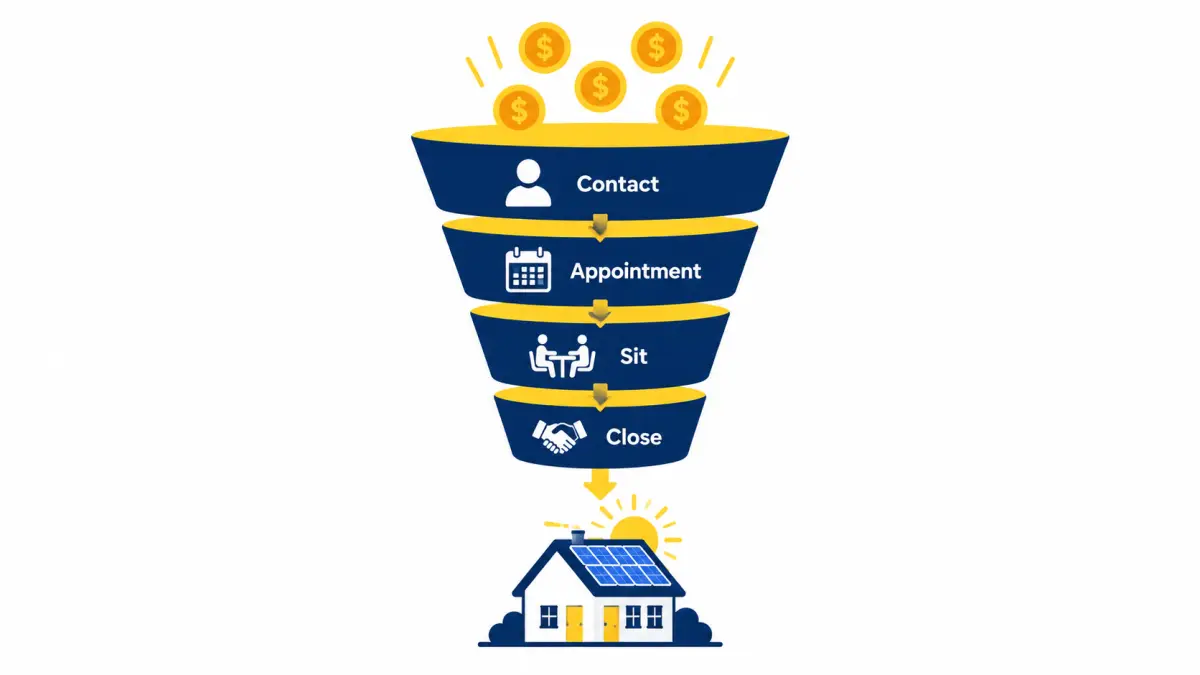
Most installers already know this in principle. Fewer track it by source, by month and by setter, which is where the money is.
The formula
Cost per sale = Cost per lead / (Contact rate x Appointment rate x Sit rate x Close rate)
Definitions, so you measure the same thing every month:
- Contact rate: leads where your team had a real two-way conversation with the homeowner, divided by leads received. A voicemail is not a contact. A wrong number is not a contact.
- Appointment rate: appointments set, divided by contacts.
- Sit rate: appointments that actually happened with the decision-makers present, divided by appointments set.
- Close rate: signed contracts, divided by sits. Decide whether you count at signing or after cancellation windows, and stay consistent.
You can also run the formula backwards to find the most you can afford to pay per lead:
Maximum cost per lead = Target cost per sale x Contact rate x Appointment rate x Sit rate x Close rate
If your target cost per sale is set by your margin (see break-even below), this tells you the ceiling for any lead source, given that source's funnel.
For appointments, drop the first two terms: cost per sale = cost per appointment / (sit rate x close rate). For live transfers, treat each billable call as a "contact" and start from the appointment rate.
Worked examples at three price points
Illustrative examples only. These numbers are invented to show the math. They are not market prices, benchmarks or our prices.
| Scenario | Price per unit | Contact | Appt | Sit | Close | Units per sale | Cost per sale |
|---|---|---|---|---|---|---|---|
| A: low-price shared lead | $35 | 30% | 30% | 60% | 20% | 92.6 | $3,241 |
| B: mid-price exclusive lead | $90 | 55% | 40% | 70% | 25% | 25.97 | $2,338 |
| C: booked appointment | $350 | n/a | n/a | 65% | 28% | 5.49 | $1,923 |
Working through scenario B step by step: 0.55 x 0.40 = 0.22 appointments per lead. 0.22 x 0.70 = 0.154 sits per lead. 0.154 x 0.25 = 0.0385 sales per lead. 1 / 0.0385 = 25.97 leads per sale. 25.97 x $90 = $2,338 per sale.
Notice what the table does not include: setter labor. Scenario A needs your team to work about 93 leads per sale; scenario C needs your team to work about 5.5 meetings per sale and no dialing. If a setter costs you a meaningful hourly wage and spends many hours per sale on scenario A, the fully loaded gap widens further.
Fully loaded cost per sale
To include labor, add it per lead before running the formula:
Fully loaded cost per lead = Price per lead + (Setter hours per lead x Loaded hourly cost) + Software and data cost per lead
Illustrative example: a setter spends an average of 20 minutes per raw lead across all attempts (dials, texts, voicemails, notes), at a loaded cost of $30 per hour. That adds $10 per lead. Software and validation add $3 per lead. A $90 lead becomes $103 fully loaded. In scenario B, cost per sale rises from $2,338 to 25.97 x $103 = $2,675.
Do the same for appointments: the seller has already done the setting, so your labor per appointment is mostly closer time, which you would spend anyway on any sit.
Sensitivity: what moves cost per sale most
Because the formula multiplies four rates, a gain at any stage has the same proportional effect on cost per sale. But the stages are not equally easy to move. Here is a sensitivity table built on scenario B (illustrative):
| Change (one at a time) | New rate | New cost per sale | Change vs base |
|---|---|---|---|
| Base case | n/a | $2,338 | n/a |
| Contact rate +10 points | 65% | $1,978 | -15% |
| Appointment rate +5 points | 45% | $2,078 | -11% |
| Sit rate +10 points | 80% | $2,045 | -13% |
| Close rate +5 points | 30% | $1,948 | -17% |
| Price per lead -$20 | $70 | $1,818 | -22% |
| Contact rate -15 points (slow follow-up) | 40% | $3,214 | +37% |
Two lessons come out of tables like this:
- Contact rate is the stage most under your control in the first hour. It depends heavily on how fast and how persistently you call. Slow follow-up can wipe out any discount you negotiated on price.
- Negotiating price matters, but only after your funnel is stable. A 20% price cut is worth less than it looks if your contact rate drifts down at the same time.
Referral and lifetime value adjustments
Cost per sale treats each job as standalone. Real installers get more from a customer than the first contract:
- Referrals. A satisfied customer may send neighbors or family your way. If your records show that, on average, a fraction of customers produce a referral sale, you can credit each bought-lead sale with that value.
- Add-ons. Battery storage, EV chargers, panel upgrades, roof work and service plans sold later.
- Reviews. Reviews from bought-lead customers feed your organic channels.
Be conservative. Use your own historical rates, not hopeful guesses, and apply the adjustment equally to every source so the comparison stays fair. If you have no data yet, leave the adjustment out.
Break-even against gross margin per job
The highest cost per sale you can tolerate is set by your gross margin per job after installation costs, before sales and marketing. Some installers also deduct commission.
Maximum affordable cost per sale = Gross margin per job - Sales commission - Target profit per job
Illustrative example: a residential job earns $6,000 gross margin after equipment, labor, permits and overhead allocations. Commission to the closer is $1,500. You want at least $2,000 profit per job. The maximum you can spend on leads per sale is $6,000 - $1,500 - $2,000 = $2,500. Scenario B ($2,338) fits; scenario A ($3,241) does not, unless you can raise its conversion rates.
After the end of the 25D credit, it is worth recalculating gross margin by financing path. A TPO sale through a partner may earn you a different margin from a cash sale, which changes your break-even for each lead source if their financing mix differs.
Use the calculator
You do not need to build this in a spreadsheet from scratch. Our solar lead cost calculator runs the same formula: enter your lead price and funnel rates and it returns leads per sale and cost per sale. For the full method, including how to measure each rate cleanly, see our guide to solar lead ROI.
Where to buy solar leads
You can buy solar leads from five kinds of sellers: lead marketplaces and aggregators, exclusive lead generators and agencies, pay-per-call networks, appointment-setting firms, and data brokers that sell lists. Each sells a different product with different risks. The best place to buy depends on the lead type you need, how much transparency the seller offers, and how your test batch performs.
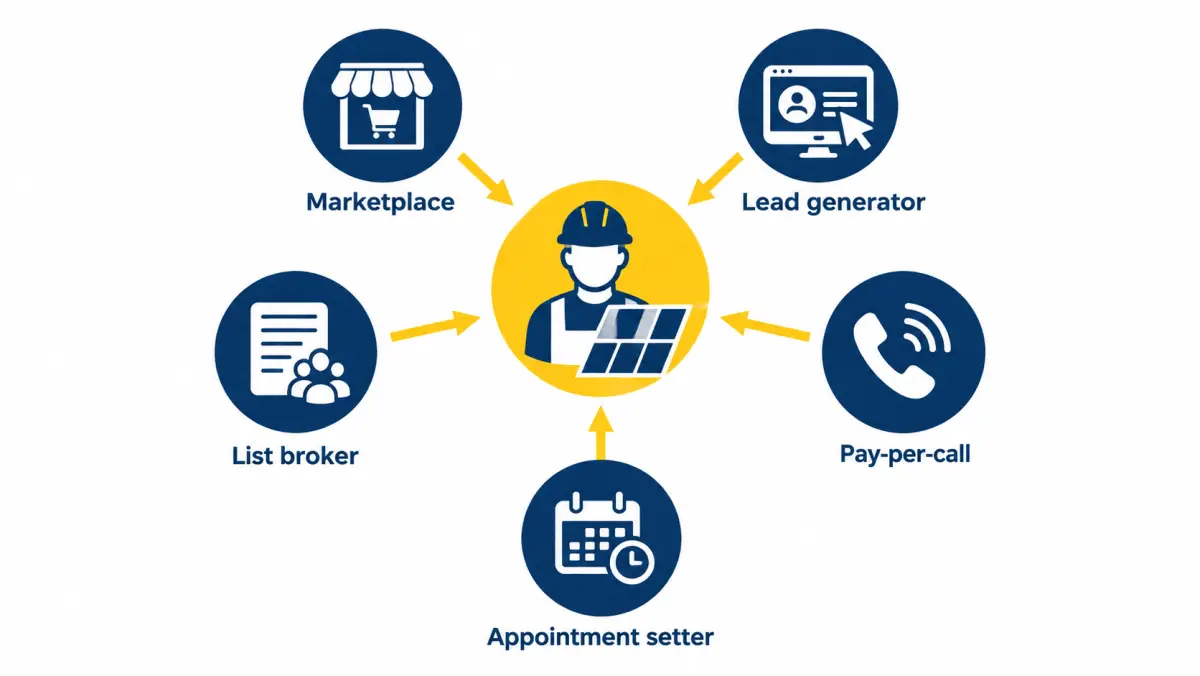
There is no single "best solar lead provider" for everyone. A provider that works well for a fast call center in one state can be a poor fit for a two-person installer in another. The sections below explain each seller type, what to expect, and what to check.
Marketplaces and aggregators
Marketplaces buy leads from many publishers (websites and ad campaigns run by independent marketers) and resell them, often through real-time auctions. A homeowner fills out a form; the marketplace "pings" a description of the lead to buyers whose filters match; buyers bid; the winner or winners receive the full record.
Strengths: volume, coverage in many states, flexible filters, self-serve dashboards, often no long contracts.
Weaknesses: the marketplace may not control how each publisher generates the lead, so source quality varies. Many leads are shared. Consent disclosures may name a long list of companies or a "marketing partners" link.
What to check: which publishers your leads come from (by site ID or URL), what consent language the homeowner saw, whether exclusive leads are truly one-buyer, and how returns work.
Exclusive lead generators and agencies
These companies run their own advertising (search, social, display, sometimes TV or radio) and landing pages, and sell the leads they collect. Some sell each lead to one buyer; others offer exclusive and shared tiers. Some agencies run campaigns in your name, where you own the ad accounts and pay the agency a management fee; that is closer to building your own channel than buying leads.
Strengths: more control over source and consent, often fresher leads, the ability to tailor questions and filters.
Weaknesses: smaller volume per territory, higher unit price, and results that depend on one company's ad skill.
What to check: whether you can see the landing pages, whether the consent disclosure names your company, how exclusivity is enforced, and the minimums and contract terms. We are in this group: we sell exclusive residential and commercial solar leads and booked appointments, with real-time delivery to your CRM, dialer, email, or SMS. No long-term contracts. Start with a test batch, scale when the numbers work.
Pay-per-call networks
Pay-per-call networks run ads with a phone number, screen callers (by a person, an automated menu, or both) and route qualified callers to buyers. Live transfer providers are a close relative: their agents call web leads, screen them, and transfer the call.
Strengths: a live conversation without dialing, good for teams with closers on standby.
Weaknesses: billing disputes over call duration and qualification, missed calls that still bill, and limited information about the caller before you pick up.
What to check: the minimum duration that triggers billing, the screening questions, call recordings for disputes, hours of operation, and caps per hour. See solar live transfer leads.
Appointment-setting providers
Appointment setters run calling teams that convert leads (theirs or yours) into scheduled meetings. Some generate their own leads and sell the resulting appointments. Others work your leads for a fee per appointment or per hour.
Strengths: your closers only show up for meetings; your company does not need to hire and manage setters.
Weaknesses: the most expensive unit; quality depends on how strictly the setter qualifies; no-shows can be frequent if appointments are not confirmed.
What to check: the written definition of a qualified appointment, confirmation steps, the no-show replacement policy, whether all decision-makers must attend, and how quickly you must report problems. See solar appointments.
Data brokers and list sellers
List sellers provide files of homeowner records, sometimes built from old solar inquiries (aged leads), sometimes from property and consumer databases with no solar inquiry at all. The second kind is not a lead; it is a prospecting list, and calling it with an auto-dialer or prerecorded message without proper consent can create serious legal exposure under the TCPA and state telemarketing laws. Confirm with counsel before using any list for outbound calls or texts.
What to check: where the records came from, when they were collected, what consent exists and for whom, whether the file has been scrubbed against the National Do Not Call Registry and state lists recently, and whether the seller will give you the consent record for each record.
Building your own demand instead
You can also generate your own leads through referrals, local search, paid ads, door-to-door canvassing, events and partnerships. Building takes longer and needs skills most installers do not have in house, but the leads are yours, exclusive by definition, and often cheaper per sale once the channel is mature. We compare the two in buy vs build.
Disclosure: we sell leads, here is how to compare us fairly
We sell exclusive residential and commercial solar leads and booked appointments. Aged leads and live transfers are product categories we describe in this guide; availability for your territory is confirmed on the call. To compare us fairly with any other vendor:
- Ask every vendor the same questions from the vetting checklist and get the answers in writing.
- Run a test batch of similar size, in the same ZIP codes, over the same weeks, with the same setters.
- Track every lead to an outcome in your CRM, tagged by source.
- Compare cost per sale, not price per lead.
- Decide by the numbers. If another vendor wins in your market, use them.
Our terms that matter for the comparison: no long-term contracts, start with a test batch; replacement credits for disconnected numbers, wrong contact details, or leads outside your filters, within a 7-day window; and approved credits apply to your next batch. To report a bad lead, reply to the lead notification (or email us) with the reason. Book a call to get ZIP-level pricing and availability.
How to vet a solar lead provider
To vet a solar lead provider, check where its leads come from, how consent is captured and proven, how exclusivity is enforced, how fresh leads are at delivery, what is verified before delivery, what the contract locks you into, and exactly what qualifies for a refund or replacement. Then run a small, measured test batch before committing real budget.
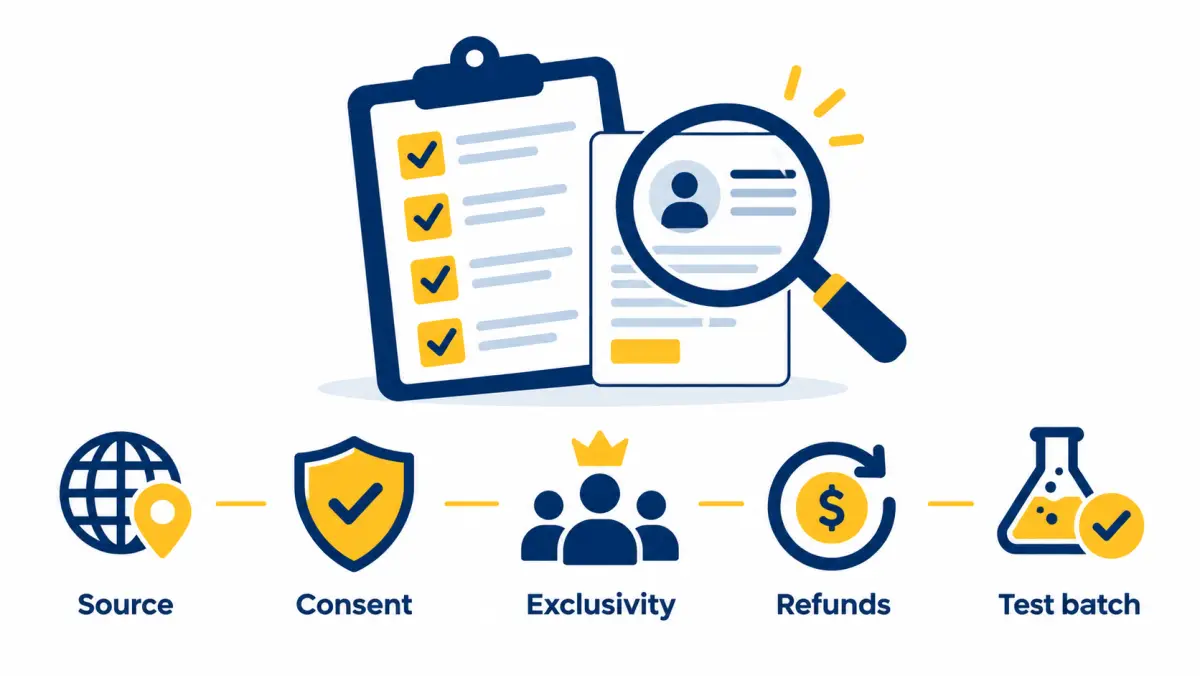
The questions below work for any vendor. Ask them all, in writing, and keep the answers in the vendor's file. When a vendor will not answer a question, that is an answer too. We go further, with red flags and a scoring sheet, in how to vet a solar lead provider.
Source transparency and consent capture
Ask:
- What websites and ad channels generate my leads? Can I see the landing pages and the ads?
- Do you generate the leads yourself, buy them from publishers, or both? What share comes from each?
- What exact consent disclosure does the homeowner see? Does it name my company? How many other companies does it name?
- Do you capture a third-party consent certificate (for example, TrustedForm or Jornaya) or a first-party session record for every lead? Will you send it to me for any lead, on request, for how long?
- How long do you retain consent records?
A good vendor answers these quickly and with examples. A vendor that says "our sources are proprietary" and will not show a single landing page or consent record is asking you to take on legal risk without evidence.
How exclusivity is enforced technically
Ask:
- Is each lead delivered to one buyer only, ever? Is that in the contract?
- Is the lead removed from your inventory after delivery, or can it be sold later as an aged lead?
- If the same homeowner submits twice, or appears on another of your sites, how do you handle it?
- If I find that another installer contacted my homeowner about the same request, what do you do?
Timestamps, lead age and delivery speed
Ask:
- How long between form submission and delivery to my CRM, on average and at the slowest?
- Do you include the submission timestamp on every lead?
- Do you ever hold leads and deliver them in batches? When?
- What hours do you deliver? Can I set delivery hours and daily caps?
Freshness matters because contact rates tend to fall as minutes pass. A lead delivered an hour after submission is a different product from one delivered in seconds.
Verification: phone, homeowner status, address
Ask what is checked before delivery, and get the list in writing. Common checks include phone validation (is the number real and reachable?), address standardization, homeowner verification against property records, duplicate checks, and do-not-call scrubbing. Our pre-delivery checks are:
- Phone number validated before delivery
- Homeowner status self-reported, then checked against property records
- Duplicate-checked against leads already sent to you
- Scrubbed against the National Do Not Call Registry
Be wary of vague claims such as "every lead is verified" or "100% qualified." Ask what exactly is verified, by what method, and what happens when a check fails.
Contract terms: lock-ins, setup fees, minimums
Ask:
- Is there a minimum term, minimum spend or minimum volume?
- Are there setup fees, onboarding fees or platform fees?
- Does the agreement renew automatically? What is the cancellation notice period?
- Is payment prepaid, and is any unused prepaid balance refundable?
- Can I pause delivery? How quickly does a pause take effect?
Our terms: no long-term contracts. Start with a test batch, scale when the numbers work.
Refund and replacement definitions
This is where many lead relationships fail. Get a written list of what qualifies for replacement or credit, the window to report it, the process, and whether you get a replacement lead, a credit, or money back (our solar lead return policy guide covers what's typically returnable and how to document disputes).
Typical replaceable problems include disconnected or wrong numbers, wrong contact details, leads outside your filters (wrong ZIP, renter when you filter for homeowners), and duplicates. Typical non-replaceable outcomes include homeowners who are not interested, do not answer, fail financing, or do not buy. That line is reasonable: the seller controls data quality, while your team controls the sale.
Our policy: replacement credits for disconnected numbers, wrong contact details, or leads outside your filters, reported within 7 days. Reply to the lead notification (or email us) with the reason; approved credits apply to your next batch. Not covered: a prospect who isn't interested, doesn't answer, doesn't get financing approved, or doesn't buy.
Run a controlled test batch
A test batch is a small purchase designed to measure a vendor, not to fill your calendar. Design it so the result means something:
- Fix the territory. Use the same ZIP codes for every vendor you test, or at least comparable markets.
- Fix the team. Have the same setters and closers work every vendor's leads, with the same scripts and cadence.
- Fix the window. Run vendors side by side over the same weeks to avoid seasonal effects.
- Size it to reach decisions. You need enough leads to see appointments and sits, not only contacts. For many installers that means at least a few dozen leads per vendor; for closes, more. A tiny batch can mislead in either direction.
- Tag every lead. Source, vendor lead ID, delivery time, first-contact time, every disposition.
- Wait for the full cycle. Do not judge a vendor on contacts alone. Wait until appointments have sat and most closes have happened.
Reporting and CRM source attribution
Ask whether the vendor can post leads directly into your CRM with a source field, whether they provide a delivery log, and whether they can receive disposition data back from you (some vendors use your outcomes to improve targeting). Our delivery: real-time delivery to your CRM, dialer, email, or SMS.
On your side, make sure every lead has a source tag that cannot be overwritten by a setter, and that close data flows back to the lead record. Without this, you cannot compute cost per sale by source, and every vendor decision becomes a guess.
Business identity and references
Before you send money, confirm who you are dealing with:
- Legal entity. Get the company's legal name and state of registration, and check it in that state's business registry. The name on the contract, the invoice and the payment account should match.
- Physical presence. Ask for a business address and a named account manager with a direct phone number.
- Telemarketing registrations. If the vendor makes calls (live transfers, appointment setting), ask whether it is registered as a telemarketer in the states that require it, and get the registration numbers. Confirm the requirement with counsel.
- References. Ask for two or three current installer customers you can call, ideally in markets similar to yours. Ask them about contact rates, consent records, replacement handling and how disputes were resolved.
- Complaint history. Search the company and its owners' names alongside words such as "TCPA," "lawsuit" and "complaint." A single case is not proof of wrongdoing, but a pattern is worth asking about.
None of these checks proves lead quality. They tell you whether there is a real, accountable business on the other side if something goes wrong.
What makes a lead qualified
A qualified residential solar lead is a homeowner, in your service area, with a roof and property that can host solar, an electric bill large enough to justify a system, a financing profile that fits at least one of your offers, a stated timeline, and the decision-makers reachable. Commercial leads add role, building ownership and energy spend. Write your definition down and give it to every vendor.
"Qualified" is the most abused word in lead selling. The fix is simple: you define it, in writing, and the vendor agrees to it.
The core qualification fields
| Field | Why it matters | How it is usually captured |
|---|---|---|
| Homeownership | Renters usually cannot sign for rooftop solar | Self-reported, sometimes checked against property records |
| Property type | Single-family detached is simplest; condos, townhomes and mobile homes have extra hurdles | Self-reported |
| Roof and shade | Heavy shade or a roof near the end of its life can stop a deal | Self-reported; your team confirms with satellite imagery |
| Electric bill | Small bills make savings hard to show | Self-reported range |
| Utility | Rate structure and net metering or net billing rules affect savings | Self-reported or derived from ZIP |
| Credit band | Loan and TPO approvals depend on it | Self-reported range; never assume it is verified |
| Timeline | Separates researchers from buyers | Self-reported |
| Decision-makers | A meeting without all owners rarely closes | Asked by setters before booking |
Scoring and routing rules
Once fields are captured, you can score and route:
- Route by ZIP and capacity. Send leads to the closer or branch covering that ZIP, with daily caps so no one is overloaded.
- Route by financing path. If you sell TPO through a partner in only some states, route leads in those states to reps trained on TPO.
- Prioritize by score. Call high-bill, near-term, good-credit-band homeowners first when several leads arrive at once.
- Filter at the source. If a field reliably predicts a non-sale in your data (for example, very low bills), ask your vendor to filter it out before delivery rather than paying for it and replacing it.
Keep scoring simple at first. A handful of rules you actually follow beats a complex model nobody trusts.
Qualification by market: TPO vs loan vs cash
After the end of the 25D credit, qualification depends more on the financing path:
- Cash buyers: bill size and savings case matter most. These buyers are often analytical and will compare quotes.
- Loan buyers: credit band and debt-to-income matter. Monthly payment compared with current bill is the core pitch.
- TPO (lease or PPA): availability depends on state, utility and the TPO provider's rules. Credit checks still apply. The pitch is a lower monthly cost with no ownership responsibilities.
Ask your vendor to capture the homeowner's stated preference if possible, and track close rates by path. For more on residential qualification after 25D, see solar leads after the 25D credit. Talk to your tax advisor about specific projects.
Compliance basics for lead buyers
When you call or text a purchased solar lead, you are responsible for following the Telephone Consumer Protection Act (TCPA), the FTC's Telemarketing Sales Rule, the National Do Not Call Registry and state telemarketing laws. In practice that means having proof of prior express written consent for autodialed or prerecorded marketing calls and texts, honoring do-not-call requests and respecting calling hours. This is not legal advice; confirm with counsel.
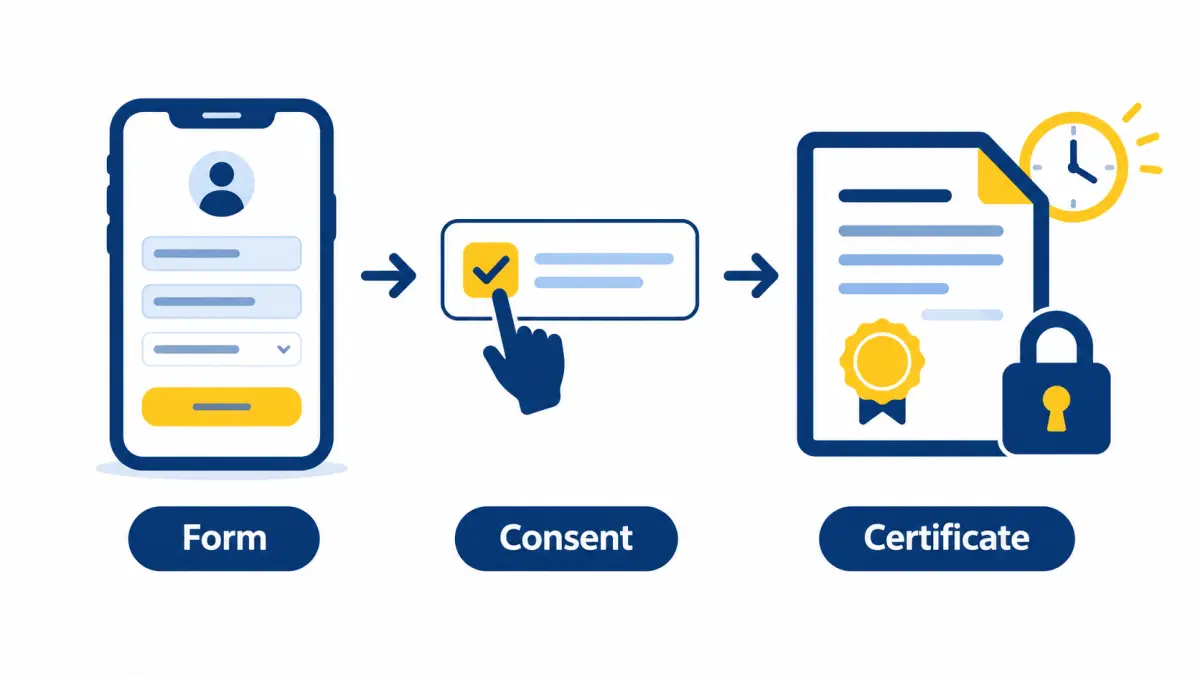
Compliance is not the seller's problem alone. Under the TCPA, the company whose products are marketed on the call can face liability, and plaintiffs' firms actively pursue solar telemarketing cases. Treat consent proof as part of what you are buying. For a deeper treatment, see our guide to TCPA rules for solar lead buyers and our TCPA compliance policy.
TCPA prior express written consent in plain terms
Under FCC rules implementing the TCPA, telemarketing calls or texts made using an automatic telephone dialing system or an artificial or prerecorded voice to a wireless number generally require the recipient's prior express written consent. "Written" can be electronic, such as a checkbox or button on a web form, if the disclosure is clear and the consumer's agreement is recorded. The disclosure should identify the seller, state that the consumer agrees to receive marketing calls or texts using automated technology, and state that consent is not a condition of purchase.
Whether a particular dialer counts as an "automatic telephone dialing system" has been narrowed by the Supreme Court's 2021 decision in Facebook v. Duguid, but prerecorded and artificial voice calls (including many AI voice tools) and state "mini-TCPA" laws can still require consent. Do not assume your setup is exempt; confirm with counsel.
The FCC's consumer guide to the TCPA and robocalls and the FTC's Telemarketing Sales Rule guidance are good starting points for the primary rules.
The FCC one-to-one consent rule was vacated
In December 2023 the FCC adopted a rule that would have required consent to be given to one seller at a time ("one-to-one consent") and to be logically related to the website where it was given. The rule was challenged, and on January 24, 2025, the U.S. Court of Appeals for the Eleventh Circuit vacated it in Insurance Marketing Coalition v. FCC. The one-to-one requirement therefore did not take effect.
What that does and does not change, as of October 2026:
- It does not remove the consent requirement. Prior express written consent rules that existed before the 2023 order still apply where they applied before.
- It does not make long "marketing partner" lists safe. Courts and state laws may still look hard at whether a consumer meaningfully agreed to hear from a specific company, and a disclosure that names hundreds of companies is a weak record to defend.
- It does not override state law. Several states have their own telemarketing and consent rules, some stricter than federal law.
- Many buyers and sellers still use one-to-one style consent voluntarily, because a disclosure naming only your company is the strongest evidence you can have. Ours names your company: every lead carries a timestamped consent record (certificate) whose disclosure names your company.
Several buying guides published before 2025 still describe the one-to-one rule as coming. It is not. Confirm the current state of the rules with counsel before you design your consent and calling process.
Consent proof, retention and audit trail
For every purchased lead you call or text, you want to be able to produce, quickly:
- The consent record: the disclosure text, the timestamp, the page URL, and the consumer's IP or device data.
- The lead record as delivered to you, with your lead ID and delivery time.
- Your call and text log for that number.
- Any opt-out request and the date you honored it.
Ask your vendor how long they keep consent records and whether you can store your own copy at delivery. Many buyers store the certificate (or its URL, plus a claimed copy where the service supports it) in the CRM lead record.
Do-not-call, quiet hours and state telemarketing laws
- National Do Not Call Registry: telemarketers must scrub against it, subject to exemptions such as an established business relationship or prior express written consent. The FTC runs the registry; see donotcall.gov for the rules.
- Internal do-not-call list: you must honor a consumer's request not to be called by your company, and keep a written policy.
- Calling hours: federal rules restrict telemarketing calls to between 8 a.m. and 9 p.m. in the consumer's local time; several states set narrower windows or limit call frequency.
- State laws: states such as Florida, Oklahoma and others have their own telemarketing laws with consent, timing and frequency rules. Some require registration for telemarketers.
- Texting: text messages are generally treated as calls under the TCPA, and carriers apply their own rules on top.
Laws change, and many states have amended telemarketing statutes in recent years. Confirm with counsel which rules apply in each state you call.
Counsel review
This section summarizes public rules for buyers' general awareness. It is not legal advice, and it is not a substitute for a lawyer who knows your business, your dialer setup and the states you work in. Have counsel review your consent requirements for vendors, your calling and texting cadence, and your record retention before you scale any lead program.
Speed to lead and follow-up operations
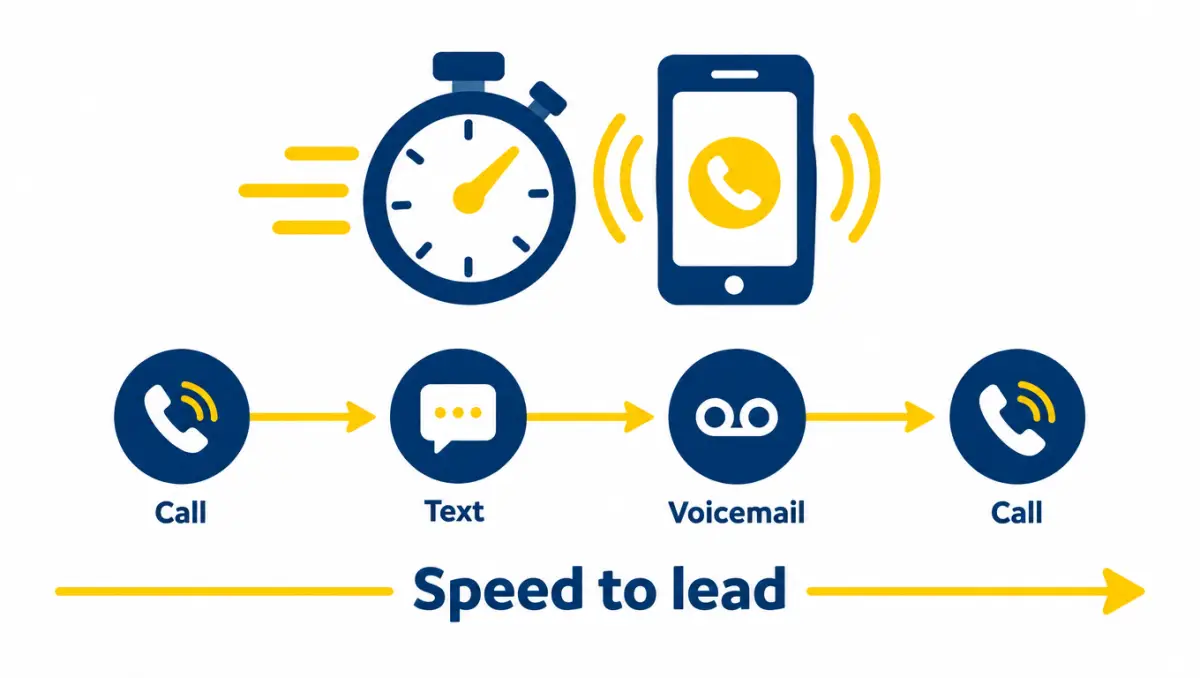
Speed to lead is the time between a homeowner submitting a form and your first call. For bought solar leads, faster is better: aim to call within minutes, during the hours leads arrive, and follow up with a planned mix of calls, texts and voicemails over the following days. Slow or inconsistent follow-up lowers contact rate, which raises cost per sale more than most price discounts can offset.
The first-five-minutes rule and its evidence limits
You will often hear that leads contacted within five minutes convert many times better than leads contacted later. The direction is well supported by experience across industries: a homeowner who just filled out a form is thinking about solar now, is near their phone, and has not yet heard from anyone else. The exact multipliers quoted in marketing materials, though, usually come from older studies in other industries, from vendors selling speed-to-lead software, or from data sets that are not public. We are not repeating those numbers here because we cannot verify that they apply to solar in 2026.
The practical answer is to measure your own curve. Record delivery time and first-dial time for every lead, then compare contact and appointment rates by response bucket (under 5 minutes, 5 to 30 minutes, 30 minutes to 2 hours, later). Most teams that do this find a clear drop-off, and the size of the drop tells them how much a faster process is worth. More on this in solar speed to lead, and for the full CRM, disposition and follow-up system see how to work solar leads, with word-for-word openers in our solar lead call scripts.
Cadence design: calls, texts, voicemail
A cadence is the planned sequence of contact attempts after a lead arrives. A sample residential cadence (adapt it with counsel to your consent records and state rules):
| Timing | Action | Notes |
|---|---|---|
| Minute 0 to 2 | Call | If no answer, leave a short voicemail naming the homeowner's request |
| Minute 2 to 5 | Text (where consent covers texts) | Short, personal, gives your name and a reason to reply |
| Minute 15 to 30 | Call again | Some homeowners call back an unknown number only after a second try |
| Hour 2 to 4 | Call | Different time of day |
| Day 1 evening | Call and text | Within permitted hours in the homeowner's time zone |
| Day 2 | Call morning, call afternoon | |
| Day 3 to 5 | One call per day, one text | |
| Day 7 | Final call and "closing the file" text | Gives the homeowner an easy way to reply later |
| Day 14 to 30 | Move to nurture | Email or periodic check-ins, within consent |
Keep the cadence the same across vendors during a test, or the comparison is unfair. Stop immediately on any opt-out, and record it.
A simple opening script anchored to the homeowner's own request:
"Hi [first name], this is [your name] with [company]. You asked about solar for your home on [street] a few minutes ago, and I'm calling to answer that. Is now an OK time for two quick questions about your electric bill?"
The opening references their request (so it does not feel like a cold call), gives your name and company, and asks permission. Then ask about the bill, the roof and timeline, and offer a meeting.
Staffing: in-house setters vs outsourced vs appointments
| Model | Best when | Main risk |
|---|---|---|
| In-house setters working raw leads | You have steady volume and someone to manage setters | Turnover, coverage gaps after hours and weekends |
| Closers working leads themselves | Very small teams, low volume | Closers are busy in meetings when leads arrive |
| Outsourced setting on your leads | You buy raw leads but cannot staff setters | Quality control, extra cost per appointment |
| Buying appointments | Closers are the bottleneck and you do not want a setter team | Highest unit price, no-show management |
| Live transfers | Closers can be on call during set hours | Paying for short or unready calls |
A practical test: count how many leads per day your team can call within five minutes during business hours. If the answer is lower than the number of leads you plan to buy, either reduce volume, add setter capacity, or switch part of your spend to appointments or live transfers.
Residential solar leads
Residential solar leads are homeowners asking about solar for their own home. The best ones show clear intent signals (a recent inquiry, a stated timeline, a meaningful bill, homeownership) and match a financing path you can offer. After the 25D credit ended, your pitch to these homeowners leans on savings, financing terms and TPO options rather than a federal homeowner credit.
Homeowner intent signals
Not every homeowner who fills out a form is ready to buy. Signals that tend to separate buyers from browsers include:
- A recent, specific request. "Get a quote for my home" is stronger than "download a guide."
- A stated timeline of weeks or a few months rather than "just researching."
- A sizeable bill relative to what makes solar pencil out in that utility territory.
- Homeownership confirmed by self-report and property records.
- Engagement on the first call: willingness to share a bill, ask about financing, or book a time.
- A trigger event: a rate increase, a new EV, a roof replacement, a recent move.
Ask your vendor which of these they capture, and track which predict sales in your own data.
Post-25D pitch: TPO, loan, cash, battery attach
With the federal homeowner credit gone for systems placed in service after 2025, closers need a pitch that does not depend on it:
- Cash: lead with lifetime savings and payback using current utility rates and any state or utility incentives that still apply. Be careful with rate-escalation assumptions; state them plainly.
- Loan: compare the monthly loan payment with the homeowner's current electric bill. Disclose loan terms clearly.
- TPO (lease or PPA): lead with a lower monthly cost, no upfront payment and maintenance included, where your TPO partner offers it. Make clear the homeowner does not own the system.
- Battery attach: in markets with time-of-use rates, export compensation below retail, or frequent outages, storage may change the savings case. Check incentives and interconnection rules in your market. Our guide to home battery storage leads covers qualifying and selling storage buyers.
Never promise a federal tax credit to a homeowner for a 2026 system unless a tax professional has confirmed it applies. Talk to your tax advisor about specific projects. Our residential solar leads page covers the lead spec, delivery and pricing logic for homeowner leads.
Commercial solar leads
Commercial solar leads are businesses and organizations asking about solar for buildings or land they own or lease. Buying them is closer to B2B account selling than consumer lead follow-up: you need the right decision-maker, building and energy data, and patience through a sales cycle that can run months. A commercial lead is worth buying when it identifies a real site and a person who can move the project.

Why C&I is a B2B account problem, not a form-fill problem
A homeowner can decide on a rooftop system in one or two meetings. A warehouse owner, school district or farm usually involves several people: an owner or executive who controls the budget, a facilities or operations manager who knows the building, a finance lead who cares about tax treatment and cash flow, and sometimes a landlord, board or lender. One form fill rarely captures all of that. The lead is the opening of an account, not a sale in waiting.
That changes how you should judge commercial leads. Contact rate and appointment rate still matter, but so do:
- Whether the inquirer has authority or influence over the decision.
- Whether the organization owns the building or has a long lease and landlord consent.
- Whether there is a usable roof, parking area or land.
- Whether energy spend is large enough for the project size you build.
Decision-makers, site data and sales cycle
Useful fields for a commercial lead include company name, inquirer's name and role, property address and type, ownership or lease status, approximate monthly or annual electricity spend, roof age and type, and timeline. Our commercial leads are C&I and multifamily solar inquiries, filtered by self-reported role.
Plan for a cycle that includes a site visit, utility interval data, a proposal with financial analysis, possibly a structural review and interconnection study, and internal approvals on the customer side. Commercial projects may draw on business tax credits such as 48E and on depreciation rules, subject to deadlines and eligibility tests that change with legislation. Talk to your tax advisor about specific projects.
Track commercial leads in a separate pipeline from residential, with longer measurement windows, and compare sources on cost per signed project and on pipeline value created. See commercial solar leads for the product details, and our guide on how to qualify commercial solar leads for a step-by-step qualification framework.
Solar appointments and live transfers
Booked solar appointments and live transfers both move setting work from your team to the seller. Appointments make sense when your closers are your scarce resource and your team cannot respond to raw leads within minutes. Live transfers suit teams with closers available on the phone during set hours. In both, the written definitions of a qualified appointment or billable call decide whether the deal works.

When appointments beat raw leads
Run this check. Compare your current cost per sit from raw leads (including setter labor) with the price of a booked appointment adjusted for its show rate.
Illustrative example: your raw leads cost $90 each, with a 55% contact rate and 40% appointment rate, so 0.22 appointments per lead, or 4.55 leads per appointment, or $409 in lead cost per appointment. Add setter labor of, say, 20 minutes per lead at $30 per hour: 4.55 x $10 = $45.50. Your appointment cost is about $455. If 70% of those sit, your cost per sit is about $650. A bought appointment priced at $350 with a 65% sit rate costs about $538 per sit. In this made-up case the bought appointment is cheaper per sit, and it frees your setters for other work. With different numbers, the answer flips.
Appointments tend to win when:
- Your speed to lead is slow and you cannot fix it soon.
- Your setters are inconsistent or you have none.
- Your closers have open calendar time and are your best asset.
Raw leads tend to win when you already have fast, skilled setters and want control of every conversation.
Sit definition, no-show backfill and held-meeting cost
Agree on these definitions before you buy:
- What counts as a qualified appointment: homeowner, in your service area, matching your filters, all decision-makers committed to attend, confirmed within a stated time before the meeting.
- What counts as a sit: the meeting happened, with the decision-makers present, for a minimum length.
- No-show handling: how fast you must report it, and whether you get a replacement, a credit or a refund. Our terms: if a confirmed appointment doesn't sit because the prospect no-shows or doesn't match your filters, report it within 7 days of the scheduled time and we replace it.
- Rescheduling: whether a rescheduled appointment counts as one or two.
Measure your "held-meeting cost": total appointment spend divided by meetings that actually sat. That is the honest unit to compare with your own setting cost.
Live transfer: screening script, call duration rules, billing
A live transfer seller's agent calls a fresh lead (or takes an inbound call), confirms a short list of qualifications, and transfers the homeowner to your team. Good practice includes:
- A written screening script you have approved, confirming homeownership, rough bill, interest and willingness to speak with your company now.
- A warm introduction in which the agent introduces the homeowner by name and summarizes their answers before dropping off.
- A minimum duration for billing that reflects a real conversation, plus a list of disqualifying outcomes that do not bill (wrong person, renter, hung up during introduction).
- Recordings of every transfer, available for disputes.
- Hours and caps that match when your closers are available.
Billing disputes are the most common friction in live transfer deals. Settle definitions and the dispute process before the first call. For more, see solar live transfer leads. Availability of live transfers for your territory is confirmed on the call.
Aged leads: when they work and when they do not
Aged solar leads are older inquiries resold after their first sale window, at a fraction of the price of fresh leads. They can work for teams with spare setter capacity, a disciplined dialing process and strong consent records, mainly for nurture and reactivation. They work poorly for teams that are already short on time, and they carry more consent risk than fresh leads.
Cost vs conversion reality
Aged leads are cheap because most of the people in them have already decided: some bought from another installer, some decided against solar, some moved, and some changed numbers. You will dial many records to reach a few interested homeowners. The low price per lead is real; so is the high number of leads per sale. Run the cost-per-sale formula with honest, measured contact rates before judging.
Illustrative example: an aged lead at $5 with a 10% contact rate, 25% appointment rate, 55% sit rate and 20% close rate gives 0.1 x 0.25 x 0.55 x 0.2 = 0.00275 sales per lead, or about 364 leads and $1,818 in lead cost per sale. That looks attractive until you add setter time: if each aged lead takes 6 minutes of dialing at $30 per hour ($3 per lead), labor adds about $1,091 per sale, for a fully loaded $2,909.
Consent risk and re-permissioning
Consent captured months ago, for a different company or a long list of companies, may not cover your calls or texts today. Before using aged leads for outbound calls or texts, check:
- Whose name is on the original consent disclosure.
- When it was captured and whether any state law limits how long consent lasts.
- Whether the record has been scrubbed against the National Do Not Call Registry and your internal list recently.
- Whether the homeowner has opted out from anyone since.
Some buyers use email or manually dialed calls to re-permission aged contacts before adding them to automated cadences. Confirm your approach with counsel.
Use cases
- Nurture lists: email education to homeowners who showed interest before.
- Reactivation: a short, careful campaign when rates change or new incentives appear in a market.
- Setter training: new setters practice on lower-value records, with close supervision and strict compliance.
- Filling gaps: slow weeks when fresh leads are short and setters have capacity.
See aged solar leads for more. Availability of aged leads for your territory is confirmed on the call.
Build a buying program
A solar lead buying program is a repeatable process for testing vendors, measuring results and moving budget toward the sources with the lowest cost per sale. It starts with a small pilot in a fixed territory, uses a shared scorecard for every source, and has written rules for when to scale a vendor, hold steady, or cut it.
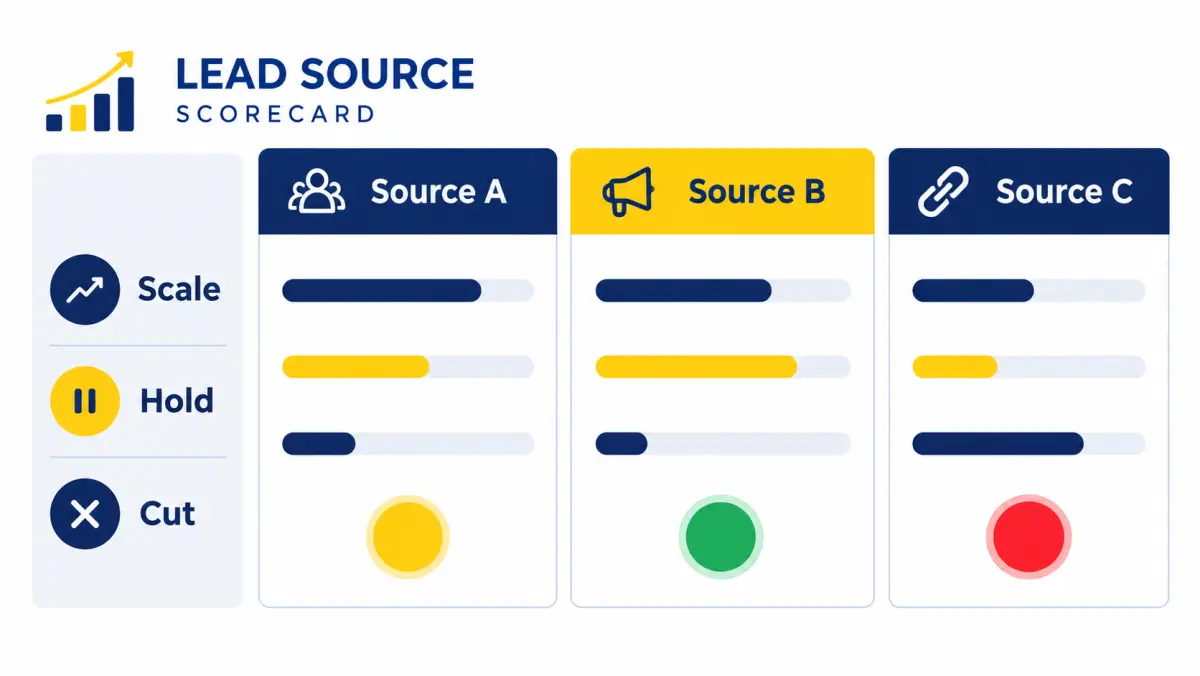
Installers who buy leads well rarely have a secret vendor. They have a process: test small, measure everything, move money to what works, and stop what does not.
Pilot design: budget, geography, success metrics
Decide these before you buy:
- Budget. Set a test budget you can afford to lose entirely. Divide it by the expected unit price to see how many leads or appointments you will get, then check that the number is large enough to produce several sits.
- Geography. Pick ZIP codes where you install efficiently and close well with referrals or other leads. Testing a vendor in a market where you are weak mixes up two variables.
- Lead type. Test one lead type per vendor at a time, so you know what you are measuring.
- Duration. Long enough for appointments to sit and most deals to close. For residential, many teams use a window of several weeks plus a follow-up period for late closes.
- Success metrics, written in advance. A target cost per sale (from your break-even math) and minimum contact and sit rates. Decide what result means scale, hold or cut before you see the data.
- Process controls. Same setters, same script, same cadence, same CRM tags for every source.
Scorecard template
Track every source monthly in a table like this. The cells below are blank on purpose; fill them from your CRM.
| Metric | Source A | Source B | Source C | Your target |
|---|---|---|---|---|
| Lead type | ||||
| Units bought | ||||
| Total spend (after credits) | ||||
| Average time to first call | ||||
| Contact rate | ||||
| Appointment rate | ||||
| Sit rate | ||||
| Close rate | ||||
| Sales | ||||
| Cost per sale (lead spend) | ||||
| Cost per sale (fully loaded) | ||||
| Replacement requests / approved | ||||
| Average contract value | ||||
| Cancellation rate after signing | ||||
| Decision (scale, hold, cut) |
Add a column for each setter or closer if you want to separate source quality from rep performance. A source that looks bad because one rep worked all of its leads may be fine.
Mixing lead types
Most established installers end up with a mix, for example:
- Exclusive real-time leads as the core, worked by in-house setters during business hours.
- Booked appointments to fill closer calendars in territories where setters are thin, or during peak months.
- Live transfers during hours when closers are free and want conversations.
- Aged leads for training and nurture, with strict compliance.
- Owned channels (referrals, local search) as the long-term base.
The mix should follow your capacity. When setters are overloaded, shift toward appointments. When closers are overloaded, cut appointments first. Review the mix monthly against the scorecard.
When to scale and when to cut a vendor
Write rules like these, and follow them:
- Scale when a source's cost per sale is below target for at least two measurement periods, with enough sales to trust it, and the vendor can add volume in the same ZIPs without quality falling. Increase in steps, and watch contact rate for drops after each increase.
- Hold when results are near target or the sample is still small. Keep volume steady and gather more data.
- Cut when cost per sale is well above target after a full cycle, when contact rates fall sharply, when consent records cannot be produced on request, or when replacement disputes are frequent and unresolved.
Give vendors a chance to fix problems you raise, but set a date. A vendor that cannot produce a consent record on request is a cut regardless of the numbers.
Seasonality and budget pacing
Solar demand and lead supply both move through the year, and the pattern differs by market. In many regions, homeowner interest rises in spring as bills and daylight change, and again when summer cooling bills arrive; winter can be slower in cold climates, while hot-climate markets may see a different shape. Utility rate changes, new net billing rules, storms and outages, and local news can all create spikes. We are not quoting a national seasonal curve because the pattern depends on the market and we have not found a current public data set that covers lead demand specifically.
What you can do is pace your budget against your own data:
- Keep twelve months of scorecards so you can see your own seasonal pattern in contact, sit and close rates, not only lead volume.
- Plan capacity before peaks. If spring brings more leads, hire and train setters in late winter, not after the leads arrive.
- Expect prices to move with demand. When many installers buy in the same months, auction-based prices often rise. Lock in filters and caps before the busy season.
- Protect install schedules. Buying more leads than your crews can install within a reasonable time creates cancellations. Set lead volume from install capacity backwards: crews x jobs per crew per month = sales needed, then sales needed / sales per lead = leads needed.
- Use slow months for testing. Quieter months are a good time to pilot a new vendor or lead type, because your team has time to work every lead carefully.
Illustrative example of backwards planning: two crews can each install eight residential jobs a month, so you need 16 sales a month. Your exclusive source produces 0.04 sales per lead on your scorecard, so you need about 400 leads a month, or roughly 18 to 20 per business day. If your setters can only call 12 leads a day within minutes, either add setter capacity, shift part of the volume to appointments, or accept fewer installs. Buying 20 leads a day anyway will lower your contact rate and raise your cost per sale.
Buy vs build: bought leads and owned channels
Bought leads give you predictable volume quickly, while owned channels such as referrals, local search, paid ads you run yourself and community partnerships take longer to build but produce leads only you receive. Most installers do best with a hybrid: bought leads to fill calendars and test markets, owned channels to lower average cost per sale over time.
Referrals, local search and paid search
- Referrals. Often the highest-converting source an installer has. A structured program (asking at install and at first bill savings, offering a referral reward where allowed, following up) can turn customers into a steady flow. Bought-lead customers can become referral sources too.
- Local search. A complete Google Business Profile, steady reviews, service-area pages and useful content can bring homeowners searching "solar installer near me." It takes months to build and needs ongoing work.
- Paid search and social ads. You can run the same kinds of campaigns lead generators run, in your own accounts. You keep the data and the leads are exclusive by definition, but you need ad skills, landing pages, consent capture done right, and budget to test. Many installers find this harder than it looks; lead generators exist partly because ad management at scale is its own trade.
- Canvassing and events. Door-to-door and home show programs can be strong in some markets, with their own compliance rules (local soliciting permits, state door-to-door sales rules).
The hybrid model
Think of bought leads as a supplement, not a substitute. They are useful:
- When you enter a new territory with no referral base.
- When owned channels are seasonal and you need to keep crews busy.
- When you want to grow faster than referrals allow.
- As a benchmark: if your own ads cost more per sale than a bought source, that tells you something about your ad program.
Use the same scorecard for owned channels. Count ad spend, agency fees and staff time, and compute cost per sale. Then shift budget to whatever is cheapest per sale at the volume you need. For a channel-by-channel comparison of referrals, ads, door-knocking, events and bought leads, see our guide to the best solar lead sources. To work out whether to buy solar leads or generate your own, including break-even volume and in-house ramp costs, see our decision guide.
Common mistakes and red flags
The most common mistakes when buying solar leads are judging vendors on price per lead, buying more leads than your team can call quickly, accepting vague definitions of "exclusive" or "qualified," skipping consent checks, and scaling before a test has run its full cycle. Red flags in vendors include unverifiable volume promises, guarantees that cannot be checked, and refusing to show sources or consent records.
Volume at a too-good-to-be-true price
If a vendor promises large volumes of "exclusive, verified, ready-to-buy" leads at a price far below what other vendors quote in the same market, ask how. Generating a real solar inquiry costs money in advertising. Very cheap leads usually mean one of: shared or resold leads, incentivized forms (homeowners who filled out a form for a prize or survey reward), old data repackaged, or consent that does not cover your company. Ask to see the landing pages and a consent record before you buy.
Guarantees that are bait
"Guaranteed appointments," "guaranteed sales" or "guaranteed ROI" sound reassuring. Read the fine print. Often the guarantee is a replacement lead, not money back, and the conditions to claim it are hard to meet. A clear, narrow replacement policy for data problems is more useful than a broad guarantee you cannot claim.
The same lead sold to many and called exclusive
The signs: homeowners say on the first call that several companies have already called; the consent disclosure names multiple installers or a "partners" link; the vendor will not put a one-buyer definition in the contract. Ask for consent records on a sample of leads and check the named companies.
Buying more leads than your team can work
This is the most expensive mistake, and the vendor cannot fix it. If your team cannot call each lead within minutes during the hours it arrives, adding more leads lowers contact rates and raises cost per sale. Set daily caps that match setter capacity, and add capacity before adding volume.
Other mistakes we see often
- No source tags in the CRM, so nobody can compute cost per sale by vendor.
- Judging a vendor in the first week, before appointments sit.
- Changing scripts, setters and vendors all at once, so no result can be explained.
- Ignoring replacement windows and losing credits you were owed.
- Using old pitch materials that still promise the 25D credit.
- Buying aged lists and loading them into an auto-dialer without checking consent.
Which lead type fits your company
The right solar lead type depends on four things: how fast your team can respond, whether setters or closers are your bottleneck, your market, and your budget. Fast teams with setters do well with exclusive real-time leads. Closer-heavy teams without setters often do better with appointments. Commercial developers need qualified B2B inquiries. Use the matrix below as a starting point, then test.
Decision matrix by team size, speed, market and budget
| Your situation | Start with | Add later | Avoid at first |
|---|---|---|---|
| 1 to 2 closers, no setters, slow to call | Booked appointments, small volume | Exclusive leads once you hire a setter | Shared and aged leads |
| Small team, one fast setter | Exclusive real-time leads with a daily cap | Appointments for peak months | Large shared volume |
| Mid-size team, several setters, dialer | Exclusive leads as core | Shared leads in price-driven markets; aged for training | Appointments in markets where setters are idle |
| Large sales org, multi-state | Exclusive and shared mix by market; live transfers for closers on standby | Appointments in new territories | Any source without CRM attribution |
| Selling mainly TPO through a partner | Exclusive leads filtered to TPO-eligible states and utilities | Appointments | Leads from pages promising a federal homeowner credit |
| Commercial / C&I developer | Qualified commercial inquiries filtered by role | Account-based outreach | Residential lead products |
| Tight budget, testing a market | Small exclusive test or small appointment batch | Scale the winner | Long contracts, large prepaid minimums |
Small installer path
- Run the break-even math to set a maximum cost per sale.
- Be honest about speed: who will call leads, and when?
- If nobody can reliably call within minutes, start with a small batch of appointments.
- If someone can, start with a small exclusive batch with a daily cap.
- Track every lead to outcome; compare to your break-even after a full cycle.
- Scale slowly, adding capacity before volume.
Multi-crew path
- Map setter and closer capacity by territory and hour.
- Run side-by-side pilots of two or three vendors and two lead types.
- Build the scorecard and review it monthly.
- Set routing rules by ZIP, financing path and score.
- Use appointments and live transfers to fill gaps where setters are thin.
- Hold a vendor review each quarter: scale, hold, cut.
Commercial path
- Define your ideal project: size range, building types, ownership, geography.
- Buy leads with role, company and property data, or appointments with decision-makers.
- Run a separate pipeline with longer measurement windows.
- Measure cost per signed project and pipeline value, not cost per lead.
- Combine bought leads with account-based outreach to target organizations.
Buyer checklist and sample brief
Use this checklist before you buy solar leads from any vendor, and send the sample brief questions to each vendor you are considering. Keep the answers in writing. Compare vendors on the same ZIP codes, the same lead type and the same measurement window, and decide on cost per sale.
Buyer checklist
Before you contact vendors
- Gross margin per job calculated by financing path
- Maximum affordable cost per sale written down
- Target ZIP codes chosen
- Setter and closer capacity per day and hour counted
- Lead type chosen to match capacity
- CRM source tags and dispositions set up
- Calling cadence and scripts written and reviewed with counsel
Vendor questions answered in writing
- Lead sources and landing pages shown
- Consent disclosure text shown; names your company
- Consent record available per lead on request, with retention period
- Exclusivity defined in the contract (if buying exclusive)
- Delivery speed and timestamps confirmed
- Pre-delivery checks listed
- Replacement policy: what is covered, window, process, credit or refund
- Contract term, minimums, fees, renewal and pause rules
- Delivery method and CRM integration confirmed
During the test
- Every lead tagged by source with vendor lead ID
- Time to first call recorded
- Same team, script and cadence for all sources
- Replacement requests filed within the window
- Opt-outs honored and logged
After the test
- Scorecard completed for each source
- Cost per sale (lead spend and fully loaded) computed
- Decision made: scale, hold or cut
Sample vendor RFP questions
Send these to every vendor:
- Describe how you generate solar leads for my territory: channels, sites and whether you or third-party publishers run them.
- Send two examples of the landing pages and ads currently used.
- Paste the exact consent disclosure a homeowner sees. Which companies does it name?
- Send a sample consent record for a recent lead. How long do you keep these?
- How do you define an exclusive lead? Is it ever resold, including as an aged lead?
- What is checked before a lead is delivered? How?
- What is your average and slowest time from form submission to delivery?
- What filters can I set (ZIP, homeownership, bill, credit band, property type, timeline)?
- What qualifies for replacement or credit? What is the window and the process?
- What are your contract term, minimums, fees and cancellation terms?
- How do you deliver leads (CRM post, webhook, email, SMS)? Can you accept disposition data back?
- What happens when I pause or change my filters?
Sample lead card (illustrative)
This is a made-up example to show what a complete record looks like. It is not a real person or a real lead.
| Field | Sample, illustrative |
|---|---|
| Lead ID | SAMPLE-000123 |
| Submitted | 2026-10-13 10:42:07 local time |
| Delivered | 2026-10-13 10:42:19 local time |
| Name | Jordan Sample |
| Phone | (555) 010-0000 |
| jordan@example.com | |
| Address | 100 Example St, Sampletown, ST 00000 |
| Homeowner | Yes (self-reported; property record match) |
| Property type | Single-family detached |
| Average monthly bill | Range selected by homeowner |
| Utility | Named utility |
| Roof shade | Little or none |
| Timeline | Within 3 months |
| Credit band | Self-reported range |
| Source | Landing page URL or site ID |
| Consent record | Certificate link; disclosure names the buying company |
| Checks | Phone validated; duplicate-checked; DNC scrubbed |
Worked scenarios by installer size
These three scenarios show how the cost-per-sale method plays out for different installers planning a first quarter of lead buying. All numbers are illustrative examples chosen to show the math. They are not market prices, benchmarks or our prices, and your own funnel rates will differ.
Seeing the method applied end to end is often more useful than the formulas alone. Each scenario starts with capacity, sets a budget from margin, picks a lead type, and shows what the scorecard might look like after the test.
Scenario 1: a two-person residential installer
Situation. An owner who also closes, plus one office manager who answers phones. Two install crews, one metro area. Mostly cash and loan sales; starting to offer TPO through a partner. Nobody can reliably call a lead within five minutes during the day, because the owner is in meetings and the office manager handles permits.
Margin math (illustrative). Average gross margin per job after installation costs: $5,500. No separate commission (the owner closes). Target profit per job: $2,500. Maximum affordable cost per sale: $3,000.
Lead type choice. Because speed to lead is weak and there are no setters, the owner tests booked appointments first. Raw leads would likely sit uncalled for hours.
Test design. A small batch of appointments in 15 ZIP codes near the shop, over six weeks, with the owner running every meeting.
Illustrative results. Appointments at $325 each; 68% sit; 27% close. Cost per sale = $325 / (0.68 x 0.27) = $325 / 0.1836 = $1,770. Under the $3,000 ceiling.
Decision. Scale gradually, and plan a part-time setter hire. Once a setter is in place and can show a fast response time, test a small batch of exclusive real-time leads against appointments in the same ZIPs.
Scenario 2: a regional installer with a setter team
Situation. Four closers, three in-house setters on a dialer, two branches in neighboring states. Mix of cash, loan and TPO. Setters call new leads within a few minutes during business hours, but evenings and weekends are uncovered.
Margin math (illustrative). Gross margin per job: $7,000. Closer commission: $1,800. Target profit: $2,500. Maximum affordable cost per sale: $2,700.
Lead type choice. Exclusive real-time leads as the core, with delivery hours set to match setter coverage. A side test of shared leads in one price-driven market. Booked appointments for weekends only.
Illustrative results after a full cycle:
| Source | Unit price | Contact | Appt | Sit | Close | Cost per sale (lead spend) |
|---|---|---|---|---|---|---|
| Vendor X exclusive | $95 | 58% | 42% | 72% | 26% | $95 / 0.0456 = $2,083 |
| Vendor Y exclusive | $70 | 41% | 35% | 66% | 22% | $70 / 0.0208 = $3,365 |
| Vendor Z shared | $38 | 33% | 30% | 62% | 21% | $38 / 0.0129 = $2,946 |
| Weekend appointments | $340 | n/a | n/a | 64% | 25% | $340 / 0.16 = $2,125 |
(Multiplying the rates: Vendor X 0.58 x 0.42 x 0.72 x 0.26 = 0.0456; Vendor Y 0.41 x 0.35 x 0.66 x 0.22 = 0.0208; Vendor Z 0.33 x 0.30 x 0.62 x 0.21 = 0.0129; appointments 0.64 x 0.25 = 0.16.)
Decision. Scale Vendor X and weekend appointments. Cut Vendor Y even though it is cheaper per lead, after raising its low contact rate with the vendor and seeing no improvement. Hold Vendor Z for another cycle while testing a faster dialer setting; if contact rate does not rise, cut it.
Notice that the "cheap" exclusive vendor was the most expensive per sale. Its low contact rate (41% vs 58%) suggested weaker phone validation or older leads, which is exactly the kind of difference price-per-lead comparisons hide.
Scenario 3: a commercial developer
Situation. A C&I developer building rooftop and carport systems for warehouses, light industrial buildings and multifamily properties in two states. Business development reps (BDRs) run discovery calls; engineers do site assessments.
Margin math (illustrative). Average gross margin per signed project: $60,000. Acceptable acquisition cost per signed project: up to $12,000 including BDR time.
Lead type choice. Commercial inquiries filtered by role (owner, executive, facilities or finance), property type and ownership status.
Test design. A batch of commercial leads over a quarter, with a six-month measurement window for signed projects, because the cycle is long.
Illustrative results. 40 leads at $200 each ($8,000). Contact 70%, discovery meeting 45% of contacts, site assessment 50% of meetings, proposal 70% of assessments, signed 30% of proposals. Signed projects per lead = 0.70 x 0.45 x 0.50 x 0.70 x 0.30 = 0.0331. Leads per signed project = 30.2. Lead cost per signed project = $6,048. With BDR time added, still under $12,000.
Decision. Continue, track pipeline value created, and reassess after the six-month window. For commercial, a small number of signed projects can swing the result, so look at pipeline value (proposals issued and their size) as an early indicator alongside signed deals.
Negotiating with lead vendors
Negotiate with solar lead vendors on terms, not just price: replacement definitions, test batch size, delivery hours, daily caps, filters, exclusivity language, contract length and payment terms. A better replacement policy or a tighter filter often saves more than a lower unit price. Bring your own scorecard data to the conversation once you have it.
Most vendors expect some negotiation, and most will work with a buyer who measures carefully and pays on time. Here is what tends to matter.
What to negotiate first
- Filters. Every lead you can filter out before delivery is a lead you do not pay for. If your data shows that very small bills, certain property types or particular ZIP codes never close, ask to exclude them.
- Replacement terms. Clear definitions, a reporting window long enough for your team to work the lead, and a simple process.
- Test terms. A small first batch, no setup fee, no long commitment.
- Delivery hours and caps. Leads delivered when nobody can call are wasted. Ask to match delivery to your coverage.
- Exclusivity language. If you are buying exclusive leads, get the one-buyer definition in the contract.
- Payment terms. Prepaid is common in this industry. If you prepay, ask how unused balances are handled.
What to bring to the table
- Your scorecard results for that vendor, including contact and sit rates.
- Disposition data: what share of leads were wrong numbers, renters, outside filters.
- Your planned volume if the vendor performs.
- Comparable terms from other vendors (without naming confidential prices if your agreements restrict it).
A vendor who sees that you measure and act on data has a reason to send you their better leads and to fix problems you raise.
What not to push for
- Unrealistically low prices that force the vendor to cut corners. If a vendor drops price sharply, watch contact rate and consent quality closely.
- Replacement for sales outcomes. Asking for credits when a homeowner simply chooses not to buy shifts sales risk onto the vendor, and vendors who agree to it usually recover the cost elsewhere.
- Guarantees you cannot verify. A clear process beats a promise.
Your lead-handling tech stack
To work bought solar leads well you need a CRM that receives leads in real time with source tags, a way to call and text quickly within consent rules, consent-record storage, and reporting that connects each lead to its outcome. You do not need an expensive stack to start, but you do need every lead to land in one place, tagged, within seconds.

The minimum setup
| Component | Job | Must-have features |
|---|---|---|
| CRM | One record per lead, from delivery to install | API or webhook intake, source field locked from edits, dispositions, pipeline stages, reporting by source |
| Dialer or phone system | Fast, logged calls | Click-to-call or power dialing, call logging to CRM, local caller ID where lawful, recording where lawful and disclosed |
| Texting | Short follow-ups where consent covers texts | Opt-out handling (STOP), logging to CRM, quiet-hours controls |
| Consent storage | Proof for each lead | Store certificate ID or URL and a copy where the consent service allows it |
| Do-not-call management | Honor opt-outs everywhere | Internal DNC list synced to dialer and texting tools |
| Reporting | Cost per sale by source | Spend per source, funnel rates, dashboards or exports |
Our delivery options cover the intake end: real-time delivery to your CRM, dialer, email, or SMS.
Lead routing and alerts
When a lead arrives, the right person should know within seconds:
- Push the lead to the CRM and assign it by ZIP or round robin.
- Alert the assigned setter by mobile notification or SMS, with a one-tap call link.
- If the lead is not called within a set number of minutes, reassign it or alert a manager.
- After hours, queue the lead for the first call at the start of permitted hours and send an automated text only if consent and your counsel allow it.
Data hygiene
- Lock the source and vendor lead ID fields so nobody overwrites them.
- Use a fixed list of dispositions (no contact, contacted, appointment set, sat, closed, lost reason) so reports add up.
- Record the reason for every lost deal; patterns by source tell you what to filter.
- Reconcile vendor invoices against leads received and credits approved each month.
Your first 30 days with a new lead vendor
The first 30 days with a new solar lead vendor should follow a plan: set up delivery and tracking before the first lead arrives, start at a low daily cap, review every lead's outcome weekly, file replacement requests inside the window, and hold a formal review once appointments from the first weeks have sat. Most failed vendor relationships fail in the setup, not the leads.
Week 0: before the first lead
- Confirm filters in writing: ZIP codes, homeownership, property types, bill range, credit band if offered, delivery hours, daily cap.
- Test delivery end to end. Ask the vendor to send a test record into your CRM. Check that every field maps, the source tag is set, and the assigned setter gets an alert.
- Request a sample consent record and check that it names your company and matches the disclosure the vendor described.
- Brief the team. Tell setters which leads come from the new vendor, the cadence to follow, and how to record dispositions. Remind them to log opt-outs.
- Write down the success criteria you set during pilot design, so nobody moves the goalposts later.
Week 1: low cap, close watch
Start with a daily cap below your setters' capacity. Each day, check:
- Delivery times against submission timestamps.
- Time to first call for every lead.
- Obvious data problems: disconnected numbers, wrong names, out-of-area addresses, renters.
File replacement requests the same day you find a problem, with the lead ID and reason. Our process: reply to the lead notification (or email us) with the reason; approved credits apply to your next batch.
Weeks 2 and 3: steady volume, early signals
Raise the cap toward your planned test volume if week 1 looked clean. By now you will see contact and appointment rates. Compare them with your other sources worked by the same team. If contact rate is far below your other sources, raise it with the vendor now, with examples; do not wait for the end of the test.
Spot-check consent: pick a few leads at random and ask the vendor for their consent records. A vendor that delivers them quickly is showing you something important.
Week 4 and after: let the cycle finish
Appointments set in weeks 2 and 3 are sitting now. Closes may take several more weeks. Hold a first review at day 30 on contact, appointment and sit rates, and a second review once most closes are in. Only then compute cost per sale and make the scale, hold or cut decision.
First-call scripts and common objections
A first call on a bought solar lead should confirm the homeowner's request, earn permission to ask a few questions, qualify on bill, roof, ownership and timeline, and set a specific appointment. Handle objections by acknowledging them and returning to the homeowner's own reason for asking. Keep scripts honest: no promises about tax credits, savings or approvals you cannot back up.
These examples are starting points. Adapt them to your offer, your market and your counsel's guidance on disclosures.
The opening
"Hi, is this [first name]? This is [your name] with [company]. You asked about solar for your home on [street name] [today / earlier this week], and I'm following up on that. Do you have two minutes for a couple of quick questions?"
If the homeowner says they do not remember asking: "No problem. It came through a solar quote request with your name and this number, about the home on [street]. Were you looking into solar for that home?" If they say no or ask not to be called, apologize, end the call, and add the number to your internal do-not-call list. Report the lead to the vendor if it looks like bad data.
Qualifying questions
- "Roughly what do you pay for electricity in a typical month? Does it go up much in summer or winter?"
- "Do you own the home? Is anyone else on the title we'd want to include?"
- "How old is the roof, roughly? Any big trees shading it?"
- "What got you looking at solar now?"
- "If the numbers made sense, when would you want a system running?"
- "Are you leaning toward owning a system, or would a lease or power agreement with a monthly payment be worth hearing about?" (Only if you offer both.)
Setting the appointment
"Based on what you've told me, it's worth putting real numbers together for your home. That takes about [length] with [closer name], and it works best with everyone on the title there. Would [day] at [time] or [day] at [time] work better?"
Offer two specific times. Confirm the address, who will attend, and send a confirmation by text or email where consent allows. Call or text the day before to confirm.
Common objections
| Objection | Response approach |
|---|---|
| "I'm just looking for a price." | "Fair. Price depends on your roof and usage, so a number without those would be a guess. The meeting gives you an actual figure for your home, with no obligation." |
| "I heard the tax credit is gone." | "You're right that the federal homeowner credit ended for systems installed after 2025. We'll show you the numbers without it, including any options where a monthly payment can come in under your current bill. Talk to your tax advisor about your situation." |
| "Several companies have called me already." | "I understand. When we meet, we'll lay out exactly what we install and what it costs so you can compare side by side." (If you bought this as exclusive, report it to your vendor.) |
| "I need to talk to my spouse." | "Of course. Let's find a time when you can both be there, so you only have to hear it once." |
| "Just email me something." | "Happy to. So I send the right thing, what's your average bill and roughly how old is the roof? Then let's pencil in a time to walk through it, and you can cancel if it doesn't look worth it." |
| "Not interested anymore." | Thank them, ask briefly what changed (useful data for your source report), and close the file. Honor any request not to be contacted. |
Track the objections your setters hear by source. A vendor whose leads often say "I never asked" or "everyone is calling me" has a quality problem worth raising.
FAQ
How much do solar leads cost?
Solar lead prices vary by lead type, exclusivity, state, ZIP code, filters and volume. In general, aged leads cost the least per unit, followed by shared leads, exclusive real-time leads, live transfers, and booked appointments at the top. Published price ranges from vendors disagree and are often undated, so get quotes by ZIP code and compare them on cost per sale. Our pricing is confirmed by ZIP on your call. For a dated, sourced breakdown, see how much solar leads cost.
Where can I buy solar leads?
You can buy solar leads from lead marketplaces and aggregators, exclusive lead generators and agencies, pay-per-call and live transfer networks, appointment-setting firms, and data brokers that sell lists. Each sells a different product. Choose based on the lead type that matches your team's speed and capacity, ask every vendor the same vetting questions in writing, and run side-by-side test batches before committing budget.
Are purchased solar leads worth it?
Purchased solar leads are worth it when your cost per closed sale, including setter labor, is below what you can afford based on your gross margin per job. Many installers buy leads profitably; others lose money because they respond slowly or judge vendors on price per lead. Calculate your break-even, run a measured test, and decide on your own numbers. Our solar lead cost calculator does the math.
What is the difference between exclusive and shared solar leads?
An exclusive solar lead is sold to one installer only; a shared lead is sold to several installers, who then compete to reach the homeowner first. Exclusive leads cost more per lead but usually contact and close at higher rates. Shared leads cost less but reward only very fast teams. Compare the two on cost per sale. See exclusive vs shared solar leads.
What are aged solar leads?
Aged solar leads are older inquiries, often 30 days to a year or more past their original sale, resold at a much lower price than fresh leads. Most homeowners in an aged list have already decided, so you dial many records to find a few interested buyers. Check consent carefully before calling or texting aged leads, and confirm your approach with counsel.
What is a solar live transfer?
A solar live transfer is a phone call in which a seller's agent screens a homeowner and then connects the homeowner, still on the line, to your closer or setter. You pay per call that meets agreed screening and duration rules. Live transfers suit teams with closers available on the phone during set hours. Read the billing definitions closely before buying.
How do I know if a solar lead provider is legitimate?
A legitimate solar lead provider will show you its landing pages, give you the exact consent disclosure homeowners see, provide a consent record for any lead on request, define exclusivity and replacement terms in writing, and let you start with a small test batch. Be cautious of providers that refuse to show sources, promise guaranteed sales, or push long contracts before a test.
Do I need TCPA consent to call purchased solar leads?
In many cases, yes. Under FCC rules implementing the TCPA, telemarketing calls or texts to cell phones using an autodialer or a prerecorded or artificial voice generally require prior express written consent, and do-not-call and state telemarketing rules also apply. Make sure every purchased lead comes with a consent record that covers your company, and confirm your calling process with counsel. This is not legal advice.
Is the FCC one-to-one consent rule in effect?
No. The FCC adopted a one-to-one consent rule in December 2023, but the Eleventh Circuit vacated it on January 24, 2025, so it did not take effect. Existing prior express written consent requirements still apply, and state laws may add rules. Many buyers still prefer consent that names only their company because it is the strongest proof. Confirm the current rules with counsel.
What is a good cost per lead for solar?
There is no single good cost per lead, because the right price depends on how well the lead converts for your team. A good cost per lead is one that produces a cost per sale below your maximum affordable cost per sale. Work backwards: maximum cost per lead equals target cost per sale multiplied by your contact, appointment, sit and close rates.
How fast should I contact a solar lead?
As fast as you can, ideally within a few minutes of delivery during permitted calling hours. Fresh leads are most likely to answer while their request is top of mind and before other companies call. Measure your own contact rates by response time to see how much speed is worth for your team. See solar speed to lead.
Should I buy leads or appointments?
Buy appointments if your closers are your scarce resource and your team cannot call raw leads quickly. Buy raw leads if you have fast, skilled setters and want to control the first conversation. Compare your fully loaded cost per sit from raw leads with the cost per sit of bought appointments, then test both in the same territory.
How many solar leads turn into sales?
It depends on lead type, market, your speed to lead and your sales process, so any single industry figure is a rough guide at best. Track your own contact, appointment, sit and close rates by source, then multiply them to get sales per lead. Leads per sale is simply one divided by that result.
Do solar leads still convert after the 25D credit ended?
Yes, but the pitch has changed. The federal 25D homeowner credit no longer applies to systems placed in service after 2025, so cash and loan offers rely on savings, financing and state or utility incentives, while TPO offers may benefit from business credits. Qualify leads more carefully on bill size, credit and financing path. Talk to your tax advisor about specific projects. See solar leads after the 25D credit.
Can I get a refund for bad solar leads?
Most reputable vendors replace or credit leads with data problems, such as disconnected numbers, wrong contact details or leads outside your filters, if you report them within a set window. Outcomes such as a homeowner not being interested or not buying are usually not covered. Our policy covers disconnected numbers, wrong contact details and leads outside your filters, reported within 7 days, with approved credits applied to your next batch.
Do I need a long-term contract to buy solar leads?
Not necessarily. Some vendors require minimum terms, minimum spend or prepaid balances; others, including us, do not. Our terms: no long-term contracts. Start with a test batch, scale when the numbers work. Whatever vendor you use, read renewal, cancellation and pause terms before signing.
What is the best solar lead provider?
There is no single best solar lead provider for every installer. The best provider for you is the one that produces the lowest cost per sale in your territory, with consent records you can produce on demand and terms you can live with. Test several vendors side by side on the same ZIP codes, team and time window, and let the scorecard decide.
Can I buy commercial solar leads the same way as residential?
Partly. The vetting questions are the same, but commercial leads need different data (company, role, property ownership, energy spend) and a longer measurement window, because C&I projects take months to sign. Judge commercial sources on cost per signed project and pipeline value, not cost per lead. See commercial solar leads.
Sources, methodology and last updated
This guide was last updated October 13, 2026. Rules and market conditions change; we review the page quarterly. Every worked number on this page is an illustrative example unless a source is named. We do not publish vendor price ranges here because the public ranges we reviewed conflicted and were mostly undated; see our cost guide for dated, sourced figures.
Sources referenced
- Internal Revenue Service, Residential Clean Energy Credit, for the 25D homeowner credit and its end for systems placed in service after 2025. Retrieved October 2026.
- National Renewable Energy Laboratory, Solar Installed System Cost Analysis, for how residential soft costs, including customer acquisition, are benchmarked. Retrieved October 2026.
- Federal Communications Commission, Stop Unwanted Robocalls and Texts, for TCPA consumer guidance. Retrieved October 2026.
- Federal Trade Commission, Complying with the Telemarketing Sales Rule, and the National Do Not Call Registry. Retrieved October 2026.
- U.S. Court of Appeals for the Eleventh Circuit, Insurance Marketing Coalition Ltd. v. FCC, decided January 24, 2025, vacating the FCC's one-to-one consent rule.
- U.S. Supreme Court, Facebook, Inc. v. Duguid, 592 U.S. 395 (2021), on the definition of an automatic telephone dialing system.
Methodology. The lead-type rankings reflect the usual relative order of unit prices observed across public vendor pages and buying guides we reviewed in October 2026; they are rankings, not prices. Funnel formulas are standard arithmetic. Scenario figures are invented to illustrate the math and should be replaced with your own data. Descriptions of our own offer use our published terms. Tax and legal statements are general information, not advice: talk to your tax advisor about specific projects, and confirm compliance questions with counsel.
Ready to compare us on your own numbers? Book a call for ZIP-level pricing and availability, then run a test batch against any other vendor.