Buy Solar Leads or Generate Your Own? How Installers Should Decide
Should you buy solar leads or generate your own? Compare in-house lead generation costs, agencies vs lead vendors, hybrid models and timelines by installer size.
Updated · 81 min read
In this guide (41 sections)
- Should you buy solar leads or generate your own?
- What do "buy", "build" and "agency" actually mean?
- How do you compare bought and in-house leads fairly?
- What does it cost to generate solar leads in-house?
- At what volume does in-house lead generation break even?
- How long does it take to build an in-house lead program?
- What are the advantages of buying solar leads?
- What are the disadvantages of buying solar leads?
- What are the advantages of generating your own leads?
- What are the disadvantages of generating your own leads?
- What hybrid models work for solar installers?
- Which in-house channels should you build first?
- How do you choose a solar lead generation agency?
- How do you decide? A step-by-step framework
- Scenarios by installer size
- Scenarios by market and lead type
- How do you run a 90-day in-house pilot without stopping bought leads?
- How should you transition from buying to building, or back?
- What does an in-house lead team look like at each stage?
- What does consent and compliance look like when you generate your own leads?
- Which metrics should you track for both sources?
- What hidden costs do both models carry?
- How does having your own leads change vendor negotiations?
- What tech stack do you need for each model?
- Illustrative case walkthroughs
- How do you build an annual lead budget that mixes both?
- Scripts for talking to vendors, agencies and your team
- Troubleshooting: why isn't my in-house program working?
- Troubleshooting: why aren't my bought leads working?
- Risk register: what can go wrong with each model?
- Owned-channel playbooks you can start this month
- Does the answer change for battery storage and add-on products?
- Common myths about buying vs generating solar leads
- How do you model cash flow for an in-house program?
- What state and local factors change the decision?
- A one-page build-vs-buy policy you can adapt
- What should you do this week?
- Ten questions to answer before you decide
- Glossary
- FAQ
- Sources, methodology and last updated
Whether to buy solar leads or generate your own is a capital allocation question, not a marketing preference. Buying turns lead acquisition into a variable cost you can start this week and stop next week. Generating in-house turns it into a small business you own: ad accounts, landing pages, consent records, tracking, and people, with a ramp period before it pays back. Hiring an agency sits in between: you own the data and the ad accounts, but you rent the skill. This guide gives you a decision framework you can run in an afternoon, a line-by-line cost structure for an in-house program, the realistic timeline from first ad to steady state, hybrid models that most installers end up using, and scenarios by installer size from a two-person crew to a multi-state operator. Every cost figure here is either linked to a dated public source or labelled as an illustrative example you should replace with your own numbers. Everything is current as of October 2026, after the 25D homeowner credit ended for systems placed in service after 2025.

Key takeaways (as of October 2026)
- Compare sources on fully loaded cost per signed, non-cancelled contract. Cost per lead from an ad dashboard leaves out most of the real cost of in-house generation.
- In-house lead generation has fixed costs (people, tools, compliance) that only pay back above a certain monthly volume. Below that volume, buying is usually cheaper per sale even at a higher price per lead.
- An in-house program needs a ramp: setup, a learning phase where cost per sale runs high, and optimization. Budget for that period before you judge it.
- When you generate leads yourself, you are the party responsible for consent capture and record keeping. Confirm your consent language and process with counsel.
- Most installers land on a hybrid: bought leads for predictable volume and new territories, owned channels (referrals, local search, your own ads) to pull average cost per sale down over time.
- Run your inputs in the solar lead cost calculator, and see how to buy solar leads for the buying side in depth.
This page focuses on the decision itself. If you need detail on lead prices, see how much solar leads cost. For the full cost-per-sale formula and break-even rules, see solar lead ROI. For evaluating vendors once you decide to buy, see how to vet solar lead providers. For a channel-by-channel look at where leads come from, see the best solar lead sources. We link to those pages instead of repeating them.
Should you buy solar leads or generate your own?
Buy solar leads when you need predictable volume within weeks, your monthly volume is too low to spread the fixed costs of an in-house team, or you are entering a territory with no brand presence. Generate your own when you have steady volume, someone who can own the program, and the cash to fund a ramp period. Most installers should do both.
The question is usually asked as if it were binary. It almost never is in practice. The real decision is how much of your appointment calendar each source should fill, and in what order you build the owned channels. That said, there are clear cases at both ends.
When buying is clearly the better choice
- You need appointments in the next 30 days. A vendor with inventory in your ZIP codes can start delivering in days. An in-house program cannot produce reliable volume that fast.
- Your volume is small. If you close a handful of residential jobs a month, a dedicated marketer's salary alone can exceed the entire lead budget a vendor would charge you for the same number of sales.
- You are testing a new territory. Buying a test batch in a new county tells you whether your sales process works there before you invest in local search, brand, and ad accounts.
- Nobody on your team can own marketing. An in-house program without a clear owner drifts. Ad accounts get left on, landing pages break, consent records go unchecked.
- Your cash is tight. Buying lets you match spend to closed revenue. Building front-loads cost before revenue.
When generating your own is clearly the better choice
- You already have strong organic demand. Referrals, reviews and local search are bringing inbound calls. Paid campaigns on top of a known brand usually convert better than campaigns for an unknown name.
- Your volume is high and steady. Fixed costs spread over many sales shrink per sale.
- You need control over the message. Some installers sell specific products (batteries, premium panels, commercial PPAs) where the lead's expectations matter as much as the lead itself.
- Your sales cycle is long and relationship-driven. Commercial solar in particular often rewards owned content and direct outreach more than bought form fills. See commercial solar leads for that market.
- You want an asset. A domain with rankings, a review profile and a referral base have value if you ever sell the company. A vendor relationship does not transfer the same way.
When a hybrid is the better choice
Nearly everyone else. A hybrid uses bought leads as the predictable base and owned channels as the margin improvement. The rest of this guide shows how to size each side.
What do "buy", "build" and "agency" actually mean?
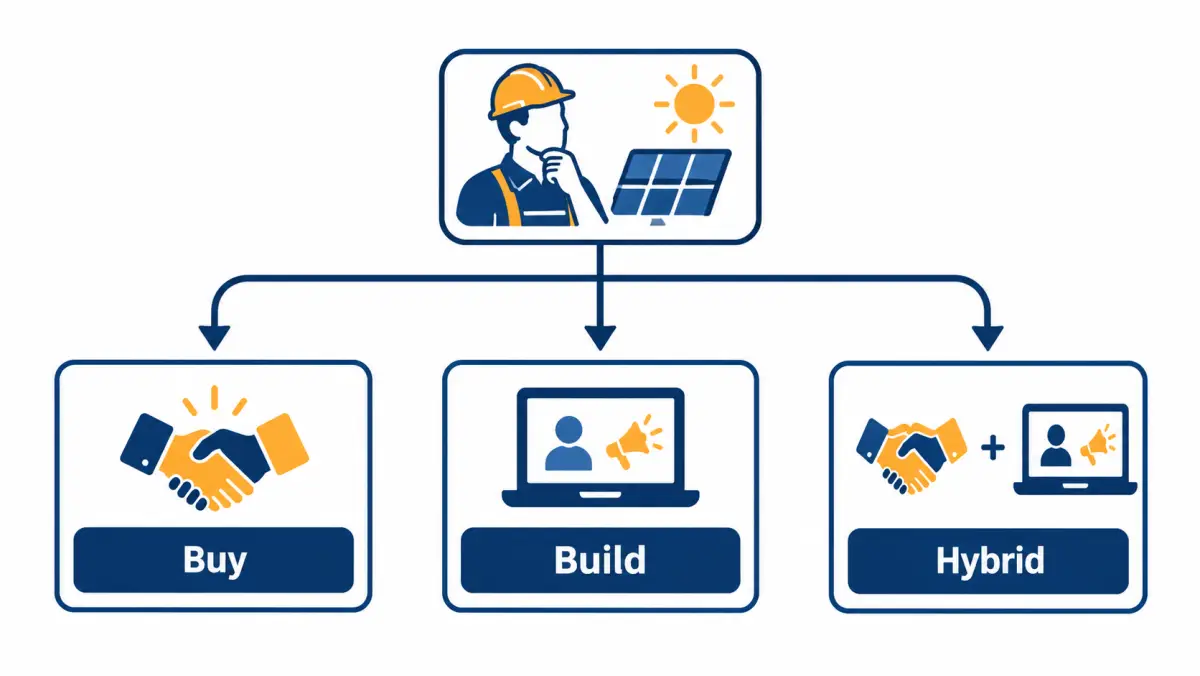
Buying means paying a lead vendor per lead, per appointment or per transfer, with the vendor running the marketing and consent capture. Building means running your own ads, pages and follow-up with your own staff. Hiring an agency means paying a firm to run campaigns in your accounts, usually for a fee plus ad spend. Each moves cost, risk and control to a different place.
These terms get used loosely, so pin them down before you compare quotes. A lot of bad decisions come from comparing a vendor's price per exclusive lead with an agency's "cost per lead" that excludes the agency's own fee, or with an internal number that excludes salaries.
The four models side by side
| Model | Who runs the ads | Who owns the data | Who captures consent | How you pay | Main risk |
|---|---|---|---|---|---|
| Buy from a lead vendor | Vendor | You receive a copy; vendor keeps its records | Vendor (you should get the consent record) | Per lead, appointment or transfer | Quality varies by vendor; shared leads mean competition |
| Hire a lead generation agency | Agency, in your accounts or theirs | Depends on contract; ideally you | Your landing pages, so you are responsible | Monthly fee or percentage of spend, plus ad spend | You pay for effort, not results |
| Build in-house | Your staff | You | You | Salaries, tools, ad spend | Fixed costs and ramp period |
| Pay-per-performance agency | Agency | Often the agency | Agency | Per lead or appointment | Functionally a lead vendor; check exclusivity |
The last row matters. Some firms call themselves agencies but sell you leads from their own campaigns at a per-lead price. Treat those as lead vendors and vet them the same way. Ask whether the leads are exclusive, whether they run campaigns for other installers in your area, and whose name appears in the consent disclosure.
Solar lead generation agency vs lead vendor
This is the comparison that trips up the most installers, so it is worth a closer look.
A lead vendor sells an outcome: a lead, an appointment, a live transfer. The vendor carries the risk that its ads underperform. If a campaign's cost per lead doubles next month, that is the vendor's problem unless they raise your price. You pay more per unit than the raw media cost because you are paying for that risk transfer, the vendor's margin, and its infrastructure.
An agency sells effort: campaign management, creative, landing pages, reporting. You carry the media risk. If click prices rise or a campaign stalls, you pay the same fee and get fewer leads. In exchange, you usually get lower cost per lead when things go well, full exclusivity, and data you own.
Questions that separate the two:
- What exactly am I paying for? A unit of output, or hours and management?
- Who owns the ad accounts? If the agency owns them, you lose the history and audiences when you leave.
- Whose name is on the consent disclosure? If you will call these leads, your company should be named. Confirm the exact requirement with counsel.
- Are the leads exclusive? With a true agency running your accounts, yes by definition. With a pay-per-lead agency, ask.
- What happens in a bad month? A vendor's price stays fixed; an agency's fee stays fixed while your volume drops.
- How do I leave? Notice periods, account handover, landing page ownership, and domain ownership all matter.
Neither model is better in general. A vendor fits an installer who wants to buy outcomes and focus on selling. An agency fits an installer who wants to own the channel and has the budget to absorb a few bad months.
How do you compare bought and in-house leads fairly?
Compare every source on fully loaded cost per signed, non-cancelled contract over the same period, tracked in the same CRM with the same stage definitions. Fully loaded means media, fees, tools, salaries, management time and compliance overhead, not only the price per lead or the ad dashboard's cost per conversion. Anything less flatters in-house numbers.
The solar lead ROI guide sets out the core formula: cost per sale equals cost per lead divided by the product of your contact, appointment set, sit and close rates. Use the same stage definitions for every source. What changes for an in-house program is the cost per lead you plug in. It has to include everything.
The fully loaded cost per lead for an in-house program
In-house cost per lead = (ad spend + agency or freelancer fees + tool subscriptions + share of salaries + creative production + compliance overhead) ÷ usable leads
"Usable" matters. Ad platforms count conversions, not qualified homeowners in your service area. A form fill from a renter, a duplicate, a fake number or a ZIP code you do not serve costs you the same as a good one. Vendors typically filter these out or credit them back under a replacement policy; when you generate your own, you absorb them.
The fully loaded cost per lead for a bought source
Bought cost per lead = (lead spend − credits received) ÷ leads delivered, plus a share of the time spent managing the vendor
Vendor management is usually small: weekly quality checks, credit requests, monthly reviews. But it is not zero.
A worked comparison
Illustrative example. All inputs are hypothetical; replace them with your own.
An installer is comparing a bought exclusive lead source with a pilot of its own Google search campaign over one quarter.
| Line item (quarter) | Bought exclusive leads | In-house search campaign |
|---|---|---|
| Lead or media spend | $30,000 | $24,000 |
| Credits or refunds | −$1,500 | $0 |
| Freelance campaign manager | $0 | $4,500 |
| Landing page, form, call tracking tools | $0 | $1,200 |
| Consent capture and record storage tool | $0 | $600 |
| Owner and staff time managing source (valued) | $1,000 | $4,000 |
| Total cost | $29,500 | $34,300 |
| Usable leads | 200 | 190 |
| Fully loaded cost per usable lead | $147.50 | $180.53 |
On the ad dashboard, the in-house campaign might have shown a cost per conversion of $24,000 ÷ 240 form fills = $100. After counting fees, tools, staff time, and the 50 unusable form fills, the fully loaded figure is $180.53. That gap between the dashboard number and the real number is the most common reason installers believe in-house generation is cheaper than it is.
The comparison does not end there. If the in-house leads contact and close better (they are exclusive, they saw your brand, they chose you), cost per sale can still favor the in-house program. Run both through the ROI formula with their own stage rates before deciding.
Use the same stage definitions for both
- Contact: a two-way conversation with the person who submitted the lead.
- Appointment set: a confirmed date and time for a consultation.
- Sit: the consultation happened with the decision makers present.
- Close: a signed contract that survives the cancellation window.
If your in-house leads are counted as "sold" at signature and bought leads at install, your comparison is broken before it starts.
What does it cost to generate solar leads in-house?
An in-house program has six cost layers: ad spend, landing pages and web infrastructure, consent capture and record keeping, tracking and attribution, people, and the management time of whoever owns it. Media is usually the largest single line, but people often cost more than media at low volume, which is why small programs rarely beat bought leads per sale.
Each layer below explains what it covers, what drives the cost, and what installers most often forget. Where we give numbers they are illustrative unless linked to a dated public source, because tool prices and salaries vary widely by market and change often.
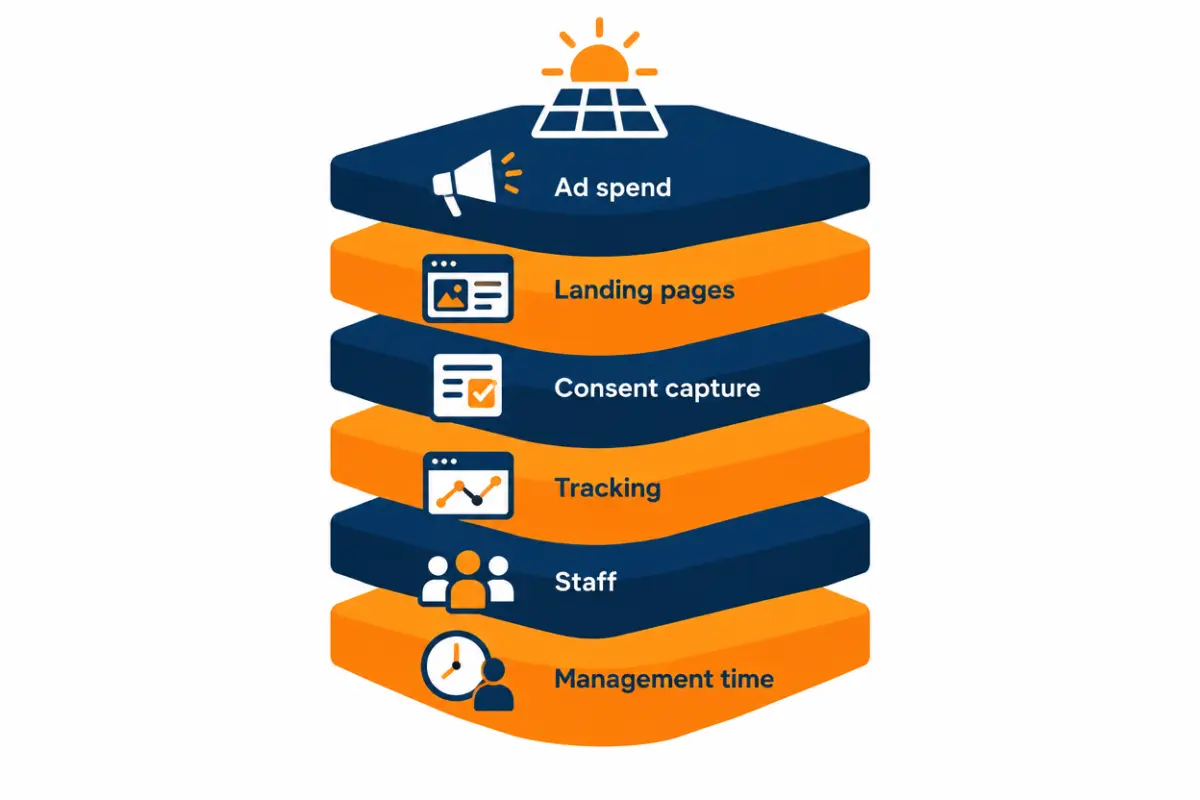
Layer 1: Ad spend
Ad spend is what you pay platforms for clicks, impressions or calls. For solar, the main channels are search ads (homeowners actively searching for installers or quotes), social ads (homeowners who match a profile but are not searching), and to a lesser extent display, video and local service listings.
What drives it:
- Click prices in your market. Solar is a competitive search category because the lifetime value of a customer is high. Expect your click prices to be among the higher ones you have seen in home services. Check your own market with the platform's keyword planner before you budget; published averages blend markets and often blend industries.
- Landing page conversion rate. Doubling the share of visitors who submit a form halves your cost per lead at the same click price.
- Targeting tightness. Narrow geographic and audience targeting cuts waste but raises click prices and limits volume.
- Seasonality and competition. National lead generators bid on the same keywords you do. When they spend heavily, your click prices rise.
What installers forget:
- The learning budget. New campaigns and new ad accounts typically need a period of spending before the platform's algorithms stabilize. That spending produces leads, but often at a worse cost per lead than you will see later.
- Brand search. Some of the cheapest leads in your account are people searching your company name. Those would often have found you anyway. Separate brand from non-brand when you judge performance.
- Click fraud and junk. Some percentage of clicks and form fills is not real. You pay for them.
Layer 2: Landing pages and web infrastructure
You need pages built for conversion, not your general company website. A typical setup includes:
- A dedicated landing page per campaign or offer (savings estimate, battery backup, free roof assessment)
- A form that asks enough to qualify (homeowner status, ZIP, utility, roof type, average bill) without asking so much that people abandon it
- Mobile speed and usability, since most social traffic is on phones
- A thank-you page and immediate confirmation by text or email where your consent covers it
- A/B testing so you can improve conversion over time
Cost drivers are the landing page builder or developer time, hosting, form tools, and any calculator or quote widget. These are usually modest monthly subscriptions, but someone has to build, test and maintain them, and that time is the bigger cost.
Layer 3: Consent capture and record keeping
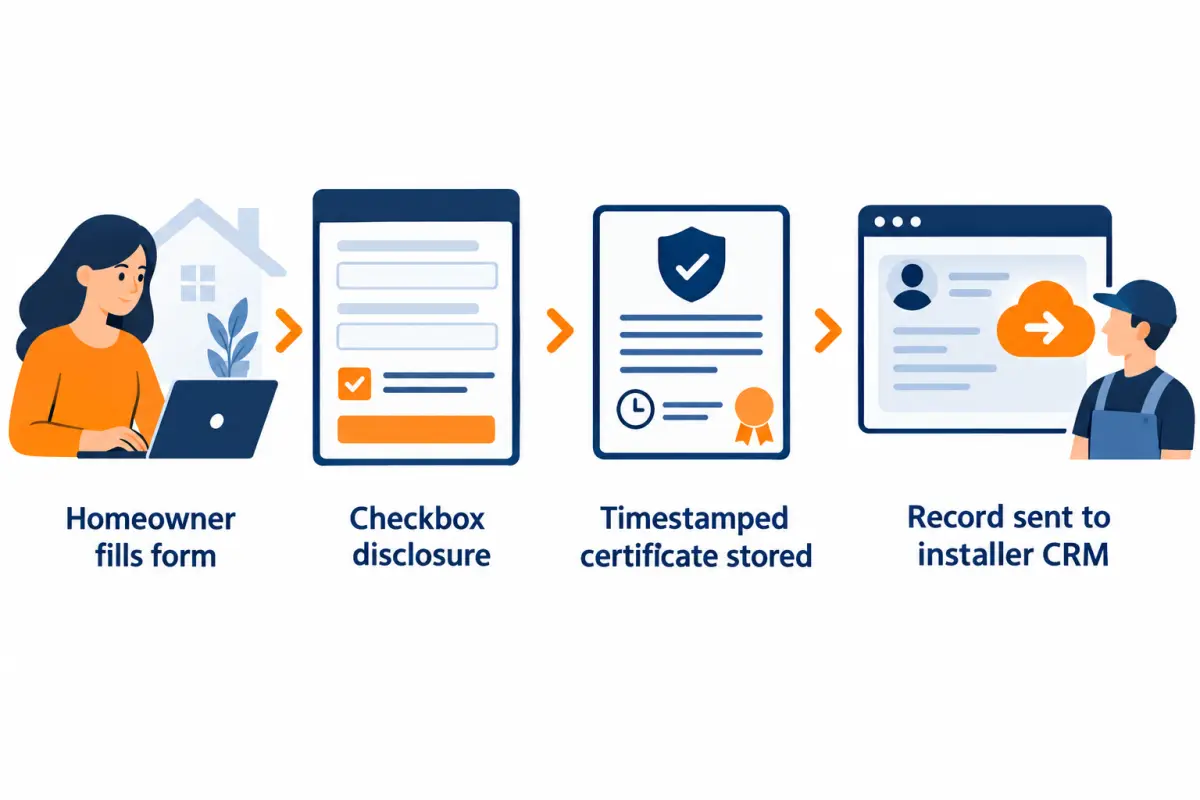
When you buy leads, the vendor captures consent and should provide you with the record. When you generate leads yourself, that job is yours. It is not a one-time setup. It is an ongoing operating responsibility.
What it involves:
- Disclosure language next to the submit button that clearly tells the homeowner who will contact them and how (calls, texts, possibly automated). Have counsel review this language before you launch.
- A record of each consent event: the timestamp, the page and disclosure as the homeowner saw them, the IP address and the data submitted. Third-party consent certificate tools exist for this; some installers build it into their own form stack.
- Retention of those records for as long as you might need them to answer a complaint or claim.
- Do Not Call scrubbing. Your outbound calls still have to respect the National Do Not Call Registry and your internal do-not-call list, and any state lists that apply.
- Opt-out handling across every channel: a homeowner who says stop by text should not get a call the next day.
A note on the rules as of October 2026: the FCC's one-to-one consent rule, which would have required consent to name a single seller per disclosure, was vacated by the Eleventh Circuit on January 24, 2025. That does not remove the underlying consent requirements under the TCPA or the FTC's Telemarketing Sales Rule, and state laws add their own requirements. This is not legal advice; confirm your setup with counsel. For a fuller treatment of the rules, see solar leads and TCPA compliance.
Layer 4: Tracking and attribution
You cannot manage what you cannot attribute. An in-house program needs:
- Conversion tracking on every form and call, sent back to the ad platforms so their bidding learns from real results
- Call tracking numbers per campaign so phone leads are not lost
- UTM parameters and source fields that survive into your CRM
- Ideally, offline conversion imports: sending "appointment sat" and "contract signed" events back to the ad platforms so they optimize for sales, not just form fills
Offline conversion imports are where many installer programs either become efficient or stay mediocre. A campaign optimized for form fills will find people who fill out forms. A campaign optimized for signed contracts will, over time, find people who sign.
Layer 5: People
This is the layer that decides whether in-house generation works at your size. The roles involved:
| Role | What they do | Can it be part-time or outsourced? |
|---|---|---|
| Program owner | Sets budget, reviews results weekly, decides what to cut | No. Someone senior must own it. |
| Paid media manager | Builds and optimizes campaigns, manages bids and budgets | Yes, freelancer or agency |
| Web and landing page builder | Builds and tests pages and forms | Yes, freelancer |
| Creative producer | Ad copy, images, short video | Yes, freelancer or in-house generalist |
| Lead intake and setters | First contact, qualification, booking | Usually in-house; you need this for bought leads too |
| Compliance reviewer | Reviews disclosures, scripts, DNC process | Outside counsel plus an internal owner |
Notice that the setters appear in both models. Bought leads still need to be called fast and followed up properly. That is why setter cost should not be counted as an in-house generation cost in your comparison; it is a sales cost common to both. The incremental in-house people cost is everything above the setter line.
Salaries and freelance rates vary too widely by market to give a useful single figure. For a public reference point, the U.S. Bureau of Labor Statistics publishes occupational wage data, including for advertising, promotions and marketing managers, updated periodically. Use local job postings and freelancer quotes for your own budget.

Layer 6: Management time and opportunity cost
The owner or sales manager who reviews campaigns every week is not spending that time selling, recruiting or running installs. Put a value on that time and include it. In small companies, this is often the cost that makes or breaks the decision. An owner who closes deals personally may lose more in missed sales than the program saves.
A sample monthly in-house budget
Illustrative example. Every figure is hypothetical; your market will differ.
| Line item | Lean program | Mid program | Full program |
|---|---|---|---|
| Ad spend | $8,000 | $25,000 | $75,000 |
| Paid media management (freelancer, agency or salary share) | $1,500 | $4,000 | $9,000 |
| Landing pages, forms, hosting | $200 | $500 | $1,200 |
| Call tracking and attribution tools | $150 | $400 | $900 |
| Consent capture and records | $150 | $350 | $800 |
| Creative production | $300 | $1,500 | $4,000 |
| Owner or manager time (valued) | $1,500 | $2,000 | $3,000 |
| Monthly total excluding setters | $11,800 | $33,750 | $93,900 |
| Media share of total | 68% | 74% | 80% |
The pattern to notice is the media share. In the lean program, nearly a third of the budget goes to things other than ads. In the full program, overhead is a smaller share, and that is the scale effect: fixed costs spread across more media and more leads. The scale effect is the main economic argument for building in-house, and the main argument against building it too small.
At what volume does in-house lead generation break even?
In-house generation breaks even when its fixed monthly overhead, spread across your sales, plus its media cost per sale, falls below the cost per sale of your best bought source. Because overhead is mostly fixed, there is a minimum monthly sale count below which buying wins. Calculate that threshold before you hire anyone.
The break-even formula
Let:
- F = monthly fixed overhead of the in-house program (management, tools, creative, consent tooling, owner time), excluding media
- M = media cost per sale from in-house campaigns (ad spend per sale at steady state)
- B = fully loaded cost per sale from your bought source
- N = monthly sales from the in-house program
In-house cost per sale = F ÷ N + M
In-house is cheaper than buying when F ÷ N + M < B, which rearranges to:
N > F ÷ (B − M)
If M is greater than or equal to B, in-house never breaks even on cost alone: your own media is already more expensive per sale than the vendor's all-in price. That happens more often than installers expect, especially in markets where national lead generators bid aggressively.
A worked break-even example
Illustrative example. All inputs are hypothetical.
- Fixed overhead F = $6,000 per month
- In-house media cost per sale at steady state M = $1,800
- Bought cost per sale B = $2,600
N > 6,000 ÷ (2,600 − 1,800) = 6,000 ÷ 800 = 7.5 sales per month
So in this example, the in-house program needs to produce at least 8 sales a month from its own campaigns before it costs less per sale than buying. At 4 sales a month, its cost per sale is 6,000 ÷ 4 + 1,800 = $3,300, well above the bought source. At 15 sales a month, it is 6,000 ÷ 15 + 1,800 = $2,200, meaningfully below.
Break-even sensitivity table
Illustrative. Fixed overhead F = $6,000 per month in every row.
| Bought cost per sale (B) | In-house media per sale (M) | Break-even sales per month |
|---|---|---|
| $2,000 | $1,500 | 12 |
| $2,000 | $1,800 | 30 |
| $2,600 | $1,800 | 7.5 |
| $2,600 | $2,200 | 15 |
| $3,200 | $1,800 | 4.3 |
| $3,200 | $2,800 | 15 |
| $2,000 | $2,100 | Never |
Two things stand out. First, the break-even point is very sensitive to the gap between B and M. Small improvements in your own media efficiency, or small increases in vendor prices, move the threshold a lot. Second, if a vendor is already efficient (low B), building in-house only makes sense at high volume or if you can run media better than they do.
Don't forget capacity
The break-even calculation assumes your sales team can handle the extra volume. If the in-house program generates 15 sales a month but your closers are already full, you either hire (a cost) or the leads go stale (a waste). Check sales and install capacity before scaling either source. The speed to lead guide covers why unworked leads lose value fast.
How long does it take to build an in-house lead program?
Plan on roughly a quarter to get from zero to a working in-house program and longer to reach steady-state cost per sale, depending on your starting point. There is a setup phase, a learning phase where cost per lead runs high, and an optimization phase. Bought leads can start in days. Budget for the gap, not just the end state.
These phases are general patterns we see described across the industry, not guaranteed durations. Your timeline depends on whether you already have ad accounts with history, a working website, a CRM with clean source tracking, and someone with paid media experience.
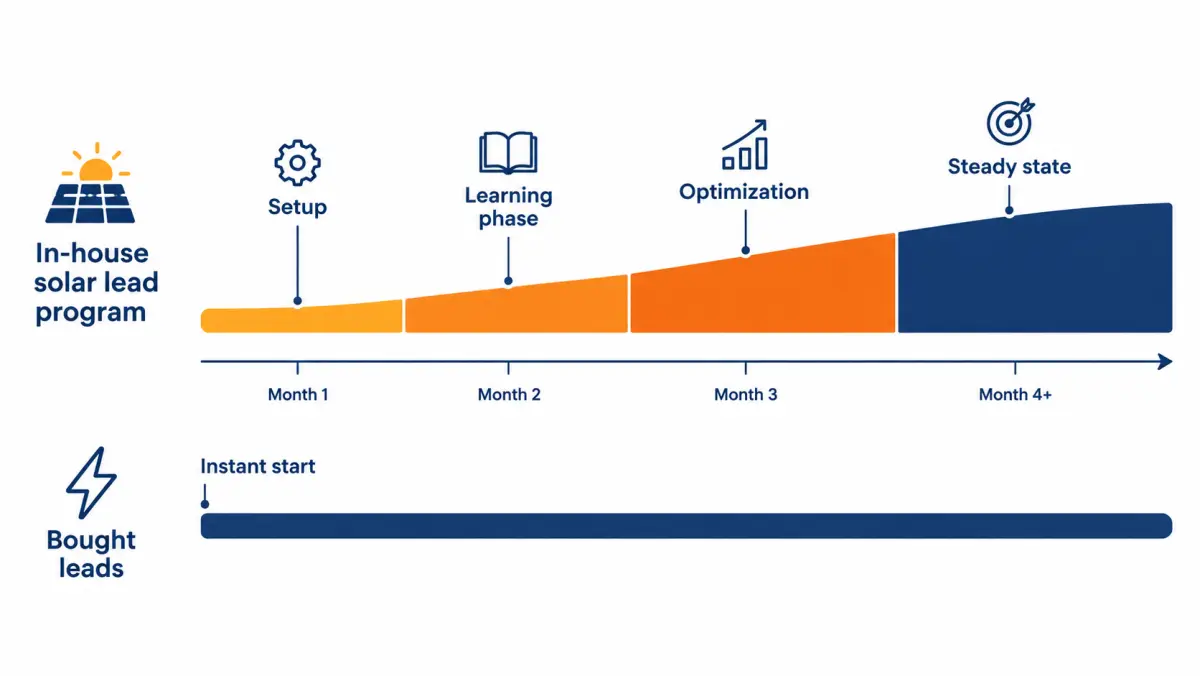
Phase 1: Setup (typically weeks 1 to 4)
- Decide the owner, budget, territories and target cost per sale
- Set up or audit ad accounts, conversion tracking and call tracking
- Build landing pages and forms; have counsel review consent language
- Connect forms to your CRM with source fields intact
- Write first-contact scripts and set response time standards
- Set up DNC scrubbing and opt-out handling
What goes wrong: tracking is wired incorrectly and nobody notices for weeks; consent language is copied from another site without review; leads land in an inbox instead of the CRM.
Phase 2: Learning (typically weeks 4 to 12)
- Launch campaigns with enough budget for the platforms to collect data
- Expect cost per lead and cost per sale to run above your target
- Review search terms, placements and audiences weekly; cut obvious waste
- Test two or three landing page versions
- Start sending appointment and sale events back to the ad platforms
What goes wrong: the owner panics at the early numbers and turns everything off before the campaigns have learned, or the opposite, lets bad campaigns run because "it's still learning."
Phase 3: Optimization (typically months 3 to 6)
- Shift budget to the campaigns and keywords producing sales, not just leads
- Tighten geographic targeting to ZIPs where you close well
- Improve landing page conversion
- Bid on sale-level conversions once you have enough volume
- Compare fully loaded cost per sale against bought sources monthly
Phase 4: Steady state (month 6 onward)
- Monthly reviews instead of weekly firefighting
- Seasonal budget shifts
- Periodic creative refresh as ads fatigue
- Ongoing consent and compliance review
What this means for cash flow
The ramp period is a real cash commitment. During the learning phase you are spending at or near full budget while producing sales at a worse rate than you will later. And because solar sales cycles mean a lead generated this month may not sign for several weeks and may not pay out until install, the revenue from that spending arrives later still.
Illustrative example. An installer budgets $20,000 a month for an in-house program. In months 1 and 2, the program produces sales at roughly double the eventual target cost per sale. By month 4 it reaches target. Because of the sales cycle, revenue from month 1 leads arrives in months 3 to 5. The installer's peak cash outlay before the program is self-funding is far larger than a single month's budget. Map this out before committing, and keep bought leads running through the ramp so your crews do not go idle.
What are the advantages of buying solar leads?
Buying gives you speed, a variable cost that scales up or down with your needs, no fixed overhead, someone else carrying the media risk, and filtering and replacement policies that absorb some junk. You trade some control and pay a margin for those benefits. For many installers, especially smaller ones, that trade is worth it.
Speed to volume
A vendor with active campaigns and inventory in your territory can deliver leads within days of your test order. No setup, no learning phase, no landing page work. If your calendar has gaps next month, buying is the only lever that fills them that fast.
Variable cost
You can increase or pause spending as your install backlog changes. When crews are booked out, you cut lead spend. When a crew is idle, you raise it. With an in-house team, salaries continue whether you need leads or not.
Media risk sits with the vendor
When click prices spike or a campaign stops working, a vendor selling at a fixed price per lead absorbs the hit, at least until they reprice. With an in-house program, you absorb it immediately.
Built-in quality filters and replacement
Vendors typically filter for homeowner status, service area and valid phone numbers, and offer credits for bad leads. For example, our exclusive solar leads carry replacement credits for disconnected numbers, wrong contact details or leads outside your filters, within 7 days. Prospects who simply aren't interested, don't answer, don't get financing approved or don't buy are not covered; that is true of almost every vendor's policy. When you generate your own leads, there is no one to credit you for junk.
Consent capture handled upstream
A good vendor runs the consent capture and keeps the records. Every lead we deliver carries a timestamped consent record whose disclosure names your company, and we send it on request. You are still responsible for how you contact the lead, but you are not maintaining the capture infrastructure.
Testing new territory cheaply
Buying a test batch in a county you have never worked tells you more, faster, than building an ad program there. If the leads close, you can build owned channels on top. If they don't, you have lost a test budget, not a quarter of setup work.
What are the disadvantages of buying solar leads?
Buying costs more per unit than raw media, quality varies widely between vendors, shared leads put you in a race with other installers, you do not control the message the homeowner saw, and you build no lasting asset. Each of these can be managed, but they are real costs you should weigh honestly.
Margin
A vendor's price includes its media, its operations, its risk premium and its profit. At high volume with a skilled in-house team, you can often produce leads at a lower media cost. At low volume, you usually cannot, because the overhead swamps the saving.
Variable quality
Vendor quality ranges from excellent to poor. Recycled leads, leads sold to many buyers, incentivized form fills and stale data are all common complaints in the industry. That is why vetting matters. See how to vet solar lead providers for a full checklist.
Competition on shared leads
Shared leads are sold to multiple installers. The first to call often wins, and the homeowner may be fielding several calls in an hour. Exclusive leads cost more but remove that race. See exclusive vs shared solar leads for the trade-offs.
Less control over the message
The homeowner saw the vendor's ad and landing page, not yours. If that page promised something your company doesn't offer, your rep starts the conversation correcting expectations. Ask vendors to show you the pages and ad angles they use.
No lasting asset
When you stop buying, the leads stop. Nothing accumulates: no rankings, no reviews from those ads, no audience lists. Customers you close from bought leads can still become referral sources, which is the best way to build an asset on top of bought volume.
What are the advantages of generating your own leads?
In-house generation gives you exclusivity by default, control over the message and consent language, first-party data you own, compounding assets like search rankings and audiences, and potentially lower cost per sale at scale. It also builds marketing capability inside your company that can support new products and territories.
Exclusivity
Every lead from your own campaign is exclusive. Nobody else gets the homeowner's details from your form.
Brand and message control
The homeowner saw your name, your offer and your reviews before submitting. They chose your company. That tends to make first calls easier and expectations clearer.
Data you own
Search terms, audience performance, creative results and customer lists stay in your accounts. Over time, that data makes your campaigns more efficient and gives you insight into your market that no vendor report will.
Compounding channels
Paid ads stop when you stop paying. But an in-house program often funds work that compounds: landing pages that rank organically, reviews from customers acquired through ads, retargeting audiences, and email lists of past inquirers you can recontact where your consent covers it.
Lower cost per sale at scale
Once fixed costs are spread across enough volume, and your campaigns are optimized for signed contracts, in-house cost per sale can fall below bought sources. The break-even section above shows how to estimate where that happens for you.
What are the disadvantages of generating your own leads?
In-house generation carries fixed overhead, a slow and expensive ramp, media risk you absorb directly, full responsibility for consent capture and records, key-person risk, and management distraction. Below a certain volume, these costs make it more expensive per sale than buying, and they are easy to underestimate.
Fixed overhead
Salaries, tools and management time continue whether campaigns perform or not.
The ramp
As covered above, you will spend money before the program is efficient, and the revenue arrives later still.
Media risk
A competitor or national lead generator raises bids in your market and your cost per lead goes up the same day.
Compliance responsibility
You become the party that captured consent. If your disclosure language is wrong, your records incomplete, or your opt-out handling sloppy, that exposure is yours. Confirm your process with counsel before launch and review it periodically.
Key-person risk
Many small in-house programs depend on one person. When that person leaves, account knowledge, creative history and sometimes account access leave with them. Keep account ownership in the company's name and document your setup.
Management distraction
Owners of growing installers are already stretched across sales, operations, hiring and finance. A marketing program that needs weekly attention competes for the same hours.
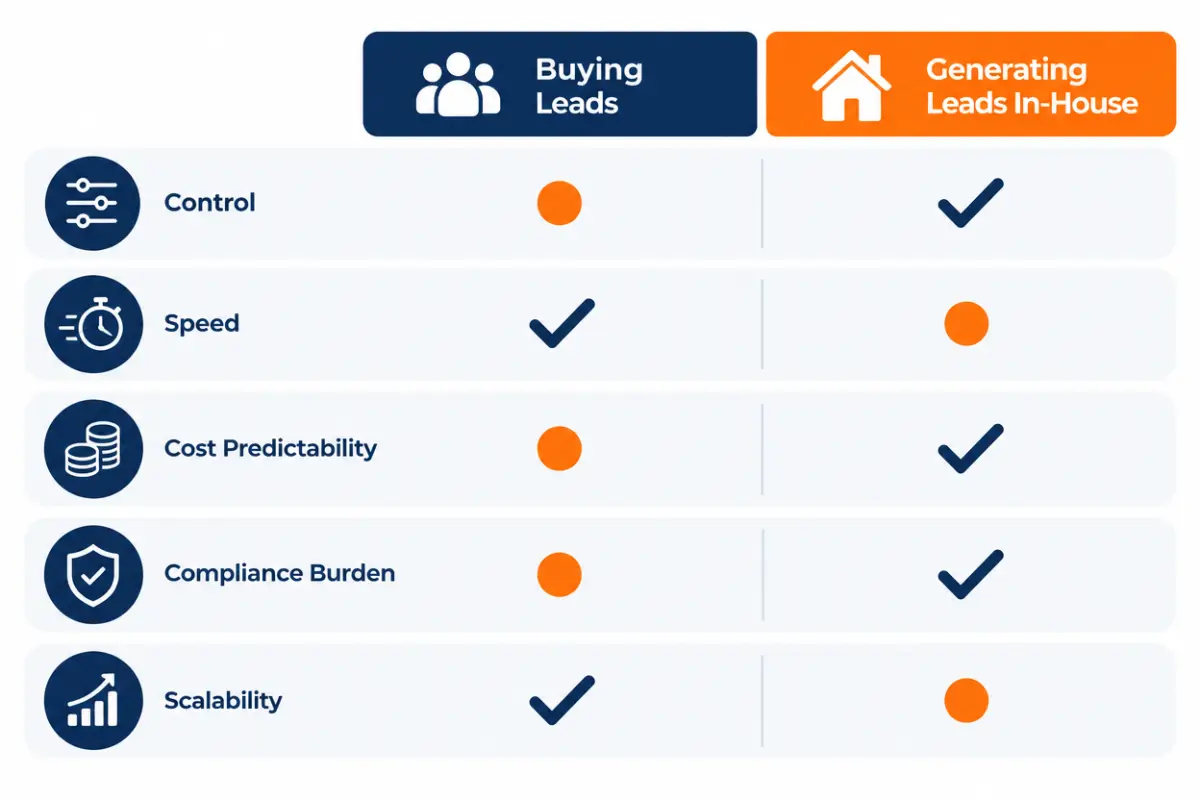
Scorecard summary
| Factor | Buy leads | Generate in-house | Agency |
|---|---|---|---|
| Time to first leads | Days | Weeks | Weeks |
| Time to efficient cost per sale | Immediate (if vendor is good) | Months | Months |
| Fixed overhead | None | High | Medium (fees) |
| Media risk | Vendor | You | You |
| Exclusivity | Depends on product | Always | Always (if your accounts) |
| Message control | Low | High | High |
| Consent capture responsibility | Vendor captures; you contact | You | You (your pages) |
| Data ownership | Partial | Full | Depends on contract |
| Lasting asset | Low | High | Medium |
| Best fit | Fast volume, low volume, new territories | High steady volume, strong brand | Want ownership without hiring |
What hybrid models work for solar installers?
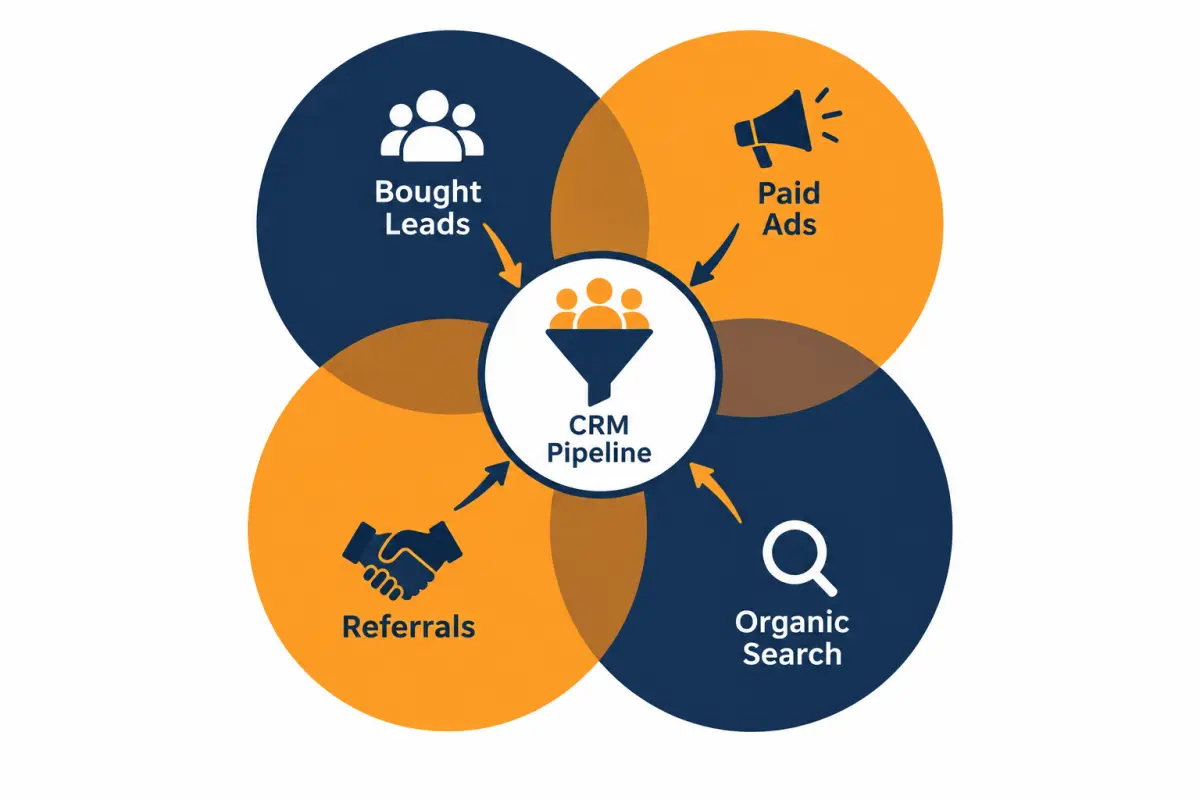
The hybrid models that work best assign each source a job: bought leads fill a predictable base of appointments, owned channels lower the average cost per sale, and the mix shifts as owned channels mature. Five patterns cover most installers: base-plus-build, territory split, seasonal flex, product split and benchmark-and-replace. Pick one deliberately rather than drifting into a mix.
Model 1: Base plus build
Bought leads cover most of your appointment target from day one. You build one owned channel at a time (usually referrals first, then local search, then paid ads) and reduce bought volume only as each owned channel proves itself on cost per sale.
- Best for: installers who need volume now and want to reduce dependence on vendors over time.
- Rule of thumb: never cut bought volume based on a forecast. Cut it after the owned channel has produced sales at a lower cost for at least two consecutive months.
- Risk: the owned channels never get attention because bought leads keep the calendar full. Give someone the explicit job of building them.
Model 2: Territory split
Owned channels serve your core territory, where your brand, reviews and referrals are strongest. Bought leads serve expansion territories where you have no presence yet.
- Best for: installers expanding into new counties or states.
- Why it works: in your core market, your brand lifts in-house conversion rates; in new markets, you have no brand advantage, so vendor leads are more competitive.
- Risk: you end up with two very different cost structures by territory. Track cost per sale separately for each.
Model 3: Seasonal flex
Owned channels run year-round at a steady budget. Bought leads flex up when your backlog drops and down when crews are booked out.
- Best for: installers with seasonal demand or variable install capacity.
- Why it works: in-house campaigns are most efficient at a steady budget; turning them on and off disrupts learning. Bought leads absorb the variation.
- Risk: vendors may not have inventory exactly when you need it. Keep a relationship warm with a test order every month or two.
Model 4: Product split
Different sources for different products. For example, bought residential leads for standard systems, in-house campaigns for battery retrofits targeting your past customers and homes in areas with frequent outages, and direct outreach for commercial.
- Best for: installers with multiple product lines.
- Why it works: a niche product often has an audience a general lead vendor does not target well.
- Risk: splitting budget too thin across products leaves each campaign underfunded.
Model 5: Benchmark and replace
You run a small in-house campaign and a bought source side by side, with the same budget and the same CRM tracking. Each quarter, you shift budget toward whichever had the lower fully loaded cost per sale.
- Best for: installers who are unsure and want data, not opinions.
- Why it works: it turns the build-vs-buy question into a running experiment.
- Risk: the in-house side needs enough budget to get past the learning phase, or it will always lose. Fund it properly or don't run it.
How to set the mix
Illustrative example. An installer wants 60 sits a month. Owned channels currently produce about 15. They plan to buy enough leads to produce the remaining 45 sits, and to grow owned channels by a few sits per month as the in-house program matures. Each month, they reduce the bought target by the number of additional sits owned channels delivered at an acceptable cost per sale. After a year, if owned channels reach 35 sits, the bought target is 25, not zero. Bought leads remain the flexible layer.
Which in-house channels should you build first?
Build in order of cost and payback: referrals first (cheapest, highest trust), then local search and reviews (slow but compounding), then paid search (fast, expensive, needs skill), then paid social (scalable, lower intent), then canvassing and events if your market suits them. Each channel has different costs, timelines and compliance rules.
Referrals
A structured referral program is often the highest-converting and lowest-cost source an installer has. It also turns every customer you close from bought leads into a potential source of owned leads, which is the most direct way buying and building reinforce each other.
What a working program includes:
- Asking at defined moments: at contract signing, at install, at permission to operate, and when the first lower utility bill arrives
- A simple way to refer (a link, a text, a card)
- A referral reward where your state's rules allow it; check any licensing or consumer protection rules that apply to referral payments with counsel
- Fast follow-up on every referral, with the referring customer's name mentioned
- A thank-you to the referrer whether the referral buys or not
Cost structure: rewards paid only on closed jobs, plus some staff time. No media, no fixed tools beyond your CRM.
Timeline: depends on your customer base. A new installer has few customers to ask; an established one may have hundreds.

Local search and reviews
Homeowners searching "solar installers near me" see map results and organic listings. Ranking there takes a complete business profile, steady reviews, service area pages and useful content. It costs mainly time and some content production. It takes months to show results but keeps producing leads without per-click cost.
Paid search
Search ads catch homeowners actively looking. Intent is high, competition is high, and click prices reflect both. It is the most skill-dependent channel; poorly managed accounts waste money quickly on irrelevant searches. Budget for a capable manager, not just media.
Paid social
Social ads reach homeowners who match a profile but are not actively searching. Volume can be large and click prices lower, but intent is lower, so more of those leads need nurturing. Lead forms inside the social platform are convenient but tend to produce more low-intent submissions than a dedicated landing page. Consent capture works differently inside platform lead forms; confirm your disclosure setup with counsel.
Canvassing and door-to-door
Some installers run strong door-knocking teams. It is a different business: recruiting, training, commissions, local soliciting permits and state rules on home solicitation sales, including cooling-off period requirements under the FTC's Cooling-Off Rule and state equivalents. It can produce exclusive conversations at scale but carries reputational risk if reps oversell.
Events and partnerships
Home shows, community events, partnerships with roofers, electricians, real estate agents and local businesses. These are relationship channels: slow to build, often high quality. Referral payments to partners may have their own rules; confirm with counsel.
Channel comparison
| Channel | Main cost | Time to first leads | Intent | Skill required | Compounds over time? |
|---|---|---|---|---|---|
| Referrals | Rewards on closed jobs | Depends on customer base | Very high | Low | Yes |
| Local search | Time, content | Months | High | Medium | Yes |
| Paid search | Media plus management | Weeks | High | High | Partly (data) |
| Paid social | Media plus creative | Weeks | Low to medium | High | Partly (audiences) |
| Canvassing | Commissions, recruiting | Weeks | Varies | High (management) | No |
| Events and partners | Time, fees | Months | Medium to high | Medium | Yes (relationships) |
| Bought leads | Price per lead or appointment | Days | Depends on product | Low (to buy), high (to work) | No |
How do you choose a solar lead generation agency?
Choose an agency the way you would hire a senior employee: check their solar experience, insist your company owns the ad accounts and landing pages, agree on how success is measured (cost per sit or sale, not cost per lead), understand how they capture consent, and make sure you can leave cleanly. An agency that cannot explain your fully loaded cost per sale is not managing for it.
Questions to ask an agency
- Which solar companies have you run campaigns for, and can I speak to one? Ask for references you can call. Treat unverifiable claims cautiously.
- Who owns the ad accounts, pages, domains and tracking? The answer should be: your company.
- What do you charge, and what does the fee include? Flat monthly, percentage of spend, or hybrid. Percentage-of-spend fees reward the agency for spending more, which is not always aligned with your interest.
- What metric will you report and optimize for? You want sits and signed contracts from your CRM, not just leads or clicks.
- How do you capture and store consent records? Who reviews the disclosure language? What tool stores the records? Who keeps them if you part ways?
- Do you run campaigns for other installers in my territory? If so, you may be bidding against yourself.
- How long is the contract, and what happens at the end? Short notice periods and a clear handover process are better.
- What will the first 90 days look like? A credible agency describes a setup and learning period and does not promise immediate low costs.
- Will you send sale events back to the ad platforms? If they can't or won't, the campaigns will optimize for form fills.
- Who exactly works on my account? Senior people sell the contract; ask who runs it day to day.
Red flags
- Guaranteed lead counts or cost per lead before they've seen your market
- They own the ad account and won't transfer it
- Reports show impressions and clicks but never sits or sales
- No answer on consent capture
- Long contracts with no performance exit
- They describe "proprietary" lead sources they won't explain (they may be reselling leads)
How do you decide? A step-by-step framework
Decide in six steps: set a target cost per sale from your margin, measure your current sources, estimate in-house fixed overhead, calculate the break-even sale volume, check cash for the ramp, and choose a hybrid model with a review date. The process takes a few hours with your own numbers and prevents most expensive mistakes.
Step 1: Set your allowable acquisition cost per sale
Start from margin, not from what others pay. Take your average gross margin per residential job and decide what share you can spend on acquiring it. The solar lead ROI guide walks through this. Post-25D, many installers are recalculating margin because homeowner financing and pricing have shifted; see solar leads after the 25D credit.
Step 2: Measure your current sources
For every source you use now, pull last quarter's spend, leads, contacts, appointments, sits and closes from your CRM. Calculate fully loaded cost per sale. If you cannot, fix your tracking before making any build-vs-buy decision. You would be deciding blind.
Step 3: Estimate in-house fixed overhead
List every non-media cost the in-house program would add: management (freelancer, agency or salary), tools, creative, consent capture, owner time. Be honest about owner time.
Step 4: Estimate in-house media cost per sale
This is the hardest number to estimate before you run campaigns. Options:
- Run a small test with a capable freelancer for a quarter
- Ask installers in non-competing markets what they see (and discount it, since markets vary)
- Use your best bought source's cost per sale as a ceiling: if your media alone would exceed it, building won't save money
Step 5: Calculate break-even volume and check capacity
Use N > F ÷ (B − M). Compare N with the number of sales you could realistically produce from in-house campaigns and handle with your sales and install capacity.
Step 6: Check cash for the ramp
Multiply your monthly budget by the months you expect before the program is efficient, add the sales cycle delay, and confirm you can fund it without starving operations.
Step 7: Choose a model and set a review date
Pick one of the hybrid models. Write down what result would make you shift budget, and when you'll review it. Ninety days is a sensible first checkpoint for a new source.
Decision worksheet
| Question | Your answer | Points toward |
|---|---|---|
| Do you need more appointments within 30 days? | Yes → buy | |
| Monthly sales you could get from in-house campaigns at steady state | Above break-even → build | |
| Is there someone who will own the program weekly? | No → buy or agency | |
| Can you fund 3 to 6 months of ramp? | No → buy | |
| Is your brand and review profile strong locally? | Yes → build | |
| Are you entering a new territory? | Yes → buy there | |
| Do you want full message and data control? | Yes → build or agency | |
| Is your setter team fast and consistent? | No → fix this before either |
That last row matters more than any other. Neither bought nor in-house leads will perform if nobody calls them within minutes. Fix speed to lead first.
Scenarios by installer size
The right answer changes with size. Owner-operators usually should buy and build referrals. Small teams should buy and add one owned channel. Mid-size installers can justify a freelancer or agency running paid search alongside bought leads. Regional and multi-state operators can justify a full in-house team, while still buying for new territories and seasonal gaps.
Each scenario below is an illustrative walkthrough. The companies are hypothetical, and every number is an example input chosen to show the reasoning, not a benchmark. Swap in your own figures.
Scenario A: Owner-operator, one crew

Profile (illustrative): The owner sells, manages installs and handles the books. One install crew. Closes around four residential jobs a month, mostly from referrals and a few bought leads. Wants to reach six.
The tempting idea: "I'll run my own Facebook ads. How hard can it be?"
The math (illustrative):
- Fixed overhead of even a lean in-house program: freelancer $1,200, tools $300, owner time valued at $1,000 = $2,500 per month
- Media cost per sale at steady state, if things go well: $1,800
- Bought exclusive lead cost per sale: $2,400
- Break-even: 2,500 ÷ (2,400 − 1,800) = 4.2 sales per month from the in-house program alone
The owner wants two more sales a month. The in-house program would need to produce more than four sales a month to beat buying, which the crew couldn't install anyway. At two sales a month, in-house cost per sale would be 2,500 ÷ 2 + 1,800 = $3,050, well above the bought source.
Recommendation: Buy the extra volume. Spend the owner's marketing hours on a referral program, which needs almost no fixed cost, and on getting reviews from every install. Revisit in-house ads when a second crew is running.
What would change the answer: a family member or partner with real paid media experience who can run campaigns at low cost; or a niche (for example, battery retrofits for past customers) where a small targeted campaign has little competition.
Scenario B: Small team, two to three crews
Profile (illustrative): Owner plus a sales manager, two closers, one setter, three install crews. Closes 12 to 15 jobs a month. Currently buys most leads from two vendors and gets some referrals.
The question: Should we hire a marketing person?
The math (illustrative):
- A full-time in-house marketer plus tools: $7,500 per month all in
- Plus ad spend
- Media cost per sale at steady state (estimated): $1,900
- Bought cost per sale (current best vendor): $2,500
- Break-even: 7,500 ÷ (2,500 − 1,900) = 12.5 sales per month from in-house campaigns
To justify the hire, the in-house campaigns would need to replace nearly all bought volume. That is a big bet on an unproven program.
Alternative: Hire a freelancer or small agency at $3,000 a month to run paid search in the core territory, owned by the company.
- Break-even: 3,000 ÷ (2,500 − 1,900) = 5 sales per month
That is achievable. The company keeps buying for the remainder.
Recommendation: Benchmark-and-replace model. Fund a freelancer-run search campaign properly for two quarters, keep buying, compare fully loaded cost per sale monthly. Give the sales manager formal ownership of the program with an hour a week blocked for reviews. Build referral and review processes at the same time.
What would change the answer: if the media cost per sale turns out at or above the bought cost per sale after the learning phase, stop and put the budget back into bought leads and referrals.
Scenario C: Mid-size installer, several sales reps

Profile (illustrative): Six closers, three setters, a sales manager, an operations manager, six crews. Closes 30 to 40 jobs a month. Spends a significant monthly amount on bought leads and has an agency running paid search that the owner suspects isn't working.
The question: Fire the agency and build in-house, or fire the agency and buy more?
Diagnosis first. Before deciding, the owner pulls fully loaded cost per sale by source for the last two quarters:
| Source (illustrative) | Fully loaded cost per sale | Sales per month |
|---|---|---|
| Bought exclusive leads, vendor 1 | $2,300 | 14 |
| Bought shared leads, vendor 2 | $3,400 | 5 |
| Agency-run paid search | $3,100 | 8 |
| Referrals | $600 | 6 |
| Organic and direct | $400 | 4 |
The agency isn't the worst source; the shared vendor is. But the agency is reporting cost per lead, not cost per sale, and hasn't set up offline conversion imports. Its campaigns are optimizing for form fills.
Options:
- Fix the agency: require CRM-based reporting and sale-level conversion imports, give them 90 days.
- Build in-house: hire a paid media manager and bring the accounts in-house.
- Cut the shared vendor and move that budget into vendor 1 and referrals.
Recommendation (illustrative): Do option 3 immediately; it's the clearest win. Give the agency 90 days on option 1 with a written target. If they hit it, keep them. If not, option 2 becomes viable at this size: an in-house media manager's cost spread over 10+ sales a month is reasonable, and the company already has enough data to optimize.
The lesson: at this size, the build-vs-buy question is often really a "manage each source on cost per sale" question.
Scenario D: Regional installer, multiple offices

Profile (illustrative): Three offices in one state, 20+ closers, a small in-house marketing team, 80 to 100 jobs a month. Already generates about half its leads in-house. Buys the rest.
The question: Should we go fully in-house?
Considerations:
- At this volume, fixed overhead per sale is low. In-house media efficiency is the main driver.
- The in-house team can probably match or beat bought costs in the core metro markets where the brand is strong.
- In the rural parts of the territory and the newest office, brand awareness is low and in-house costs are higher.
- Seasonal swings mean in-house campaigns either overspend in slow months or leave crews idle.
Recommendation (illustrative): Territory split plus seasonal flex. Run in-house campaigns at steady budgets in the two established metros. Buy leads in the newest office's territory and use bought volume to flex with backlog across all three. Re-evaluate the newest office after a year of brand building.
What to watch: marketing team headcount creep. As in-house volume grows, it is easy to add people faster than sales. Track overhead per sale quarterly.
Scenario E: Multi-state operator
Profile (illustrative): Operations in several states, a full marketing department, data analysts, a large call center. Hundreds of jobs a month.
The question: Is there any reason to keep buying?
Yes, a few:
- New-state entry. Bought leads let you test a state before committing a full marketing launch.
- Overflow and seasonality. Even large in-house programs hit diminishing returns when they push budget past the efficient point. Bought leads can be cheaper at the margin than the last dollars of in-house spend.
- Benchmarking. A bought source keeps your in-house team honest. If a vendor can deliver sales cheaper than your own campaigns in a market, that is useful information.
- Specific products. Appointments or live transfers for a particular product line or territory where your call center is thin.
The marginal cost point. At this size, the useful question is not average cost per sale but marginal cost per sale: what the next sale from more in-house spend costs versus the next sale from a vendor. As you push any ad budget higher, each additional dollar usually buys less, because you are reaching further down the list of keywords, audiences and placements. At some budget level, the marginal in-house sale costs more than a bought one. That is where buying should pick up.
Illustrative marginal cost table for one market:
| Monthly in-house media budget | Sales produced | Average media cost per sale | Marginal cost per extra sale |
|---|---|---|---|
| $40,000 | 25 | $1,600 | — |
| $60,000 | 34 | $1,765 | $2,222 |
| $80,000 | 41 | $1,951 | $2,857 |
| $100,000 | 46 | $2,174 | $4,000 |
If a bought source delivers sales at $2,600 fully loaded, the efficient in-house budget in this example sits somewhere between $60,000 and $80,000. Spending beyond that in-house costs more per extra sale than buying.
Scenario F: Commercial-focused installer
Profile (illustrative): A company that installs mostly commercial rooftop and carport systems for small businesses, warehouses and farms, with a few large residential jobs. Four business development reps, one engineer doing proposals, deals that take months to close.
The question: Should we buy commercial leads or build our own pipeline?
Considerations:
- Deal sizes are large and few. A single additional project can justify significant acquisition spend, but each project takes months, so feedback on a lead source is slow.
- Decision makers (owners, CFOs, facilities managers) rarely respond to the same ads as homeowners. Direct outreach, industry associations, utility programs, and partnerships with electricians, roofers and property managers often produce better conversations.
- Bought commercial leads exist, but volume is lower and qualification (roof condition, ownership, energy usage, credit) matters more than for residential.
Recommendation (illustrative): Build owned channels as the core: a target account list, partner referrals, and content that answers commercial owners' questions about payback and tax treatment (with their accountant). Use bought commercial leads selectively to supplement the pipeline, judged on cost per qualified proposal rather than cost per lead, because cost per signed project takes too long to measure. Review on a six-month cycle, not monthly.
What would change the answer: a vendor that can show strong qualification for your target building types and territory. Ask on the call what filters are available.
Scenario summary
| Size (illustrative) | Default model | First owned channel | When to revisit |
|---|---|---|---|
| Owner-operator | Buy plus referrals | Referrals and reviews | Second crew running |
| Small team | Benchmark and replace | Freelancer-run paid search | After two quarters of data |
| Mid-size | Manage all sources on cost per sale | Fix or replace agency | 90-day agency review |
| Regional | Territory split plus seasonal flex | In-house team in core metros | New office after one year |
| Multi-state | Mostly in-house, buy at the margin | Already built | Quarterly marginal cost review |
| Commercial-focused | Owned pipeline, selective buying | Partners and target accounts | Six-month review |
Scenarios by market and lead type
Market conditions shift the answer as much as company size does. Dense, competitive metros push in-house click prices up; rural markets limit ad volume; states with strong net metering attract more competitors; and commercial projects behave differently from residential entirely. Adjust the framework for your situation.
Competitive metro markets
Large metros with many installers and national lead generators bidding often have the highest click prices. In-house media cost per sale can be high unless your brand is well known. Buying exclusive leads or appointments may be competitive here, and owned channels like referrals and reviews matter more because they don't depend on outbidding anyone. For a state-by-state view of pricing, see solar lead cost by state.
Rural and small-town markets
Ad volume is limited by population. Even a well-run campaign may only generate a handful of leads a month, so fixed overhead per sale stays high. Vendors may also have thin inventory in rural ZIPs. Here, community presence, partnerships and referrals often outperform both paid ads and bought leads. Confirm vendor coverage for your ZIPs before assuming you can buy volume.
Markets after a policy change
When net metering rules, incentives or utility rates change, homeowner demand and messaging change with them. As of October 2026, the residential 25D credit is no longer available for systems placed in service after 2025 (see the IRS residential clean energy credit page). In-house programs can adjust messaging quickly; with bought leads, ask vendors how they've updated their pages so homeowners aren't expecting a credit that no longer applies.
Residential vs commercial
Commercial solar has longer sales cycles, fewer and larger deals, and decision makers who rarely fill out a web form on impulse. Owned channels such as direct outreach, partnerships with property managers and content tend to play a larger role. Bought commercial leads exist, but volume is lower and qualification matters more. See commercial solar leads.
Leads vs appointments vs live transfers
Buying doesn't have to mean buying raw leads. If your setter capacity is the bottleneck, buying solar appointments shifts setting work to the vendor. If speed is the bottleneck, live transfers connect a homeowner to your rep while they're on the phone. Each product shifts a different cost off your books. In-house programs require you to do all of that work yourself.
| What you buy | What the vendor does | What you still do |
|---|---|---|
| Raw exclusive or shared leads | Marketing, consent capture, basic filtering | Contact, qualify, set, sit, close |
| Live transfers | Marketing, consent, initial qualification, warm transfer | Qualify further, set or sit, close |
| Booked appointments | Marketing, consent, contact, setting, confirmation | Sit, close |
| Aged leads | Supplies older inquiries at a lower price | Re-engage, qualify, set, sit, close |
Aged leads are their own category. They can work for installers with strong nurture processes and patience; see aged solar leads.
How do you run a 90-day in-house pilot without stopping bought leads?
Run a 90-day pilot by ring-fencing a fixed budget for one in-house channel in one territory, keeping bought leads running at full volume, tracking both sources through the same CRM stages, and agreeing in advance what result means scale, continue or stop. The pilot answers the build question with your own data instead of guesses.
Before day 1: the pilot charter
Write a one-page charter. It forces decisions that otherwise get made under pressure later.
Pilot charter template
- Owner: (one named person)
- Channel: (for example, paid search, non-brand keywords only)
- Territory: (ZIP codes or counties)
- Monthly media budget: $_____
- Monthly non-media budget: $_____ (management, tools, creative)
- Success metric: fully loaded cost per sit and cost per signed contract, measured from the CRM
- Target at day 90: cost per sit at or below $_____ (set from your bought source's cost per sit)
- Stop rule: if cost per sit at day 60 is more than ___% above target with no improving trend, stop
- Scale rule: if cost per sit at day 90 is at or below target, increase budget by ___%
- Consent review: disclosure language reviewed by counsel on (date)
- Review dates: day 30, day 60, day 90
Why measure cost per sit as well as cost per sale? Ninety days is short relative to many solar sales cycles. Sits are a leading indicator you will actually have data on by day 90. Track cost per sale too and confirm it later.
Days 1 to 30: build and launch
| Week | Tasks |
|---|---|
| 1 | Ad account set up or audited; conversion and call tracking installed; CRM source fields created |
| 2 | Landing page built; form fields finalized; consent disclosure reviewed; test submissions traced into CRM |
| 3 | Campaigns launched at full planned budget; setter scripts updated for in-house leads; response time target set |
| 4 | First search term and placement review; obvious waste cut; first weekly report |
Checkpoint at day 30: Is tracking working end to end? Can you trace a test lead from click to CRM record with source, campaign and consent record attached? If not, fix that before evaluating anything else.
Days 31 to 60: learn
- Weekly reviews of search terms, cost per lead, contact rate and appointments by campaign
- One landing page test running at all times
- Begin sending appointment events back to the ad platforms
- Compare contact and set rates with bought leads in the same territory
Checkpoint at day 60: Apply your stop rule. If cost per sit is far above target and not improving, stop and redeploy the budget. If it's trending toward target, continue.
Days 61 to 90: optimize and decide
- Move budget to the best-performing campaigns and keywords
- Narrow geography to ZIPs that set and sit well
- Start sending sit and sale events to the platforms if volume allows
- Prepare the day-90 report
Day-90 report template
| Metric | In-house pilot | Bought source (same territory, same period) |
|---|---|---|
| Total spend (fully loaded) | ||
| Leads | ||
| Usable leads | ||
| Contact rate | ||
| Appointment set rate | ||
| Sit rate | ||
| Signed contracts so far | ||
| Cost per usable lead | ||
| Cost per sit | ||
| Cost per signed contract (to date) | ||
| Trend over last 30 days | ||
| Recommendation | Scale / continue / stop |
Common pilot mistakes
- Underfunding. A pilot budget too small to get through the learning phase proves nothing.
- Changing everything at once. If you change the offer, the landing page and the targeting in the same week, you won't know what worked.
- Different follow-up. If setters call in-house leads faster than bought leads (or the reverse), you are measuring your team, not the source.
- Counting from different stages. Both sources must use identical stage definitions.
- Ignoring brand search. If the pilot includes your brand keywords, it will look better than it is. Exclude brand or report it separately.
How should you transition from buying to building, or back?
Transition gradually and on evidence. When moving toward in-house, cut bought volume only after the owned channel has delivered lower cost per sale for at least two consecutive months at the volume you need. When moving back toward buying, start vendor test batches before you wind down the in-house program so your calendar never empties.
Moving from buying to building
- Keep bought volume flat during the pilot. Your crews need work while the new channel learns.
- Set a replacement ratio. For example, for every sit the in-house channel delivers below target cost, reduce the bought target by one sit the following month.
- Keep at least one vendor relationship active. Even if you eventually move most volume in-house, a vendor you've tested is valuable when campaigns stall, a new territory opens, or crews need filling quickly.
- Transfer learning. Bought lead data tells you which ZIPs, homeowner profiles and system sizes close best. Use that to target your in-house campaigns.
Moving from building back to buying
Sometimes the in-house program doesn't work: costs never fall, the key person leaves, or the market gets too competitive. That's a legitimate outcome, not a failure.
- Start vendor test batches first. Get two or three vendors delivering in your core territory and measure them for a month.
- Reduce in-house budget in steps. Keep the highest-performing campaigns (often brand and a few high-intent keywords) running.
- Keep ownership of assets. Keep the ad accounts, landing pages, domains and consent records. Keep the records for as long as counsel advises.
- Keep the owned channels that cost little. Referrals, reviews and local search don't need a media budget.
Transition timeline example
Illustrative. An installer moving from 100% bought to a hybrid:
| Month | Bought sits target | In-house sits (actual) | Notes |
|---|---|---|---|
| 1 | 50 | 2 | Pilot launch |
| 2 | 50 | 6 | Learning |
| 3 | 50 | 10 | At target cost per sit for first time |
| 4 | 48 | 12 | Second month at target; bought reduced |
| 5 | 44 | 15 | |
| 6 | 40 | 18 | |
| 9 | 35 | 22 | Growth slowing in core territory |
| 12 | 32 | 24 | Steady state; bought remains flex layer |
What does an in-house lead team look like at each stage?
An in-house lead team grows from a part-time owner plus a freelancer, to a marketing coordinator with outsourced specialists, to a manager with dedicated media, web and analytics roles. Add roles when the volume and budget justify them, not before, and keep lead intake and setting under sales rather than marketing so response speed stays a sales priority.
Stage 1: Owner plus freelancer
- Owner or sales manager: weekly review, budget decisions
- Freelance paid media manager: campaign setup and optimization
- Freelance web builder (as needed): landing pages
- Setters (existing): handle in-house leads alongside bought
Fits: small team, one channel, modest budget.
Stage 2: Coordinator plus specialists
- Marketing coordinator (in-house): owns reporting, creative coordination, review requests, referral program
- Agency or freelancer: paid media
- Freelance designer and writer: creative and landing pages
- Outside counsel: consent language and process review
Fits: mid-size installer, two or three channels.
Stage 3: Marketing department
- Marketing manager: strategy, budget, vendor and agency management
- Paid media specialist(s): campaigns across platforms
- Web and conversion specialist: landing pages, testing, site speed
- Analyst: attribution, CRM reporting, offline conversions
- Content and local search specialist: reviews, local pages, organic
- Compliance owner: internal owner of consent records and DNC process, with counsel
Fits: regional and multi-state operators.
Sample job description: paid media manager (solar)
Purpose: Generate homeowner appointments at or below target cost per sit through paid search and social campaigns.
Responsibilities:
- Build, manage and optimize campaigns in company-owned ad accounts
- Maintain conversion tracking, including offline conversion imports from the CRM
- Run landing page and creative tests
- Report weekly on spend, leads, sits and sales by campaign, from CRM data
- Work with the compliance owner to keep consent disclosures current
- Coordinate with the sales manager on lead quality and response times
Measures of success: cost per sit and cost per signed contract by campaign; share of budget on campaigns meeting target.
Experience to look for: home services or high-ticket lead generation; comfort with CRM data and offline conversions; examples of accounts they improved, with numbers they can explain.
Keep setting under sales
Whether leads are bought or generated, the setter team should report to sales. Marketing's job ends when a qualified lead lands in the CRM with its consent record attached. Sales owns what happens next, including response time, which matters more than almost anything else. The how to work solar leads guide covers follow-up cadence.
What does consent and compliance look like when you generate your own leads?
When you generate your own leads, you become responsible for the full consent chain: clear disclosure language naming your company, a stored record of every consent event, DNC scrubbing, opt-out handling across channels, and retention. Bought leads shift the capture to the vendor, though you still own how you contact the lead. Have counsel review your setup; this section is not legal advice.
The consent chain you own
| Step | What it means | Who handles it with bought leads | Who handles it in-house |
|---|---|---|---|
| Disclosure | Clear text telling the homeowner who will contact them and how | Vendor | You |
| Agreement | An affirmative action (submitting with a clear disclosure, a checkbox) | Vendor | You |
| Record | Stored evidence of what the homeowner saw and did | Vendor, with copy to you on request | You |
| Delivery | Getting the lead and record into your CRM | Vendor | You |
| DNC scrub | Checking against federal, state and internal lists | Vendor scrubs before delivery; you scrub before calling | You |
| Contact | Calls, texts and emails within the consent scope | You | You |
| Opt-out | Honoring stop requests across channels | You | You |
| Retention | Keeping records available if needed later | Both | You |
Practical setup checklist for in-house consent
- Disclosure text reviewed by counsel and placed directly above or beside the submit button
- Disclosure names your company
- Disclosure covers each contact method you will use (calls, texts, automated technology if applicable)
- Consent record tool captures timestamp, page version, disclosure text, IP and data submitted
- Records retrievable by lead ID from the CRM
- Phone numbers scrubbed against the National Do Not Call Registry and your internal list before outbound calls
- State-specific rules checked for each state you market in
- Opt-out keywords (STOP, etc.) processed across all texting tools
- Verbal opt-outs logged by setters and synced across systems
- Calling hours respected per federal and state rules
- Periodic audit: sample leads monthly and confirm each has a complete record
Platform lead forms
Lead forms that live inside social platforms are convenient but give you less control over how the disclosure appears. Review each platform's form options with counsel and make sure your custom disclosure is present and stored.
A word on the vacated one-to-one rule
The FCC's one-to-one consent rule would have required each consent to name a single seller. It was vacated by the Eleventh Circuit on January 24, 2025, before it took effect. That changed what lead vendors can do with multi-seller disclosures, but it did not remove the underlying TCPA and Telemarketing Sales Rule requirements, and some states have their own rules. Naming your company clearly in the disclosure remains good practice whether you buy or build. For more, see the FCC's guide on unwanted robocalls and texts and our TCPA compliance page.
Which metrics should you track for both sources?
Track the same funnel metrics for every source in one CRM: spend, leads, usable leads, contact rate, set rate, sit rate, close rate, cancellation rate, cost per sit, cost per signed contract and average contract value. For in-house sources, also track media share of total cost and the trend in cost per sale month over month. Review weekly for operations, monthly for budget.
The shared source dashboard
| Metric | Definition | Why it matters for build vs buy |
|---|---|---|
| Fully loaded spend | All costs attributable to the source | The denominator everything else depends on |
| Usable lead rate | Usable leads ÷ total leads | In-house sources absorb junk; vendors may credit it |
| Speed to first attempt | Minutes from lead arrival to first call | If one source gets slower follow-up, results are skewed |
| Contact rate | Two-way conversations ÷ usable leads | Exclusive and branded leads often contact better |
| Set rate | Appointments set ÷ contacts | Reflects intent and expectations |
| Sit rate | Appointments held ÷ set | No-shows waste closer time |
| Close rate | Signed ÷ sits | Reflects fit and sales skill |
| Cancellation rate | Cancelled ÷ signed | Some sources sign more contracts that don't survive |
| Cost per sit | Spend ÷ sits | Leading indicator, available faster than cost per sale |
| Cost per signed contract | Spend ÷ non-cancelled contracts | The decision metric |
| Average contract value | Revenue per signed contract | A source producing bigger systems can justify higher cost |
| Cost per sale trend | Month-over-month change | In-house sources should improve; flat or rising is a warning |
Weekly vs monthly reviews
Weekly (operations): speed to first attempt, contact rate, sets, sits by source. Fix follow-up problems fast.
Monthly (budget): fully loaded cost per sit and per signed contract by source; shift budget accordingly.
Quarterly (strategy): build vs buy mix, owned channel growth, break-even check, hiring decisions.
Attribution pitfalls
- Double counting. A homeowner who submitted a bought lead and later clicked your ad is one customer. Decide on a rule (first touch, last touch or a defined priority) and apply it consistently.
- Brand halo. In-house ads often raise brand search and direct traffic. Some of that lift is real value of the in-house program that won't show in campaign reports. Some of it would have happened anyway. Don't credit all of it either way.
- Referral leakage. Customers acquired from bought leads who later refer friends create owned leads. That is real value from bought sources. Track referral source back to the original customer's source if you can.
What hidden costs do both models carry?
Both models carry costs that don't appear on the invoice or the ad dashboard. Bought leads carry vendor management time, junk not covered by credits, and competition on shared leads. In-house generation carries salaries, tools, the ramp, compliance overhead, key-person risk and management attention. List both sets honestly before comparing.
Hidden costs of buying
- Time spent reviewing leads and submitting credit requests
- Junk outside the replacement policy (homeowners who were never interested, numbers that ring but never answer)
- Lost deals on shared leads to faster competitors
- Leads in ZIPs or for products you didn't really want, if filters are loose
- Switching costs when a vendor's quality drops and you have to test new ones
- For a deeper list, see the hidden costs section of how much solar leads cost
Hidden costs of building
- Learning-phase spend at poor efficiency
- Unusable form fills with no credit
- Salary and benefits for staff, including during slow months
- Tool subscriptions that accumulate and rarely get cancelled
- Creative refresh as ads fatigue
- Consent record storage and periodic compliance review
- Owner and manager time
- Recruiting and replacing marketing staff
- Lost account history if accounts aren't company-owned
Hidden cost checklist
| Hidden cost | Buy | Build | Agency | Your estimate per month |
|---|---|---|---|---|
| Management time | Low | High | Medium | |
| Junk not credited | Some | All | All | |
| Ramp spend | None | Significant | Significant | |
| Tool subscriptions | Low | Medium | Low to medium | |
| Compliance overhead | Lower | Higher | Higher | |
| Key-person risk | Low | High | Medium | |
| Switching cost | Medium | High | Medium |
How does having your own leads change vendor negotiations?
Having a working in-house channel gives you leverage with vendors because you have a credible alternative and a real cost-per-sale benchmark. Use it to negotiate filters, exclusivity, replacement handling and test terms, not just price. Equally, a working vendor relationship gives you leverage with an agency, because you know what a sale costs elsewhere.
What leverage looks like
- A benchmark. "Our own search campaign is producing sits at this cost in these ZIPs. For your leads to stay in the mix, they need to be competitive on cost per sit."
- Volume flexibility. You can credibly shift volume, so vendors have an incentive to keep quality up.
- Data on what works. You know which ZIPs, homeowner profiles and system sizes close well, so you can ask for tighter filters.
What to negotiate besides price
- Tighter geographic and qualification filters
- Exclusivity (if you currently buy shared leads)
- Clear replacement terms and a fast credit process
- Delivery format and speed into your CRM
- Access to consent records on request
- Test batch terms before scaling
- No long-term commitment
Our own terms, for reference: no long-term contracts, start with a test batch and scale when the numbers work; real-time delivery to your CRM, dialer, email or SMS; and every lead phone-validated, homeowner status self-reported then checked against property records, duplicate-checked against leads already sent to you, and scrubbed against the National Do Not Call Registry. Territory availability is confirmed by ZIP on your call, and pricing is confirmed by ZIP on your call as well. For more on negotiating, see how to buy solar leads.
What tech stack do you need for each model?
Both models need a CRM with clean source tracking, a dialer or calling workflow, texting with opt-out handling, and reporting. In-house generation adds ad accounts, landing page tools, call tracking, a consent record tool, and offline conversion connections. The shared core matters more than the extras, because it is where leads are won or lost.
Shared core (needed either way)
| Tool | Purpose |
|---|---|
| CRM | Single record per homeowner, source fields, stage tracking |
| Dialer or calling workflow | Fast first attempt, structured follow-up |
| Texting platform | Confirmations and follow-up within consent, opt-out processing |
| Calendar and scheduling | Appointment booking and reminders |
| Reporting | Source-level funnel and cost reports |
| DNC scrubbing | Before outbound calls |
In-house additions
| Tool | Purpose |
|---|---|
| Ad accounts (company-owned) | Search, social, local service ads |
| Landing page builder | Conversion-focused pages and testing |
| Form tool | Qualification fields and CRM integration |
| Consent record tool | Timestamped evidence of disclosure and agreement |
| Call tracking | Attribute phone leads to campaigns |
| Tag manager and analytics | Conversion tracking |
| Offline conversion integration | Send sits and sales back to ad platforms |
Integration test
Before launching any new source, bought or built, submit a test lead and confirm:
- It lands in the CRM within seconds
- Source and campaign fields are populated
- The consent record is attached or retrievable
- A setter is alerted immediately
- The first call attempt happens within your response time target
- Opt-out handling works if the test contact texts STOP
Illustrative case walkthroughs
These walkthroughs are composite, illustrative stories built to show common decision paths. They are not real clients and the numbers are examples, not results.
Walkthrough 1: The installer who built too early
A two-crew residential installer hired a full-time marketer and stopped buying leads in the same month, expecting the new hire to replace vendor volume within weeks. The marketer needed a month to set up accounts and pages, and the campaigns spent two more months learning. By month three, crews had gaps in their schedule and the owner was paying a salary, ad spend and idle labor at the same time. The owner restarted bought leads in month four. By month eight, the in-house program was producing sits at a reasonable cost, but at a volume that only justified a part-time role.
What they'd do differently: keep bought volume flat during the ramp, start with a freelancer, and set a stop rule at day 60.
Walkthrough 2: The installer who never measured
A mid-size installer used three lead vendors and an agency for years without connecting spend to signed contracts. When margins tightened after the 25D change, the owner finally pulled fully loaded cost per sale by source. One vendor was producing sales at nearly double the cost of the others; the agency was optimizing for form fills. Cutting one vendor and rewriting the agency's targets reduced blended acquisition cost without changing overall volume.
Lesson: the build-vs-buy question can't be answered until every source is measured the same way.
Walkthrough 3: The installer who used bought leads to enter a new market
A regional installer wanted to open in a neighboring county. Instead of launching a full marketing program there, it bought a test batch of exclusive leads in the target ZIPs, worked them with its existing team, and tracked results for a quarter. The leads closed at a rate close to its home market. Only then did it open a satellite office, start a local search presence, and run in-house ads there. Bought leads stayed as a flex layer.
Lesson: buying is a cheap way to test a market before building in it.
Walkthrough 4: The large installer who found its ceiling
A multi-state operator kept raising in-house budgets in its largest metro. Average cost per sale rose slowly, but the marginal cost of the last tranche of spend was far higher. An analyst showed that the final portion of in-house budget was buying sales at more than the cost of a bought exclusive source. The operator capped in-house spend at the efficient level and filled the remaining target with bought appointments.
Lesson: at scale, compare marginal cost, not average cost.
Walkthrough 5: The agency that wasn't an agency
An installer hired a self-described agency that charged per lead and promised exclusive leads from "our proprietary campaigns." Lead quality was inconsistent, and some homeowners mentioned speaking to other installers. When pressed, the agency couldn't show the ad accounts or landing pages and wouldn't share consent records naming the installer. The installer switched to a vendor that provided consent records on request and an agency that worked in company-owned accounts.
Lesson: ask who owns the accounts, whose name is on the disclosure, and whether leads are shared, regardless of what a firm calls itself.
How do you build an annual lead budget that mixes both?
Build the annual budget backwards from install capacity: decide how many jobs your crews can install each month, convert that into the sits you need using your close rate, assign sits to owned channels at their realistic capacity, and fill the rest with bought sources. Then price each source using its fully loaded cost per sit and add a reserve for the in-house ramp.
Step-by-step
- Install capacity. Crews × installs per crew per month, adjusted for weather and permitting seasons.
- Signed contracts needed. Installs ÷ (1 − cancellation rate), shifted earlier by your typical sign-to-install lag.
- Sits needed. Signed contracts ÷ close rate.
- Owned-channel sits. Referrals, organic, in-house ads: use last year's actuals plus a conservative growth assumption.
- Bought sits. Sits needed minus owned-channel sits.
- Cost. Bought sits × bought cost per sit; in-house sits × in-house cost per sit; plus fixed overhead.
- Reserve. Add a reserve for ramp spend on any new in-house channel and for seasonal surges.
Annual planning template
Illustrative example for a small team. All figures hypothetical.
| Quarter | Installs planned | Signed needed | Sits needed | Owned sits | Bought sits | Notes |
|---|---|---|---|---|---|---|
| Q1 | 30 | 34 | 113 | 30 | 83 | Winter; permitting slower |
| Q2 | 42 | 47 | 157 | 38 | 119 | In-house pilot launches |
| Q3 | 45 | 50 | 167 | 50 | 117 | Pilot past learning phase |
| Q4 | 36 | 40 | 133 | 50 | 83 | Holiday slowdown; flex bought down |
Assumptions in this example: 10% cancellation rate, 30% close rate on sits. Plug in yours.
Reserve planning
| Reserve type | Purpose | How to size it |
|---|---|---|
| Ramp reserve | Learning-phase spend on a new in-house channel | One to two months of the new channel's budget |
| Surge reserve | Extra bought volume when backlog drops unexpectedly | A few weeks of bought spend |
| Test reserve | New vendor or new territory test batches | One test batch per quarter |
Use the solar lead cost calculator to turn your sits and close rate into a spend estimate by source.
Scripts for talking to vendors, agencies and your team
Clear conversations prevent most build-vs-buy mistakes. Use these scripts to ask vendors about quality and consent, to set expectations with an agency, and to explain a hybrid plan to your sales team so they work every source the same way. Adapt the wording to your company.
Script: asking a lead vendor the right questions
"Before we order a test batch, I'd like to understand a few things. Are these leads exclusive to us, or sold to other installers? Whose company name appears in the consent disclosure the homeowner sees? Can you send the consent record for any lead on request? What filters can you apply for our ZIPs and homeowner status? What's your replacement policy, and what isn't covered? How fast do leads reach our CRM after the homeowner submits?"
Script: setting expectations with an agency
"We'll judge this engagement on cost per sit and cost per signed contract from our CRM, not cost per lead. The ad accounts, landing pages and tracking stay in our company's name. We'd like to see sale-level conversions sent back to the platforms by the end of month two. We'll review at day 30, 60 and 90. If cost per sit isn't trending toward our target by day 60, we'll talk about changes or ending the engagement. Who on your team will run the account day to day?"
Script: explaining a hybrid plan to the sales team
"We're going to run our own ads in the core territory alongside the vendor leads you're already working. Every lead, whatever the source, gets the same response time target and the same follow-up cadence. Please don't treat one source as better or worse in how you work it. We need a fair comparison. Log every outcome in the CRM with the correct stage so the numbers mean something. If you notice a pattern, like leads from one source expecting something we don't offer, tell me that week."
Script: first call on an in-house lead
"Hi, this is [name] with [company]. You asked for a solar estimate on our website a few minutes ago. Is now an okay time? Great. I just have a few quick questions so we send the right person out: do you own the home? And roughly what's your monthly electric bill? ..."
For full call frameworks and objection handling, see solar lead call scripts.
Script: asking for a referral at install
"We're glad the install went smoothly. Most of our customers hear about us from neighbors and friends. If you know anyone who's been thinking about solar, I'd be happy to give them the same experience. Is there anyone who comes to mind?"
Add any referral reward details only if your program and state rules allow them.
Troubleshooting: why isn't my in-house program working?
When an in-house program underperforms, the cause is usually one of a few things: broken tracking, campaigns optimized for form fills instead of sales, a weak landing page, slow follow-up, poor targeting, or simply a market where media costs exceed bought alternatives. Diagnose in that order, because tracking and follow-up problems are common and cheap to fix.
Diagnostic table
| Symptom | Likely cause | What to check | Fix |
|---|---|---|---|
| Ad platform shows many conversions, CRM shows few leads | Tracking or integration broken | Test submission from ad click to CRM | Repair integration; reconcile counts weekly |
| Plenty of leads, low contact rate | Junk leads or slow follow-up | Speed to first attempt; share of fake numbers | Faster response; phone validation on form; stricter form |
| Good contact, low set rate | Wrong audience or mismatched expectations | Search terms, ad copy, landing page promises | Tighten keywords; align page with what you sell |
| Good sets, low sit rate | Weak confirmation process | Reminder sequence; time from set to appointment | Confirmation calls and texts; shorter set-to-sit window |
| Good sits, low close rate | Lead fit or sales skill | Close rate by rep and by source | Coaching; better qualification upstream |
| Cost per lead rising steadily | Competition or ad fatigue | Click prices over time; creative age | Refresh creative; test new keywords; check competitors |
| Cost per sale flat after six months | Campaigns not learning from sales | Offline conversion setup | Send sit and sale events to ad platforms |
| Great results, then sudden drop | Account change, policy issue or tracking break | Change history; platform notifications | Revert changes; resolve policy issues; retest tracking |
When to stop
If after a properly funded learning phase and at least one round of optimization your fully loaded cost per sale is still above your best bought source, and you can't identify a fixable cause, stop or shrink the program. Keep the low-cost owned channels running. That's a sound business decision.
Troubleshooting: why aren't my bought leads working?
When bought leads underperform, check your own follow-up first, then the vendor's filters and exclusivity, then whether the vendor's landing pages set the right expectations. Many installers blame lead quality when the real issue is response time or inconsistent follow-up. Fix your side before switching vendors or deciding to build.
Diagnostic table
| Symptom | Likely cause | What to check | Fix |
|---|---|---|---|
| Low contact rate | Slow first attempt; too few attempts | Speed to first attempt; attempts per lead | Call within minutes; multi-day cadence |
| Homeowners say they've talked to other installers | Shared leads or resold leads | Product purchased; vendor's exclusivity terms | Move to exclusive; vet vendor |
| Many leads outside your area | Filter problem | ZIP list sent to vendor | Correct filters; request credits within policy |
| Renters or non-decision makers | Qualification weakness | Vendor's homeowner check | Ask vendor how homeowner status is verified |
| Homeowners expect something you don't offer | Vendor's landing page messaging | Ask to see the pages | Request message changes or switch |
| Credits slow or disputed | Unclear replacement terms | Written policy | Clarify upfront; use the policy window |
For a detailed vendor checklist, see how to vet solar lead providers, and for follow-up mechanics see solar speed to lead.
Risk register: what can go wrong with each model?
Each model carries distinct risks: bought leads risk vendor quality swings and dependence; in-house generation risks cost overruns, key-person loss and compliance gaps; agencies risk misaligned incentives and lost account access. Writing these down with a mitigation for each makes the decision safer and gives you a checklist for quarterly reviews.
| Risk | Model | Likelihood (your judgment) | Impact | Mitigation |
|---|---|---|---|---|
| Vendor quality drops | Buy | Medium | Track weekly; keep a second vendor tested | |
| Vendor runs out of inventory in your ZIPs | Buy | Medium | Keep owned channels running; test other vendors | |
| Shared-lead competition | Buy | Medium | Buy exclusive; improve speed to lead | |
| Learning phase runs long | Build | High | Stop rule at day 60; keep bought volume flat | |
| Key marketer leaves | Build | High | Company-owned accounts; documented setup | |
| Consent records incomplete | Build | High | Monthly audit; counsel review | |
| Click prices spike | Build | Medium | Bought leads as flex; diversify channels | |
| Agency optimizes for wrong metric | Agency | Medium | Contract on cost per sit; CRM reporting | |
| Agency holds accounts | Agency | High | Accounts in your name from day one | |
| Owner distraction | Build, Agency | Medium | Named owner other than the CEO where possible |
Owned-channel playbooks you can start this month
Three owned channels need little or no media budget and work alongside bought leads from day one: a structured referral program, a review request process, and a basic local search setup. Each takes a few hours to set up and a little weekly attention. They lower your average cost per sale over time regardless of how much you buy.
Referral program playbook
Week 1: design
- Decide the moments you'll ask: signing, install day, permission to operate, first lower bill
- Decide on any reward and confirm it's allowed in your state and under any licensing rules that apply to you
- Create a simple referral link or form that tags the referring customer in your CRM
- Write the ask scripts (see the scripts section above)
Week 2: launch
- Train closers and install leads on when and how to ask
- Add a referral request to your post-install email or text where consent covers it
- Create a CRM report: referrals received, contacted, set, sat, signed, by referring customer
Ongoing
- Contact every referral within the same response time target as paid leads
- Thank every referrer, whether or not the referral buys
- Review monthly: which ask moments produce the most referrals?
Review request playbook
Reviews raise conversion on every channel, including bought leads, because homeowners look you up after the first call.
- Ask at the moment of highest satisfaction, usually right after install or after the system is turned on
- Make it easy: a direct link to your review profile
- Respond to every review, including negative ones, calmly and specifically
- Never offer incentives for reviews in ways that break platform rules or FTC guidance on endorsements; check the FTC's guidance before running any review program
Local search starter plan
| Task | Time | Frequency |
|---|---|---|
| Complete business profile: categories, service area, hours, photos | 2 to 3 hours | Once, then update |
| Add photos of real installs | 30 minutes | Monthly |
| Post updates (new projects, seasonal tips) | 30 minutes | Weekly or biweekly |
| Service area pages on your website for core towns | A few hours each | Once, then refresh yearly |
| Answer common homeowner questions on your site | A few hours | Ongoing |
| Check business listings for consistent name, address, phone | 1 to 2 hours | Quarterly |
None of this needs an agency to start. It needs someone to own it.
Does the answer change for battery storage and add-on products?
Often, yes. Battery retrofits, panel expansions and service plans sell best to audiences you already know: past customers, homes in your installed base's neighborhoods, and areas with frequent outages. Those audiences are cheap to reach with owned channels and poorly served by general bought leads. For new-system sales, bought leads remain competitive.
Why owned channels fit add-ons
- Past customers already trust you and have solar. Contact them through channels your consent and existing relationship cover.
- Neighborhood targeting around existing installs benefits from social proof.
- Outage-driven interest is local and timely. An in-house campaign can respond within days of a storm season; a vendor may not segment that finely.
When to buy for add-ons
- When you want new homeowners interested in solar plus storage together
- When a vendor offers storage-specific filters for your territory (ask on the call)
Illustrative comparison
Illustrative. An installer with several hundred past customers sends a battery retrofit offer by email and text where consent allows. A small share respond and a few sign. The cost is staff time and a little creative. Buying general solar leads would have reached people without solar, who need a full system first. For this product, owned channels win clearly.
Common myths about buying vs generating solar leads
Several beliefs push installers into the wrong choice: that in-house leads are always cheaper, that bought leads are always junk, that an agency guarantees results, that you can build an ad program on the side, and that you must pick one model forever. Each is wrong often enough to be dangerous.
"In-house leads are always cheaper"
Only when fixed overhead is spread over enough volume and your media is efficient. At low volume, overhead dominates. The ad dashboard's cost per conversion leaves out most costs.
"Bought leads are all junk"
Quality varies by vendor and product. Exclusive leads with consent records, homeowner checks and clear replacement terms are a different product from recycled shared leads. Vet vendors and measure them like any other source.
"An agency will handle it"
An agency handles campaigns. You still own the decision, the budget, the follow-up, the CRM data and the compliance responsibility for your pages. An agency without clear targets drifts toward the metrics it controls.
"I can run ads on the side"
You can run them. Running them well takes weekly attention, testing and analysis. Owners who try this alongside selling and operations usually find the ads get neglected, and neglected ad accounts waste money.
"Once I build, I'll never buy again"
Even large in-house programs hit diminishing returns, enter new territories and face seasonal swings. Most mature installers keep at least one vendor relationship active.
"Exclusive leads cost too much, so build instead"
Compare cost per sale, not cost per lead. Exclusive leads often contact and close better than shared leads; see exclusive vs shared solar leads. And your own leads have their own costs that may exceed a vendor's exclusive price per sale at your volume.
How do you model cash flow for an in-house program?
Model cash flow month by month: spend leaves in the month you run ads, but revenue arrives only after the homeowner signs, finances clear and the system is installed. Lay out spend, sits, signings and install payments on one timeline, and the trough between first spend and self-funding becomes visible. Bought leads have the same lag, but no ramp or fixed overhead on top.
The four timing gaps
- Lead to sit. Days to a couple of weeks, depending on your setting speed and the homeowner's schedule.
- Sit to signature. Same day for some homeowners, weeks for others.
- Signature to install. Site survey, design, permitting, utility approval and scheduling. Often the longest gap.
- Install to payment. Depends on your financing partners and payment milestones.
Illustrative cash flow table
Illustrative. A new in-house program with a $15,000 monthly budget including overhead, compared with no program. All figures hypothetical; gross margin received is shown in the month it arrives.
| Month | In-house spend | Contracts signed | Gross margin received | Cumulative cash position |
|---|---|---|---|---|
| 1 | $15,000 | 1 | $0 | −$15,000 |
| 2 | $15,000 | 3 | $0 | −$30,000 |
| 3 | $15,000 | 5 | $5,000 | −$40,000 |
| 4 | $15,000 | 7 | $15,000 | −$40,000 |
| 5 | $15,000 | 8 | $25,000 | −$30,000 |
| 6 | $15,000 | 8 | $35,000 | −$10,000 |
| 7 | $15,000 | 9 | $40,000 | $15,000 |
In this example, the program needs about $40,000 of working capital before it starts paying back, and it does not turn cash positive until month seven. Your figures will be different. The point is the shape: a trough you have to fund. If your bank balance can't absorb your version of that trough without risking payroll or materials, start smaller or lean more on bought volume until you can.
Questions for your bookkeeper or CFO
- What's our typical time from signature to cash received, by financing type?
- How much working capital can we commit to a program that won't pay back for several months?
- Does our line of credit cover it, and at what cost?
- How would a slow permitting season change the curve?
What state and local factors change the decision?
State and local factors shift both sides of the comparison. Telemarketing and texting rules vary by state and affect how you contact any lead. Door-to-door rules and local permits affect canvassing. Net metering and incentive programs change homeowner demand and messaging. Check the rules in each state you market in before you build or buy there.
Contact rules
Several states have their own telemarketing laws that add to federal rules, sometimes covering calling hours, registration, or texting. These apply to how you contact a lead whether you bought it or generated it. If you generate your own leads in multiple states, your disclosure language and contact process need to account for each. Confirm the specifics with counsel; rules change.
Home solicitation rules
If canvassing is part of your owned-channel plan, check municipal permits, state home solicitation sales rules and the federal Cooling-Off Rule mentioned above. Some towns restrict door-to-door hours or require registration.
Demand and incentives
State net metering rules, utility rates and local incentives shape demand and the right message. Resources like DSIRE list state and utility incentive programs, and the U.S. Energy Information Administration publishes state electricity profiles. A market with rising electric rates and strong net metering may support more in-house ad spend; a market where net metering was cut may need a storage-focused message, whether you buy or build. For how lead pricing differs across states, see solar lead cost by state.
Licensing and contractor registration
Your marketing must match where you're licensed to sell and install. In-house campaigns should target only areas you serve; bought lead filters should do the same. Leads from areas where you can't legally work are waste in either model.
A one-page build-vs-buy policy you can adapt
Writing your rules down keeps the decision consistent when results swing month to month. A short policy covers who decides, how sources are measured, when budget moves, and how new sources are tested. Adapt this template and review it once a year.
Lead source policy (template)
- Owner. [Name] owns lead source decisions and reviews them monthly with [name].
- Metric. All sources are compared on fully loaded cost per sit and per signed, non-cancelled contract, from the CRM.
- Target. Maximum acquisition cost per signed contract: $____, set from gross margin and reviewed annually.
- Testing. New vendors start with a test batch. New in-house channels start with a 90-day pilot charter including stop and scale rules.
- Budget moves. Budget shifts toward sources below target for two consecutive months and away from sources above target for two consecutive months.
- Follow-up parity. Every source gets the same response time target and follow-up cadence.
- Ownership. Ad accounts, pages, domains, tracking and consent records belong to the company.
- Compliance. Disclosures and contact processes are reviewed by counsel before launch and annually.
- Flex layer. At least one tested vendor stays active for new territories and seasonal surges.
- Review. This policy is reviewed every [month].
What should you do this week?
This week, pull fully loaded cost per signed contract for every current source, check your speed to first call, set your allowable acquisition cost from margin, and start a referral ask at every install. Those four steps cost almost nothing and make every later build-vs-buy decision better informed, whichever way you go.
A five-day starter plan
| Day | Task | Output |
|---|---|---|
| Monday | Export last two quarters of leads, stages and spend by source from your CRM and accounting | One spreadsheet with all sources |
| Tuesday | Add non-media costs to each source: fees, tools, staff time | Fully loaded cost per sit and per signed contract |
| Wednesday | Measure median speed to first call and attempts per lead by source | A follow-up baseline |
| Thursday | Set your maximum acquisition cost per signed contract from gross margin | A written target |
| Friday | Launch a referral ask at install and a review request after turn-on | Two owned channels running |
By the following Monday you will know which sources are above target, whether follow-up is skewing results, and how much room you have to experiment. If a bought source is your cheapest, keep it and grow owned channels on top. If your own campaigns are already cheapest at the volume you need, the break-even and pilot sections above show how to scale them without leaving crews idle.
What not to do this week
- Don't fire a vendor or an agency before you have the cost-per-sale comparison.
- Don't hire a full-time marketer before you've calculated break-even volume.
- Don't copy another company's consent language onto your forms.
- Don't change several things at once; you won't know what worked.
Ten questions to answer before you decide
Answer these ten questions with real numbers before committing money in either direction. If you can't answer the first three, fix your tracking first; any build-vs-buy decision made without them is a guess. The rest tell you whether you have the people, cash and market conditions to build.
- What is our fully loaded cost per signed contract from each current source? Pull it from the CRM for the last two quarters.
- What can we afford to spend to acquire one signed contract? Start from gross margin per job.
- How fast do we call new leads today, and how many attempts do we make? If the answer is "it depends," fix that before anything else.
- How many more installs can our crews handle each month? More leads don't help if you can't install the jobs.
- Who will own an in-house program every week? A name, not a department.
- How much working capital can we commit to a ramp? Use the cash flow table above as a guide.
- How strong is our brand where we want to advertise? Reviews, referrals and recognition change in-house conversion rates.
- Are we expanding into new territories in the next year? If yes, plan to buy there first.
- Do we have consent capture and record keeping we'd trust in a dispute? If we'd generate our own leads, we need a yes, confirmed with counsel.
- What result in 90 days would make us scale, continue or stop? Write it down now.
Bring your answers to a planning session with your sales manager and bookkeeper. If you'd like to compare a bought source against your numbers, the 30-minute strategy call covers territory and pricing by ZIP, and you can explore our residential solar leads program.
Glossary
Terms used in this guide, defined the way we use them.
- Agency: a firm paid to run marketing campaigns, usually for a fee plus ad spend.
- Break-even volume: the monthly sales an in-house program must produce for its cost per sale to match a bought source.
- Brand search: searches that include your company's name.
- Consent record (certificate): stored evidence of the disclosure a homeowner saw and the action they took to agree to be contacted.
- Cost per sit: total spend divided by appointments actually held.
- Cost per signed contract: total spend divided by contracts that survive cancellation.
- Exclusive lead: a lead sold to one company only.
- Fixed overhead: costs that don't change with lead volume, such as salaries and subscriptions.
- Fully loaded cost: all costs attributable to a source, including fees, tools, people and management time.
- Hybrid model: a planned mix of bought and owned lead sources.
- Learning phase: the period after launching campaigns when platforms are still optimizing and costs run high.
- Lead vendor: a company that sells leads, appointments or transfers at a unit price.
- Live transfer: a homeowner connected by phone to your rep in real time.
- Marginal cost per sale: what the next sale costs from additional spend in a source.
- Media cost: what you pay ad platforms.
- Offline conversion import: sending CRM events like sits and sales back to ad platforms.
- Owned channel: a lead source your company controls, such as referrals, organic search or your own ads.
- Ramp: the time and spend before a new program reaches efficient performance.
- Shared lead: a lead sold to more than one company.
- Usable lead: a lead that meets your criteria (homeowner, in area, valid contact details, not a duplicate).
FAQ
Is it cheaper to buy solar leads or generate your own?
It depends on volume. Generating your own carries fixed costs for people, tools and compliance that only pay back above a certain monthly sales volume. Below that, buying is usually cheaper per sale. Calculate your break-even with N > F ÷ (B − M), using your own fixed overhead, media cost per sale and bought cost per sale.
How long does it take for in-house solar lead generation to work?
Plan for a setup period of a few weeks, a learning phase of one to two months where costs run high, and optimization over the following months. Many installers judge results around the 90-day mark using cost per sit, then confirm with cost per signed contract as deals close. Keep bought leads running through the ramp.
What is the difference between a solar lead generation agency and a lead vendor?
A lead vendor sells outcomes such as leads, appointments or transfers at a unit price and carries the media risk. An agency sells campaign management for a fee, usually in your ad accounts, and you carry the media risk. Some firms called agencies actually sell leads per unit; vet those like vendors.
Who is responsible for TCPA consent if I generate my own leads?
You are. When you run your own forms and pages, you capture the consent, store the records, handle opt-outs and scrub against do-not-call lists. With bought leads, the vendor captures consent, but you remain responsible for how you contact homeowners. Have counsel review your setup; this is not legal advice.
Should a small solar installer hire a marketing person?
Usually not as a first step. At low volume, a full-time salary can exceed what the same number of sales would cost from a vendor. Start with referrals, reviews and, if volume justifies it, a freelancer running one paid channel in company-owned accounts. Hire when in-house volume clearly passes break-even.
Can I use bought leads and my own ads together?
Yes, and most installers should. Use bought leads for predictable volume, new territories and seasonal gaps, and owned channels to lower average cost per sale over time. Track every source in the same CRM with the same stage definitions so you can shift budget based on cost per sale.
What should I measure to compare bought and in-house leads?
Fully loaded cost per signed, non-cancelled contract, plus cost per sit as a faster leading indicator. Include media, fees, tools, salaries, management time and compliance overhead for in-house sources. Use identical stage definitions and response times for both, or the comparison is not fair.
Do bought leads ever stop making sense?
They make less sense when your owned channels consistently produce sales below a vendor's cost per sale at the volume you need. Even then, many installers keep one tested vendor for new territories, seasonal surges and as a benchmark. At large scale, compare marginal in-house cost with bought cost.
Are exclusive leads worth it compared with building my own?
Compare on cost per sale. Exclusive leads remove the race against other installers and often contact and close better than shared leads. Against your own campaigns, the question is whether your fully loaded in-house cost per sale beats the exclusive source at your volume.
How do I get pricing for bought leads in my area?
Prices vary by state, ZIP, lead type and exclusivity. For market context, see our solar lead cost guide. For our own leads, pricing and territory availability are confirmed by ZIP on a 30-minute strategy call; you can book a call.
What is the biggest mistake installers make when they start generating their own leads?
Cutting bought leads before the in-house program has proven itself. New campaigns need setup time and a learning phase, and the revenue from early leads arrives months later because of permitting, install and financing timelines. Keep bought volume flat during the ramp, set a stop rule at day 60, and reduce bought volume only after the owned channel has beaten your bought cost per sale for two consecutive months.
Does building in-house lead generation make my company more valuable?
It can. Company-owned ad accounts with history, search rankings, a strong review profile, a referral base and clean first-party data are assets that stay with the business. A vendor relationship provides volume but not those assets. Whether that justifies the cost depends on your plans; discuss valuation questions with your advisors.
Sources, methodology and last updated
This guide was written for solar installer owners and sales managers and last updated October 14, 2026. Cost tables and scenarios are illustrative examples with hypothetical inputs, labelled where they appear; they are not benchmarks or results. We do not cite our own prices. Regulatory references:
- IRS, Residential Clean Energy Credit (25D; not available for systems placed in service after 2025)
- FTC, Complying with the Telemarketing Sales Rule
- FTC, Cooling-Off Rule
- FCC, Stop Unwanted Robocalls and Texts
- National Do Not Call Registry, donotcall.gov
- U.S. Bureau of Labor Statistics, Advertising, Promotions, and Marketing Managers, Occupational Outlook Handbook
- Eleventh Circuit decision vacating the FCC one-to-one consent rule, January 24, 2025
Nothing here is legal advice. Confirm consent language, referral rewards, door-to-door rules and state requirements with counsel.
Ready to compare a bought source against your current numbers? Start with a test batch: book a call and we'll confirm territory availability and pricing by ZIP.