Exclusive Solar Leads for Installers, Sold to One Company
Exclusive solar leads sold to one installer, with the exclusivity rule, lead spec, price drivers and replacement terms in writing. Compare to shared leads and book a call.
Updated · 81 min read
In this guide (31 sections)
- What are exclusive solar leads?
- How is lead exclusivity enforced?
- Exclusive vs shared leads: which costs less per sale?
- What does an exclusive solar lead include?
- How much do exclusive solar leads cost?
- How should you design an exclusive lead territory?
- Do exclusive solar leads come with consent proof?
- What is the replacement policy for invalid leads?
- How should you work exclusive solar leads?
- How do exclusive leads compare with live transfers and appointments?
- Are exclusive solar leads worth the premium for you?
- How do you start an exclusive lead pilot?
- How do exclusive solar leads work for different installer sizes?
- How do you set up your CRM and routing for exclusive leads?
- What should your first-call script for an exclusive lead sound like?
- How do you troubleshoot problems with exclusive solar leads?
- How do exclusive solar leads perform in different market types?
- What questions should you ask an exclusive solar lead vendor?
- How should you read an exclusive lead agreement?
- How do you budget for exclusive solar leads month by month?
- How do you calculate whether exclusive beats shared for your team?
- How should you staff to work exclusive leads?
- What do illustrative exclusive lead walkthroughs look like?
- How do you keep records for exclusive leads and consent?
- Glossary of exclusive solar lead terms
- How do you scale exclusive solar leads after a successful pilot?
- How do exclusive leads fit with your own marketing?
- What templates and checklists help you work exclusive leads?
- How should you handle exclusive leads for different homeowner situations?
- How do you know when to stop or change an exclusive lead program?
- FAQ
Exclusive solar leads are homeowner or business inquiries that go to one installer and no one else. This page explains how that promise is enforced, what each lead contains, what moves the price, how to judge whether the premium pays for itself, and how to run a small test before you commit real budget. Everything here is current as of October 2026.
If you want the wider picture first, start with our guide to buying solar leads. If you already know exclusive is what you want, the fastest route is to book a call and confirm availability for your ZIP codes.
What are exclusive solar leads?
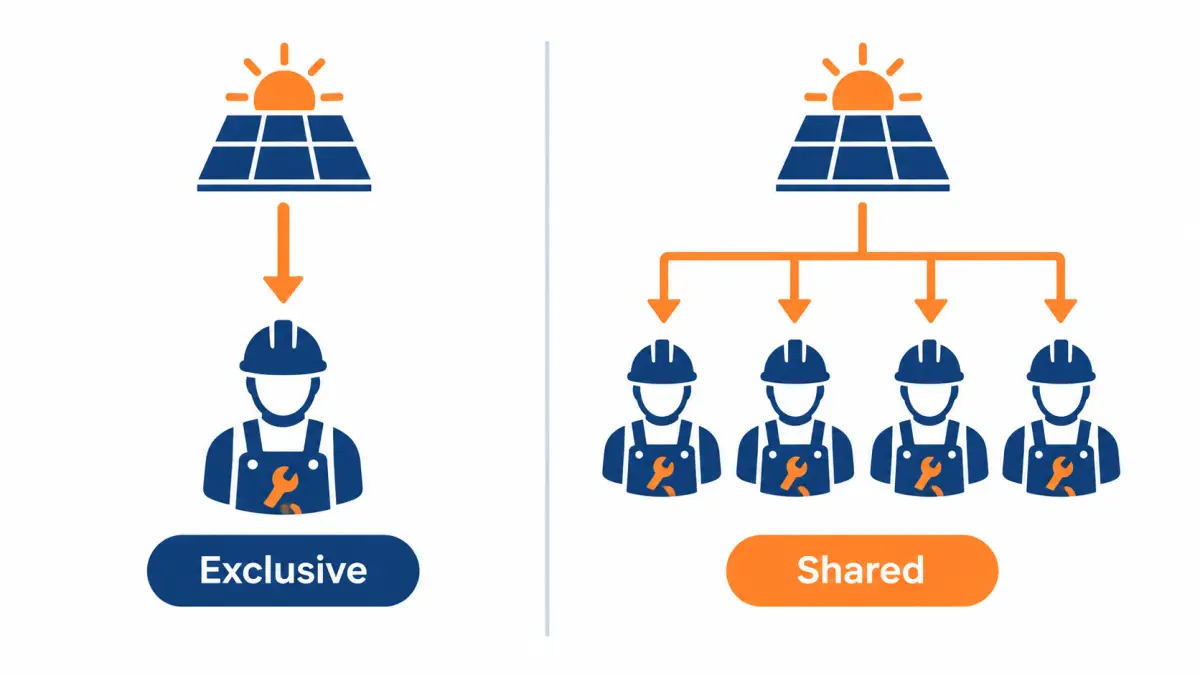
An exclusive solar lead is a solar inquiry sold to a single installer. No other company receives that person's contact details from the lead seller, either at the moment of delivery or later. The buyer is the only company calling, which removes the race against three or four competitors that defines shared leads.
Definition. An exclusive solar lead is a consumer or business solar inquiry delivered to exactly one installer, with a written rule that the seller will not sell it to anyone else. It differs from a shared lead, which the seller delivers to several installers at once.
Our own rule is written into our terms and reads exactly like this: "Each exclusive lead is sold to one company. It is never resold, recycled or sold later as an aged lead." That last clause matters more than most buyers realize, and the section on enforcement below explains why.
One definition, one buyer
The word "exclusive" is used loosely in this industry. Some sellers mean exclusive for a period (say, 24 hours, then the lead goes back on the market). Some mean exclusive within a ZIP code but not across the state. Some mean exclusive at the first sale, with the lead later bundled into an aged list. Before you compare prices across vendors, get each seller to answer the same three questions in writing:
- Is the lead delivered to any other company at the time of sale?
- Is the lead ever sold again, at any age, in any format, including aged lists?
- Is the lead ever re-marketed to other buyers under a different product name (for example "re-engaged" or "reactivated" leads)?
A lead is exclusive in the sense this page uses only when the answer to all three is no.
What exclusive is not
Exclusivity controls who else gets the contact. It does not, on its own, guarantee anything about the person on the other end. Specifically:
- Exclusivity does not guarantee intent. A homeowner who filled in a form out of curiosity is just as curious when only one installer calls.
- Exclusivity does not guarantee consent. Consent depends on how the form was built and what the disclosure said. That is a separate check, covered below.
- Exclusivity does not guarantee a sale. It removes competition from other lead buyers. It does not remove the homeowner's own hesitation, financing outcome, roof condition, or the installer down the street who knocked on their door last week.
What exclusivity does do is change the odds in your favor at the most fragile stage of the funnel: getting the first real conversation.
Sample lead card (labeled example)
The card below is an illustrative example of the fields an exclusive residential lead typically carries. It is a format sample, not a real person.
| Field | Example value (illustrative) |
|---|---|
| Name | Jordan Example |
| Phone | (555) 010-0000 |
| jordan@example.com | |
| Street address, city, ZIP | 100 Sample Ln, Anytown, 00000 |
| Homeowner (self-reported) | Yes |
| Average monthly electric bill (self-reported) | Range selected on form |
| Roof shade (self-reported) | Some shade |
| Timeline | Within 3 months |
| Utility | Name of local utility |
| Consent record | Certificate ID and timestamp |
| Delivered | Date and time, to one company |
For commercial programs the fields shift toward building type, role of the person submitting, and approximate monthly energy spend. See buy commercial solar leads for that version.
How is lead exclusivity enforced?
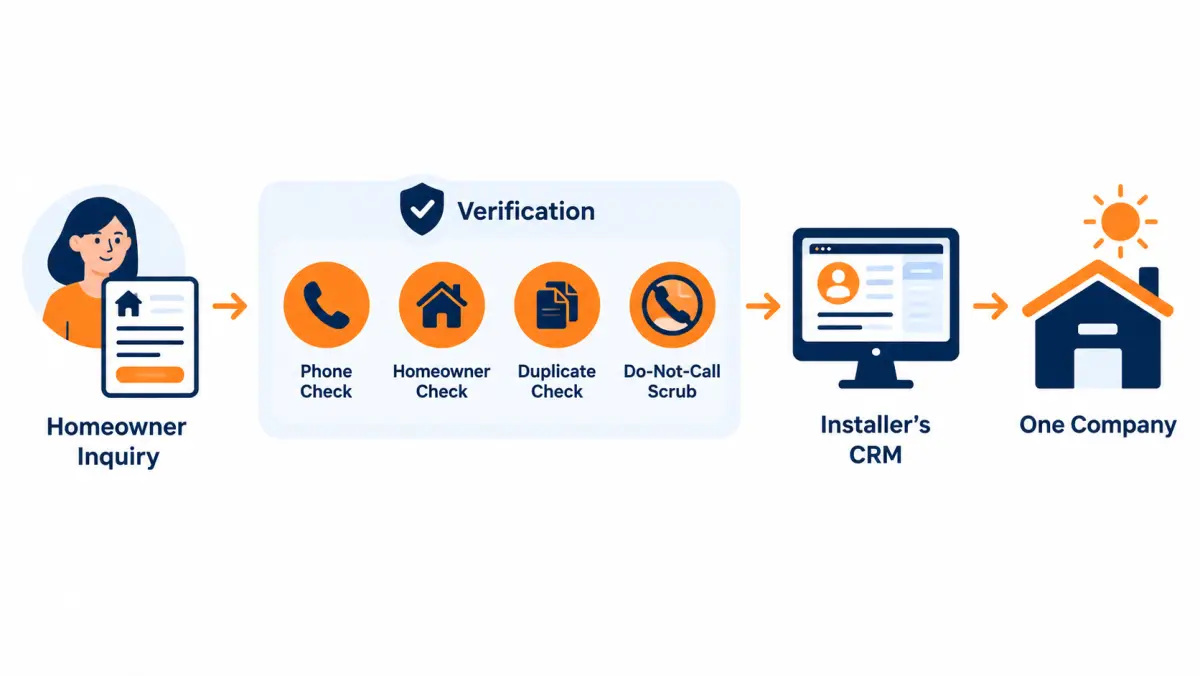
Exclusivity is enforced through routing rules that deliver each lead once, a written policy that the lead is never resold or recycled into aged inventory, and records (timestamps and consent certificates naming your company) that let you audit it. A seller who cannot explain all three is offering a marketing word, not a policy.
Single-delivery routing
In a typical lead system, a submitted form becomes a record. The record is matched against buyer filters (territory, homeowner status, bill range, and so on). In a shared model the system sends the record to every buyer whose filters match, up to a cap. In an exclusive model the system picks one buyer and closes the record to further delivery.
Questions worth asking any vendor about routing:
- When two buyers have overlapping territory and filters, how is the one buyer chosen? (Rotation, bid, priority, capacity.)
- Is the record locked after delivery, or is exclusivity enforced only by policy?
- Can you see the delivery timestamp in your own CRM, and does it match the certificate timestamp?
Exact routing mechanics differ by system, and ours are walked through on the call.
Resale and re-marketing rules
The most common gap in "exclusive" offers is the afterlife of the lead. A lead that was exclusive on day one and sold as part of a 90-day aged list on day ninety is exclusive only in a narrow sense. The homeowner experiences it as being called by companies they never asked to hear from, and the original buyer may find a competitor working the same household three months later.
Our written rule closes that gap: an exclusive lead is never resold, recycled, or sold later as an aged lead. If you are comparing vendors, ask for their resale rule in writing and check whether it appears in the contract or terms, not just in a sales deck.
How you can verify exclusivity yourself
You cannot see inside a vendor's database, but you can look for signals that would show up if leads were being shared:
- Ask the homeowner. On first contact, a light question such as "Have any other solar companies reached out since you filled in the form?" will surface sharing fast. Track the answer in a CRM field for the first 50 to 100 leads of a test.
- Check the consent record. Each of our leads carries a timestamped consent record whose disclosure names your company. A disclosure that lists several installers, or a generic "partners" list, is a sign the form was built to share.
- Compare timestamps. The time on the certificate, the time of delivery to your CRM, and the time of your first dial should line up in a believable sequence.
- Audit a sample. Pick ten leads a month at random and request the full consent record for each. We send it on request.
What happens if a lead is found to be shared
If a homeowner tells your rep that another company called about the same inquiry, log it with the lead ID and the date. Report it the same way you would report any other lead issue: reply to the lead notification or email us with the reason. Patterns matter more than single reports, since homeowners often confuse a solar inquiry with door knockers, mailers, or a utility program. A pattern of reports from one source is something a seller should investigate and explain.
Exclusive vs shared leads: which costs less per sale?
Exclusive leads cost more per lead but often cost less per sale, because one installer gets the first conversation without a race. Shared leads are cheaper per lead, but each one is split among several buyers, which lowers contact and close rates. The only fair comparison is cost per closed job in your own numbers.
The competition math
When a lead is shared with several installers, every buyer is calling the same homeowner, usually within minutes. The homeowner answers one or two calls, gets frustrated, and stops picking up. Even the installer who reaches them is competing on price from the first sentence. That pressure shows up in three places:
- Contact rate. Fewer of your dials connect, because the homeowner has already talked to someone or has started ignoring unknown numbers.
- Appointment rate. Those you do reach are comparing quotes, so fewer agree to a full consultation.
- Close rate. Those who do sit are more likely to have several bids in hand.
The price per lead tells you none of this. Two leads at different prices can produce the same cost per sale, or the cheaper one can produce a far higher cost per sale.
You will see published claims comparing close rates on exclusive and shared leads. We do not repeat those numbers here, because the ones we found are vendor-reported and unsourced. The method below lets you test it with your own data.
Worked example with adjustable inputs
The figures below are an illustrative example, not our prices and not market data. Swap in your own numbers, or use the cost calculator to run them.
The formula:
Cost per sale = price per lead ÷ (contact rate × appointment rate × sit rate × close rate)
| Input (illustrative) | Shared lead | Exclusive lead |
|---|---|---|
| Price per lead | $40 | $120 |
| Contact rate | 40% | 65% |
| Appointment rate (of contacts) | 25% | 40% |
| Sit rate (of appointments) | 60% | 70% |
| Close rate (of sits) | 15% | 25% |
| Leads per sale | 1 ÷ (0.40 × 0.25 × 0.60 × 0.15) = 111 | 1 ÷ (0.65 × 0.40 × 0.70 × 0.25) = 22 |
| Lead cost per sale | about $4,440 | about $2,640 |
In this example the exclusive lead costs three times as much per lead and still comes out roughly 40% cheaper per sale. Change the inputs and the answer can flip. If your shared-lead contact rate is unusually strong, or your exclusive close rate is no better than shared, shared can win. That is the point of measuring.
Two things the table leaves out, which you should add for your own business:
- Labor. 111 leads per sale means many more dials, texts and voicemails than 22 leads per sale. Put a cost on setter or rep hours per lead and add it.
- Discounting. A homeowner holding four bids often pushes price down. Lower revenue per job raises your effective acquisition cost as a share of margin.
Where to go deeper
For the full side-by-side, read shared vs exclusive leads. For a model of your own pipeline with these stages, open the cost calculator.
Adding labor to the example
Here is the same illustrative example with a labor line. Assume (illustratively) that working a lead to the point of a disposition takes 20 minutes of rep or setter time across all attempts, and that time costs $30 an hour loaded.
| Line (illustrative) | Shared | Exclusive |
|---|---|---|
| Leads per sale | 111 | 22 |
| Labor per lead (20 min at $30/hr) | $10 | $10 |
| Labor per sale | about $1,110 | about $220 |
| Lead cost per sale | about $4,440 | about $2,640 |
| Total acquisition cost per sale | about $5,550 | about $2,860 |
The gap widens once labor is counted, because every lead costs roughly the same to work regardless of what you paid for it. That is easy to miss when the only number on the invoice is price per lead.
What does an exclusive solar lead include?
An exclusive solar lead includes the contact's name, phone, email and address, self-reported answers to qualifying questions such as homeownership, electric bill range and timeline, a timestamped consent record naming your company, and a delivery timestamp. Before delivery, the phone is validated, the record is duplicate-checked and scrubbed against the National Do Not Call Registry.
Fields
The standard residential field set is shown in the sample card above. The fields fall into four groups:
| Group | Fields | Why it matters to your rep |
|---|---|---|
| Contact | Name, phone, email, address | Enables first call, text and email within minutes |
| Property | Homeowner (self-reported, checked against property records), property type | Filters out renters and properties you cannot install on |
| Energy and intent | Bill range, timeline, shade, reason for interest | Lets the rep open with relevant questions instead of a script |
| Proof | Consent certificate ID, timestamp, delivery time | Lets you show how and when the person asked to be contacted |
Fields can be adjusted by program. If your team never sells to properties with heavy shade, that becomes a filter rather than a field.
What is checked before delivery
These are the checks we run on every residential lead before it reaches you, copied from our terms:
- Phone number validated before delivery
- Homeowner status self-reported, then checked against property records
- Duplicate-checked against leads already sent to you
- Scrubbed against the National Do Not Call Registry
Note what the list does not say. It does not say income was verified, credit was pulled, or the roof was inspected. Self-reported answers are what the homeowner told the form. Treat them as a starting point for your rep's discovery, not as a site survey.
Qualification and disqualification
Most of the value of an exclusive program comes from agreeing filters up front. Typical filters and the trade-offs:
| Filter | Tighter filter means | Looser filter means |
|---|---|---|
| Territory (ZIPs, counties) | Shorter drive times, fewer leads | More leads, more travel |
| Homeowner only | Fewer wasted calls | n/a (renters are rarely useful for residential) |
| Minimum bill range | Higher system size potential, fewer leads | More leads, more small systems |
| Property type (single family only) | Simpler installs | Adds townhomes, manufactured homes where you can serve them |
| Timeline | More ready buyers, fewer leads | More nurture work |
| Shade | Fewer site-fail surprises | More leads, more disqualifications at survey |
Every filter you add raises the price per lead or lowers the volume, or both. Add filters that remove leads you would never sell, and leave the rest to your reps.
Real-time delivery
Our leads are delivered in real time to your CRM, dialer, email, or SMS. "Real time" means the record is sent as soon as it passes the pre-delivery checks, so your rep can call while the homeowner still remembers filling in the form. Common setups:
- CRM webhook or API post into Salesforce, HubSpot, a solar CRM, or a custom endpoint.
- Dialer push so the lead lands in a calling queue with priority.
- Email and SMS alerts to the assigned rep, for smaller teams without a dialer.
Ask for a test record during onboarding and check that every field maps correctly before the first live lead arrives. A lead that lands in the wrong pipeline stage is a lead that gets called tomorrow.
How much do exclusive solar leads cost?
Exclusive solar lead prices depend on market, filters, volume and exclusivity terms. ActiveProspect's July 2026 roundup cites Enervio at $100 to $250 for exclusive marketplace leads, against $25 to $100 for shared. Our own pricing is quoted by ZIP code on your call; we do not publish a flat rate because territory changes it.
What drives the price
The factors that move the price of an exclusive lead, roughly in order of impact:
- Market. States and metros with high installer competition and high advertising costs produce more expensive leads. A ZIP in a crowded coastal market costs more to generate than one in a quieter inland market.
- Filters. Every qualifying requirement narrows the pool of people who qualify. Homeowner-only, single-family-only and a minimum bill range each push the price up.
- Volume and cadence. Steady, predictable weekly volume is easier to fulfil than spiky demand. Very small or very large orders can both change the per-lead rate.
- Format. A real-time web lead, a live transfer and a booked appointment involve different amounts of work and are priced differently.
- Exclusivity terms. True one-buyer, never-resold leads cost more to produce than leads that recover cost through later resale.
Reported market ranges, dated and attributed
The table below lists third-party ranges we could find with a named source and date. These are vendor-reported benchmarks, not our prices.
| Lead type | Reported range (USD per lead) | Source | As of |
|---|---|---|---|
| Shared marketplace lead | $25 to $100 | Enervio, as cited by ActiveProspect | July 2026 |
| Exclusive marketplace lead | $100 to $250 | Enervio, as cited by ActiveProspect | July 2026 |
| Real-time lead | $40 to $120 | The Leads Warehouse, as cited by ActiveProspect | July 2026 |
| Booked appointment | $150 to $500 | Enervio, as cited by ActiveProspect | July 2026 |
ActiveProspect describes its figures as directional benchmarks, not fixed rates. For a fuller breakdown of solar lead prices by type and state, see the cost guide.
Volume and territory terms
We do not lock you into long-term contracts. You start with a test batch and scale when the numbers work. Volume in a given territory is limited by how many qualified people in that area ask for solar quotes. If your territory is small, the realistic volume may be modest, and that is better learned on the call than after a deposit. Territory availability is confirmed by ZIP code on your call.
How should you design an exclusive lead territory?
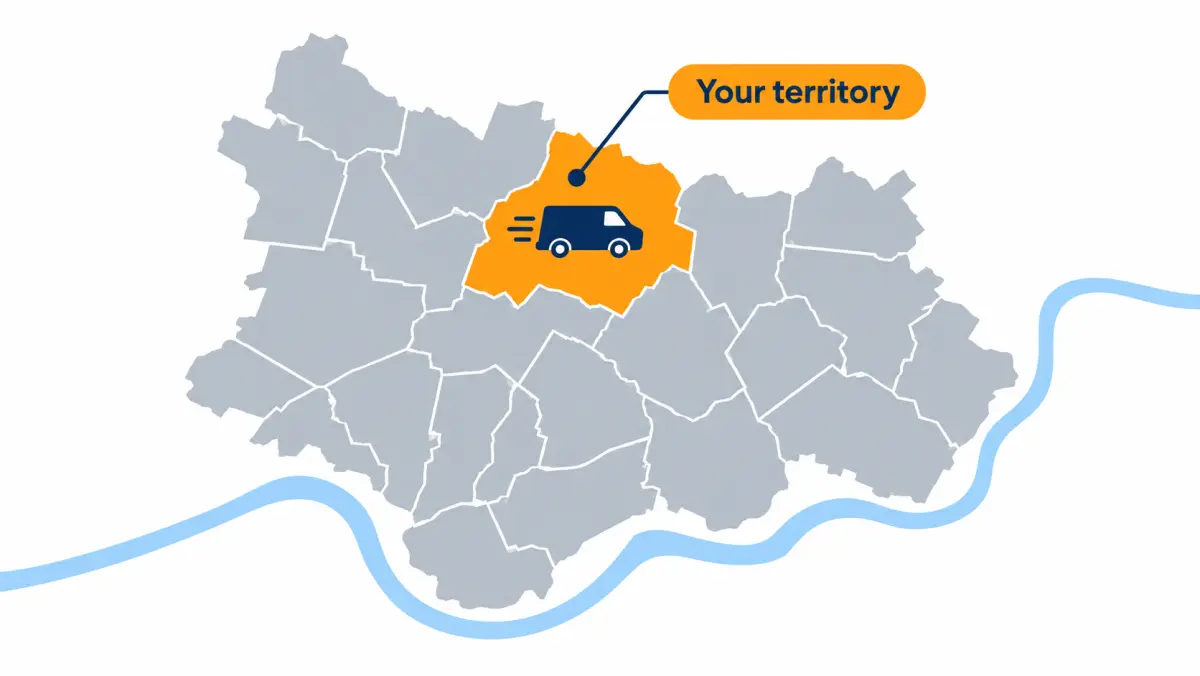
Design an exclusive territory around where your crews can install profitably, not around where you wish you had sales. Start with ZIP codes inside a drive radius you can survey and install within, expand to whole counties once volume is proven, and avoid overlapping with ZIPs where your own paid ads already generate inquiries.
ZIP, county or state
| Territory unit | Best for | Watch out for |
|---|---|---|
| ZIP code list | Small installers with a tight service area | Too few ZIPs can starve volume |
| County | Regional installers with one or two crews | Large rural counties can hide long drives |
| Radius from address | Single-office installers | Radius lines can cut across utility territories |
| State | Multi-crew or multi-office installers | Mixed utility rules and permitting inside one state |
A useful rule: list the ZIPs where your last 20 installs happened, then add neighbours where your drive time and permitting are similar. That gives you a territory you know you can deliver in.
Utility territory matters
Net metering rules, interconnection timelines and rates are set at the utility and state level. Two neighbouring ZIPs served by different utilities can have quite different savings stories. If your team sells best in one utility's area, filter for it. The U.S. Department of Energy's solar homeowner guide is a fair neutral explainer to send homeowners who ask how utility rules affect them.
Avoiding overlap with your own marketing
If you already run Google or Meta ads, door-to-door campaigns or referral programs, some of your territory will produce inquiries on its own. Buying exclusive leads in the same ZIPs can mean paying for a homeowner who would have found you anyway, or two of your own reps calling the same household. Practical steps:
- Share your existing customer and open-lead list for suppression, if the vendor supports it. Our duplicate check covers leads we have already sent you.
- Tag every lead source in your CRM so you can see which ZIPs are already well covered.
- Start purchased leads in ZIPs where your own marketing is thin.
Do exclusive solar leads come with consent proof?
Yes. Every lead we deliver carries a timestamped consent record (a certificate) whose disclosure names your company, and we send it to you on request. That record is the evidence of how and when the person asked to be contacted. Whether it is sufficient for the calls and texts you plan is a question for your own counsel.
What consent record accompanies each lead
A consent record typically captures the page the person saw, the disclosure language, the checkbox or button they used, the timestamp, and identifiers for the session. The point is to show that this person, at this time, agreed to be contacted by this company about solar. Because our disclosure names your company, not a list of unnamed partners, the record supports one-to-one contact in practice.
TCPA basics
The Telephone Consumer Protection Act (TCPA) and the FCC's rules restrict autodialed and prerecorded calls and texts to mobile numbers without prior express consent, and prior express written consent for telemarketing. The Do Not Call rules restrict telemarketing calls to numbers on the National Do Not Call Registry. The FCC's consumer guide to unwanted calls and texts summarizes the rules, and the FTC explains the Telemarketing Sales Rule for businesses.
One change buyers often ask about: the FCC's one-to-one consent rule, which would have required consent to name a single seller, was vacated by the Eleventh Circuit on January 24, 2025. That ruling removed a federal requirement. It did not make shared-consent forms risk free, and several states have their own telemarketing laws. A disclosure that names your company remains the cleaner record. This is general information, not legal advice; confirm your calling and texting practices with counsel.
For more detail, read our TCPA compliance page and the guide to calling purchased solar leads.
What is the replacement policy for invalid leads?
We issue replacement credits for leads with disconnected numbers, wrong contact details, or leads outside your agreed filters, if reported within 7 days. Credits do not cover a prospect who isn't interested, doesn't answer, doesn't get financing approved, or doesn't buy. Approved credits apply to your next batch.
Definition of invalid
| Covered (credit eligible) | Not covered |
|---|---|
| Disconnected or non-working phone number | Prospect not interested |
| Wrong contact details (the person reached did not submit the inquiry) | Prospect does not answer |
| Lead outside your filters (for example outside your ZIPs, or a renter on a homeowner-only program) | Financing not approved |
| Prospect does not buy |
This line is drawn on purpose. Things the seller controls (data accuracy, filter match) are covered. Things that are part of selling (reaching people, persuading them, financing) are not. A vendor who promises to replace any lead that does not close is either pricing that in or will find reasons to decline claims.
Window and process
- Window: 7 days from delivery.
- How: Reply to the lead notification, or email us, with the reason.
- Outcome: Approved credits apply to your next batch.
Tips for clean claims: note the dial time and result in your CRM, keep the carrier message for disconnected numbers, and for "wrong person" claims record what the person said. Clean notes make approvals quick.

How should you work exclusive solar leads?
Work exclusive leads fast and persistently: call within minutes of delivery, follow with a text and email, and keep a structured cadence of attempts over about two weeks before parking the lead in nurture. Exclusivity removes competing lead buyers, but it does not stop the homeowner from losing interest, so speed still decides most first conversations.
Why exclusive leads still need speed
An exclusive lead gives you the field to yourself only among buyers from that seller. The homeowner may also be talking to a neighbour's installer, a door knocker, or a utility program. Interest also fades on its own. Someone who filled in a form at lunch is easier to reach that afternoon than next week. For the detailed rules, read how fast to call solar leads.
A contact cadence you can adapt
This is a sample cadence, not a rule. Adjust it to your team, and confirm with counsel that your texting and dialing setup fits your consent records and the rules in your states, including calling-hour limits.
| Day | Action |
|---|---|
| Day 0, within 5 minutes | Call. If no answer, leave a short voicemail and send a text naming your company and the form they filled in |
| Day 0, within 1 hour | Second call attempt; send email with your name, photo and a single question |
| Day 1 | Morning call; evening call |
| Day 2 | One call; text with a specific reason to talk (for example, how their utility bills solar credits) |
| Days 3 to 5 | One call per day at varied times |
| Day 7 | Call and email |
| Day 10 | Call; last text asking if they would like you to stop |
| Day 14 | Final call; move to long-term email nurture if no response |
Stop immediately if the person asks you to stop, and record it.
The first conversation
Your rep's first two minutes decide whether the lead becomes an appointment. A simple structure:
- Confirm and anchor. "Hi, it's Sam with [your company]. You asked about solar for your home on Elm Street earlier today, is now still OK?"
- Ask why now. "What got you looking?" The answer (rising bills, a new EV, a neighbour's install) tells you what to talk about.
- Confirm basics. Ownership, roof age, shade, rough bill. Fix anything the form got wrong.
- Set the next step. Offer two specific times for a consultation, in person or virtual.
Keep it short. The goal of the first call is an appointment, not a proposal.
Post-25D conversations
The federal Residential Clean Energy Credit (Section 25D) does not apply to systems placed in service after 2025, per the IRS credit page. Homeowners who read older articles may still expect a 30% credit on a cash or loan purchase. Reps should be ready to explain that change plainly and to talk about the options that remain in their market, such as lease or power purchase agreements where available, state and utility incentives, and bill savings. Every tax statement your team makes should end with: talk to your tax advisor about your situation.
Measure every stage
Exclusive leads earn their premium only if you can show it. Track, per source and per month:
- Leads received
- Contacted (two-way conversation)
- Appointments set
- Appointments sat
- Proposals delivered
- Closed jobs and revenue
With those six numbers you can calculate cost per sale and compare sources honestly. Without them, every vendor discussion is opinion.
How do exclusive leads compare with live transfers and appointments?
Exclusive real-time leads, live transfers and booked appointments all go to one installer, but they hand over the prospect at different stages. A lead hands you contact details, a live transfer hands you a screened homeowner already on the phone, and an appointment hands you a confirmed time on your closer's calendar. Each costs more as more of the work is done for you.
| Format | What you receive | Who does the first contact | Best fit | Main risk |
|---|---|---|---|---|
| Exclusive real-time lead | Contact details and form answers, in real time | Your team | Teams with setters or reps who call fast | Slow follow-up wastes the lead |
| Live transfer | A screened homeowner connected to your rep by phone | Screening agent, then your rep | Teams with closers who can take calls during set hours | Missed transfers when no one picks up |
| Booked appointment | A confirmed meeting time | The seller's setters | Teams with closers but no setters | No-shows; reschedules |
| Aged lead | Older inquiry, lower price | Your team | Nurture and reactivation programs | Low contact rates; consent age |
Many installers mix formats. A common pattern is exclusive leads for the in-house setter team and appointments for overflow closer capacity. Our appointment program has its own policy: if a confirmed appointment doesn't sit because the prospect no-shows or doesn't match your filters, report it within 7 days of the scheduled time and we replace it.
Are exclusive solar leads worth the premium for you?
Exclusive leads are usually worth the premium when your team can call within minutes, close at least as well as your competitors face to face, and your job margin is large enough to absorb a higher lead cost. They are rarely worth it for teams that call the next day, or that only want cheap volume for a setter floor.
A decision test by team size and close rate
Answer these honestly:
- Can someone on your team call a new lead within five minutes during business hours? If not, fix that first. Exclusive leads called late perform like shared leads.
- Do you know your current close rate on sat appointments? If not, measure it on your existing sources for a month.
- What is your gross margin per average job? The cost per sale you can tolerate depends on it.
- How many sat appointments can your closers handle per week? Buying more leads than your team can work raises cost per sale.
| Team profile | Usually a fit for exclusive? | Why |
|---|---|---|
| Owner-operator, 1 to 2 sellers | Yes, in small batches | One competitor-free call is worth more than ten raced ones when time is short |
| 3 to 10 reps with a setter | Yes | Setter can hit speed targets; reps focus on sits |
| Large setter floor, high dial capacity | Sometimes | Volume may matter more than exclusivity; mix with aged or shared |
| Commercial-only developer | Program-dependent | Use a commercial program built for C&I roles |
| Team that calls next day | No | Fix speed to lead first |
When shared or aged is enough
Shared leads can make sense when you have a fast, high-capacity dialing team that routinely wins races and you want volume at a lower entry price. Aged leads make sense for nurture and reactivation programs with patient, multi-channel follow-up and careful compliance. See aged lead lists for solar for that category and how it is worked. Neither is wrong; they suit different operations. What is wrong is buying any format without measuring cost per sale.
How do you start an exclusive lead pilot?
Start with a 30-minute strategy call: we confirm territory availability by ZIP, agree filters, set up real-time delivery to your CRM or dialer, and run a test batch. There is no long-term contract. You scale when your cost per sale on the test meets your target, and stop if it does not.
Pilot checklist
- Before the call. List target ZIPs or counties, your average job size, current close rate, and how fast your team can call.
- On the call. Confirm availability by ZIP, filters, delivery method, and pricing for your territory.
- Setup. Send a test record to your CRM. Check every field mapping and the alert to the assigned rep.
- Test batch. Work every lead with the same cadence. Log contact, appointment, sit and close stages.
- Review. After enough leads to see a pattern, compute cost per sale and compare against your other sources.
- Decide. Scale, adjust filters, or stop.
What to measure in the test
| Metric | How to compute | What it tells you |
|---|---|---|
| Speed to first dial | Median minutes from delivery to first call | Whether your process is the bottleneck |
| Contact rate | Contacts ÷ leads | Data quality and speed together |
| Appointment rate | Appointments ÷ contacts | Intent and rep skill |
| Sit rate | Sits ÷ appointments | Confirmation process |
| Close rate | Sales ÷ sits | Closer skill and lead fit |
| Cost per sale | Total lead spend ÷ sales | The number that decides scale |
| Replacement claims | Credits requested and approved | Data accuracy |
Ready to check your territory? Book a call. Pricing is confirmed by ZIP on your call.
How do exclusive solar leads work for different installer sizes?
Exclusive solar leads work differently depending on how many people answer the phone, how many closers you have, and how many installs your crews can absorb each month. A one-truck owner-operator buys a handful per week and calls each personally. A regional company with a setter floor buys steady daily volume and routes it by office. The product is the same; the operating plan around it is not.
The scenarios below are written so you can find your own shape and copy the parts that fit. Every dollar figure in this section is an illustrative example built to show the math. None of it is a quote, a market average or a result from a client. Plug your own numbers into the solar lead cost calculator to see your version.

Scenario 1: The owner-operator (one to two sellers)
Profile. The owner sells, does site surveys and often manages the crew. A second person may help with sales part-time. Installs run a few per month. The owner's time is the scarcest resource in the company.
Why exclusive fits. When the person calling is also the person climbing the roof, every call has to count. A shared lead that three other companies are also dialing costs the owner a call that may never connect, and if it does connect, the homeowner has already heard three pitches. An exclusive lead does not guarantee a sale, but it removes the race and lets the owner call between site visits without worrying that a faster call center has already booked the homeowner.
Operating plan.
- Small, predictable volume. Order a batch size the owner can personally call the same day. For many owner-operators that means a few leads per day at most, with delivery limited to working hours.
- Delivery by SMS and email, not only CRM. If the owner lives in a truck, the alert needs to hit the phone. Real-time delivery can go to your CRM, dialer, email or SMS, so set up the channel you will actually see.
- Hours caps. Ask for delivery windows that match when the owner can call. A lead delivered at 7:40 p.m. on a Friday to a person who is off until Monday has lost most of its value.
- One page of notes per lead. Owner-operators often skip the CRM. Keep at least a shared spreadsheet with contact attempts, outcome and next step, because without it you cannot calculate cost per sale.
Illustrative example. Suppose an owner-operator buys 40 exclusive leads in a month at an illustrative $120 each, spending $4,800. The owner reaches 24 of them, sets 10 appointments, sits 8 and closes 2. Cost per sale on leads alone is $4,800 ÷ 2 = $2,400. If gross margin on an average job is comfortably above that plus labor and overhead, the test passed. If the owner had closed one, cost per sale doubles to $4,800, and the question becomes whether follow-up or close skill is the issue before blaming lead quality.
Common mistakes at this size.
- Buying volume for a month you know is booked solid with installs. Pause delivery instead.
- Letting leads sit until evening. Owner-operators are busiest during the hours homeowners are easiest to reach. A part-time setter, even a family member with a script, can change the economics.
- Not asking homeowners whether other companies called. At this size, you have time to ask every one, and the answers are your best check on exclusivity.
Scenario 2: The growing team (three to ten reps, one setter)
Profile. The company has a dedicated setter or inside sales rep, several closers in the field, and enough install capacity to want steady weekly volume. The owner manages sales rather than selling every deal.
Why exclusive fits. This is the size where exclusive leads usually make the most sense. A setter can hit a sub-five-minute first dial during business hours, closers get calendars filled by someone else, and the owner can compare sources by cost per sale because the CRM is actually used.
Operating plan.
- Route every lead to the setter first. The setter owns first contact, qualification and booking. Closers own the sit.
- Daily caps by territory. If closers cover different counties, cap daily volume per county so one rep is not flooded while another waits.
- Round-robin with rules. Assign booked appointments by geography first, then by calendar availability. Avoid giving the best-looking leads to a favorite closer, because it distorts close-rate comparisons.
- Weekly source review. Every Monday, look at last week's leads, contacts, appointments, sits and closes by source. Ten minutes is enough.
Illustrative example. A seven-rep company buys 200 exclusive leads in a month at an illustrative $110 each, spending $22,000. The setter reaches 120, books 50, 38 sit and closers win 9. Lead cost per sale is about $2,444. Add the setter's monthly cost (say an illustrative $4,500) and cost per sale including setting labor rises to about $2,944. Compare that against the same calculation for every other source the company uses, including referrals (which have their own costs in referral fees and owner time) and paid ads.
Common mistakes at this size.
- Hiring a second closer before the setter is consistently hitting speed targets. The bottleneck is usually first contact.
- Letting closers set their own appointments from leads "when they have time." That turns exclusive leads into next-day leads.
- Reporting close rate on sits without reporting sit rate. A team can look like it closes well while losing a third of appointments to no-shows.

Scenario 3: The regional installer (multiple offices or states)
Profile. Several branch offices, a central call center or setter team, and a marketing manager who buys from more than one source. The company may operate in states with very different utility rates and permitting timelines.
Why exclusive fits, with conditions. Exclusive leads work well for regional installers when territory is managed carefully. The risk at this size is internal: two branch offices claiming the same county, marketing campaigns that overlap with purchased lead territories, and centralized setters who do not know local context.
Operating plan.
- One territory map, owned by one person. Every ZIP or county assigned to a branch, written down, and shared with every lead vendor. Changes go through one person.
- Separate delivery endpoints per branch. Each branch gets its own CRM queue or tag so performance can be compared branch by branch.
- State-specific scripts. Rates, net metering rules and incentives differ by state and utility. A central setter needs a short local brief for each market. See solar lead cost by state for why price and demand differ across markets.
- Monthly vendor scorecard. Compare vendors on cost per sale by state, replacement claims, and speed-to-first-dial (which is your team's metric, but it changes how leads perform).
Illustrative example. A regional installer runs exclusive leads in two states. In State A, a sale costs an illustrative $2,100 in lead spend; in State B, $3,600. The gut reaction is to cut State B. Before doing that, check: is State B's average job larger? Is the State B branch slower to first dial? Is the State B closer newer? Often the fix is operational, and the expensive market is the one with the most room to improve.
Common mistakes at this size.
- Buying the same ZIP codes from two vendors under exclusive terms. Each vendor may honor its own exclusivity, but you are now competing with yourself for the same homeowners' attention, and you lose the ability to attribute results.
- Treating a central call center's results as one number. Break it out by state and by setter.
Scenario 4: The high-volume setter floor
Profile. A large dialing team with power or predictive dialers, dozens of setters, and a business model built on volume. Often paired with a big field closer network or a dealer program.
Where exclusive fits. Exclusive leads can be a premium tier inside a high-volume operation. Many floors run a mix: exclusive real-time leads go to the fastest, best setters, while aged or shared leads go to newer setters for practice and volume. The important rule is to report each tier separately so the premium tier's cost per sale is visible on its own.
Operating plan.
- Tiered routing. Exclusive real-time leads to a dedicated pod with the shortest speed-to-dial.
- Dialer compliance settings reviewed by counsel. Volume operations face the highest exposure under the TCPA and state telemarketing laws. Confirm with counsel how you dial, text, and honor revocation. Our TCPA compliance overview explains what records we provide.
- Separate budgets. Do not let a cheap tier subsidize the premium tier's numbers, or vice versa.
Common mistakes at this size.
- Dumping exclusive leads into the same dialer campaign as aged lists, so the exclusive lead gets called at the same pace as a two-year-old record.
- Measuring setters on dials rather than on sits. Volume floors drift toward activity metrics; exclusive leads pay off on outcome metrics.
Scenario 5: The commercial or C&I developer
Profile. The company sells to business owners, facility managers and property owners. Sales cycles run months, not days. Decisions involve multiple people, financing structures and site engineering.
Where exclusive fits. Exclusivity matters even more in commercial work, because a commercial prospect who hears from four developers in a week will often stall or run a formal bid. But the product needs to be built for commercial roles and qualification. Our commercial solar leads page covers how commercial programs differ: who fills out the form, what qualification looks like, and why the first conversation is about the building and the bill rather than the roof alone.
Operating plan.
- Longer follow-up cadence. Commercial leads need structured follow-up for weeks or months.
- Different qualification. Decision-maker role, ownership vs. lease, building type, bill size, and timeline.
- Different success metric. Measure qualified site assessments and proposals, not only closes within the month.
Quick comparison of the five scenarios
| Scenario | Typical first-contact owner | Delivery channel to prioritize | Biggest risk | First metric to watch |
|---|---|---|---|---|
| Owner-operator | Owner | SMS and email | Calling late | Speed to first dial |
| Growing team | Setter | CRM plus rep alert | Closers self-setting | Sit rate |
| Regional installer | Central setters | Branch CRM queues | Territory overlap | Cost per sale by branch |
| Setter floor | Dedicated pod | Dialer with priority queue | Mixing with aged lists | Sits per setter hour |
| Commercial developer | Business development rep | CRM with task cadence | Short follow-up | Qualified assessments |
How do you set up your CRM and routing for exclusive leads?
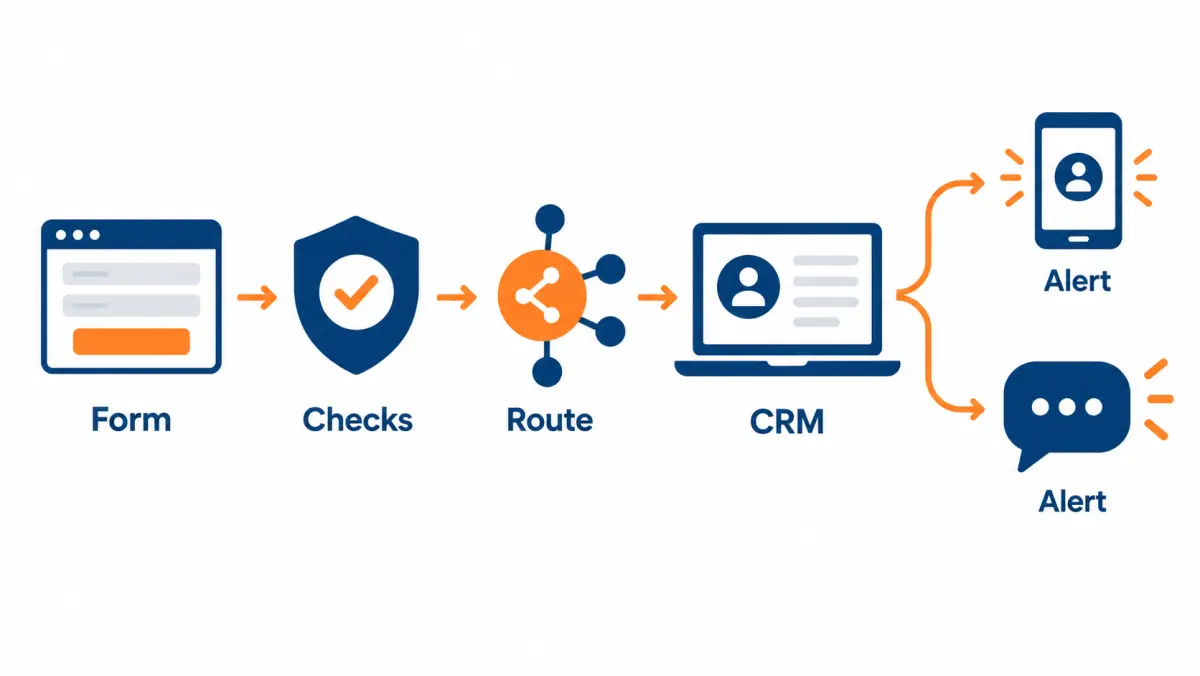
To set up a CRM for exclusive leads, create a dedicated lead source, map every delivered field to a CRM field, trigger an instant alert to the person who calls first, and build a stage pipeline that tracks contact, appointment, sit and close. Test with a sample record before the first live lead arrives. Most lost value happens in the first hour, inside your own systems.
Step 1: Create a lead source you can report on
Give the vendor's leads their own source value in your CRM, for example "Exclusive – Vendor name – Residential." If you buy different programs (residential, commercial, appointments), give each its own source. Every report you will want later depends on this one field being consistent.
Step 2: Map the fields
Ask your vendor for the field list and a sample payload. Then map each one:
| Delivered field | Typical CRM field | Notes |
|---|---|---|
| First name, last name | Contact name | Watch for all-caps or lowercase entries; normalize if your CRM supports it |
| Phone | Mobile phone | Store in a consistent format so your dialer and duplicate check work |
| Optional for first contact but useful for confirmations | ||
| Street address, city, state, ZIP | Property address | Needed for satellite roof checks before the call |
| Homeowner (yes/no) | Custom field | Use as a filter, not just a note |
| Average electric bill | Custom field | Helps the setter frame the first conversation |
| Roof shade, roof age (if collected) | Custom fields | Use for prioritization, not disqualification by itself |
| Consent record ID or link | Custom field | Store so you can produce it later if asked |
| Timestamp of inquiry | Custom field | Compare with your first-dial time to measure speed |
| Lead ID | External ID | Use in replacement requests |
Step 3: Alert the person who calls first
Real-time delivery is wasted if the alert lands in a shared inbox nobody watches. Set up:
- A push or SMS alert to the setter or rep on duty.
- A fallback alert to a second person if the lead has not been dialed within a set number of minutes.
- A visible queue on a screen in the sales room, if you have one.
Step 4: Build the pipeline stages
Use stages that map to the metrics in this guide: New, Attempted, Contacted, Appointment set, Appointment sat, Proposal delivered, Won, Lost (with reason). Keep "Lost" reasons short and fixed, such as "not homeowner," "wrong number," "not interested," "financing," "shade/roof," "chose competitor," "no response." Free-text reasons are impossible to report on.
Step 5: Add a replacement-request flag
Create a checkbox or stage for "Replacement requested" plus a date. Our replacement policy covers disconnected numbers, wrong contact details, or leads outside your filters, reported within 7 days. A flag in your CRM makes it easy to stay inside the window and to see your claim rate by source.
Step 6: Test before go-live
Send a test record end to end. Confirm the record lands with the right source, every field fills, the alert fires on the right phone, and the record shows in the right pipeline. Then have a teammate pretend to be the homeowner and walk through the first-call script with the real record on screen.
Routing rules that protect exclusive value
- First dial within five minutes in business hours. Write it down as a team rule and report on it weekly.
- After-hours plan. Decide what happens to leads that arrive after hours: an automated text acknowledging the inquiry (confirm the content and consent basis with counsel), then a first call at opening time, ahead of everything else in the queue.
- No cherry-picking. Every lead gets the same cadence. Reps who skip "weak-looking" leads distort the data and often skip buyers.
- Ownership timer. If the assigned rep has not reached the lead within a set time, reassign it.
Speed-to-lead and why it still matters
Exclusive leads remove other installers from the race, but they do not remove the homeowner's attention span. A homeowner who filled out a form is thinking about solar now. Two hours later they are making dinner. The detailed follow-up rules, including cadences by hour and day, are in our solar speed to lead guide; the short version is to call fast, call again, and use every channel your consent record and counsel support.
What should your first-call script for an exclusive lead sound like?
A first-call script for an exclusive solar lead should confirm the homeowner's request, thank them, verify they own the home, ask three or four questions about the bill and roof, and book a specific time for a consultation. It should sound like a reply to their inquiry, because it is. Skip the hard pitch; the job of the first call is a sat appointment.
The script below is a starting template. Edit it to match your company, your state's rules and your counsel's guidance on disclosures. Do not read it word for word; reps who sound like they are reading lose the homeowner in the first ten seconds.
Opening (first 20 seconds)
"Hi, is this [first name]? This is [rep name] with [company]. You asked about solar for your home on [street name] a little earlier today. I'm calling to follow up on that. Is now an OK time for two or three minutes?"
Why this works:
- It names the street, which tells the homeowner you have their actual request in front of you.
- It references "a little earlier today," which is only true if you call fast.
- It asks permission, which lowers defensiveness.
If they say it is not a good time: "No problem. Is later this afternoon or tomorrow morning better?" Book the callback time and send a short confirmation text if your consent and counsel support it.
Confirming the request
"Just so I have it right, you're looking at solar for the house you own at [address], is that correct?"
If they rent, end politely. If they say they did not request anything, see the troubleshooting section below. That answer matters for your exclusivity and consent records.
Discovery (two to four minutes)
Ask, and listen:
- "What got you looking at solar right now?" (Bills, a new EV, roof replacement, outages, a neighbor's system.)
- "Roughly what does your electric bill run in summer and winter?"
- "Do you know about how old your roof is? Any plans to replace it soon?"
- "Is anyone else involved in a decision like this, a spouse or partner?"
- "Have any other solar companies reached out to you about this request?" (Your exclusivity check. Log the answer.)
Booking
"Here's what I'd suggest. We'll take a look at your roof on satellite before we meet, and then [closer name] can sit down with you and [partner name] for about an hour to go through what a system would look like and what it would cost. Does [day] at [time] or [day] at [time] work better?"
Offer two specific times. Confirm both decision-makers will attend. Confirm the address and the best number. Tell them what to have ready: a recent electric bill or online account access.
Post-25D framing
As of October 2026, the federal residential clean energy credit under Section 25D is not available for systems placed in service after 2025. Some homeowners still expect it because older articles and ads mention it. Do not promise tax credits. If asked, say something like:
"The federal homeowner credit that a lot of articles mention ended for systems placed in service after 2025. We'll show you the numbers without it, and if there are any state or utility programs in your area, we'll include those. For anything tax-specific, your tax professional is the right person to confirm."
The IRS maintains the official Residential Clean Energy Credit page. For how this changes buyer conversations and lead mix, see solar leads after 25D.
Voicemail script
"Hi [first name], this is [rep name] with [company], following up on the solar request for your home on [street]. I'll try you again shortly, or you can reach me at [number]. Thanks."
Keep it under 20 seconds. Say the number twice if your team prefers.
Text message template (only where your consent record and counsel support it)
"Hi [first name], this is [rep name] with [company] about the solar request for your home on [street]. Is now a good time for a quick call, or is later today better? Reply STOP to opt out."
Objection handling for exclusive leads
| What the homeowner says | What it often means | A response that keeps the door open |
|---|---|---|
| "I was just looking." | Early stage, not ready to buy this week | "That's what most people say at first. The consult is just numbers for your house so you can decide later. No decision needed that day." |
| "How much does it cost?" | Wants a sense of scale before committing time | "It depends on your roof and usage, which is exactly what the consult answers. Most people want to see a real number for their house, not a range. Can we get that on the calendar?" |
| "I heard the tax credit is gone." | Doubts the economics | "The federal homeowner credit ended for systems placed in service after 2025. We'll show you the numbers without it, so you can judge on the real figures." |
| "Send me something by email." | Polite brush-off or genuine preference | "Happy to. So I send the right thing, can I ask two quick questions about your bill and roof?" Then try to book. |
| "I need to talk to my spouse." | Real second decision-maker | "Of course. Let's pick a time you're both home, so you only have to hear it once." |
| "Another company already called me." | Possible exclusivity issue, or the homeowner contacted others | "Thanks for telling me. Do you remember which company, and was it about this same request?" Log it for your exclusivity check. |

The appointment confirmation sequence
Sit rate is where a lot of exclusive-lead budget disappears. A simple confirmation sequence protects it:
- Right after booking. Confirmation text or email with date, time, closer's name, and what to have ready.
- The day before. A short reminder with an easy reschedule option.
- Two hours before. A final reminder, ideally from the closer by name.
- If no reply to reminders. A call from the setter to reconfirm, not to resell.
Track sit rate weekly. If it falls, look at the time between booking and appointment first. Appointments booked more than a few days out sit less often in many teams' experience, so offer the earliest slots first.
How do you troubleshoot problems with exclusive solar leads?
Most problems with exclusive solar leads fall into five groups: the lead cannot be reached, the lead does not remember asking, the lead does not fit your filters, the lead says other companies called, or the numbers look fine but sales lag. Each has a different cause and a different fix, and only some are lead-quality issues.
Problem: "We can't reach anyone."
Check your side first.
- What is your median speed to first dial? If it is over an hour, start there.
- How many attempts does each lead get, over how many days? One or two calls is not a cadence.
- Is your caller ID showing as spam? Many carriers label numbers that make high call volumes. Register your numbers with the carrier reputation programs your phone provider supports, and rotate numbers only in ways your counsel approves.
- Are you calling at the right times? Early evening and weekend mornings often reach working homeowners.
Then check the vendor side.
- Look at the specific leads. Are numbers disconnected or wrong? Those qualify for replacement credits if reported within 7 days.
- Is the rate of disconnected or wrong numbers rising? Raise it on a call with the vendor, with lead IDs.
Problem: "The homeowner doesn't remember filling anything out."
This happens with every lead source, including your own website. People fill out forms quickly, sometimes on a phone while doing something else, and forget. It can also point to a real issue.
What to do on the call. Remind them gently of the details: "It was a request about solar for the house on [street], about [time] today." Many people then remember. If they firmly say they did not request it, apologize, end the call, and mark the lead.
What to do afterward. Request the consent record for that lead. Check the timestamp, the disclosure and the page it came from. If the record does not support the inquiry, report it to the vendor with the lead ID. Track "doesn't remember" as a separate lost reason so you can see if it is a pattern or a scattering.
Problem: "The lead is outside my filters."
If you set filters (homeowner only, specific ZIPs, minimum bill, no mobile homes, for example) and receive a lead outside them, that is covered: replacement credits apply to leads outside your filters. Reply to the lead notification or email us with the reason; approved credits apply to your next batch.
If many leads are near the edge of your filters (for example, bills just below your cutoff), the issue may be the filter itself. Talk it through on a call; tight filters reduce volume and can raise price.
Problem: "The homeowner says three companies already called."
This is the most important complaint for an exclusive product, and it deserves a careful look, not an assumption.
- Ask which companies, and whether they called about this same request. Homeowners who shop for solar often fill out multiple forms on different sites. That is the homeowner's choice and not a breach of exclusivity by any one seller.
- Check the timing. Did the other calls come before or after your lead's timestamp? Calls before the timestamp came from a different inquiry.
- Look for a pattern. One homeowner who shopped around is normal. A pattern across many leads in a short time is worth a direct conversation with your vendor, with lead IDs and dates.
- Check your own marketing. If you also run ads or use another vendor in the same ZIPs, the "other company" may be your own second source.
Our written exclusivity rule is that each exclusive lead is sold to one company and is never resold, recycled or sold later as an aged lead. If you find evidence against that, raise it with lead IDs.
Problem: "Contact and appointment rates are fine, but we're not closing."
This one is almost always downstream of the lead.
- Sit rate first. Are appointments actually happening? If not, fix confirmation.
- Proposal quality. Are closers presenting post-25D numbers clearly? Homeowners who expected a credit and see a surprise can stall.
- Financing. How many deals are lost at financing? That is a lender and product question, not a lead question.
- Closer comparison. If one closer wins at twice the rate of another on the same source, it is a coaching issue.
- Price competitiveness. If you lose "to a competitor" often, check whether your pricing is in line with the market in that area.
Problem: "Volume is lower than we expected."
Exclusive volume depends on how many homeowners in your territory inquire, and on your filters. Narrow territory plus tight filters plus exclusive terms equals limited supply. Options include widening ZIPs, loosening a filter that does not predict sales well, or adding a different format such as live transfers or booked appointments. Volume and availability are confirmed by ZIP code on your call.
Troubleshooting summary table
| Symptom | Most likely cause | First fix | Replacement eligible? |
|---|---|---|---|
| Low contact rate | Slow first dial, short cadence, spam labeling | Measure speed; extend cadence | Only for disconnected or wrong numbers |
| "Didn't request" | Forgotten form, or bad source | Remind politely; pull consent record | Discuss with lead ID; depends on finding |
| Outside filters | Data or filter mismatch | Report within 7 days | Yes |
| "Others called" | Homeowner shopped around, or overlap | Ask which company and when; check pattern | Raise with evidence |
| Good appointments, low closes | Sit rate, proposal, financing, closer | Break down by stage and closer | No |
| Low volume | Narrow territory or filters | Widen ZIPs or adjust filters | No |
How do exclusive solar leads perform in different market types?
Exclusive solar leads perform differently in mature high-rate markets, newer or lower-rate markets, rural areas and dense suburbs. Utility rates, net metering rules, installer competition and homeowner awareness all shift contact rates, appointment rates and the price of a lead. Plan territory and budget by market type rather than assuming one statewide result.
This section describes market types in general terms. It does not rank states or quote prices, because those change quickly and depend on vendor and filter choices. For state-level price drivers, see solar lead cost by state. For public data on electricity prices by state, the U.S. Energy Information Administration publishes average retail electricity prices, which is a useful input when you size savings conversations.

Mature, high-rate markets
What they look like. Many installers, high homeowner awareness, many existing systems on neighborhood roofs, and electricity rates that make the savings conversation easy to start.
How exclusive leads behave. Demand from installers is high, so lead prices tend to be higher. Homeowners often know what solar is and may have had prior quotes. Exclusivity matters a great deal here, because shared leads in crowded markets mean a homeowner can receive several calls within minutes.
What to adjust.
- Expect more "I already have a quote" conversations. Train closers to compare proposals fairly rather than knock competitors.
- Expect net metering or rate structure changes to be a frequent topic. Keep a one-page local explainer for setters.
- Consider tighter ZIP targeting around your install base, where your reviews and yard signs help.
Newer or lower-rate markets
What they look like. Fewer installers, lower awareness, and electricity rates that make savings a harder conversation.
How exclusive leads behave. Lead prices can be lower because fewer buyers compete for them, but appointment and close rates may also be lower, because more education is needed. Exclusivity matters less for the race, since fewer competitors are calling, but still matters for consent and for not being lumped in with aggressive callers.
What to adjust.
- Lengthen the follow-up cadence. Homeowners take longer to decide.
- Lead with problems solar solves locally: outages, a planned EV, roof replacement timing, or rate increases, rather than abstract savings.
- Judge the test over a longer window before deciding.
Rural and exurban territories
What they look like. Large lots, longer drive times, more ground-mount interest, more well pumps and outbuildings, and often cooperative or municipal utilities with their own interconnection rules.
How exclusive leads behave. Volume per ZIP is low, so territories need to be wider. Drive time affects cost per sit; a closer who drives 90 minutes each way can sit fewer appointments per day.
What to adjust.
- Cluster appointments by geography. Book a "north county day."
- Qualify for ground-mount interest and utility type on the first call.
- Include drive time in your cost-per-sale math, not only lead spend.
Dense suburbs
What they look like. Many homeowners per ZIP, HOAs, tree cover that varies street by street, and many competing installers.
How exclusive leads behave. Volume is available in small territories. Shade and HOA rules cause more disqualifications after the satellite check.
What to adjust.
- Do a quick satellite roof check before the appointment, not after. Your vendor's filters can capture self-reported shade, but a look at the roof saves a wasted sit.
- Keep HOA guidance handy; many states limit HOA restrictions on solar, but the details vary. Confirm with counsel or a local permitting expert rather than giving homeowners legal advice.
Market type summary
| Market type | Lead price tendency | Contact and appointment pattern | Key adjustment |
|---|---|---|---|
| Mature, high-rate | Higher | Informed homeowners, more comparison shopping | Train fair proposal comparison |
| Newer, lower-rate | Lower | More education needed, slower decisions | Longer cadence and test window |
| Rural, exurban | Varies | Low volume per ZIP, long drives | Wider territory, geographic clustering |
| Dense suburb | Varies | High volume, more shade and HOA issues | Satellite check before sit |
"Tendency" here is a qualitative description, not a measured figure. Your vendor can tell you what volume and pricing look like for your ZIPs on a call.
What questions should you ask an exclusive solar lead vendor?
Ask an exclusive solar lead vendor for its resale rule in writing, how leads are generated, what is checked before delivery, what the consent record says and who it names, how replacements work, what the contract term is, and how territory is assigned. A vendor that answers each of these clearly and puts them in writing is easier to evaluate than one that answers with close-rate claims.
Our full vetting process, with red flags, is in how to vet a solar lead provider. The list below is specific to exclusive leads.
Exclusivity and resale
- "Is each exclusive lead sold to one company only?"
- "Is it ever sold again later, including in aged lists, after any period of time?"
- "Is it ever shared with a partner, a sister company or a call center that sells to installers?"
- "If a lead is returned or replaced, what happens to it? Is it resold?"
- "Will you put the exclusivity rule in the order form or terms?"
Our answers, in writing: each exclusive lead is sold to one company. It is never resold, recycled or sold later as an aged lead.
Lead generation
- "Where do these inquiries come from? Your own sites, partner sites, ads, or something else?"
- "Can I see the form a homeowner fills out, including the consent language?"
- "Do you buy leads from other generators and resell them?"
- "Are any incentives offered to homeowners for filling out the form?" (Incentivized leads can behave very differently.)
Checks before delivery
- "What exactly is checked before a lead reaches me?"
- "Is the phone number validated? How?"
- "Is homeowner status checked against anything beyond self-report?"
- "Do you check for duplicates against leads already sent to me?"
- "Do you scrub against the National Do Not Call Registry?"
Our checks, which we keep literally true: phone number validated before delivery; homeowner status self-reported, then checked against property records; duplicate-checked against leads already sent to you; scrubbed against the National Do Not Call Registry.
Consent records
- "Does each lead come with a consent record? What is in it?"
- "Does the disclosure name my company?"
- "How do I get the record for a specific lead, and how long do you keep it?"
Our answer: every lead carries a timestamped consent record (certificate) whose disclosure names your company. We send it to you on request.
Replacements
- "What qualifies for a replacement or credit?"
- "What does not qualify?"
- "How long do I have to report it, and how?"
- "Are credits applied as cash or as replacement leads?"
Our answers: replacement credits for disconnected numbers, wrong contact details, or leads outside your filters, within 7 days. Not covered: a prospect who isn't interested, doesn't answer, doesn't get financing approved, or doesn't buy. Reply to the lead notification (or email us) with the reason; approved credits apply to your next batch.
Contract, volume and territory
- "Is there a minimum term or minimum spend?"
- "Can I pause delivery when my install calendar is full?"
- "How is territory defined, and can it change?"
- "If two of your clients want the same ZIP, how is that handled?"
Our answers: no long-term contracts; start with a test batch and scale when the numbers work. Territory availability is confirmed by ZIP code on your call.
Questions that should make you cautious if the answer is vague
| Question | A clear answer looks like | A vague answer looks like |
|---|---|---|
| Is the lead resold later? | "No, never, and it's in our terms." | "Our leads are high quality." |
| Who does the consent name? | "Your company, by name, in the disclosure." | "We're fully compliant." |
| What's checked? | A specific list | "Every lead is verified." |
| What's replaced? | Specific reasons and a window | "We stand behind our leads." |
| What's the close rate? | "That depends on your team; here's how to measure it." | A specific number with no source |
A vendor quoting your future close rate is guessing. Close rate is mostly a function of your speed, your closers, your price and your market.
How should you read an exclusive lead agreement?
Read an exclusive lead agreement for five things: the exclusivity and resale language, the definition of a billable lead, the replacement terms and window, the term and cancellation rules, and how consent records are provided. Anything promised on a sales call that matters to you should appear in the written terms. This is a buyer's checklist, not legal advice; have counsel review contracts before you sign.
Clause-by-clause checklist
Exclusivity.
- Does it say the lead is sold to one buyer?
- Does it cover later resale, including aged lists, or only the initial sale?
- Does it cover affiliates, partners and related companies?
Billable lead definition.
- What makes a lead billable? Delivery, acceptance, or something else?
- Are leads outside your filters billable?
Replacement or credit terms.
- What reasons qualify?
- How many days do you have?
- How do you submit, and what evidence is needed?
- Is the credit applied to future leads or refunded?
Term and cancellation.
- Is there a minimum term or spend?
- How much notice to pause or stop?
- Are there auto-renewals?
Consent and compliance.
- Who is responsible for the consent capture?
- How do you obtain the record for a specific lead?
- How long are records retained?
- Does the contract address indemnification? (A counsel question.)
Territory.
- How is territory defined?
- Can the vendor sell exclusive leads in your territory to another buyer? (If territory is not exclusive but each lead is, you may share a ZIP with another installer while never sharing a lead. That can be fine; just know which one you are buying.)
Lead exclusivity versus territory exclusivity
These are two different promises, and they are easy to confuse.
| Term | What it means | What it does not mean |
|---|---|---|
| Lead exclusivity | Each individual lead goes to one buyer | No other installer buys leads in your ZIP |
| Territory exclusivity | Only one buyer receives leads in a defined area | Every lead is unique to you forever (that depends on the lead rule too) |
Our written rule is lead exclusivity: each exclusive lead is sold to one company and never resold. Territory availability is confirmed by ZIP code on your call; ask there if territory-level arrangements matter to you.
How do you budget for exclusive solar leads month by month?
Budget for exclusive solar leads by working backward from installs: decide how many jobs you want, estimate how many leads each job takes from your own funnel rates, multiply by the lead price for your territory, and add the labor to work them. Start with a small test month, then set the next month's budget from what the test actually produced.
Every number in this section is an illustrative example. Replace each with your own figures. The solar lead cost calculator runs the same math, and our solar lead ROI guide goes deeper on cost-per-sale formulas.
The backward budget formula
- Target installs per month from purchased leads (not total installs).
- Leads needed = target sales ÷ (contact rate × appointment rate × sit rate × close rate).
- Lead spend = leads needed × price per lead.
- Labor = setter hours plus closer hours attributable to these leads.
- Total acquisition cost = lead spend + labor + any software or dialer costs tied to the program.
- Cost per sale = total acquisition cost ÷ sales.
Worked example: building a budget from scratch (illustrative)
Assume an installer wants 6 sales per month from exclusive leads. Before testing, the team uses conservative planning rates:
| Funnel stage | Planning rate (illustrative) |
|---|---|
| Contact rate | 55% |
| Appointment rate (of contacts) | 40% |
| Sit rate (of appointments) | 75% |
| Close rate (of sits) | 25% |
Combined: 0.55 × 0.40 × 0.75 × 0.25 = 0.04125, or about 4.1 sales per 100 leads.
Leads needed for 6 sales: 6 ÷ 0.04125 ≈ 145 leads.
At an illustrative $115 per lead: 145 × $115 = $16,675 in lead spend.
Labor (illustrative): a setter at 0.75 of a full-time role for this program costing $3,400 per month, plus closer commission paid only on sales (excluded here because it scales with revenue, though you may choose to include it).
Total acquisition cost before commission: $16,675 + $3,400 = $20,075.
Cost per sale: $20,075 ÷ 6 ≈ $3,346.
The question is not whether $3,346 is "good." The question is whether it is lower than the margin left after equipment, install labor, permitting, overhead and commission on an average job, with enough room left for profit. If yes, the plan is viable. If no, either the funnel rates must improve, the price must be lower, or the lead program is not the right channel for this company yet.
Sensitivity: which rate moves cost per sale most?
Using the same illustrative baseline, change one rate at a time:
| Change (one at a time) | New sales per 100 leads | New cost per sale (illustrative) |
|---|---|---|
| Baseline | 4.13 | about $3,346 |
| Contact rate 55% → 65% (faster dialing) | 4.88 | about $2,840 |
| Appointment rate 40% → 45% (better script) | 4.64 | about $2,983 |
| Sit rate 75% → 85% (confirmation sequence) | 4.68 | about $2,961 |
| Close rate 25% → 30% (closer coaching) | 4.95 | about $2,797 |
| Lead price $115 → $95 (cheaper source, same rates) | 4.13 | about $2,872 |
To keep the comparison simple, each row holds lead count at 145 and labor at $3,400 and recalculates sales; the cost per sale shown is total cost ÷ new sales count. The pattern matters more than the exact figures: in this example, a modest improvement in contact rate or close rate saves about as much as negotiating the lead price down. Operational fixes are often cheaper to get than a price cut.
A three-month ramp (illustrative)
| Month | Goal | Volume decision | What to review at month end |
|---|---|---|---|
| Month 1: Test | Measure real funnel rates | Small batch your team can work completely | Speed to dial, contact, appointment, sit rates; early closes |
| Month 2: Adjust | Fix the weakest stage | Same or slightly higher volume | Did the fix move the rate? Closes from Month 1 leads that took longer |
| Month 3: Decide | Scale, hold, or stop | Scale only if cost per sale meets target | Cost per sale using Month 1–2 leads with matured outcomes |
Solar sales take time to close. Leads delivered late in a month may close the following month. Judge cost per sale on a lead cohort (all leads delivered in a given period) after enough time for most deals to resolve, rather than on calendar-month sales.
Cohort tracking template
| Cohort (delivery week) | Leads | Contacted | Appointments | Sat | Closed to date | Spend | Cost per sale to date |
|---|---|---|---|---|---|---|---|
| Week 1 | |||||||
| Week 2 | |||||||
| Week 3 | |||||||
| Week 4 |
Update "Closed to date" every week for at least two to three months after delivery. You will usually see cost per sale improve as late deals close.
Seasonal budgeting
Homeowner interest, installer capacity and weather all vary by season, and the pattern differs by region. Rather than assume a calendar, use your own history: which months did your install crews run at capacity, and which months had gaps? Buy more leads 30 to 90 days before the gaps (depending on your typical sale-to-install time), and pause or reduce delivery when the calendar is full. With no long-term contract, you can adjust volume as the numbers and the season change.
How do you calculate whether exclusive beats shared for your team?
To decide whether exclusive beats shared for your team, compare cost per sale, not price per lead. Run each format through the same funnel with your real contact, appointment, sit and close rates, include labor, and compare the result. Exclusive leads often cost more per lead and less per sale, but the outcome depends on your speed and close rate.
Our dedicated comparison, exclusive vs shared solar leads, covers the general case. This section works through a few specific team profiles so you can see where the answer flips.
Profile A: Fast setter team, average closers (illustrative)
| Input | Exclusive | Shared |
|---|---|---|
| Price per lead | $115 | $45 |
| Contact rate | 60% | 40% |
| Appointment rate | 40% | 30% |
| Sit rate | 78% | 70% |
| Close rate | 25% | 20% |
| Sales per 100 leads | 4.68 | 1.68 |
| Lead cost per sale | about $2,457 | about $2,679 |
Here exclusive wins narrowly on lead cost alone. Add labor (shared leads require far more dials per sale), and the gap widens.
Profile B: Very fast, high-capacity dialing floor (illustrative)
| Input | Exclusive | Shared |
|---|---|---|
| Price per lead | $115 | $45 |
| Contact rate | 62% | 52% |
| Appointment rate | 40% | 36% |
| Sit rate | 78% | 74% |
| Close rate | 25% | 22% |
| Sales per 100 leads | 4.84 | 3.05 |
| Lead cost per sale | about $2,378 | about $1,476 |
A team that consistently wins the race on shared leads may get a lower lead cost per sale from shared. Labor per sale is higher, though, so include setter hours before deciding.
Profile C: Slow follow-up team (illustrative)
| Input | Exclusive | Shared |
|---|---|---|
| Price per lead | $115 | $45 |
| Contact rate | 35% | 20% |
| Appointment rate | 30% | 25% |
| Sit rate | 70% | 65% |
| Close rate | 20% | 18% |
| Sales per 100 leads | 1.47 | 0.59 |
| Lead cost per sale | about $7,823 | about $7,692 |
Both are expensive. The answer for this team is not a lead format; it is speed to lead. Fix that first, then test again.
What these profiles show
- The format decision depends on your speed and your close rate more than on the price tag.
- Exclusive tends to win when your team is fast and your closers are average or better but you cannot outdial large call centers.
- Shared can win for very fast, high-capacity floors, especially when labor is cheap relative to lead price.
- Neither format rescues slow follow-up.
These are illustrative inputs, not measured averages. Run your own numbers from a test batch of each format, worked with the same cadence and the same people, before deciding.
How should you staff to work exclusive leads?
Staff exclusive leads so that someone is available to call within minutes during delivery hours, closers have room on their calendars for the appointments that result, and one person owns reporting. For many installers that means at least one setter role (full- or part-time), closers with protected appointment slots, and a weekly review owned by the sales manager or owner.

Roles and what each owns
| Role | Owns | Key metric |
|---|---|---|
| Setter or inside sales rep | First contact, qualification, booking, confirmations | Speed to first dial; appointments per lead |
| Closer or field consultant | Site assessment, proposal, close | Close rate on sits |
| Sales manager or owner | Source mix, budget, coaching, weekly review | Cost per sale by source |
| Operations or admin | CRM hygiene, replacement requests, consent record requests | Claim submission within window |
How many leads can one setter handle?
It depends on cadence length, talk time and how many other duties the setter has. A practical way to size it: time how long one lead takes across its full cadence (all attempts, talk time, notes, confirmations) during your test month, then divide available setter hours by that figure. Leave headroom; the first hour after delivery is the one that matters, and a setter who is already on a call when a new lead arrives cannot call it in five minutes.
Coverage hours
Match delivery hours to coverage hours. If your setter works 9 to 5 on weekdays, either ask for delivery in those hours or add coverage for evenings and Saturdays, when many homeowners are easier to reach. An answering service that only takes messages is a weak substitute; the purpose of speed is a real conversation.
Coaching rhythm
- Daily (10 minutes). Yesterday's leads: how many reached, how many booked, any odd ones.
- Weekly (30 minutes). Funnel by source and by rep; listen to two recorded calls (where recording is lawful and disclosed, which you should confirm with counsel).
- Monthly (60 minutes). Cohort cost per sale; decide volume for next month.
Compensation design
Pay that rewards dials rather than outcomes pushes setters to rush calls. Pay that rewards only closes pushes setters to over-qualify and book fewer appointments. Many teams use a base plus a bonus on sat appointments, which aligns the setter with what the closer needs. Whatever you choose, make sure it does not encourage skipping leads that "look weak," because that distorts your source data.
What do illustrative exclusive lead walkthroughs look like?
The walkthroughs below follow single exclusive leads from delivery to outcome, so you can see where value is won or lost in practice. They are illustrative composites written for this guide, not client stories or results. Names, places and figures are invented to show the process. Use them to train new setters and to stress-test your own workflow.
Walkthrough 1: The fast win
10:42 a.m. A homeowner in a suburban ZIP submits a form asking about solar. The lead passes phone validation, a homeowner check against property records, a duplicate check against leads already sent to the installer, and a National Do Not Call Registry scrub. It is delivered to the installer's CRM and the setter's phone.
10:45 a.m. The setter, Dana, sees the alert, opens the record, glances at the roof on satellite (south-facing, little shade), and dials.
10:46 a.m. The homeowner answers. Dana uses the opening from the script, confirms the address and homeownership, and asks what prompted the request. The homeowner says their summer bills have been high and they just bought an electric vehicle.
10:51 a.m. Dana asks whether anyone else is involved. The homeowner's spouse is. Dana offers two evening slots; they pick Thursday at 6 p.m. Dana asks whether any other companies have called; the homeowner says no.
10:53 a.m. Confirmation text sent. CRM stage: Appointment set.
Thursday, 6 p.m. The closer sits with both homeowners, reviews twelve months of bills, presents a system sized to the home plus EV charging, and shows the numbers without the expired federal homeowner credit. The homeowners ask for a day to think.
Friday. The closer follows up with one revised option. The homeowners sign.
What made it work. Three-minute first dial. Both decision-makers at the sit. Honest post-25D numbers, so no surprise at signing.
Walkthrough 2: The late call that still worked
4:58 p.m. Friday. A lead arrives. The setter has left for the day. The after-hours rule fires an automated acknowledgment text (content approved by counsel, sent under the consent record).
9:00 a.m. Monday. The lead is at the top of the queue. The setter calls and gets voicemail, leaves the short script, and sends a text.
11:30 a.m. Monday. Second call. No answer.
5:40 p.m. Monday. Third call. The homeowner answers from the car, says they are interested but busy, and asks for a call Wednesday evening.
Wednesday, 6:15 p.m. The setter calls as promised and books an appointment for Saturday morning.
Saturday. The appointment sits; the homeowners are early in their research. The closer leaves a proposal and sets a follow-up.
Three weeks later. After a roof inspection and a revised proposal, they sign.
What made it work. A real after-hours rule, a multi-day cadence, and a callback kept on time. A team that tried once on Monday and gave up would have written this off as a "bad lead."
Walkthrough 3: The lead that was outside filters
Delivery. A lead arrives for a ZIP the installer had removed from its territory two weeks earlier.
Setter action. The setter notices the ZIP during the satellite check, does not call, and flags the lead in the CRM as "Outside filters – replacement requested."
Admin action. The admin replies to the lead notification with the lead ID and the reason the same day, inside the 7-day window.
Outcome. The credit is approved and applied to the next batch. The admin also confirms the current ZIP list with the vendor in writing so it does not happen again.
What made it work. The replacement flag in the CRM, a person who owns submissions, and a written territory list.
Walkthrough 4: The "other companies called" lead
First call. The homeowner says, "You're the fourth solar company to call me today."
Setter action. Dana asks politely which companies and whether they called about the same request. The homeowner says they filled out "a couple of forms" on different websites the night before.
Logging. Dana logs the answer as "Homeowner shopped multiple sites" rather than "Not exclusive."
Outcome. The homeowner books an appointment, partly because Dana was the only caller who knew their street and asked about their bill rather than pitching immediately.
What it shows. Homeowners can and do contact several companies. An exclusive lead means the seller sold your lead to you only; it cannot stop a homeowner from shopping. Log the reason accurately, so your exclusivity check measures what it should.
Walkthrough 5: The good lead lost at the sit
Setting. The setter books a strong appointment: high bills, good roof, both homeowners engaged.
The sit. The closer arrives 25 minutes late without calling ahead, presents a payback figure that includes a federal homeowner tax credit that is no longer available for new systems, and is corrected by the homeowner, who had read about the change.
Outcome. The homeowners lose trust and stop responding.
What it shows. Lead quality was not the issue. Punctuality, accuracy and preparation lost the deal. When cost per sale on a source rises, check the sit before blaming the lead.
Using walkthroughs for training
Turn each walkthrough into a role-play. One person plays the homeowner using the facts above; the trainee runs the call or sit. Score the trainee on the stages that mattered in each one: speed, discovery, booking both decision-makers, accurate post-25D numbers, and logging.
How do you keep records for exclusive leads and consent?
Keep records for exclusive leads by storing the lead ID, delivery timestamp, consent record reference, every contact attempt with time and channel, any opt-out or revocation, and the final outcome in your CRM. These records support replacement requests, your own exclusivity checks, and any compliance question later. Confirm what your company must retain, and for how long, with counsel.
This is an operations checklist, not legal advice. For the legal background, see our TCPA compliance overview and solar leads and TCPA in 2026.
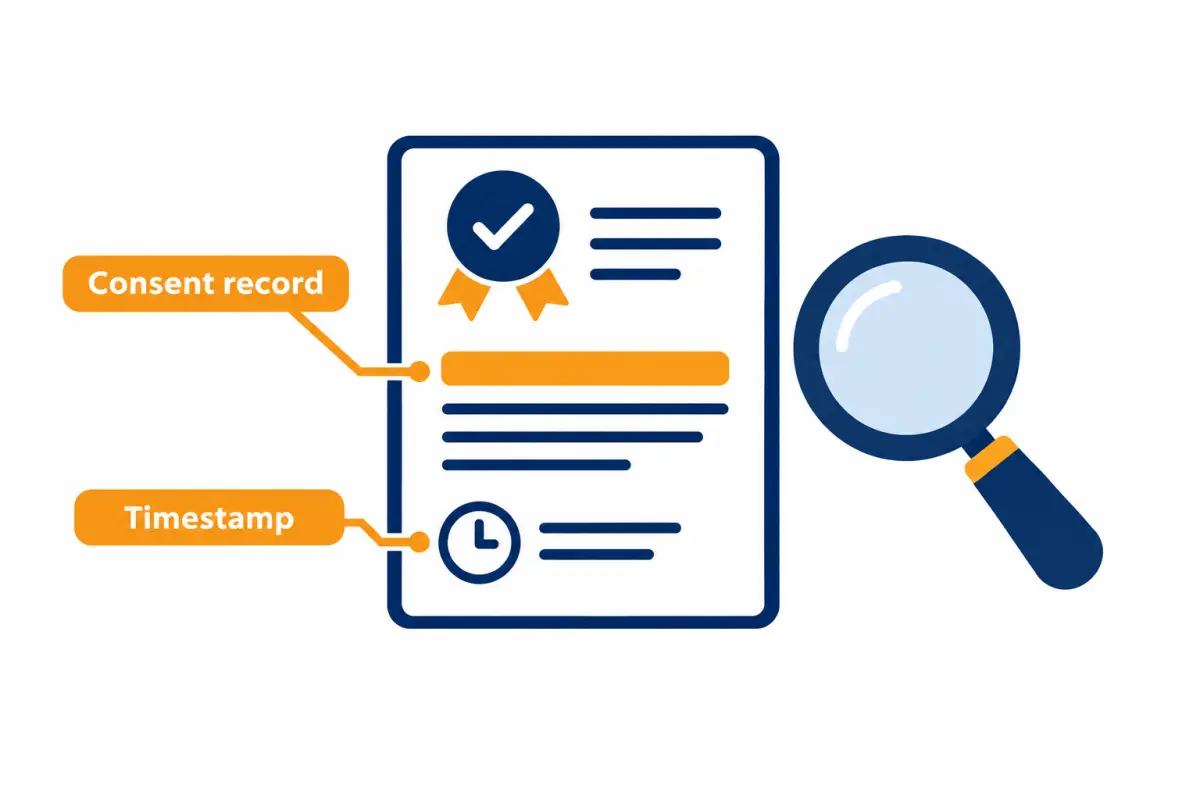
What to store per lead
| Record | Where it comes from | Why you keep it |
|---|---|---|
| Lead ID | Vendor delivery | Ties every claim and question back to one record |
| Delivery timestamp | Vendor delivery | Measures speed to lead; compares with consent time |
| Consent record reference | Vendor (certificate available on request) | Shows when and how the homeowner asked to be contacted |
| Contact attempts | Your dialer, CRM, SMS tool | Shows what you did and when |
| Opt-out or revocation | Homeowner, by any reasonable means | Must be honored; log the date and channel |
| Outcome and lost reason | Your team | Reporting and source comparison |
| Replacement request and result | Your admin | Tracks claim rate and approvals |
Honoring opt-outs
If a homeowner asks you to stop calling or texting, by any channel, stop and record it. Train setters to recognize informal revocations ("don't call me again," "take me off your list") as well as formal "STOP" replies. Make sure the opt-out reaches every system that can contact the person, including dialers and texting tools that are not connected to your CRM. How fast you must process revocations, and across which channels, is a question for counsel; FCC rules in this area have changed in recent years. The FCC's consumer guide on unwanted calls and texts describes the consumer side.
The one-to-one consent rule, as of October 2026
You may still see vendors or articles describing an FCC "one-to-one consent" rule for lead generation. That rule was vacated by the Eleventh Circuit on January 24, 2025, before it took effect. That does not make consent unimportant. Your records still need to show that the person agreed to be contacted by your company in the way you contact them, and state laws may add requirements. Our consent records name your company in the disclosure, which is a stronger position than a disclosure that lists many companies or none. Confirm with counsel how this applies to your calling and texting.
State telemarketing rules
Several states have their own telemarketing laws covering call hours, registration, disclosures and texting. Requirements differ, and they change. Keep a short list of the states you sell in, have counsel note any state-specific rules, and build those rules into your dialer settings and scripts.
Record request workflow
- Setter or manager identifies a lead needing its consent record (for example, a homeowner who says they never asked).
- Admin sends the lead ID to the vendor and requests the certificate.
- Admin saves the certificate to the CRM record.
- Manager reviews: does the record match the person, timestamp and company name?
- If it does not, raise it with the vendor with the lead ID and evidence.
Glossary of exclusive solar lead terms
Exclusive solar lead terms are used loosely across vendors, so the same word can mean different things on two sales calls. The definitions below describe how this guide uses each term. When a vendor uses one of these words, ask them to define it in writing, because the definition in the contract is the one that counts.
| Term | Meaning in this guide |
|---|---|
| Exclusive lead | A lead sold to one buyer only, never resold, including later as an aged lead (our written rule) |
| Shared lead | A lead sold to more than one buyer, often at the same time |
| Semi-exclusive lead | A lead sold to a small, fixed number of buyers; the number varies by seller |
| Real-time lead | A lead delivered within moments of the homeowner's inquiry |
| Aged lead | An inquiry sold some time after it was first generated, usually at a lower price; see aged solar leads |
| Live transfer | A screened homeowner connected to your rep by phone; see solar live transfer leads |
| Booked appointment | A confirmed meeting time set by the seller's team; see solar appointments |
| Consent record (certificate) | A timestamped record of the inquiry and disclosure the homeowner agreed to |
| Lead exclusivity | The promise that one lead goes to one buyer |
| Territory exclusivity | The promise that one buyer receives all leads in an area |
| Filters | Rules that decide which inquiries are sent to you (ZIP, homeowner, bill, property type, and so on) |
| Replacement credit | A credit for an invalid lead under the seller's policy |
| Speed to lead | Time from delivery to first contact attempt |
| Contact rate | Leads with a two-way conversation ÷ leads delivered |
| Sit rate | Appointments that actually happen ÷ appointments set |
| Cost per sale | Total lead spend (and, optionally, labor) ÷ closed sales |
| Cohort | All leads delivered in a set period, tracked together over time |
| DNC scrub | Checking numbers against the National Do Not Call Registry |
| 25D | The federal residential clean energy credit, not available for systems placed in service after 2025 |
| C&I | Commercial and industrial solar; see commercial solar leads |
How do you scale exclusive solar leads after a successful pilot?
Scale exclusive solar leads in steps, not jumps. Raise volume by a modest amount, hold it long enough to see the new cohort's cost per sale, and check that speed to lead, sit rate and install capacity hold up. The usual failure when scaling is operational: more leads arrive than the team can call fast, and cost per sale climbs.
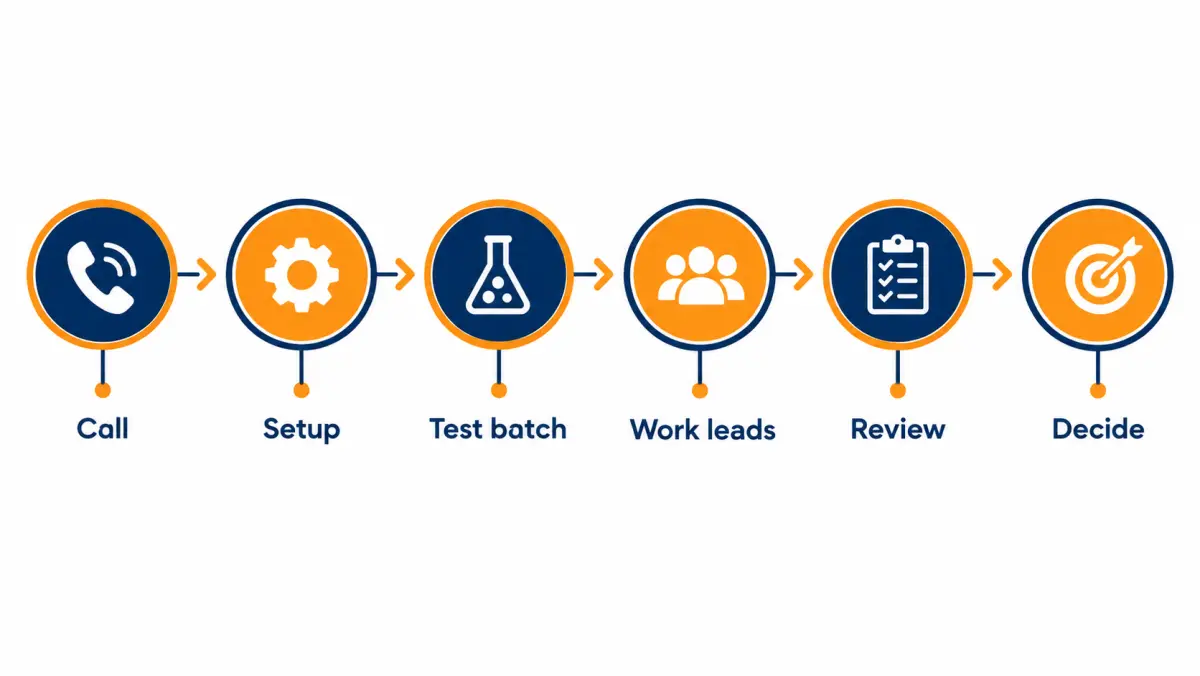
Scaling readiness checklist
Before increasing volume, confirm each of these:
- Median speed to first dial in business hours is within your target, consistently, not just on good days.
- Every lead in the test cohort received the full cadence.
- Cost per sale on the test cohort (with matured outcomes) is below your target.
- Closers have open appointment slots for the extra volume.
- Install crews and permitting can handle more signed jobs in the expected timeframe.
- Replacement claims were submitted inside the window and the claim rate is understood.
- Your weekly report runs without manual cleanup.
Step sizes
Increase volume in steps you can absorb, then hold. A practical rule: increase only as much as your current setter coverage can call within your speed target. If the next step needs a new setter, hire and train first, then scale.
Signs you scaled too fast
| Sign | What is happening | What to do |
|---|---|---|
| Speed to first dial creeps up | Setters are saturated | Reduce daily cap or add coverage |
| Contact rate drops | Leads waiting longer before first call | Same as above; check after-hours handling |
| Sit rate drops | Appointments booked further out | Add closer slots; offer earliest times first |
| Closers cancel or reschedule | Calendar overload | Hold volume until closer capacity grows |
| Signed jobs wait months to install | Install backlog | Pause or reduce delivery; customer experience matters for reviews and referrals |
Expanding territory versus increasing volume per ZIP
Two ways to get more leads: widen the territory, or ask for more volume inside the current one. Inside a fixed territory, supply depends on how many homeowners inquire; you may hit a natural limit. Widening territory adds supply but also drive time and possibly new utility or permitting rules. Run new ZIPs as their own cohort so you can compare them with the original territory before folding them in.
Adding formats as you grow
Some installers add booked appointments when closer capacity grows faster than setter capacity, or live transfers when they have reps who can take calls during set hours. Track each format as its own source. A blended "lead cost per sale" across formats hides which one is working.
How do exclusive leads fit with your own marketing?
Exclusive leads fit best alongside your own marketing when the two do not compete for the same homeowners and are tracked separately. Referrals, yard signs, reviews and your own ads usually produce your cheapest sales; purchased exclusive leads add predictable volume on top. Keep territory, attribution and follow-up consistent so you can see what each channel actually costs.
Avoiding overlap
- Duplicate checks cover leads already sent to you by us. They do not see your own website forms or other vendors. If a homeowner fills out your site form and a vendor's form the same week, you may receive both. Add a CRM duplicate check on phone and address across all sources.
- Decide which source "owns" a duplicate. Usually the earliest record. Do not double-count the sale.
- Consider your paid search footprint. If you bid heavily on solar terms in the same ZIPs you buy leads in, some homeowners will see your ad and also fill out a lead form elsewhere. That is not a problem, but it affects attribution.
Using exclusive leads to build referral density
One installed system often leads to neighbor interest. When exclusive leads cluster near your existing installs, the closer can mention nearby projects (with the customer's permission) and yard signs reinforce trust. Over time, owning a few neighborhoods well can lower your blended cost per sale more than spreading thin across a whole state.
Reviews and reputation
Homeowners from purchased leads will look you up before the appointment. A thin or outdated review profile can cut sit rate and close rate regardless of lead quality. Ask satisfied customers for reviews as part of your install closeout process.

Matching lead volume to install capacity
Every signed job has to be installed. Before scaling leads, look at the whole chain: site survey, design, permitting, utility interconnection, install crew days and inspection. If permitting in your area takes weeks, a surge in signed jobs this month becomes a surge in installs much later. Plan lead volume so your crews have steady work and homeowners are not left waiting, because long waits produce cancellations and weaker reviews. For market-level context on installation activity, the Solar Energy Industries Association publishes industry research and data.
What templates and checklists help you work exclusive leads?
The templates below cover the routine work around exclusive leads: a daily lead review, a weekly source report, a vendor scorecard, a replacement request, and a standard operating procedure for new setters. Copy them into your own tools and adjust the fields. They exist so every lead is worked the same way and every source is judged on the same numbers.
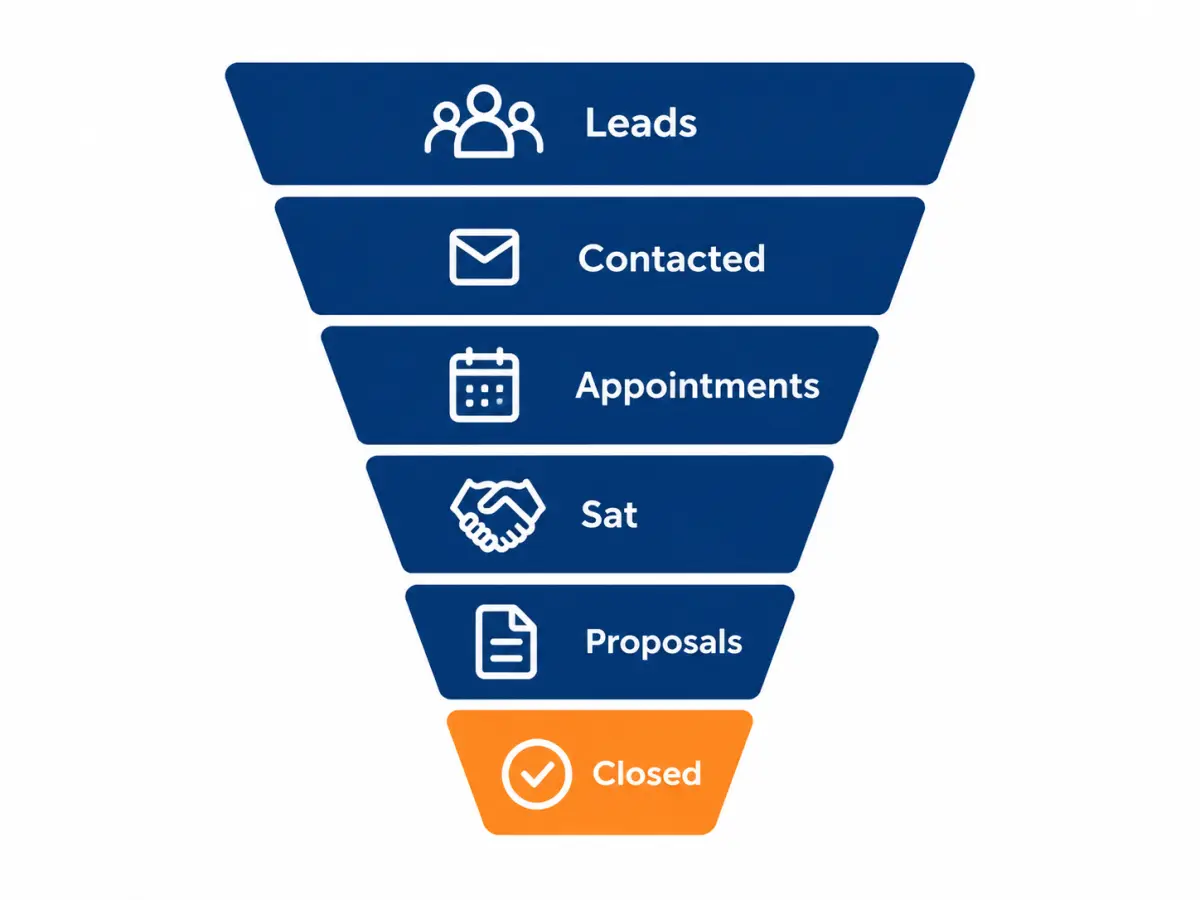
Daily lead review (10 minutes)
| Check | Yes / No | Notes |
|---|---|---|
| All of yesterday's leads received a first dial within target? | ||
| Any lead with zero attempts? | Name the owner and fix today | |
| Any lead outside filters or with bad data? | Flag for replacement | |
| Any homeowner said "didn't request"? | Request consent record | |
| Any homeowner said "others called"? | Log company and timing | |
| Appointments for today confirmed? |
Weekly source report
| Source | Leads | Median speed to dial | Contacted | Appts | Sat | Proposals | Won | Spend | Cost per sale (cohort, to date) | Replacement claims |
|---|---|---|---|---|---|---|---|---|---|---|
| Exclusive – residential | ||||||||||
| Appointments | ||||||||||
| Own website | ||||||||||
| Referrals |
Vendor scorecard (monthly)
| Criterion | Score 1–5 | Evidence |
|---|---|---|
| Exclusivity in writing and consistent with homeowner reports | ||
| Data accuracy (disconnected, wrong details, outside filters) | ||
| Consent records provided promptly on request | ||
| Replacement requests handled within stated terms | ||
| Delivery reliability (real-time, correct endpoint) | ||
| Cohort cost per sale versus target | ||
| Responsiveness of account contact |
Replacement request template
Subject: Replacement request – Lead ID [ID]
Lead ID: [ID] Delivered: [date and time] Reason: [disconnected number / wrong contact details / outside filters: which filter] Evidence: [e.g., "number disconnected on three attempts on (dates)", "ZIP 12345 removed from territory on (date)"] Requested by: [name]
Send it by replying to the lead notification or by email, within 7 days. Approved credits apply to your next batch. Remember what is not covered: a prospect who isn't interested, doesn't answer, doesn't get financing approved, or doesn't buy.
New setter standard operating procedure
- Before your shift. Log in to CRM, dialer and alerts. Check that your phone receives lead notifications.
- When a lead arrives. Open the record, check address on satellite (one minute), dial.
- On the call. Use the opening, confirm address and homeownership, discovery questions, exclusivity question, book two-option time, confirm both decision-makers.
- After the call. Update stage, log answers, send confirmation (where consent and counsel support it).
- No answer. Leave short voicemail, send text if allowed, schedule next attempt per cadence.
- Problems. Outside filters, wrong number or "didn't request": flag in CRM immediately; do not keep calling.
- Opt-out. Stop all contact, log it, make sure it reaches every system.
- End of shift. No lead from today without at least one attempt. Hand off any open callbacks.
Pre-sit checklist for closers
- Reviewed setter notes: motivation, bill, roof age, decision-makers.
- Satellite roof check done; shade and orientation noted.
- Proposal numbers exclude the federal 25D credit for systems placed in service after 2025.
- Any state or utility programs confirmed as current before mentioning them.
- Confirmed arrival time with homeowner on the day.
- Financing options ready, with honest explanation of terms.
Weekly review meeting agenda (30 minutes)
Use the same agenda every week so trends are easy to spot and the meeting does not drift into anecdotes.
- Numbers first (10 minutes). Walk the weekly source report top to bottom. For each source, note the one stage that changed most since last week.
- Speed check (5 minutes). Median speed to first dial, plus the slowest five leads of the week and why they were slow.
- Lead-level review (5 minutes). Any "didn't request," "others called," or outside-filter leads. Confirm replacement requests went out inside the window.
- Call review (5 minutes). Listen to one strong call and one weak call, where recording is lawful and disclosed. Pick one thing to change in the script or coaching.
- Decisions (5 minutes). Volume for next week, any filter or territory change to raise with the vendor, and who owns each action.
Write the decisions down in one line each. Next week's meeting starts by checking whether they happened.
Monthly owner checklist
- Cohort cost per sale for each source, using cohorts old enough for most deals to resolve.
- Compare against target and against last month.
- Review replacement claim rate and approvals by source.
- Check install backlog against signed jobs before setting next month's volume.
- Confirm the territory list your vendor has matches your current one.
- Spot-check three consent records against the matching CRM records.
- Review opt-out handling: did every revocation reach every system?
- Decide: scale, hold, adjust or stop, and write down why.
The written "why" matters. Six months from now, when someone asks why a source was cut or doubled, the answer should be in the record, not in someone's memory.
How should you handle exclusive leads for different homeowner situations?
Handle exclusive leads differently depending on why the homeowner inquired: high bills, a new electric vehicle, an aging roof, interest in battery backup, an existing system they want to expand, or a property type you may not serve. The motivation shapes the first call, who should run the sit, and which filters you set with your vendor. Ask about it in the first two minutes.
The situations below are common reasons homeowners give. They are not categories we sell separately; they are prompts for your setters and closers. Filters you can set are agreed on your call.
High-bill homeowners
What they want. Lower or more predictable electricity costs.
First-call focus. Ask for summer and winter bills, and whether they have online account access. Ask whether the bill has changed recently and why (new appliances, work-from-home, rate changes).
Sit focus. Show a year of usage, the proposed system's expected production, and the savings logic without the federal 25D credit. Be careful with rate-increase assumptions; show what happens if rates rise slowly as well as quickly, and say which assumption you are using. The National Renewable Energy Laboratory's PVWatts calculator is a public tool homeowners can use to sanity-check production estimates.
Common mistake. Leading with "you'll never pay an electric bill again." Most homes keep some utility charges. Overpromising wins the sit and loses the review.
Electric vehicle owners or buyers
What they want. To charge the car on their own power and avoid a jump in bills.
First-call focus. Ask whether the EV is already in the driveway or planned, how many miles they drive, and whether they have a home charger.
Sit focus. Size for current usage plus a realistic EV load. Explain the difference between sizing for today and sizing for a second EV later.
Common mistake. Guessing EV usage. Ask for mileage; it changes the system size.
Aging roof
What they want. Often a roof replacement first, then solar, and they may not know the order matters.
First-call focus. Ask the roof's age and condition. If the roof needs replacing soon, the conversation shifts to timing and possibly coordinating both projects.
Sit focus. Be honest about removal and reinstall costs if solar goes on an old roof. Some installers partner with roofers; if you do, explain how that works.
Common mistake. Ignoring roof age to keep the sale simple. The homeowner pays later and remembers who told them.
Battery and backup interest
What they want. Power during outages, sometimes more than savings.
First-call focus. Ask how often outages happen, how long they last, and which loads matter most (refrigerator, well pump, medical equipment, home office).
Sit focus. Separate the savings case from the resilience case. Explain what a battery can and cannot power and for how long, in plain terms.
Common mistake. Bundling a battery into every proposal without asking about outages. Homeowners who wanted savings can feel upsold.
Homeowners with an existing system
What they want. More production, a battery, or help with a system that is not performing.
First-call focus. Ask who installed the original system, its age, and whether it is still under warranty. Ask what they want to change.
Sit focus. Expansion and add-on work can be technically and contractually complicated (interconnection limits, warranty terms, mixing equipment). Be clear about what you can and cannot do.
Common mistake. Treating these as standard new-system leads. If you do not service existing systems or add-ons, tell your vendor so filters can exclude them where possible.
Property types you may not serve
Mobile or manufactured homes, condos, townhomes with shared roofs, and homes with heavy shade are examples where some installers do not sell. If any of these are outside your business, set filters on your call. A lead that arrives outside your agreed filters qualifies for a replacement credit if reported within 7 days. A lead inside your filters that later turns out not to work on site (for example, unexpected structural issues found during survey) is a normal part of selling solar, not a replacement case.
Situation quick-reference
| Homeowner situation | First-call question to ask | Who should run the sit | Filter to discuss on your call |
|---|---|---|---|
| High bills | "What do summer and winter bills run?" | Any trained closer | Minimum bill (if it predicts sales for you) |
| EV owner or buyer | "How many miles do you drive a week?" | Closer comfortable with load sizing | None usually |
| Aging roof | "How old is the roof?" | Closer who can discuss roofing coordination | Roof age, if you will not work on old roofs |
| Battery and backup | "How often do you lose power?" | Closer trained on storage | Storage interest, if you do not sell batteries |
| Existing system | "Who installed it and how old is it?" | Service-capable rep | Existing system, if you do not do add-ons |
| Property type | "Is this a single-family home you own?" | N/A if outside your business | Property type exclusions |
How do you know when to stop or change an exclusive lead program?
Stop or change an exclusive lead program when cohort cost per sale stays above your target after you have fixed the operational stages you control: speed, cadence, confirmation and closer coaching. If the funnel breaks at contact or data accuracy despite fast follow-up, raise it with the vendor using lead IDs. If it breaks at the sit or close, the fix is usually inside your team.
A simple decision tree
- Is speed to first dial within target? If no, fix speed and retest. If yes, continue.
- Is every lead receiving the full cadence? If no, fix cadence. If yes, continue.
- Is the contact rate low even with fast dialing and full cadence? If yes, review data accuracy with the vendor (disconnected, wrong details) and check your caller ID reputation. If no, continue.
- Is the appointment rate low on contacted leads? If yes, review scripts and setter coaching, and check whether filters match your ideal customer. If no, continue.
- Is the sit rate low? If yes, fix confirmations and booking windows. If no, continue.
- Is the close rate low on sits? If yes, review proposals, pricing, financing and closer performance. If no, continue.
- Is cost per sale still above target? Then the price per lead may be too high for your margin in this territory. Discuss filters, territory or format on a call, or move budget to a format that fits.
When changing format makes more sense than stopping
- Strong closers, weak setting capacity. Consider booked appointments.
- Reps available to take calls in set hours. Consider live transfers.
- Patient, multi-channel nurture team. Consider aged leads as a lower-cost supplement.
- Commercial focus. Use a program built for commercial solar leads.
A program that does not fit this quarter may fit next year when your team or market changes. Keep your cohort data; it is the best starting point for the next test. When you are ready to compare options for your ZIP codes, book a call.
FAQ
What are exclusive solar leads?
Exclusive solar leads are solar inquiries sold to one installer only. No other company receives the contact from the seller, at the time of sale or later. Our written rule: each exclusive lead is sold to one company and is never resold, recycled or sold later as an aged lead.
Are exclusive solar leads worth the price?
Exclusive solar leads are worth the price when they produce a lower cost per closed job than your alternatives. That depends on how fast you call, your close rate and your margin. Compare cost per sale, not price per lead, using a test batch and the cost calculator.
How do I know a lead is really exclusive?
Get the resale rule in writing, check that the consent record names your company only, compare certificate and delivery timestamps, and ask homeowners on first contact whether other solar companies called about the same inquiry. Track the answers across your first 50 to 100 leads.
How much do exclusive solar leads cost?
Prices vary by market, filters and volume. ActiveProspect's July 2026 roundup cites Enervio at $100 to $250 per exclusive marketplace lead. Our pricing is confirmed by ZIP code on your call, because territory is the biggest driver.
Are exclusive leads ever resold?
Not ours. Each exclusive lead is sold to one company and is never resold, recycled or sold later as an aged lead. With other vendors, ask specifically whether leads are later sold in aged lists, because that is the most common gap.
What is the difference between exclusive and shared solar leads?
An exclusive lead goes to one installer. A shared lead goes to several installers at once, who all call the same homeowner. Shared leads cost less per lead; exclusive leads usually face less competition at first contact.
Do exclusive leads convert better?
Exclusive leads often convert better because the homeowner is not fielding several competing calls, but published close-rate comparisons we found are vendor-reported and unsourced. Measure contact, appointment, sit and close rates on your own test batch.
How many installers get a shared solar lead?
It depends on the seller. Shared leads are commonly sold to a handful of buyers, and the number is set by each marketplace. Ask any shared-lead vendor for the maximum number of buyers per lead in writing.
Can I buy exclusive leads by ZIP code?
Yes. Territory can be set by ZIP code, county or similar units. Availability and volume are confirmed by ZIP code on your call.
Do exclusive leads come with consent proof?
Yes. Every lead we deliver carries a timestamped consent record whose disclosure names your company, and we send it on request. Confirm with your counsel that it supports the way you plan to call and text.
What if a lead has a wrong number?
Disconnected numbers, wrong contact details and leads outside your filters qualify for a replacement credit if reported within 7 days. Reply to the lead notification or email us with the reason; approved credits apply to your next batch.
Do I need a long-term contract?
No. There are no long-term contracts. Start with a test batch and scale when the numbers work.
What is the difference between lead exclusivity and territory exclusivity?
Lead exclusivity means each individual lead is sold to one buyer. Territory exclusivity means only one buyer receives leads in a defined area. Our written rule is lead exclusivity: each exclusive lead is sold to one company and never resold. Territory availability is confirmed by ZIP code on your call.
Can a homeowner on an exclusive lead still talk to other installers?
Yes. Exclusivity controls who the seller sells the lead to; it cannot stop a homeowner from filling out other forms or calling other companies. If a homeowner says others called, ask which company and when, and log it so your exclusivity check measures the right thing.
How fast should I call an exclusive solar lead?
Call within minutes during business hours. Exclusive leads remove competing installers from the race, but homeowner attention fades quickly after an inquiry. Set a written speed target, measure median time to first dial weekly, and have an after-hours plan for leads that arrive outside coverage hours.
How many exclusive leads should I buy for a first test?
Buy only as many as your team can work completely, with the full follow-up cadence, in the test period. The goal is a reliable read on contact, appointment, sit and close rates. Volume and pricing are confirmed by ZIP code on your call.
Do exclusive solar leads still make sense after the 25D credit ended?
They can. The federal 25D homeowner credit is not available for systems placed in service after 2025, so proposals must stand on savings, financing and any state or utility programs. Homeowners with high bills, EVs or roof replacements still inquire. Measure cost per sale on your own test.
Can I pause exclusive lead delivery when my install calendar is full?
There are no long-term contracts, so you can start with a test batch, scale when the numbers work, and adjust volume as your capacity changes. Discuss pause and restart timing on your call so delivery matches your install schedule.
What delivery options are available for exclusive leads?
Real-time delivery to your CRM, dialer, email or SMS. Choose the channel the person who calls first will actually see, and test it with a sample record before live leads arrive.
Are exclusive commercial solar leads different from residential ones?
Yes. Commercial inquiries involve business owners or facility managers, longer sales cycles and different qualification such as decision-maker role, building ownership and bill size. See our commercial solar leads page for how those programs work.