How to Vet a Solar Lead Provider Before You Spend a Dollar
Vet a solar lead provider before you spend: source and consent proof, exclusivity checks, refund terms, test-batch design and the red flags that signal trouble.
Updated · 82 min read
In this guide (32 sections)
- Why does vetting a solar lead provider matter so much?
- What source and consent proof should a solar lead provider give you?
- How do you check that solar leads are really exclusive?
- How do you test lead age, timestamps and delivery speed?
- What verification checks make a solar lead qualified?
- Which contract terms should you look for in a lead vendor agreement?
- What should a solar lead refund or replacement policy cover?
- What are the red flags with solar lead companies?
- How do you run a controlled test of a solar lead vendor?
- What questions should you put in a solar lead vendor RFP?
- How do you audit a vendor's capture forms yourself?
- How do you read a consent record line by line?
- How do you measure delivery speed and lead freshness in practice?
- What should you ask a vendor's installer references?
- How do you redline a solar lead vendor contract?
- Which solar lead red flags matter most?
- How should vetting change by installer size?
- How do you vet commercial solar lead providers differently?
- How should you vet each lead type?
- How do you judge lead quality from the first homeowner call?
- How do you build a vendor scorecard dashboard?
- How do you manage a lead vendor after onboarding?
- What do real-world vetting scenarios look like?
- How do you troubleshoot a lead vendor that is underperforming?
- Do state laws change how you vet a solar lead provider?
- What templates help you vet and manage a lead vendor?
- What is a sensible 30-day vetting timeline?
- Solar lead vendor vetting glossary
- How do you check a lead vendor's data security and privacy practices?
- Extra questions installers ask about vetting lead vendors
- How does Buy Solar Leads answer these vetting questions?
- FAQ
To vet a solar lead provider, make the vendor prove five things before you buy: where each lead was captured, what consent record travels with it, how exclusivity is enforced, how fast and how fresh leads arrive, and exactly what the refund terms cover. Then run a small, controlled test batch and judge the vendor on your own numbers, not theirs. This guide walks through each check as of October 2026, gives you the questions to ask, the answers that should worry you, and a scorecard you can reuse every time a new vendor calls.

If you are new to buying leads, start with our guide to buying solar leads for the basics on lead types and pricing models. This page assumes you already know you want to buy and need to separate good vendors from expensive mistakes.
Why does vetting a solar lead provider matter so much?
Vetting a solar lead provider matters because the vendor controls three things you cannot fix after the sale: who the homeowner is, what they agreed to, and how many other installers got the same name. A bad vendor costs you the lead spend, your reps' time, and possibly a TCPA claim. A careful 30-day vet costs far less than any of those.
The cost of a bad vendor
Most installers measure a lead vendor by price per lead. That number hides most of the real cost. Every lead you buy also consumes setter time, dialer minutes, CRM seats, manager attention and, when it turns into an appointment, a closer's evening. When a vendor sends leads that were sold four times, or that came from a sweepstakes form where the homeowner never asked about solar, you pay all of those downstream costs and get nothing back.
Here is an illustrative example of how that compounds. Suppose you buy 100 leads and each one triggers about 45 minutes of combined setter work across the follow-up cadence. That is 75 hours of labor per batch. If half the batch is unreachable or uninterested because of how it was sourced, you have wasted roughly 37 hours of paid time before counting the lead invoice. The lead price was the smallest line on the bill.
There is also a legal layer. Under the Telephone Consumer Protection Act, liability for an unlawful call or text can attach to the company that placed the call, and in some circumstances to the seller on whose behalf it was placed. Buying a lead does not transfer your responsibility to the vendor. That is why consent proof sits near the top of this checklist, and why we wrote a separate guide on solar leads TCPA compliance.
Vendor claims are marketing
Every lead vendor says its leads are high quality, exclusive, verified and compliant. Those words have no fixed meaning. "Exclusive" might mean sold to one installer, or sold to one installer per ZIP code per day, or sold to one installer before being resold as aged a week later. "Verified" might mean a phone number passed a format check or that a human spoke to the homeowner.
Your job is to replace adjectives with evidence. For each claim, ask the vendor to show you a document, a sample record, a contract clause or a system screenshot. If the answer is a slogan, treat the claim as unproven. The rest of this guide gives you the specific evidence to ask for under each heading.
Key takeaway: Judge a solar lead vendor by what it can show you, not what it says. Price per lead is the smallest cost in a bad vendor relationship.
What source and consent proof should a solar lead provider give you?
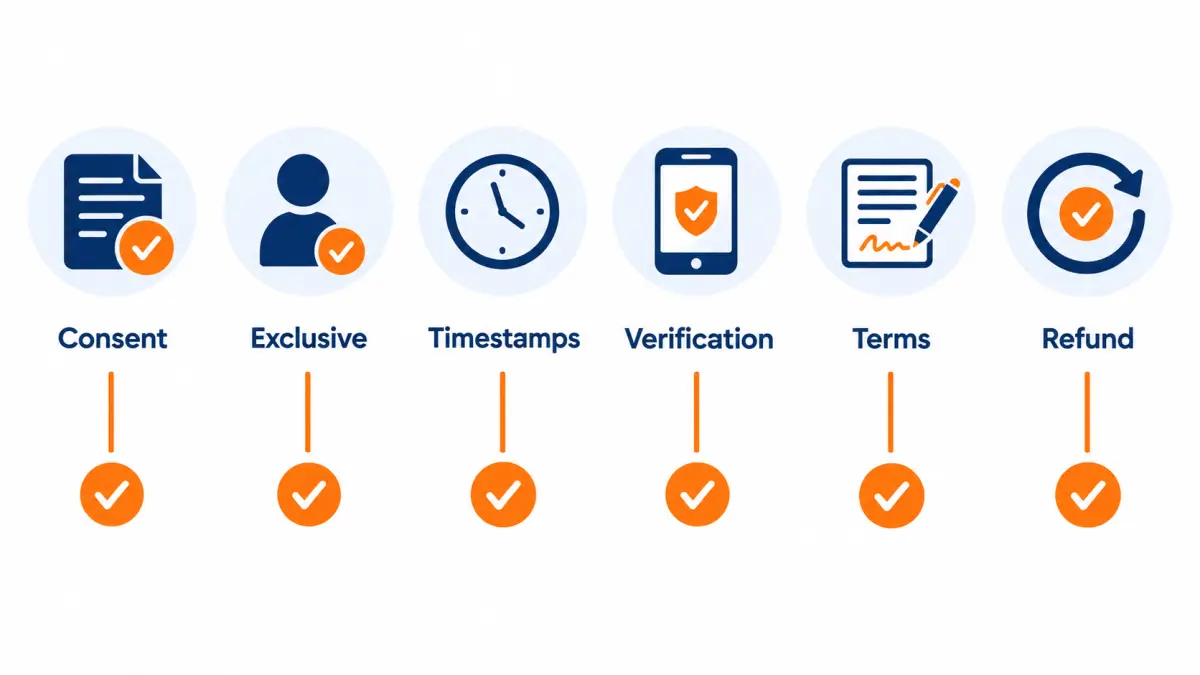
A solar lead provider should tell you, for every lead, the exact page or channel where the homeowner submitted their information, and should hand over a consent record showing the timestamp, the disclosure language the homeowner saw, and the company names that disclosure covered. If a vendor cannot produce both on request for a sample lead, stop there.
Ask where each lead was captured
Lead sources fall into a few broad groups, and each behaves differently on the phone:
| Source type | How the homeowner arrives | What to ask the vendor |
|---|---|---|
| Owned solar landing pages | Searched or clicked an ad about solar savings, filled a solar-specific form | Can I see the live page and the ad that drives traffic to it? |
| Comparison or quote sites | Asked for quotes from several installers | How many buyers can receive this lead? |
| Co-registration and incentive forms | Ticked a box while doing something else (survey, sweepstakes) | What percentage of your solar volume comes from these? |
| Inbound calls | Called a number from an ad or mailer | Are calls recorded and can I hear samples? |
| Affiliates and sub-vendors | Traffic bought from third-party publishers | Who are the publishers and how do you police them? |
| Aged or recycled data | Older leads resold after their first sale window | How old, how many prior buyers, what original consent? |
None of these sources is automatically bad. Comparison-site leads can close well if you are fast. Affiliate traffic can be fine if the vendor audits its publishers. The problem is not knowing which one you are buying. A vendor that says "proprietary sources" and will not elaborate is asking you to pay for a mystery.
Ask for the live URL of at least one capture page. Fill it out yourself with a test identity (use a phone number you control). Then watch what happens. Does the form ask about homeownership, electric bill and roof? Does the disclosure name specific companies or say "marketing partners"? Do you get calls from five companies within an hour? This one test tells you more than any sales deck.
Consent artifacts
A consent artifact is the evidence that a specific person agreed to be contacted by a specific company. For web leads, a strong consent record usually includes:
- The date and time the form was submitted, with time zone
- The URL of the page where it was submitted
- The exact disclosure text shown next to the submit button
- The company names listed in that disclosure
- The IP address and device or browser information
- A session recording or certificate from an independent consent-verification service, if the vendor uses one
- The phone number and name as entered, before any cleaning
Ask for a full consent record for three random leads from last week, not a hand-picked example. Check whether the disclosure language actually names your company or a category your company falls into. Check whether the timestamp is plausible relative to when the vendor says leads are delivered.
As of October 2026, the FCC's 2023 rule that would have required consent to be given to one seller at a time was vacated by the U.S. Court of Appeals for the Eleventh Circuit on January 24, 2025, in Insurance Marketing Coalition v. FCC. That does not make consent optional. The underlying requirement for prior express written consent for telemarketing calls using an autodialer or prerecorded voice still applies. Our TCPA compliance guide for solar lead buyers explains what still applies and why many buyers keep insisting on seller-specific disclosures anyway. This is not legal advice; confirm with counsel what your calling program needs.
Retention and access
Ask how long the vendor keeps consent records and how you get them. A useful answer looks like: "We keep them for at least five years and you can pull any record by lead ID within one business day." A weak answer looks like: "We can probably find it if you ever need it." TCPA claims can surface years after the call, so you want access that outlasts your relationship with the vendor. Put retention and access terms in the contract.
How do you check that solar leads are really exclusive?
You check exclusivity by asking how the vendor's system prevents a second sale, not just whether it promises one, and then by testing it. Exclusive should mean the lead is routed to one buyer, never resold, and never later sold as aged. Get that definition in writing and run a seeded test lead through their form.
Exclusivity is the biggest single driver of contact and close rates, which is why it is also the claim most often stretched. For the economics of exclusive versus shared, see our comparison of exclusive or shared solar leads.
Technical enforcement
Good vendors enforce exclusivity in the routing system, not on the honor system. Ask these questions and listen for specific answers:
- How is a lead assigned? Look for "each lead is posted to one buyer and locked to that buyer ID." Be wary of "we ping our network and the highest bidder wins," which is a shared or auction model.
- What happens if the assigned buyer rejects it? Some vendors re-sell rejected leads. That is reasonable only if you never pay for the reject and the lead never comes back to you.
- Is the lead ever sold again later? Many vendors move leads into an aged inventory after 30, 60 or 90 days. If you are paying exclusive prices, you want "never," in writing.
- Is the same homeowner sold to others if they submit another form? A homeowner who fills out three solar forms is three leads to many systems. Ask whether the vendor de-duplicates across its own forms.
- Who else can see the data? Ask whether sub-vendors or affiliates also keep and sell a copy.
Then test it. A seeded lead is a real-looking submission with a phone number and email you control, entered through the vendor's form in a ZIP code you serve. If you buy the lead and then receive calls or texts from other solar companies over the next weeks, exclusivity is not what the vendor claimed. Seed more than one, and vary the day and time.
Contract language
The contract should define exclusivity in plain words. Here is the shape of language to look for (have counsel draft your actual clause):
- The lead is sold to the buyer only and is not sold, rented, shared or transferred to any other party at any time, including as an aged or recycled lead.
- The vendor's publishers and sub-vendors are bound by the same restriction.
- A breach entitles the buyer to a credit for the lead and the right to terminate.
Our own exclusivity term reads: "Each exclusive lead is sold to one company. It is never resold, recycled or sold later as an aged lead." Whatever vendor you choose, ask for something at least that specific. If you want to compare, our page on exclusive leads for solar installers describes how that product works.
How do you test lead age, timestamps and delivery speed?
You test lead age by comparing the form submission timestamp in the consent record with the time the lead hit your CRM. For real-time leads, that gap should be seconds or a few minutes. Anything measured in hours means you are buying something older than advertised, and every hour lost lowers your odds of reaching the homeowner.
Sample timestamps
Ask for 20 recent leads with both timestamps: submission time and delivery time. Put them in a spreadsheet and calculate the gap. You are looking for three things:
- Consistent short gaps for leads sold as real-time.
- No impossible gaps where delivery happens before submission, which signals data was edited.
- No clustering where dozens of leads arrive at the same second in a batch, which can mean leads were held and dumped, or pulled from a stored file.
When the test batch starts, log every lead yourself. Your CRM records arrival time. Compare it with the submission time on the consent record for each lead. This is the most objective freshness test you have, and it costs nothing.
Delivery latency test
Latency is the time from homeowner click to your rep's phone ringing. It has several links: vendor processing, delivery method (API post, email, SMS), your CRM rules and your team's response. Test the vendor's part in isolation by seeding a lead and timing how long until it appears in your system.
If the vendor only delivers by email batch or daily spreadsheet, that is a product choice, not a defect, but it should be priced like aged data. Real-time delivery to a CRM or dialer is standard for fresh web leads. Ours, for reference: "Real-time delivery to your CRM, dialer, email, or SMS."
Speed matters on your side too. Our guide to solar speed to lead covers the first five minutes, cadence and staffing, because a fast vendor paired with a slow team wastes the advantage.
What verification checks make a solar lead qualified?
A qualified solar lead is a homeowner, reachable at the contact details provided, located in your service area, who asked about solar and meets the filters you agreed with the vendor. Verification checks are how the vendor confirms those facts before delivery. Ask which checks run on every lead, which are sampled, and which are self-reported.
Phone, email, address, homeowner status
Here are the common checks, what they prove and what they do not:
| Check | What it proves | What it does not prove |
|---|---|---|
| Phone validation (line type, active status) | The number is a working mobile or landline | That the person answers or wants solar |
| Phone ownership or name match | The number is associated with the named person | Intent |
| Email validation | The address can receive mail | That anyone reads it |
| Address standardization | The address is a real deliverable location | That it is a single-family home with a usable roof |
| Property records check | The named person appears as an owner of the property | Current occupancy or roof condition |
| Duplicate check | You have not received this lead before | That nobody else has |
| DNC scrub | The number was not on the National Do Not Call Registry at scrub time | That you have valid consent to call |
| Human verification call | Someone answered and confirmed interest | That they will keep an appointment |
Our pre-delivery checks for homeowner leads are: phone number validated before delivery; homeowner status self-reported, then checked against property records; duplicate-checked against leads already sent to you; and scrubbed against the National Do Not Call Registry. Ask every vendor for an equally literal list. Vague phrases like "multi-point verification" should prompt the question "Which points?"
What a qualified lead means: a fields checklist
Before you talk to any vendor, write down what a qualified lead means for your business. Use this as a starting checklist:
- Full name, phone, email and full street address
- Homeowner (self-reported, ideally checked against records)
- Property type you install on (single-family, townhome, multifamily, commercial)
- ZIP code inside your service territory
- Utility provider (useful for rate and net metering context)
- Approximate monthly electric bill, or a minimum threshold
- Roof age, material or shade, if you filter on them
- Credit range self-reported, if you only sell financed or cash
- Timeline to install
- Interest in battery storage
- Consent record that covers your company
- Submission and delivery timestamps
Not every field must be mandatory. More filters raise price and lower volume. The point is to agree the filters up front so that "outside your filters" becomes a clear refund reason later.
Which contract terms should you look for in a lead vendor agreement?
Look for month-to-month terms or a short initial test, no large setup fees, clear minimums, written notice before price changes, defined exclusivity, defined refund rules and access to consent records. A vendor confident in its leads rarely needs a long lock-in. Read every term against the question: what happens if the leads are bad?
Lock-ins: month-to-month as a signal
Long contracts protect the vendor, not you. A vendor that insists on six or twelve months before you have seen a single lead is betting you will not leave once you discover the quality. Month-to-month terms, or a short pilot with an option to extend, put the burden on the vendor to keep earning your spend.
Our term is: "No long-term contracts. Start with a test batch, scale when the numbers work." Ask other vendors whether they can match that, and if not, what the exit clause says.
Setup fees
Setup or onboarding fees are not inherently wrong. Integrating with your CRM, building filters and setting up a territory takes work. But a setup fee that is large relative to a test batch shifts risk onto you before any lead is delivered. Ask what the fee covers, whether it is credited against future purchases, and whether it is refunded if the vendor cannot deliver volume in your territory.
Minimums and pricing change notice
Minimum purchase commitments are common. They let vendors plan ad spend. Check:
- Is the minimum per week, per month or per contract? A weekly minimum you cannot pause during a crew shortage is risky.
- Can you pause? Find out notice periods and whether pausing loses your territory.
- What happens if the vendor under-delivers? If they cannot hit your volume, you should not be penalized.
- How much notice before price changes? Ask for at least 30 days written notice and the right to exit.
- Are prices fixed by ZIP, by state or floating? Floating prices can make budgeting impossible.
A contract terms comparison table
Use this table to compare vendors side by side. Fill it from the contract itself, not the sales call.
| Term | Vendor A | Vendor B | What good looks like |
|---|---|---|---|
| Initial commitment | Test batch or month-to-month | ||
| Exit notice | 30 days or less | ||
| Setup fee | None, or credited to first order | ||
| Minimum volume | Clear, pausable | ||
| Price change notice | 30 days written, right to exit | ||
| Exclusivity definition | Never resold, including as aged | ||
| Consent record access | On request, retained for years | ||
| Refund window | Written, starts at delivery or appointment | ||
| Data ownership | You own leads you paid for |
What should a solar lead refund or replacement policy cover?
A solar lead refund policy should list the exact reasons a lead qualifies for credit, the window to report it, how that window is measured, and whether you get cash, credit or a replacement lead. Typical covered reasons are bad contact details, duplicates and leads outside your filters. Policies almost never cover homeowners who simply are not interested.
Definitions of a bad lead
Ask for the written list of return reasons. Common ones:
- Disconnected or non-working phone number
- Wrong person (the number belongs to someone else)
- Duplicate of a lead already sent to you
- Outside your agreed filters (wrong ZIP, renter when you required homeowner, below bill threshold)
- Fake or test submission (obvious junk names)
- Commercial property sold as residential, or the reverse
Common exclusions:
- Homeowner not interested
- Homeowner did not answer
- Financing declined
- Homeowner chose another installer
Ours, for comparison: "Replacement credits for disconnected numbers, wrong contact details, or leads outside your filters." And what is not covered: "a prospect who isn't interested, doesn't answer, doesn't get financing approved, or doesn't buy." We publish those lines so you can compare directly. A vendor that will not put its return reasons in writing will decide them case by case, usually not in your favor.
Windows: from delivery vs from appointment
This is where many buyers get caught. A refund window can be measured from different starting points, and the starting point matters as much as the length:
| Window starts at | Suits | Watch for |
|---|---|---|
| Lead delivery | Raw web leads | Short windows (24 to 72 hours) that expire before your cadence finishes |
| First contact attempt | Raw leads with slow cadences | Disputes over when you first tried |
| Scheduled appointment time | Booked appointments | Appointments booked weeks out, where a delivery-based window would expire before the meeting |
| End of billing period | Bulk or aged lists | Long gaps where bad data piles up |
For booked appointments specifically, a window that starts at delivery makes little sense: the appointment may be ten days away. Ask that it run from the scheduled time. Our appointment program uses this rule: "If a confirmed appointment doesn't sit because the prospect no-shows or doesn't match your filters, report it within 7 days of the scheduled time and we replace it." For raw leads, our window is 7 days.
Credits vs replacements vs cash refunds
Three forms of make-good are common:
- Cash refund: cleanest for you, rare in this industry.
- Account credit: applied to your next invoice. Fine if you plan to keep buying; worthless if you are leaving.
- Replacement lead: a new lead in place of the bad one. Fine if the replacement meets the same filters and is not an older or aged lead.
Ask whether credits expire, whether they survive cancellation and whether replacement leads count against your minimum. Also ask how disputes are decided and how long approval takes. Ours works like this: "Reply to the lead notification (or email us) with the reason; approved credits apply to your next batch."
Key takeaway: The refund window's starting point matters as much as its length. For appointments, insist the clock starts at the scheduled meeting time.
What are the red flags with solar lead companies?
The main red flags are volume and price that do not add up, guarantees on outcomes the vendor cannot control, evasive answers about lead source or consent, pressure to sign long contracts before a test, and lead forms that promote the vendor's brand so heavily that homeowners do not know your company will call. Any one is a reason to slow down.
Implausible volume at low prices
Generating a genuine, exclusive, real-time solar lead costs money: ad spend, landing pages, verification and compliance tooling. When a vendor offers very large daily volume in your territory at a price well below what others quote for the same filters, ask how. The common answers are shared distribution, incentive or co-registration traffic, aged data presented as fresh, or traffic from affiliates the vendor does not control.
A practical test: ask how many ad impressions or clicks it takes them to produce one lead in your state, and what they pay per click. A real marketer can talk through that math. If the numbers do not add up to the price, the leads are coming from somewhere cheaper than they say.
Guarantees that sound too good
Be cautious of any vendor that guarantees closed deals, a fixed number of sales, a specific close rate or a return on investment. The vendor controls lead sourcing and delivery. It does not control your rep's skill, your pricing, your financing partners, your reviews or the homeowner's spouse. A guarantee on outcomes it cannot control is either priced so high it is not worth it, or written with exclusions that gut it. Read the fine print of any guarantee.
Reasonable guarantees are about things the vendor does control: contact details work, the lead fits your filters, the lead is not a duplicate, the appointment was confirmed.
Evasive source answers
Watch for these patterns on a sales call:
- "Our sources are proprietary." (Fine to protect detail, but they should still name the type.)
- "All our leads are TCPA compliant." (Ask to see a consent record.)
- "We can't show you the form, but trust us." (A form is public by definition.)
- "That's handled by our partners." (Then the partners are your vendor too.)
- Answers that change between the sales call and the contract.
Vendor brand over yours
Look at the capture page from the homeowner's point of view. If the page is branded as a big national "solar savings" program, the homeowner may expect a call from that brand, not from your company. When your rep calls, the homeowner may not recognize the name and hang up. Ask how the vendor introduces the handoff, whether your company is named in the disclosure, and whether the confirmation message tells the homeowner who will call.
Other warning signs
- No business address, or an address that is a virtual mailbox with no team behind it
- Pressure to pay large amounts upfront, especially by wire, before any lead is delivered
- Reviews that only exist on the vendor's own site
- Refusal to provide references from installers in similar markets
- No written refund policy
- Requests to remove call recording or skip DNC scrubbing to "boost contact rates"
Not every vendor with one of these issues is a scam. Many solar lead companies are legitimate businesses with weak processes. But a vendor with several of them is a poor bet for your money.
How do you run a controlled test of a solar lead vendor?
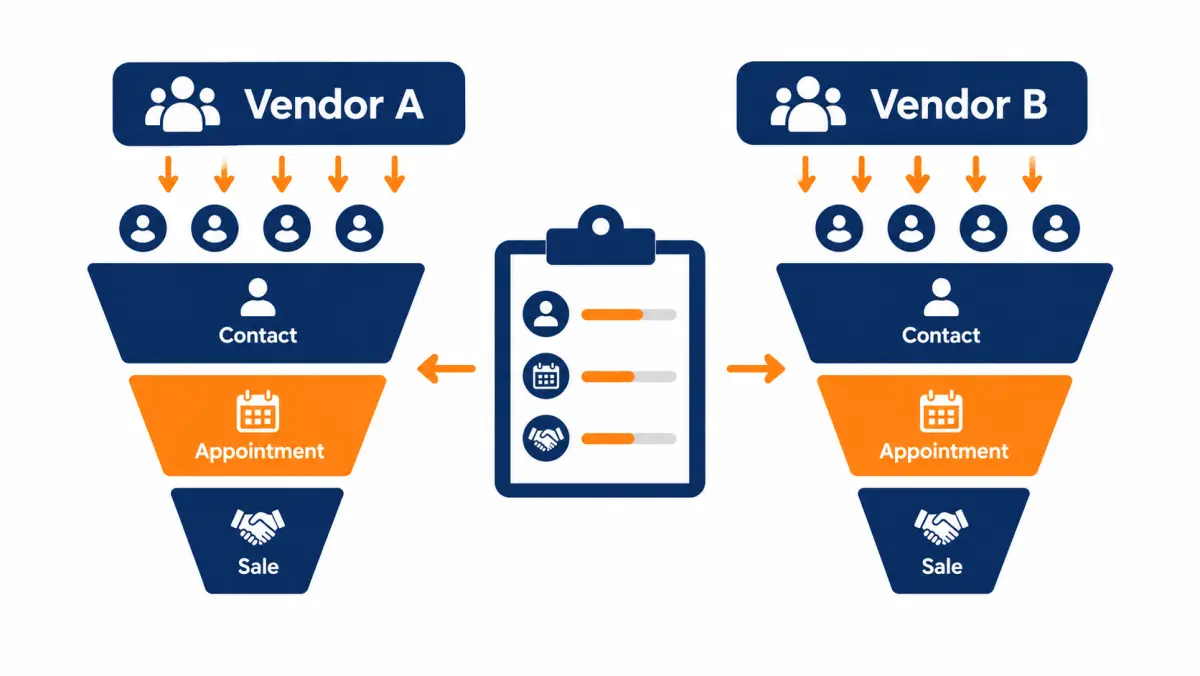
Run a controlled test by buying a small batch from one or two vendors at the same time, with identical filters, delivered into the same CRM, worked by the same team with the same cadence, for the same number of weeks. Then compare contact rate, appointment rate, sit rate and cost per appointment on your own data. That is the only fair way to compare vendors.
Same criteria across two vendors
Comparisons go wrong when variables change. Keep these identical across vendors:
- Filters: same ZIP list, homeowner rule, bill threshold and property type.
- Delivery: same CRM pipeline, same routing to the same reps.
- Cadence: same number and timing of calls, texts and emails.
- Reps: split leads evenly across the same setters, or randomize.
- Time window: run both vendors over the same weeks, so seasonality and weather affect both.
Tag every lead with its vendor in the CRM from the moment it arrives. You will need that attribution for every metric.
Batch size and duration
Too small a batch tells you little. Too big a batch risks real money on an unproven source. A practical middle ground for many installers is enough leads to produce a meaningful number of conversations over two to six weeks, with the exact count set by your budget and the price per lead.
Here is an illustrative example. If your current funnel converts about 1 in 10 leads into a sat appointment, a 50-lead batch should yield around 5 appointments. That is enough to spot a disaster, not enough to fine-tune. A 100 to 150 lead batch per vendor gives you a clearer read on contact and appointment rates. Close rate takes longer to show because sales cycles run weeks; judge the first batch mostly on contact and appointment metrics, then confirm with closes later.
Plan duration around your sales cycle. If deals take 30 days from first appointment to signed contract, keep tracking closes for at least that long after the last lead arrives.
Scorecard
Track these numbers per vendor, weekly:
| Metric | Formula | Why it matters |
|---|---|---|
| Leads delivered | Count | Volume promise check |
| Return rate | Credited leads / delivered | Data quality |
| Median delivery delay | Delivery time minus submission time | Freshness |
| Contact rate | Leads with a two-way conversation / delivered | Real people, real interest |
| Appointment rate | Appointments set / delivered | Intent |
| Sit rate | Appointments held / set | Seriousness |
| Close rate | Sales / appointments held | Fit |
| Cost per appointment | Total spend / appointments held | Comparable unit cost |
| Cost per sale | Total spend / sales | The number that pays your bills |
| Complaints and opt-outs | Count | Consent and source quality |
Use our solar lead cost calculator to turn these rates into cost per sale for different price points. For a deeper look at the math, see solar lead ROI.
Reading the results
Do not pick a winner on price per lead. A vendor that costs more per lead but produces twice the appointment rate is cheaper per appointment. Look at cost per held appointment first, then confirm with cost per sale as deals close.
Also weigh the soft signals you logged: how quickly the vendor handled returns, whether they answered compliance questions clearly, and whether homeowners recognized why you were calling. Those predict how the relationship will feel at ten times the volume.
What questions should you put in a solar lead vendor RFP?
Put questions in your RFP that force specific, checkable answers about source, consent, exclusivity, verification, delivery, contract, refunds, compliance and references. Ask vendors to answer in writing so you can compare them and hold them to it. The list below covers the questions we would want answered before buying from anyone, including us.
Source
- List every source type that will supply leads to us, with an approximate share of volume for each.
- Provide live URLs of the forms that will generate our leads.
- Do you buy traffic or leads from affiliates or sub-vendors? If yes, how are they audited?
- Do any leads come from co-registration, incentives or sweepstakes?
Consent 5. Provide full consent records for three leads delivered to any buyer in the last seven days. 6. Does the disclosure name our company specifically? 7. Do you use an independent consent certification or session-recording service? 8. How long are consent records retained, and how do we request them?
Exclusivity 9. Define exclusive in one sentence. 10. Is any lead we buy ever sold, shared or transferred later, including as aged data? 11. What happens to leads we reject or return?
Verification 12. List every check run on every lead before delivery. 13. Which fields are self-reported and which are verified against third-party data? 14. When is the DNC scrub performed relative to delivery?
Delivery 15. What delivery methods do you support and what is typical delay from submission? 16. Can you post directly to our CRM or dialer?
Contract and pricing 17. Minimum commitment, notice to exit and notice of price changes. 18. Setup fees and what they cover. 19. Can we pause without losing territory?
Refunds 20. List return reasons accepted and excluded. 21. When does the refund window start and how long is it? 22. Cash, credit or replacement? Do credits expire?
Compliance 23. Have you or your principals been subject to regulatory action or TCPA litigation in the last five years? 24. Who is your compliance counsel or compliance lead?
References 25. Provide two installer references in markets similar to ours.
How do you audit a vendor's capture forms yourself?
Audit a vendor's capture forms by acting as a homeowner: open each URL the vendor names, read every word on the page, submit the form with details you control, and record what happens next. Within minutes you learn what the homeowner was promised, who was named in the disclosure, and whether your test record ever shows up somewhere it should not.
This is the single most useful hour you can spend on vendor due diligence. Sales decks describe forms. Visiting them shows you the real thing, and the real thing is what a homeowner saw before your rep called.

Step 1: Get the list of live URLs in writing
Ask the vendor for every URL that will feed leads into your account. Not "examples of our sites," but the actual pages. A vendor that runs its own campaigns can usually name a handful of landing pages. A vendor that buys from affiliates may not know every URL, and that is itself useful information. Write down the answer, the date and who gave it to you.
If the vendor says the pages are confidential, offer a call where they share their screen and walk you through the funnel. Some vendors guard creative because competitors copy it, which is fair. A vendor that will not show you the page under any conditions is asking you to buy consent you cannot see.
Step 2: Read the page as a homeowner would
Open each URL on a phone, since that is how many homeowners see it. Note:
- The headline promise. Does it say "see if solar makes sense for your home" or "claim your free government solar panels"? The first attracts people who want a quote. The second attracts people who think something is free, and they will be confused when your rep asks about their roof and their bill.
- The questions asked. Homeowner status, monthly bill, roof shade, address, credit range. More questions usually means fewer but more intentional submissions. A two-field form (name and phone) tends to produce higher volume and lower intent.
- The offer framing. Watch for incentive language that is out of date. As of October 2026, the federal residential clean energy credit under Section 25D is no longer available for systems placed in service after 2025, so a page still advertising a 30 percent homeowner tax credit is either stale or misleading. Our guide to solar leads after 25D covers what changed and what homeowners are being told.
- The disclosure text. Usually near the submit button, often in small type. Read the full text, including any linked list of "marketing partners."
- Who the page appears to be. Is it clearly a comparison or quote-matching service, or does it look like a utility, a government program or a specific installer brand? Pages that impersonate public agencies are a serious red flag.
Step 3: Submit with details you control
Use a phone number and email address you set up for testing, and use an address you have the right to use (your office, for example). Do not use a real homeowner's details. Submit once on each page and write down the exact time.
Then wait and watch for a week:
| What to record | Why it matters |
|---|---|
| Time of first call or text | Shows how fast the vendor or its buyers act on a fresh submission |
| Number of different companies that contact you | More than the number the disclosure implied suggests the record is being shared |
| Names the callers use | If callers name companies not in the disclosure, consent may not cover them |
| Whether anyone mentions your company | If your company was supposed to be the buyer, your own lead should arrive in your CRM |
| Emails or texts from unrelated offers | Suggests the data is being used beyond solar, which can hint at co-registration |
| Calls after you say "stop" | Indicates weak opt-out handling somewhere in the chain |
If your test submission lands in your own CRM as a delivered lead during a test period, check that its consent record matches what you saw on the page. If it lands with three other installers calling you within the hour, you have learned more about exclusivity than any contract can tell you.
Step 4: Repeat after you start buying
Forms change. Vendors swap landing pages, test new headlines and add traffic partners. Repeat the audit once a quarter, and any time your contact rate or appointment rate moves sharply. Put a recurring reminder on the calendar of whoever owns vendor management.
What a form audit cannot tell you
A form audit shows you one path into the vendor's system. It does not prove that every lead came through that path. A vendor might name three clean pages while a portion of volume comes from elsewhere. That is why the audit sits beside, not instead of, the consent record review in the next section and the source questions in the RFP above. When the page you audited and the consent record on a delivered lead disagree, believe the consent record and ask why.
Key takeaway: One hour spent submitting your own test leads on a vendor's real pages tells you more about intent, consent and sharing than a week of sales calls.
How do you read a consent record line by line?
Read a consent record by checking six things in order: the timestamp, the page URL, the exact disclosure text, the companies named, the homeowner's action that signaled agreement, and the technical evidence that ties the session to the person. Each field answers a specific question about whether your company can rely on the record. Confirm with counsel what your calling program requires.
Vendors often send a "certificate" as a link or PDF and expect you to nod at it. The value is in the details. Pull three records at random from a sample or test batch and go through each one with the checklist below.

Field 1: Timestamp
The record should show when the homeowner submitted the form, ideally to the second and with a time zone. Compare it to the delivery timestamp in your CRM. A short gap is expected. A gap of days on a lead sold as "real-time" means the lead sat somewhere before reaching you, and you should ask where.
Check also that the timestamp is plausible for the homeowner's location. A burst of submissions at 3:00 a.m. local time is not impossible, but if a large share of a batch arrives in the middle of the night, ask the vendor to explain the traffic source.
Field 2: Page URL
The record should name the exact page where consent was given. Compare it to the list of URLs the vendor gave you in writing. If the URL is a domain you have never heard of, ask whether it is an affiliate site and how the vendor audits it. If the URL is missing entirely, the record cannot show what the homeowner saw.
Field 3: Disclosure text
This is the heart of the record. You want the full disclosure as it appeared on the page at the time of submission, not a generic template pasted later. Read it for:
- Whether it describes calls and texts, including any use of automated technology or prerecorded messages, if your program uses them.
- Whether it says consent is not a condition of purchase.
- Whether it names your company, or names a category ("solar partners") with a link to a list.
- Whether the language is clear enough that an ordinary homeowner would understand who will contact them.
A note on the legal background, as of October 2026: the FCC adopted a rule in 2023 that would have required consent to be given to one seller at a time, but the Eleventh Circuit vacated that rule on January 24, 2025, before it took effect. That does not make a vague, 500-company disclosure a good idea. It means the requirement is set by the TCPA, the FCC's existing rules and state laws, and you should have counsel decide what standard your calling program follows. Our TCPA compliance guide for solar leads covers this in more depth, and the FCC's TCPA consumer guide is a useful primary reference.
Field 4: Companies named
If the disclosure links to a partner list, open the list as it existed at the time of submission. Count the names. Look for yours. If your company is not on it, the record does not show that this homeowner agreed to hear from you, whatever the vendor says about "our network."
Field 5: The homeowner's action
What did the homeowner do to agree? Typical actions are clicking a submit button directly under the disclosure or checking an unchecked box. A pre-checked box, or disclosure text placed far below the button where it is easy to miss, weakens the record. Some certification tools record whether the disclosure was visible on screen when the button was pressed. Ask whether the vendor's tool does.
Field 6: Technical evidence
Look for an IP address, a browser or device description, and a session identifier. Some records include a replay of the session. These fields help show that a real person on a real device filled out the form. They also help you spot patterns. If many leads in a batch share the same IP address or device signature, ask why.
A quick scoring sheet for consent records
| Field | Strong | Weak | Missing |
|---|---|---|---|
| Timestamp | To the second, with time zone, close to delivery | Date only, or far from delivery | Not shown |
| Page URL | Matches the vendor's written list | Unknown affiliate domain | Not shown |
| Disclosure text | Full text as displayed, describes calls and texts | Generic template | Not shown |
| Companies named | Your company named directly | Category with long partner list | Your company absent |
| Homeowner action | Unchecked box or button directly under disclosure | Pre-checked box, buried text | Not described |
| Technical evidence | IP, device, session ID, replay | IP only | Not shown |
A record with all "strong" answers is what you are looking for. One "weak" is worth a question. Any "missing," especially for disclosure text or your company's name, is a reason to stop and talk to counsel before calling those leads at scale.
How to request records during a live relationship
Agree in the contract how fast the vendor must produce a record on request; a few business days is a reasonable ask to put in front of counsel. Then test it. Once a month, pick two leads at random and request their records. If the vendor takes weeks, or sends records for different leads, you have learned how it will behave if a homeowner complains and you need the record quickly.
Keep every record you receive. Store it against the lead in your CRM so anyone handling a complaint can find it. Retention periods are a legal question, so confirm with counsel how long you should keep records based on the limitation periods that apply to your calling program.
Key takeaway: A consent certificate is only as good as its disclosure text and the companies it names. If your company is not on it, the record does not cover your calls.
How do you measure delivery speed and lead freshness in practice?
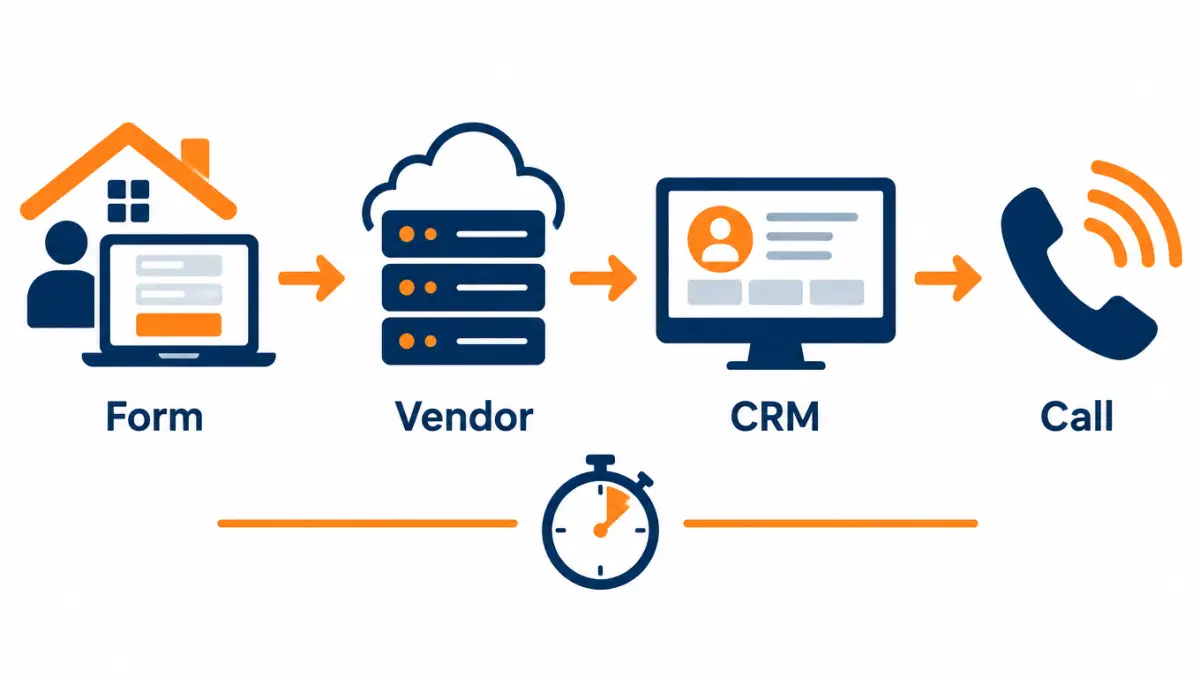
Measure delivery speed by comparing three timestamps on every lead: when the homeowner submitted, when the vendor delivered, and when your rep first dialed. The first gap is the vendor's responsibility, the second is yours. Track both for every lead in a test batch, because a slow vendor and a slow team look the same in a sales report.
Speed matters because homeowners who just asked for a quote are most reachable in the first minutes and hours after they submit. Our speed-to-lead guide covers the follow-up side in depth. This section is about checking that the vendor is not eating your window before the lead reaches you.
Set up the three timestamps
- Submission time. Take this from the consent record, not from the vendor's delivery payload, because the payload might show the time the vendor processed the lead.
- Delivery time. Your CRM or dialer records when the lead was created. If leads arrive by email, use the email's received time. If they arrive by a vendor portal you check manually, delivery time is when the lead appeared in the portal, which you may need the vendor to export.
- First dial time. Your dialer or CRM activity log has this. If reps dial from personal phones, you cannot measure this reliably, which is a problem worth fixing before you test vendors.
Create two calculated fields in your CRM: vendor delay (delivery minus submission) and team delay (first dial minus delivery). Most CRMs can do this with a formula field or a simple export to a spreadsheet.
What the numbers tell you
| Pattern | Likely meaning | What to ask the vendor |
|---|---|---|
| Vendor delay consistently under a few minutes | Real-time posting is working | Nothing, keep monitoring |
| Vendor delay steady at a round number (e.g., exactly one hour) | Leads are batched and sent on a schedule | Can you post in real time? Why the batching? |
| Vendor delay varies wildly, some leads days old | Mixed sources, or leads held and sold later | Where did the oldest leads come from? Are any aged? |
| Vendor delay fine but some leads show submission dates weeks earlier | Possible recycled or re-sold records | Was this lead sold to anyone before us? |
| Leads arrive mostly outside business hours | Traffic timing, or batch uploads overnight | When do your campaigns run? |
Test the delivery path, not just the vendor
Before you blame a vendor for slow leads, test your own plumbing. Ask the vendor to send a test lead to your integration and time it end to end. Common internal causes of delay include a CRM workflow that waits before assigning, a round-robin rule that skips reps who are offline without falling back to someone else, and email delivery landing in a shared inbox nobody watches on weekends.
If your team works leads from a dialer, have the vendor post directly to the dialer or to a CRM that pushes to the dialer within seconds. Each manual hop adds minutes.
Freshness beyond the timestamp
Timestamps can be wrong or re-stamped. A few other checks help confirm freshness:
- Ask the homeowner. On the first call, a light question like "you filled out a solar form recently, is that right?" tells you whether the homeowner remembers. If many homeowners in a batch say they filled out a form weeks ago or not at all, the timestamp is not telling the whole story.
- Look for duplicate patterns. If the same homeowner appears twice in your CRM from the same vendor with different dates, ask why.
- Watch for other installers. Homeowners will often tell your rep that "three other companies called already." One mention is normal if the homeowner shopped around. A pattern across a batch sold as exclusive is a problem.
A worked latency example (illustrative)
Suppose in a 60-lead test batch you see these medians: vendor delay of 2 minutes on 50 leads, and vendor delay of 26 hours on the other 10. Your team delay is 4 minutes during business hours and 14 hours for leads that arrive after 7 p.m.
That tells you two separate things. First, about one in six leads came by a slower path, and you should ask the vendor to identify those 10 leads' sources. Second, your team is losing the after-hours leads overnight, which is your problem to fix with an evening shift, an auto-text or a call service, not the vendor's. Without the two timestamps you would have blamed one or the other for everything.
Key takeaway: Split every delay into the vendor's part and your part. Fixing the wrong one wastes the test.
What should you ask a vendor's installer references?
Ask installer references specific, numbers-based questions about contact rate, appointment rate, exclusivity, refund handling and how the vendor behaved when something went wrong. General questions like "are you happy with them?" get polite answers. Questions about the last bad batch and how the vendor responded get useful ones. Talk to at least two references in markets like yours.
References are hand-picked by the vendor, so they will skew positive. That is fine. Your goal is not to find out whether the vendor has happy customers. It is to learn how the relationship works in practice and whether the reference's business resembles yours.

Before the call
- Ask the vendor for references that match your market type, team size and lead product. A reference buying commercial leads in a different region tells you little about residential leads in yours.
- Look up the reference company yourself. Confirm it is a real installer with a website, a license where your state requires one, and reviews from homeowners. You are checking that the reference is not a friend of the vendor.
- Prepare your questions in writing and take notes in the same template for every reference, so you can compare.
A reference call script
Open with something like: "Thanks for taking a few minutes. We're thinking about buying from [vendor] and I want to understand how it actually works day to day. Nothing you say goes back to them."
Then work through these questions:
- Context. How long have you bought from them? What lead type, roughly how many per month, and in what area?
- Contact rate. Out of every ten leads, how many do you actually reach in conversation? How does that compare with your other sources?
- Appointment and sit rate. How many of those turn into appointments that actually happen?
- Exclusivity in practice. How often do homeowners say other installers already called them?
- Speed. How quickly do leads arrive after the homeowner submits? Have you ever seen old leads come through?
- Refunds. When you return a lead, how fast is it handled? Have they ever refused a return you thought was fair? How was that resolved?
- Consent records. Have you ever requested one? How long did it take?
- Problems. Tell me about the worst batch you got from them. What did they do about it?
- Changes. Has the price, quality or terms changed since you started? Were you given notice?
- Staff. Who do you deal with there, and do they answer quickly?
- Exit. If you wanted to stop tomorrow, could you? Have you ever paused?
- Honest take. What would you tell a friend before they signed?
Reading between the lines
| What you hear | What it may mean |
|---|---|
| Specific numbers, given without hesitation | The reference tracks results and is likely candid |
| "They're great" with no numbers | Either not tracking, or not comfortable sharing |
| A story about a bad batch and a fair fix | Good sign: problems happen, response matters |
| "Never had a single problem" | Possible, but probe further; every source has bad weeks |
| Reference buys a different product or region | Discount the answers for your decision |
| Reluctance to discuss refunds | Ask the vendor directly how disputes are handled |
Go beyond the vendor's list
If you know other installers through a trade association, a distributor or a local network, ask whether anyone has bought from the vendor. Unsolicited references are more balanced than the ones the vendor provides. Keep the conversation factual, and avoid sharing the vendor's confidential pricing if your agreement restricts it.
You can also check public records. The FTC's consumer complaint data and enforcement actions and your state attorney general's office are places to look for regulatory history. A search of court records in the vendor's home state can show whether it has been named in TCPA lawsuits. One lawsuit does not prove wrongdoing, since TCPA suits are common, but a pattern is worth asking about.
Key takeaway: Ask references about their worst batch and what the vendor did. The answer predicts your relationship better than any praise.
How do you redline a solar lead vendor contract?
Redline a solar lead vendor contract by going clause by clause through definitions, exclusivity, filters, delivery, pricing, minimums, refunds, consent records, data use, indemnity and termination, and rewriting any clause that relies on the vendor's discretion. Vague words like "reasonable," "substantially" or "at our sole discretion" are where disputes start. Have your counsel review the final draft before signing.
The contract section earlier in this guide lists what terms to look for. This section shows how to mark them up. The examples below are illustrative wording to discuss with your attorney, not legal advice and not language to paste in unchanged.

Definitions
Most problems trace back to an undefined word. Make sure the agreement defines at least:
- Lead. What fields a lead must contain to count as delivered.
- Exclusive. Sold to one buyer only, never resold, including after rejection or return, and never sold later as aged data.
- Valid phone number. Connects to the named homeowner, not disconnected, not a business line if you buy residential.
- Homeowner. Self-reported, verified against property records, or both. Which one, exactly.
- Delivery. The moment the lead posts to your system, not the moment the vendor generates it.
- Duplicate. A lead matching one already delivered to you within a stated lookback period, by phone, email or address.
| Vague clause (illustrative) | Tighter alternative to discuss with counsel (illustrative) |
|---|---|
| "Leads are exclusive to Buyer." | "Each Lead is sold to Buyer only and will not be sold, shared, transferred or licensed to any third party at any time, including after rejection or return." |
| "Vendor will use reasonable efforts to verify leads." | "Before delivery, Vendor will perform the following checks on every Lead: [list]." |
| "Refunds at Vendor's discretion." | "Vendor will credit any Lead returned within [X] days of Delivery for the following reasons: [list]." |
| "Pricing subject to change." | "Vendor will give Buyer [X] days' written notice of any price change. Buyer may terminate without penalty during the notice period." |
| "Consent records available upon request." | "Vendor will provide the consent record for any Lead within [X] business days of written request, for [retention period]." |
Filters and service area
List your filters in an exhibit: ZIP codes or counties, property type, homeowner status, monthly bill threshold, roof or shade questions, credit range if collected, and any exclusions (mobile homes, renters, commercial addresses). The refund clause should refer to this exhibit, so "outside filters" has a fixed meaning.
Pricing, minimums and pauses
Look for:
- Price per lead or per appointment, stated for each product.
- Whether price can vary by ZIP code and how you are told.
- Minimum monthly spend or volume, and what happens if the vendor cannot fill it.
- Your right to pause without losing your territory, and how much notice you must give.
- Prepayment terms and what happens to unused prepaid balance if you leave.
That last point gets overlooked. If you prepay and then stop, can you get the balance back in cash, or only as credit that expires? Write it down.
Refunds and replacements
Point the refund clause to a list of accepted reasons and a list of excluded reasons, a window that starts at delivery (or at the scheduled time for appointments), a process for submitting returns, a time limit for the vendor to respond, and the form of remedy (credit, replacement, cash). If credits expire, the expiry should be long enough that you can use them.
Consent records and compliance
Ask counsel to consider language covering: the vendor's representation that each lead was collected with consent sufficient for the contact methods you will use; delivery of consent records on request within a set time; retention of records for a set period; notice to you if the vendor receives a complaint or regulatory inquiry about leads sold to you; and handling of opt-out requests the vendor receives.
Data ownership and use
Who owns the lead data after you buy it? Can the vendor use your returned or rejected leads for anything? Can it use your conversion data (if you share it) to sell to others? Many installers share disposition data with vendors to improve targeting, which is reasonable, but the contract should limit how that data is used.
Indemnity and insurance
Indemnity clauses say who pays if a claim arises. An indemnity from the vendor is only as good as the vendor's ability to pay. Ask whether the vendor carries insurance that covers TCPA or privacy claims, and ask counsel whether to require a certificate. Remember that an indemnity does not stop a homeowner from suing you.
Termination and exit
You want to be able to leave on short notice, ideally without penalty, and you want the vendor to stop delivering on the termination date. The contract should say what happens to pending refunds, prepaid balances and leads delivered after termination.
A redline checklist you can print
- Every key term is defined, including exclusive, duplicate, delivery and homeowner
- Filters are listed in an exhibit and referenced by the refund clause
- Verification checks are listed, not described as "reasonable efforts"
- Price change notice period and right to exit during notice
- Minimums, pause rights and territory protection while paused
- Prepaid balance treatment on exit
- Refund reasons, exclusions, window start, window length, response time, remedy
- Credit expiry, if any
- Consent record delivery time and retention period
- Complaint and regulatory inquiry notification
- Data ownership and limits on vendor use of your data
- Indemnity and insurance reviewed by counsel
- Exit notice period and post-termination handling
Key takeaway: Replace every "reasonable," "substantially" and "at our discretion" with a list, a number or a date. If the vendor will not agree, you have learned how disputes will go.
Which solar lead red flags matter most?
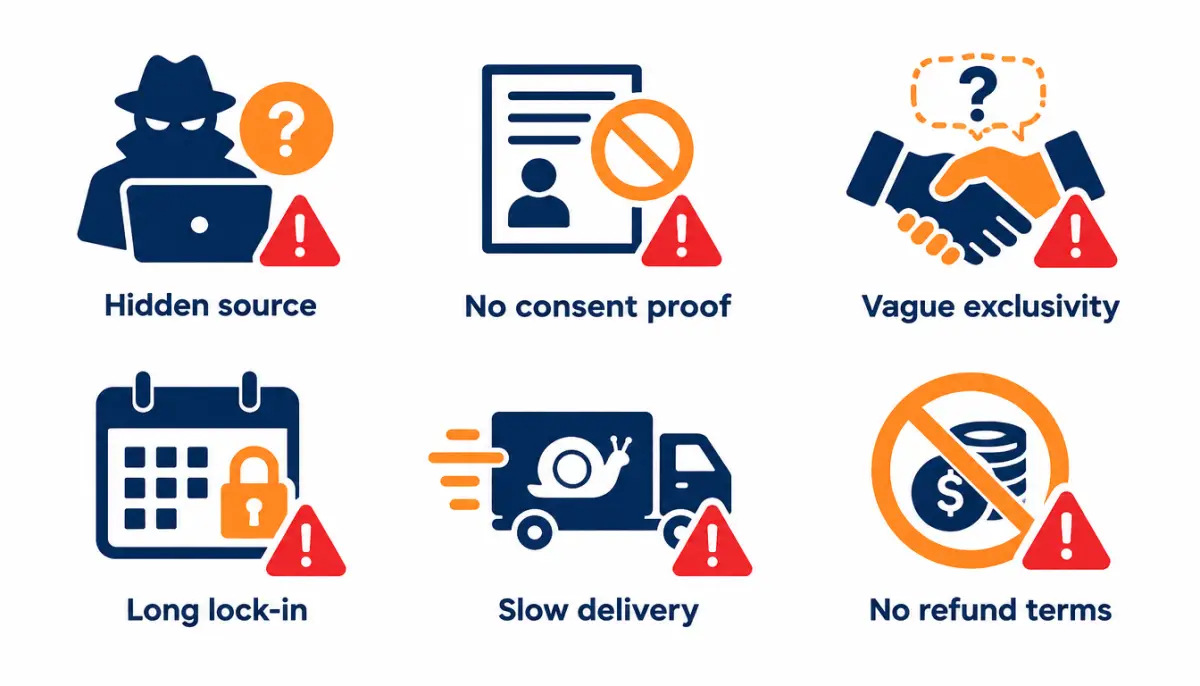
The red flags that matter most are the ones that put you at legal risk or make results impossible to measure: no consent records, disclosures that do not name you, refusal to show capture pages, resold "exclusive" leads, and long commitments before a test. Price and sales-style problems matter too, but they cost money rather than create liability. Rank flags by severity before deciding to walk away.
The earlier red flags section describes each warning sign. Use the grid below to triage them. A single severe flag is usually enough to stop. Several moderate flags in combination should make you cautious. Minor flags are worth noting and asking about.
Severe: stop or get counsel involved
| Red flag | Why it is severe | What to do |
|---|---|---|
| Vendor cannot or will not produce a consent record | You cannot show the homeowner agreed to be contacted by you | Do not call leads at scale until resolved |
| Disclosure does not name your company or link to a list that includes you | Consent may not cover your calls | Ask counsel; require named disclosure |
| Capture pages imitate a utility or government program | Homeowners were misled; complaints likely | Walk away |
| Your test submission was called by many unnamed companies | Data is being shared well beyond the disclosure | Walk away or demand explanation in writing |
| Leads sold as exclusive turn up with other installers repeatedly | Core promise is false | Stop buying; request refunds |
| Vendor asks you to remove or alter consent language | Shifts risk onto you | Walk away |
Moderate: proceed only with conditions
| Red flag | Why it matters | Condition to proceed |
|---|---|---|
| Long contract or large prepayment before a test | Limits your ability to exit if results are poor | Insist on a test batch first |
| Vague refund policy | Disputes will be decided by the vendor | Get reasons and window in writing |
| Leads arrive in scheduled batches, not real time | Lower contact rates; possible holding and reselling | Require real-time posting or a lower price that reflects it |
| Affiliate sources the vendor cannot list | Quality and consent are hard to audit | Ask for audit process and right to exclude sources |
| Price far below other quotes for the same product and area | Often signals shared or recycled data | Test with a small batch and audit closely |
| Pressure to sign today | Removes your time to check | Take the time anyway |
Minor: note and ask
| Red flag | Why it is worth asking |
|---|---|
| No physical business address on the website | Makes the company harder to hold accountable |
| Sales rep cannot answer basic sourcing questions | May just be a new rep; ask for someone who can |
| References all in very different markets | Results may not transfer to yours |
| Testimonials with no names or specifics | Weak evidence, not proof of a problem |
| Out-of-date incentive language on capture pages | Homeowners may expect something you cannot offer |
How to weigh combinations
Two moderate flags in the same area (for example, vague refunds plus a large prepayment) are as serious as one severe flag, because together they mean you will pay upfront and have no clear way to recover money for bad leads. Moderate flags in different areas, such as batched delivery plus references from other markets, are reasons for a smaller test, not necessarily a reason to stop.
Write your findings down using the severity grid and share them with whoever approves vendor spend. A one-page summary with each flag, its severity and the vendor's answer makes the decision easier to explain later.
Key takeaway: One severe flag is a stop. Two moderate flags in the same area are a stop. Minor flags are questions.
How should vetting change by installer size?
Vetting should scale with how much a bad vendor can cost you. A solo owner-operator needs a short, fast vet focused on consent and refunds because one wasted month hurts. A mid-size installer should run a structured side-by-side test. A multi-state company needs a formal procurement process with legal review, source audits and ongoing monitoring by someone who owns the vendor relationship.
The checks are the same at every size. What changes is how deep you go, who does the work, and how much volume you put at risk before the vendor has proven itself.
Solo installer or owner-operator
You probably do the selling, the site visits and the paperwork. Time is your scarcest resource, and you cannot afford a vendor that floods you with unreachable names.
- Focus on: consent record with your company named, a clear refund policy, no long contract, a small first order.
- Skip or simplify: a formal RFP. A one-page list of the RFP questions sent by email is enough.
- Test design: one vendor at a time, a small batch you can personally work within a few days of delivery, tracked in a simple spreadsheet if you have no CRM.
- Watch for: volume you cannot handle. Leads that wait two days for your callback will look bad no matter who sold them. Order what you can call the same day.
- Decision rule (illustrative): if you cannot reach a reasonable share of the batch on the phone, or the homeowners do not remember asking about solar, stop and ask for a credit before buying more.
Exclusive leads or booked appointments often fit this size best because you are not racing other installers. Our pages on exclusive solar leads and solar appointments explain how each works.
Small team (2 to 10 sales staff)
You have a setter or two, a few closers and probably a CRM. You can run a proper test, but you rarely have a dedicated operations person.
- Focus on: side-by-side testing of two vendors with identical filters, the three-timestamp delivery check, and consistent dispositions.
- Assign an owner: one person who requests consent records, files refunds and updates the scorecard weekly. Without an owner, refunds go unclaimed and data goes stale.
- Test design: as described in the controlled test section above, with enough leads per vendor for each rep to get a fair share.
- Watch for: rep bias. Reps quickly decide one source is "bad" and work it less. Assign leads by round-robin and audit call attempts per lead.
Mid-size installer (10 to 50 sales staff, one or a few states)
At this size you likely buy from several sources and have someone in marketing or sales operations who can run reports.
- Focus on: written RFP responses, contract redlines by counsel, quarterly form audits, source-level reporting (asking vendors to tag each lead with a source or campaign ID).
- Test design: stagger vendor tests so you are not changing more than one variable at a time. Run each new vendor alongside a benchmark source you already trust.
- Compliance: have counsel review your calling program, including how consent records from each vendor are stored and how opt-outs are honored across dialers.
- Watch for: vendor sprawl. Each additional vendor adds integration work, compliance review and reporting overhead. Retire weak vendors rather than keeping them "just in case."
Multi-state or enterprise installer
You may buy at significant volume, run multiple call centers and operate in states with different telemarketing rules.
- Focus on: formal procurement with security and privacy questionnaires, legal review of every agreement, source audits including affiliate lists, regular consent record sampling, and contractual notice of complaints.
- State-level differences: several states have their own telemarketing statutes, registration requirements and calling-hour rules that can be stricter than federal law. Have counsel map requirements by state and make sure each vendor's consent language and your calling practices meet them.
- Test design: pilot by state or region, with separate scorecards, because a vendor that performs in one market may not in another. Our guide to solar lead cost by state explains why markets differ.
- Watch for: concentration risk. If one vendor supplies most of your pipeline, a quality drop or a legal problem at that vendor stalls your business. Keep at least one alternative source warm.
Summary table
| Size | Vetting depth | Owner | Test format | First order (illustrative) |
|---|---|---|---|---|
| Solo | Core checks, email RFP | Owner | One vendor, small batch | What you can call same day |
| Small team | Core checks plus timestamps | Named ops lead | Two vendors side by side | Enough per rep for a fair share |
| Mid-size | Full RFP, counsel redline | Sales or marketing ops | New vendor vs benchmark | Staggered by vendor |
| Multi-state | Formal procurement, audits | Vendor manager plus counsel | Pilot by state or region | Per-market pilots |
Key takeaway: The questions do not change with size. The amount you risk before a vendor proves itself should.
How do you vet commercial solar lead providers differently?
Vet commercial solar lead providers by checking who the contact is inside the business, whether that person can make or influence the decision, whether the site is actually suitable, and how the lead was gathered, since many commercial leads come from research or outbound work rather than inbound forms. Sales cycles are longer, so judge results over months, and agree in writing what makes a commercial lead valid.
Commercial and industrial leads behave differently from residential ones. A homeowner who fills out a form usually owns the roof and makes the decision. A facilities manager who downloads a guide might have neither the authority nor the budget. Our page on commercial solar leads covers the product itself. Here we focus on the vetting differences.

Who is the contact?
Ask the vendor to define the contact role for each lead. Owner, CFO, facilities director and operations manager can all be valid, but they move differently. A lead that names a receptionist or a generic info@ address is not the same product. Agree which roles count as qualified and put that in the filter exhibit.
Does the business control the roof or land?
Many businesses lease their buildings. A tenant may be interested in solar but unable to approve roof work without the landlord. Ask whether the vendor collects ownership or lease status and, if so, whether it is self-reported or checked. If not collected, budget extra discovery time on every lead.
Is the site plausible?
Commercial projects depend on roof size and condition, structural capacity, electrical service, utility rate structure and interconnection. A vendor cannot assess all of that, but it can collect basic facts such as building type, approximate roof area and monthly or annual utility spend. Ask what is collected and how.
How was the lead gathered?
Commercial leads come from many methods: inbound forms, content downloads, event lists, outbound calling by the vendor, appointment setting, or data lists. Each needs a different check.
| Method | What to check |
|---|---|
| Inbound form | Same form audit and consent record review as residential |
| Content download | Did the person request a solar quote, or just a guide? Intent is often lower |
| Outbound calling by vendor | How the vendor found the contact, and whether its own calling met the rules that apply to business numbers |
| Appointment setting | Who confirmed the meeting, what was said, and whether the decision-maker will attend |
| Data list | Not a lead in the inbound sense; treat as prospecting data and price accordingly |
Rules for calling businesses differ from rules for calling consumers in some respects, and many business contacts use mobile phones. Confirm with counsel how the TCPA and state laws apply to your commercial calling.
Measuring results on a long cycle
Commercial sales can take many months from first meeting to signed contract. You cannot wait that long to decide whether to keep a vendor. Use leading indicators instead:
- Share of leads where you reach the named contact
- Share where the contact confirms authority and interest
- Share that agree to a site assessment or share utility bills
- Share that reach proposal stage
Set expectations with the vendor about which of these milestones count, and revisit the decision at proposal stage rather than at close.
Refund terms for commercial leads
Residential refund lists (disconnected phone, wrong contact, outside filters) still apply. Add commercial-specific reasons to discuss with the vendor: the contact has left the company, the business is outside the agreed size or industry, the business does not occupy the stated site, or the "appointment" was with someone who has no role in the decision. Get the list in writing.
Key takeaway: For commercial leads, verify authority, site control and how the lead was gathered. Judge vendors on proposal-stage milestones, not closes.
How should you vet each lead type?
Vet each lead type against the specific promise that type makes. Exclusive leads promise one buyer, so test exclusivity. Shared leads promise lower price, so test whether the price offsets the competition. Aged leads promise cheap volume, so test consent and record age. Live transfers and appointments promise a conversation or a meeting, so test what was said and whether it happens.
A single checklist misses the point of each product. Use the decision tree below to pick which checks get the most weight, then apply the rest of this guide around them.
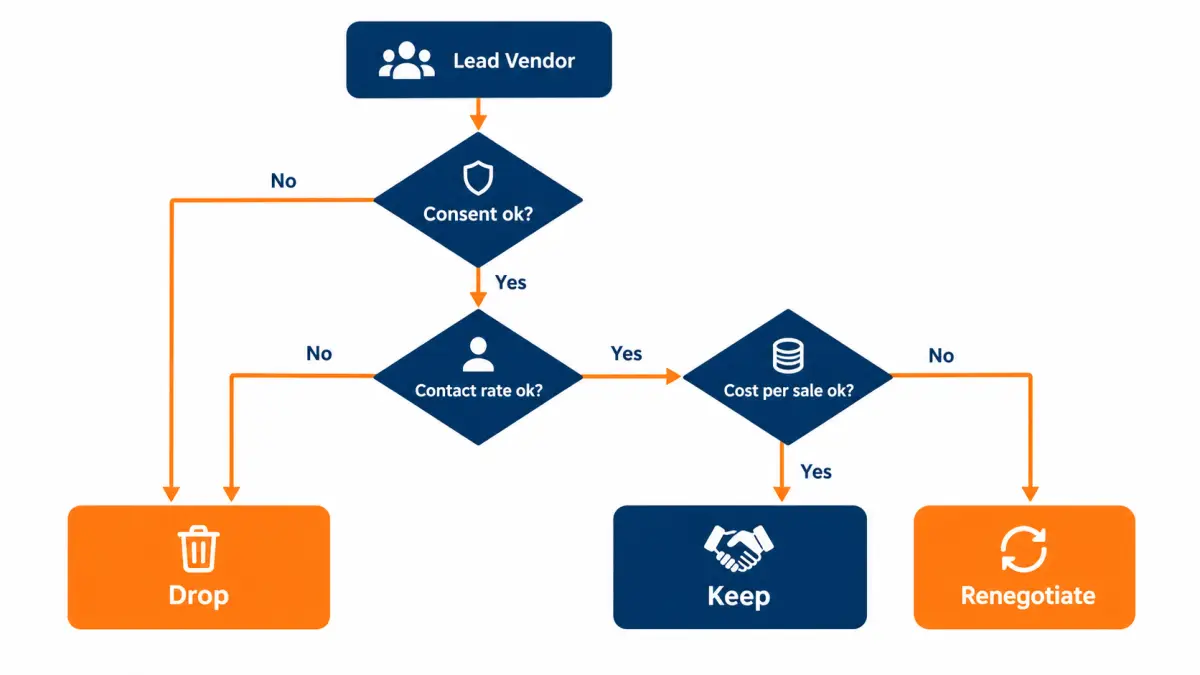
Exclusive leads
The core promise is that no other installer gets the same homeowner. Weight your vetting toward:
- A one-sentence written definition of exclusive that covers resale after return and sale as aged data
- Your own test submissions, to see who calls
- Asking homeowners in the first call whether others have called
- Technical controls the vendor uses to stop a lead going to two buyers
Our comparison of exclusive vs shared solar leads runs through the cost-per-sale math between the two.
Shared leads
Shared leads are sold to several installers, usually at a lower price per lead. Vetting is less about exclusivity and more about how many buyers there are and how fast you can get there first.
- Ask the maximum number of buyers per lead and get it in writing
- Ask whether the disclosure names every buyer
- Measure your speed carefully: with shared leads, the first credible caller has an advantage
- Compare cost per held appointment, not price per lead, against your exclusive sources
Aged leads
Aged leads are older records sold at a discount, often after they were first sold as fresh leads. The main risks are consent and data decay.
- Ask the age range and how age is measured (from original submission, not from when the vendor acquired the list)
- Ask whether the original consent covers your company and the contact methods you plan to use; confirm with counsel before calling or texting
- Expect more disconnected numbers and changed circumstances, and price your test accordingly
- Scrub against the National Do Not Call Registry and your internal do-not-call list before any outreach. The FTC's National Do Not Call Registry for businesses explains access requirements
More on this category, including what to ask, is on our page about aged solar leads. Availability for your territory is confirmed on the call.
Live transfers
A live transfer is a homeowner connected to your rep by phone, usually after a short qualifying call by the vendor's agent. Vet the conversation itself.
- Ask for call recordings of sample transfers, with homeowner details removed if needed
- Ask what script the vendor's agents use and what qualifies a homeowner for transfer
- Confirm how the original consent covered the vendor's outbound call, if it was outbound
- Track how many transfers reach a rep in real time versus a voicemail or hold queue on your side
Our page on solar live transfer leads covers the product in depth. Availability for your territory is confirmed on the call.
Booked appointments
Appointments promise a meeting. The key questions are who booked it, what the homeowner was told, and what happens if it does not sit.
- Ask how appointments are confirmed (call, text, both) and how close to the meeting time
- Ask what the homeowner is told about the meeting's purpose and length
- Get the no-show and replacement policy in writing, with the window measured from the scheduled time
- Track sit rate by vendor, separately from close rate
Quick reference
| Lead type | Primary check | Secondary checks | Key metric |
|---|---|---|---|
| Exclusive | Exclusivity definition and proof | Consent naming you, speed | Contact rate, competitor mentions |
| Shared | Max buyers per lead | Your speed, disclosure | Cost per held appointment |
| Aged | Consent coverage and age | DNC scrub, data decay | Valid contact rate |
| Live transfer | Call recordings and script | Consent for vendor's call | Transfers reaching a rep |
| Appointment | Confirmation process | No-show policy | Sit rate |
Key takeaway: Weight your checks toward the promise each lead type makes. Testing exclusivity on a shared lead, or sit rate on a raw lead, measures the wrong thing.
How do you judge lead quality from the first homeowner call?
Judge lead quality on the first call by checking four things in order: is this the right person, do they remember asking about solar, do they meet your filters, and are they open to a next step. Record the answer to each as a structured disposition, not a free-text note, so you can compare vendors on the same terms after the test batch ends.
The first call is your best source of truth about a vendor. Consent records and contracts tell you what should be true. The homeowner tells you what is true. The trick is capturing it in a way you can count.

A first-call script built for vetting
This script is designed to collect vetting data without making the call feel like an interrogation. Adapt it to your own style and have your compliance lead review it.
Opening. "Hi, is this [first name]? This is [rep] with [your company]. You requested information about solar for your home at [street], is that right?"
- If yes: continue.
- If "I don't remember" or "no": "No problem. It may have been a form on a website about solar or energy savings. Does that sound familiar?" Record the answer either way.
- If wrong person: apologize, ask if the named person is reachable at another time, record "wrong person."
Remembering and source. "Do you remember roughly when you filled that out, or what site it was on?" Many homeowners will not remember the site name, which is fine. You are listening for "weeks ago," "I never did that," or "I filled out something about a free government program."
Other companies. "Have any other solar companies reached out to you about this?" Record the answer as none, one, or several.
Filters. Confirm the fields you paid for: homeowner, property type, approximate bill. "And you own the home, is that right? Roughly what does your electric bill run in a typical month?"
Next step. Move into your normal qualifying and appointment-setting conversation.
Opt-out. If the homeowner asks not to be contacted, end politely, record the request and make sure it flows to your internal do-not-call list across every system and dialer.
Disposition codes for vendor comparison
Use a fixed list. Free-text notes are impossible to compare at the end of a test.
| Code | Meaning | Refund-eligible under typical policies? |
|---|---|---|
| NC-DISC | Number disconnected or not in service | Usually yes |
| NC-WRONG | Reached a person who is not the named homeowner and does not know them | Usually yes |
| NC-NOANS | No answer after full cadence | Usually no |
| C-NOREC | Reached homeowner, does not recall any solar inquiry | Ask vendor; often disputed |
| C-OUTFLT | Reached homeowner, outside agreed filters (renter, wrong area, etc.) | Usually yes |
| C-NOINT | Reached homeowner, recalls inquiry, not interested now | Usually no |
| C-OTHERS | Reached homeowner, says several other installers called | Not a refund reason, but key for exclusivity |
| C-APPT | Appointment set | n/a |
| C-FOLLOW | Interested, follow-up scheduled | n/a |
| OPT-OUT | Asked not to be contacted | Not usually refundable; must be honored |
Note that a homeowner can carry two signals at once (for example, appointment set and several other installers called). Use a separate yes/no field for "other installers mentioned" so you do not lose that signal when the primary code is a success.
Coaching reps to collect clean data
- Make the codes required. Do not let reps close a lead without a disposition.
- Audit a sample. Listen to a handful of calls per vendor per week and check that codes match what happened.
- Do not reward or punish by source. If reps believe one vendor is bad, they may code its leads more harshly. Keep the conversation focused on accuracy.
- File refunds from codes. The vendor management owner can pull every NC-DISC, NC-WRONG and C-OUTFLT within the refund window and submit them in one batch.
Turning call data into a vendor signal
At the end of a test batch, calculate for each vendor:
- Valid contact rate: leads reached and confirmed as the right person, divided by leads delivered
- Recall rate: leads reached who remember the inquiry, divided by leads reached
- Competitor mention rate: leads reached who mention other installers, divided by leads reached
- Filter match rate: leads reached who meet filters, divided by leads reached
- Appointment rate: appointments set, divided by leads delivered
Low recall with high competitor mentions points to sourcing or exclusivity problems. Low filter match points to weak verification. Low valid contact with high disconnected numbers points to data quality. Each pattern leads to a different conversation with the vendor.
Key takeaway: Every first call is a data point about the vendor. Fixed disposition codes turn hundreds of calls into a comparison you can act on.
How do you build a vendor scorecard dashboard?
Build a vendor scorecard dashboard with one row per vendor and columns for the full funnel from delivered lead to closed sale, plus quality signals like refund rate and competitor mentions, all calculated the same way for every source. Update it weekly during tests and monthly afterward. The dashboard turns the scorecard from the controlled test section into an ongoing management tool.
You do not need business intelligence software. A spreadsheet fed by a weekly CRM export works for most installers. What matters is that definitions are fixed and that cost is attributed correctly.

Columns to include
| Column | Definition | Source |
|---|---|---|
| Leads delivered | Count of leads posted to your system in period | CRM |
| Spend | Invoiced amount for those leads, minus credits received | Invoices |
| Refund requests | Count submitted | Vendor management log |
| Refunds approved | Count approved | Vendor response |
| Valid contact rate | Reached and confirmed right person / delivered | Dispositions |
| Recall rate | Remember inquiry / reached | Dispositions |
| Competitor mention rate | Mention other installers / reached | Dispositions |
| Appointment rate | Appointments set / delivered | CRM |
| Sit rate | Appointments held / appointments set | CRM |
| Close rate | Signed contracts / appointments held | CRM |
| Cost per held appointment | Net spend / appointments held | Calculated |
| Cost per sale | Net spend / signed contracts | Calculated |
| Median vendor delay | Delivery minus submission | Timestamps |
| Median team delay | First dial minus delivery | Timestamps |
A worked dashboard example (illustrative)
The table below uses invented round numbers to show how the calculations work. They are not benchmarks and do not describe any real vendor.
| Metric | Vendor A | Vendor B |
|---|---|---|
| Leads delivered | 100 | 100 |
| Net spend | $X | $1.5X |
| Valid contact rate | 45% | 65% |
| Competitor mention rate | 60% | 10% |
| Appointment rate | 8% | 15% |
| Sit rate | 60% | 75% |
| Held appointments | 4.8 | 11.25 |
| Cost per held appointment | $X ÷ 4.8 ≈ 0.21X | $1.5X ÷ 11.25 ≈ 0.13X |
In this illustration, Vendor B costs 50 percent more per lead but produces held appointments at roughly two thirds the cost of Vendor A. The high competitor mention rate on Vendor A also suggests its leads are being shared, which matters if it sold them as exclusive. You can run your own numbers through our solar lead cost calculator, and the solar lead ROI guide walks through cost-per-sale math in more detail.
Attribution rules to agree internally
- Count each lead once. If a homeowner arrives from two vendors, credit the first delivery and flag the second as a duplicate for refund purposes.
- Attribute by delivery date, not close date. Closes from leads delivered in March belong to March's cohort, even if they sign in June. This keeps vendor comparisons fair.
- Net out credits in the period you receive them, or keep a separate column so spend is not overstated.
- Separate re-engaged leads. If a lead goes cold and comes back via a different channel months later, decide in advance how you will credit it.
Review cadence
- Weekly during a test: delivered, contact, recall, competitor mentions, refunds. These move fast and reveal problems early.
- Monthly ongoing: the full funnel, with closes for older cohorts filling in.
- Quarterly: a vendor review meeting (see the lifecycle section below) using the dashboard as the agenda.
Key takeaway: Fix definitions once, attribute by delivery cohort, and compare vendors on cost per held appointment and cost per sale, never on price per lead alone.
How do you manage a lead vendor after onboarding?
Manage a lead vendor after onboarding with a simple lifecycle: a test period with tight monitoring, a scale-up period with weekly checks, a steady state with monthly reviews and quarterly audits, and a planned exit if results slip. Each stage has its own checks, and the vendor should know in advance what will trigger a pause or an exit.
Vetting does not stop once you sign. Vendors change sources, traffic quality shifts, and staff turn over on both sides. The installers who get consistent results from purchased leads treat vendor management as an ongoing job.
Stage 1: Vet
Everything earlier in this guide: form audit, consent records, references, RFP, contract redline. Output: a signed agreement with a test batch.
Stage 2: Test
Run the controlled test. Check timestamps and dispositions weekly. File refunds promptly. Request a consent record or two at random. Output: a go, no-go or extend decision based on cost per held appointment and quality signals.
Stage 3: Scale
Increase volume in steps rather than all at once. A vendor that performed at small volume may need to bring in new traffic sources to deliver more, and new sources mean new quality. After each step up:
- Repeat the form audit for any new URLs
- Watch recall and competitor mention rates for a change
- Confirm delivery delay has not grown
If quality drops at higher volume, step back to the previous level and talk to the vendor about why.
Stage 4: Steady state
Monthly dashboard review. Quarterly:
- Repeat form audit on current URLs
- Request consent records for a random sample of recent leads
- Review refund handling: approval rate and response time
- Review any homeowner complaints that mention the lead source
- Hold a short vendor review meeting to discuss results and upcoming changes
Stage 5: Exit or reset
Agree internally on exit triggers before you need them. Examples to adapt:
- Cost per held appointment above your target for two consecutive months
- Any severe red flag from the grid above
- Repeated failure to produce consent records on request
- A homeowner complaint or legal demand tied to the vendor's sourcing that the vendor cannot explain
When you exit, give notice under the contract, stop delivery on the agreed date, collect outstanding refunds and prepaid balances, and keep all consent records you have received. Remove the vendor's integration credentials from your CRM and dialer. Write a short note on why you exited, so the next person who considers that vendor has the history.
The quarterly vendor review agenda
- Results since last review (dashboard)
- Changes on the vendor side: new sources, staff, pricing, products
- Changes on your side: territory, filters, team capacity
- Refund and record request performance
- Complaints and compliance items
- Decision: keep, adjust, reduce or exit
Key takeaway: Re-vet every time a vendor scales or changes sources. Decide your exit triggers before you need them.
What do real-world vetting scenarios look like?
Vetting scenarios usually follow one of a few patterns: a cheap vendor whose leads turn out to be shared, a clean vendor whose results are hurt by slow follow-up, a vendor whose quality drops as it scales, or a vendor whose consent records do not match its pages. The walkthroughs below are illustrative composites, not real clients or vendors, and show how the checks in this guide catch each one.
Each scenario lists what the installer saw, which check exposed the issue, and what they did next.
Scenario 1: The bargain that was shared (illustrative)
Situation. A small residential installer in a competitive suburban market is quoted a per-lead price well below two other quotes for "exclusive" leads. The sales rep promises plenty of volume and asks for a three-month commitment with a prepayment.
What the checks showed.
- The installer asked for a test batch instead of three months. The vendor agreed after some pushback, which was a moderate flag already.
- During the form audit, the owner submitted a test lead on the vendor's main page. Within an hour, four different solar companies called, none of them named on the page.
- In the test batch, the competitor mention rate was high: most homeowners reached said they had already spoken with other installers.
What they did. The owner asked the vendor to explain in writing how the leads were exclusive. The answer described "exclusive per ZIP code per day," a different promise. The owner requested credits under the refund clause for leads outside filters, stopped buying and put the budget into a vendor whose definition of exclusive matched the contract.
Lesson. A low price plus pressure to commit is a combination worth testing hard. The form audit cost an hour and settled the question.
Scenario 2: The good vendor that looked bad (illustrative)
Situation. A mid-size installer tests two vendors. Vendor X looks far worse on appointment rate. The sales manager wants to cut it.
What the checks showed.
- The three-timestamp analysis showed Vendor X delivered quickly, but most of its leads arrived in the evening, because its campaigns ran at night.
- The installer's setters went home at 6 p.m., so Vendor X's leads waited until morning. Team delay, not vendor delay, explained the gap.
- Recall rates and competitor mention rates were similar for both vendors.
What they did. The installer added an evening setter shift and an automated text acknowledging new leads immediately (after counsel reviewed the text program). In the next batch, Vendor X's appointment rate closed most of the gap.
Lesson. Split delay into the vendor's share and yours before deciding. The speed-to-lead guide covers how to set up after-hours coverage.
Scenario 3: Quality slipped at scale (illustrative)
Situation. A multi-state installer had good results with a vendor at modest volume and tripled the order in one step.
What the checks showed.
- Weekly monitoring showed recall rate dropping and disconnected numbers rising within two weeks of the increase.
- The vendor's lead payloads began carrying a new campaign ID tied to an affiliate domain the installer had never audited.
- A form audit of the new domain found a headline promising "free solar panels," which explained why homeowners did not recognize the inquiry.
What they did. The installer stepped volume back to the previous level, asked the vendor to exclude the new affiliate source, and filed refunds for leads outside filters. The vendor complied, and the installer agreed to scale in smaller steps with a form audit after each.
Lesson. Scaling changes sources. Re-vet every time volume steps up.
Scenario 4: Records that did not match (illustrative)
Situation. A small team requested consent records for three random leads after their first month.
What the checks showed.
- Two records came back quickly and matched the vendor's pages.
- The third took two weeks, came from a domain not on the vendor's URL list, and its disclosure named a category of "home improvement partners" without naming the installer.
What they did. The installer paused calling leads from that source, raised it with counsel, and asked the vendor to confirm which other delivered leads came from the same domain. The vendor identified them and offered credits. The installer added a contract clause requiring notice before any new source could feed their account.
Lesson. Random record requests catch problems that a pre-signing review cannot. Make them routine.
Scenario 5: Commercial leads with the wrong contacts (illustrative)
Situation. A commercial installer bought appointment-set leads with small business owners. Many meetings happened, but few progressed.
What the checks showed.
- Disposition analysis showed many meetings were with office managers or tenants, not owners.
- The vendor's appointment script asked about interest in "lowering energy costs" but not about decision authority or property ownership.
What they did. The installer and vendor rewrote the qualification questions to confirm role and building ownership, and agreed that meetings without a decision-maker present would be replaced. Progress to site assessment improved in later batches.
Lesson. For commercial leads, define authority and site control in the filter exhibit.
Key takeaway: Most vendor problems show up in a few predictable ways. The checks in this guide are designed to catch each one early, before the spend gets large.
How do you troubleshoot a lead vendor that is underperforming?
Troubleshoot an underperforming lead vendor by matching the symptom to the funnel stage where results break, then running the check that tests the most likely cause. Low contact points to data quality or speed. Low recall points to sourcing. Low appointment rate with good contact points to filters, competition or your script. Low sit rate points to confirmation. Fix your side first, then raise the rest with the vendor.
Use the table below as a diagnostic guide. Each row lists a symptom, the likely causes in order, and the check to run.
| Symptom | Likely causes | Check to run |
|---|---|---|
| Many disconnected or wrong numbers | Weak phone validation; aged or recycled records | Ask what validation runs before delivery; review submission timestamps |
| Many no-answers, numbers valid | Slow follow-up; calling at poor times; shared leads with call fatigue | Team delay analysis; call attempt audit; competitor mention rate |
| Homeowners do not recall inquiry | Incentive-style or misleading capture pages; co-registration; old leads | Form audit on all source URLs; consent record review |
| Homeowners say several installers called | Leads shared or resold | Test submission; written exclusivity definition |
| Homeowners outside filters | Self-reported data not verified; filters not applied | Compare filter exhibit with lead fields; ask which fields are verified |
| Good contact, few appointments | Rep script; homeowner expectations from capture page; price-sensitive traffic | Listen to calls; compare capture page promise with your offer |
| Appointments set, low sit rate | No confirmation process; long gap between set and meeting | Confirmation cadence; time from set to meeting |
| Good sits, low closes | Your sales process; financing; homeowner expectations | Closer coaching; review proposals; compare with other sources |
| Refunds approved slowly or rarely | Vague policy; under-resourced vendor support | Policy wording; escalation contact |
| Sudden quality drop | New source added; vendor scaling; seasonal traffic change | Ask about source changes; form audit new URLs |
Check your side first
Before raising problems with a vendor, rule out these internal causes:
- Speed. Are leads being dialed within minutes during business hours, and is there any coverage after hours?
- Attempts. How many call and text attempts does each lead get, over how many days? Compare across vendors to make sure every source gets the same cadence.
- Routing. Are leads from one vendor going disproportionately to newer or less effective reps?
- Script. Does your opener reference the homeowner's inquiry in a way they will recognize?
- Capacity. Did volume exceed what your team could work, so some leads got fewer attempts?
Then raise it with the vendor
Bring data, not adjectives. "Recall rate on your leads fell from roughly two-thirds to under half after March 10, and those leads carry campaign ID 4471" gets a better response than "your leads got worse." Ask specific questions: what changed, which source, and what will be done. Agree on a date to review again.
Key takeaway: Locate the broken funnel stage, rule out your own causes, then take specific data to the vendor.
Do state laws change how you vet a solar lead provider?
Yes, state laws can change what you need from a vendor. Several states have their own telemarketing and text-messaging statutes, some stricter than federal rules on consent, calling hours, automated dialing or registration. A vendor's consent language and your calling practices need to satisfy the rules where the homeowner lives. Confirm requirements state by state with counsel before you buy or call.
This is not a legal summary. Laws change and courts interpret them differently, so treat this section as a list of questions to bring to your attorney.
Questions to ask counsel for each state you operate in
- Does the state have its own telemarketing or text-messaging statute that applies to our calls?
- Does it require telemarketers or sellers to register or post a bond?
- Does it set calling hours or limits on call frequency that differ from federal rules?
- How does it define consent, and does it treat automated dialing differently from federal law?
- Does it maintain its own do-not-call list separate from the national registry?
- Are there state-specific rules on solar sales disclosures or door-to-door follow-up?
What to ask the vendor because of state rules
- Does your consent language account for stricter state requirements, and in which states?
- Do you scrub against any state do-not-call lists in addition to the national registry?
- Do you apply calling-hour limits for any outbound calls you make, such as live transfers?
- Can you exclude specific states or counties from delivery if our counsel advises it?
Federal reference points
At the federal level, the TCPA and the FCC's rules govern autodialed and prerecorded calls and texts, and the FTC's Telemarketing Sales Rule covers telemarketing practices, including the National Do Not Call Registry. As of October 2026, the FCC's 2023 one-to-one consent rule is not in effect because the Eleventh Circuit vacated it on January 24, 2025. The FTC's Telemarketing Sales Rule guidance is a readable primary source for the federal baseline.
Key takeaway: A vendor's consent must work for the homeowner's state as well as federal law. Map your states with counsel and ask vendors how they handle each one.
What templates help you vet and manage a lead vendor?
Templates help by making every vendor answer the same questions and every refund or record request follow the same format, which speeds up comparisons and creates a written record. The four below cover a vendor intake email, a consent record request, a refund submission and a pause notice. Adapt the wording to your business and have counsel review anything contractual.
Template 1: Vendor intake email
Subject: Solar lead vendor intake: [Your company]
Hi [name],
Thanks for the call. Before we discuss pricing, please answer the questions below in writing. We send the same list to every vendor we evaluate.
- Live URLs of every page that would generate leads for us.
- Whether any leads come from affiliates, sub-vendors, co-registration or incentive offers.
- Consent records for three leads delivered to any buyer in the last seven days.
- Your definition of exclusive, in one sentence.
- Every check run on each lead before delivery.
- Delivery methods and typical delay from submission.
- Your refund policy: accepted reasons, excluded reasons, window and remedy.
- Contract length, minimums, pause rights and price change notice.
- Two installer references in markets similar to ours.
We'll come back with a decision on a test batch once we've reviewed your answers.
[Your name]
Template 2: Consent record request
Subject: Consent record request: [lead ID(s)]
Hi [name],
Please send the full consent record for the following leads delivered to us: [lead IDs, delivery dates]. We need the submission timestamp, page URL, full disclosure text as displayed, the companies named, and any session evidence you hold.
Under our agreement this is due within [X] business days. Thanks.
Template 3: Refund submission
Subject: Refund request: [date range], [count] leads
Hi [name],
Please review the leads below for credit under section [X] of our agreement. Each was reported within the [X]-day window.
Lead ID Delivered Reason Notes [ID] [date] Disconnected Three attempts, carrier message [ID] [date] Outside filters Renter, confirmed on call Please confirm approved credits and when they will apply.
Template 4: Pause notice
Subject: Pause notice: [Your company]
Hi [name],
Under section [X] of our agreement, we are pausing delivery effective [date]. Please stop posting leads to our account from that date. Our territory reservation [continues / ends] per the agreement. Outstanding refund requests [list] remain open. We'll review resuming by [date].
Template 5: Internal vendor summary (one page)
| Field | Entry |
|---|---|
| Vendor | |
| Products tested | |
| Dates | |
| Leads delivered / net spend | |
| Valid contact / recall / competitor mention | |
| Appointment / sit / close | |
| Cost per held appointment / cost per sale | |
| Refunds requested / approved | |
| Consent records requested / received on time | |
| Red flags (with severity) | |
| Decision and reason | |
| Next review date |
Key takeaway: Same questions, same format, every vendor. Templates make vetting faster and leave a paper trail you will want later.
What is a sensible 30-day vetting timeline?
A sensible 30-day vetting timeline spends the first week on paper checks and the form audit, the second on contract terms and a signed test, weeks three and four on running the test batch with weekly reviews, and day 30 on a decision based on early funnel metrics, with closes tracked afterward. Larger companies may need longer for legal review.
| Days | Work | Output |
|---|---|---|
| 1 to 3 | Send intake email; collect URLs, sample consent records, refund policy | Written vendor answers |
| 3 to 7 | Form audit with test submissions; consent record scoring; reference calls | Red flag grid filled in |
| 7 to 10 | Contract redline; counsel review | Agreed test terms |
| 10 to 12 | Integration test; timestamp fields; disposition codes set up | Test lead delivered end to end |
| 12 to 26 | Test batch live; weekly review of contact, recall, competitor mentions, delay | Weekly scorecard |
| 26 to 30 | Refunds filed; random consent record request; decision meeting | Go, no-go or extend |
| 30 onward | Track sits and closes for test cohort; scale in steps if go | Cost per sale for the cohort |
If you want help mapping this timeline to your territory, you can book a 30-minute call and we will walk through it with you. Our main guide to buying solar leads covers pricing models and lead types if you are still deciding what to test, and how much solar leads cost explains why prices vary.
Key takeaway: Thirty days is enough to vet a vendor on paper and on early funnel results. Keep tracking the test cohort until it closes.
Solar lead vendor vetting glossary
This glossary defines the terms used throughout this guide so you can share it with your team and use the same words when comparing vendors. Where a term has a legal meaning, this is a plain-language description, not a legal definition; confirm with counsel how it applies to you.
Aged lead. A lead sold some time after the homeowner's original submission, typically at a lower price. Consent coverage and data accuracy need extra checking.
Affiliate. A third party that sends traffic or leads to a vendor in exchange for payment. Affiliates widen a vendor's reach and make sourcing harder to audit.
Appointment rate. Appointments set divided by leads delivered.
Co-registration. A practice where a person signing up for one offer is also asked to agree to offers from other companies. Leads from co-registration often show low recall of the solar inquiry.
Competitor mention rate. Share of reached homeowners who say other installers have contacted them. A practical signal of whether exclusivity holds.
Consent record (certificate). Evidence that a homeowner agreed to be contacted, usually including timestamp, page URL, disclosure text, companies named and session data.
Cost per held appointment. Net lead spend divided by appointments that actually took place.
Cost per sale. Net lead spend divided by signed contracts from that spend.
Delivery delay (vendor delay). Time between homeowner submission and the lead arriving in your system.
Disclosure. The text near a form's submit button describing who may contact the homeowner, how and for what purpose.
Disposition. A structured code recording the outcome of contact attempts with a lead.
Do Not Call (DNC) scrub. Checking phone numbers against the National Do Not Call Registry, any applicable state lists and your internal do-not-call list before calling.
Duplicate. A lead that matches one already delivered to you within an agreed lookback period.
Exclusive lead. A lead sold to one buyer only. Definitions vary, so always get the vendor's definition in writing.
Filter exhibit. The part of a contract listing the criteria leads must meet, such as ZIP codes, homeowner status and property type.
Form audit. Visiting and submitting a vendor's capture pages yourself to see what homeowners see and who contacts them.
Live transfer. A homeowner connected by phone to your rep in real time, usually after a short qualifying call by the vendor's agent.
Recall rate. Share of reached homeowners who remember making a solar inquiry.
Replacement credit. A remedy for a bad lead in the form of a credit toward future leads rather than cash.
Shared lead. A lead sold to more than one installer.
Sit rate. Appointments held divided by appointments set.
Team delay. Time between a lead arriving in your system and your first call attempt.
Test batch. A small, controlled purchase used to measure a vendor before committing to larger volume.
TCPA. The Telephone Consumer Protection Act, the federal law governing many telemarketing calls and texts.
Valid contact rate. Leads reached and confirmed as the named person, divided by leads delivered.
How do you check a lead vendor's data security and privacy practices?
Check a lead vendor's data security by asking how homeowner data is stored, who can access it, how it is transmitted to you, how long it is kept and what happens after a breach. A vendor holding names, phone numbers, addresses and sometimes credit ranges is holding sensitive data on your behalf, and a leak tied to your leads becomes your reputational problem too.
Small installers often skip this section. You do not need an enterprise security review, but a few written answers protect you and tell you whether the vendor takes operations seriously.
Questions to ask
- Transmission. How are leads sent to us? Encrypted connections (HTTPS for API posts) should be the norm. Leads sent by plain email expose personal data in inboxes and forwarding chains.
- Storage. Where is lead data stored, and is it encrypted at rest?
- Access. Who inside the vendor can see lead data? Do affiliates or sub-vendors have access to leads after they are sold to us?
- Retention. How long is lead data kept after delivery? Can we request deletion of a record, for example when a homeowner asks?
- Breach notice. Will you notify us if lead data sold to us is exposed, and how quickly?
- Privacy requests. How do you handle homeowner requests to access or delete their data under state privacy laws that apply to you? Confirm with counsel which laws apply to your own business.
- Credit data. If the form collects a credit range, is it self-reported or from a credit check? If a credit check is involved, ask counsel what rules apply.
Your side of the equation
Security is shared. Limit who in your company can export lead lists, remove access when staff leave, avoid sending lead spreadsheets by email, and make sure your CRM and dialer accounts use strong authentication. When you exit a vendor, revoke its API keys or posting credentials in your systems.
Key takeaway: Ask where homeowner data lives, who can see it and how it reaches you. Plain-email delivery of personal data is a weak point worth fixing.
Extra questions installers ask about vetting lead vendors
The questions below come up often once installers start testing vendors seriously. Each answer is short and points to the section of this guide or a related page with more detail.
Should I tell a vendor I am testing competitors?
Yes, it is usually fine and often helpful. Vendors who know they are being compared against another source tend to send their best traffic and respond faster to refunds. You do not need to name the other vendor or share its pricing, and your agreements may restrict sharing.
How many vendors should I test at once?
Most small and mid-size installers test one or two new vendors at a time, alongside an existing source as a benchmark. More than that makes it hard to give each source the same follow-up effort and to tell which change caused which result.
What if a vendor will not give me consent records until I buy?
Some vendors will not share another buyer's records, which is reasonable. Ask instead for a redacted record, or for a record from your own test submission on their page. If they still refuse, buy a very small batch with the condition that records arrive with each lead, and review them before calling at scale.
Is it a problem if a vendor uses affiliates?
Not automatically. Many legitimate vendors use affiliates to reach more homeowners. The questions are whether the vendor can list affiliate sources, how it audits them, whether consent flows through properly, and whether you can exclude a source that performs badly.
How long should I track a test cohort?
Track contact and appointment metrics within the first few weeks, then keep following the same cohort through sits and closes for at least one full sales cycle. For residential solar that is often a couple of months; for commercial it can be much longer. Decide on leading indicators early and confirm with closes later.
Can I ask a vendor for my conversion data back?
You own your CRM data. What you should ask is whether the vendor wants your dispositions to improve targeting, and if so, what it will do with them. Put any data-sharing terms in the contract.
What should I do if a homeowner says they never asked to be contacted?
Apologize, end the call, add the number to your internal do-not-call list, and request the consent record for that lead from the vendor. If the record does not support the contact, raise it with the vendor and, if needed, with counsel. Keep notes of the conversation.
Are appointment vendors easier to vet than raw lead vendors?
They are easier to measure, because sit rate is a clear number, but the vetting has its own questions: who booked the meeting, what the homeowner was told and how no-shows are handled. See the lead-type section above.
What is the most common vetting mistake?
Judging vendors on price per lead. The cheapest lead is often the most expensive appointment. Compare cost per held appointment and cost per sale, using the solar lead ROI guide and the dashboard method above.
How often should I re-vet a vendor I already use?
Run a light re-vet every quarter (form audit, a few consent records, refund performance) and a full re-vet whenever the vendor scales your volume, adds sources, changes ownership or changes its contract terms.
How does Buy Solar Leads answer these vetting questions?
We answer each check with the same terms published on our site, so you can compare us directly against any other vendor. Where a detail depends on your territory, such as volume or price, we confirm it by ZIP code on a call rather than publish a number that may not apply to you.
| Check | Our answer |
|---|---|
| Exclusivity | Each exclusive lead is sold to one company. It is never resold, recycled or sold later as an aged lead. |
| Consent | Every lead carries a timestamped consent record (certificate) whose disclosure names your company. We send it to you on request. |
| Verification | Phone number validated before delivery; homeowner status self-reported, then checked against property records; duplicate-checked against leads already sent to you; scrubbed against the National Do Not Call Registry. |
| Delivery | Real-time delivery to your CRM, dialer, email, or SMS. |
| Contract | No long-term contracts. Start with a test batch, scale when the numbers work. |
| Refunds | Replacement credits for disconnected numbers, wrong contact details, or leads outside your filters, reported within 7 days. |
| Not covered | A prospect who isn't interested, doesn't answer, doesn't get financing approved, or doesn't buy. |
| Appointments | If a confirmed appointment doesn't sit because the prospect no-shows or doesn't match your filters, report it within 7 days of the scheduled time and we replace it. |
| Coverage | Territory availability is confirmed by ZIP code on your call. |
| Pricing | Pricing confirmed by ZIP on your call. |
If you are also considering lower-cost lists, we explain how that category works, including consent questions, on our page about how to buy aged solar leads; availability for your territory is confirmed on the call.
Ready to run the test described above? Book a 30-minute call and bring this checklist. We will answer every question in writing.
FAQ
How do I know if a solar lead provider is legitimate?
A legitimate solar lead provider can show you the live forms that generate leads, produce a consent record for a sample lead, define exclusivity in writing, publish its refund reasons and give you installer references. It will agree to a small test batch before any long commitment. If a vendor refuses two or more of these, keep looking.
What are red flags with solar lead companies?
Major red flags are very high volume at prices far below other quotes, guarantees of closed deals or ROI, refusal to name lead sources, no consent records, pressure to sign long contracts or pay large sums upfront before a test, and capture pages that do not mention that an installer like you will call.
Can I get a refund on bad solar leads?
Usually yes, for defined reasons such as disconnected numbers, wrong contact details, duplicates or leads outside your agreed filters, reported within a set window. Refunds typically come as credits or replacement leads, not cash. Homeowners who are not interested or do not answer are almost never refundable.
How do I test a lead vendor?
Buy a small batch with identical filters from one or two vendors at the same time, route them into the same CRM, work them with the same reps and cadence, and compare contact rate, appointment rate, sit rate and cost per held appointment. Track closes for a full sales cycle after the last lead.
What should a solar lead contract include?
A solar lead contract should include the exclusivity definition, lead filters, delivery method, pricing and change-notice terms, minimums and pause rights, refund reasons and window, consent record access and retention, data ownership, and an exit clause with short notice. Have your counsel review it before you sign.
Are solar lead companies scams?
Most solar lead companies are real businesses, but quality and honesty vary widely, and some sell recycled or shared data as exclusive. Treat every vendor as unproven until a test batch and the checks in this guide back up its claims. Complaints to regulators and installer references are useful extra signals.
What is a qualified solar lead?
A qualified solar lead is a homeowner in your service area, reachable at the contact details provided, who asked about solar and meets the filters you agreed with the vendor, such as property type, bill threshold or credit range, with a consent record that covers your company.
How many leads should a test batch include?
It depends on price and budget, but the batch should produce enough conversations to measure contact and appointment rates with some confidence. Many installers use roughly 50 to 150 leads per vendor over two to six weeks as an illustrative starting range, then extend tracking to capture closes.
Should I trust online reviews of lead vendors?
Use reviews as one input, not proof. Prefer reviews on independent platforms and direct conversations with installer references in similar markets. Reviews hosted only on the vendor's own website, or that never mention specifics like contact rate or refund handling, carry little weight.
Does buying from a vendor move TCPA liability to them?
No. Buying a lead does not by itself shift your responsibility for the calls and texts your company makes. Contracts can include indemnities, but they only help if the vendor can pay. Ask for consent records and have counsel review your calling program. This is not legal advice.