Aged Solar Leads, Explained for Installers and Setter Teams
Aged solar leads for nurture, reactivation and setter teams: what age bands mean, realistic conversion, consent proof and how to work them. Book a call to check availability.
Updated · 80 min read
In this guide (37 sections)
- What are aged solar leads?
- How do aged leads differ from fresh leads?
- Who should buy aged solar leads?
- Is it legal to call aged solar leads?
- What do you receive with an aged lead?
- How much do aged solar leads cost?
- What quality controls should aged leads have?
- How do you work aged solar leads?
- How do aged leads compare with other lead types?
- How do aged leads fit different installer operations?
- How should you test aged solar leads?
- How does lead age change what you can expect?
- How do you vet a seller of aged solar leads?
- What does an aged lead cost once labor is included?
- What should setters say on an aged solar lead call?
- What text and email templates work for aged solar leads?
- How should you set up your CRM for aged leads?
- What compliance workflow should you run on an aged list?
- How do aged leads behave in different markets?
- Do aged leads work for commercial solar or batteries?
- What do aged lead programs look like in practice?
- How should closers handle appointments from aged leads?
- How do you build a long-term nurture program from aged leads?
- How do you run a 30-day aged lead test?
- What goes wrong with aged leads, and how do you fix it?
- Which terms should you know when buying aged solar leads?
- What should you ask on your call about aged leads?
- Should you work your own old inquiries before buying aged leads?
- How do you staff and train setters for aged leads?
- How do you plan an aged lead budget across the year?
- How do aged leads fit with the rest of your lead mix?
- How do you protect your brand when working aged lists?
- What should an aged lead order put in writing?
- How do you read a sample aged lead file?
- How do aged leads work for different installer sizes over a year?
- How do you handle homeowner questions about their data?
- FAQ
Aged solar leads are older solar inquiries sold after their first window has passed, usually at a fraction of the price of a fresh lead. They can work for patient, well-run setter and nurture teams. They can also waste money and create compliance risk when bought blind. This page explains the category in depth as of October 2026: what the age bands mean, where the records come from, what consent questions to ask, how to work them, and how to test them without betting the budget.
A note on availability: whether aged inventory exists for your territory, and on what terms, is confirmed on your call. We do not publish a standing aged-lead offer on this page. If you want to talk it through, book a call. For the full map of lead types, see the guide to solar leads for sale.
What are aged solar leads?
Aged solar leads are solar inquiries that were generated some time ago (commonly anywhere from about 30 days to several years) and are sold later, usually at a much lower price than real-time leads. The person once asked about solar, but the first sales window has passed, so contact and conversion rates are lower and consent age becomes a real question.
Definition. An aged solar lead is a solar inquiry sold after its original real-time window, priced lower because the homeowner's interest and contactability have decayed. It differs from a real-time lead, which is delivered within seconds or minutes of the form being submitted.
Age bands
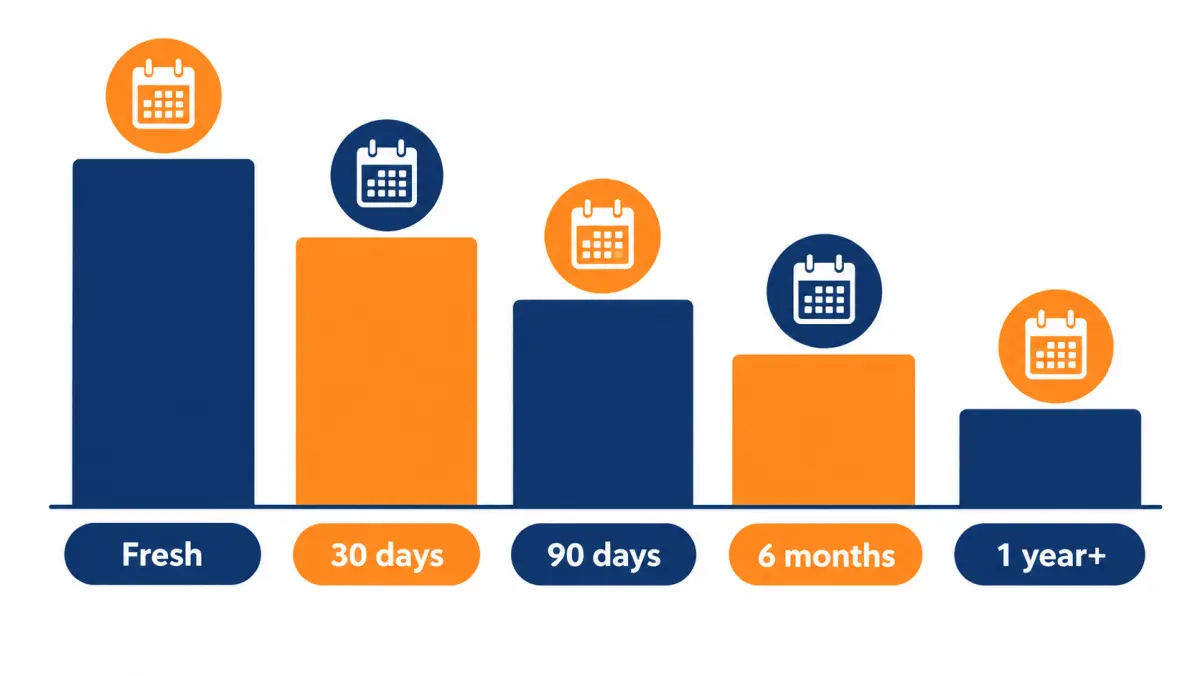
There is no industry standard for when a lead becomes "aged". Vendors set their own bands. Common groupings look like this:
| Age band (typical vendor grouping) | What usually changes |
|---|---|
| 1 to 30 days | Still close to the original inquiry; may have been worked by the first buyer(s) |
| 31 to 90 days | Most first-round follow-up is over; some homeowners still shopping |
| 91 to 365 days | Many have bought, decided against, or moved on; nurture territory |
| Over 1 year | Reactivation territory; contact data and circumstances may have changed |
When comparing vendors, ask how they count age (from form submission, or from first sale?) and whether a list labelled "60 days" means exactly 60 days or "60 days and older".
Where aged leads come from
Aged leads come from the same places as fresh leads: web forms, quote comparison sites, ad landing pages, and sometimes call-center campaigns. The difference is what happened next. A record usually becomes aged inventory by one of these routes:
- Shared real-time leads, resold. The lead was sold to several buyers in real time, then sold again later.
- Unsold leads. The record did not match any buyer's filters in real time, so it was held and sold later.
- Returned or unworked leads. The original buyer returned it or never worked it.
- Reactivation lists. Older inquiries from a seller's own campaigns.
Each route has a different consent and privacy story, which is why "where did this record come from?" is the first question to ask. One point worth stating plainly: our own exclusive leads are never resold, recycled or sold later as an aged lead, so they never become aged inventory. Any aged program is a separate category with its own sourcing.
Sample record (labeled example)
An illustrative example of what an aged lead record typically contains. Not a real person.
| Field | Example value (illustrative) |
|---|---|
| Name | Casey Example |
| Phone | (555) 010-0001 |
| casey@example.com | |
| City, state, ZIP | Anytown, 00000 |
| Homeowner (self-reported at submission) | Yes |
| Bill range (at submission) | Range selected on form |
| Original submission date | Date |
| Age band | 91 to 180 days |
| Source label | Web form, campaign type |
| Consent record reference | Certificate ID, original timestamp |
Note the words "at submission". Every self-reported field was true, or claimed, on the day the person filled in the form. Months later, some have moved, sold the house, or already gone solar.
How do aged leads differ from fresh leads?
Aged leads differ from fresh real-time leads in three ways: fewer people answer, fewer of those who answer still want solar, and the record has often been called before by other buyers. The low price per lead is real, but cost per appointment and cost per install are what decide whether aged leads are cheap.
Contact rate, intent decay and repeated dialing
Three forces work against aged leads:
- Intent decay. Interest is highest at the moment of the form. A homeowner's reasons (a high summer bill, a neighbour's install) fade or get resolved.
- Data decay. Phone numbers change, people move, inboxes go stale. The older the record, the more of this you see.
- Prior contact. If the lead was shared or resold, the homeowner may have heard from many companies. Some will be tired of solar calls and quick to say no or report the call.
None of this makes aged leads worthless. It means the work per appointment is higher, and the sales motion has to be different: slower, more multi-channel, more about re-opening a conversation than catching a hot buyer.
Cost per sale logic: cheap lead vs cost per install
The figures below are an illustrative example, not market data or our prices. Use your own numbers or the calculator.
| Input (illustrative) | Aged lead (91 to 365 days) | Exclusive real-time lead |
|---|---|---|
| Price per lead | $5 | $120 |
| Contact rate | 12% | 65% |
| Appointment rate (of contacts) | 15% | 40% |
| Sit rate | 50% | 70% |
| Close rate | 15% | 25% |
| Leads per sale | 1 ÷ (0.12 × 0.15 × 0.50 × 0.15) = about 741 | about 22 |
| Lead cost per sale | about $3,700 | about $2,640 |
| Labor per lead (illustrative $5 of setter time) | $5 | $10 |
| Labor per sale | about $3,700 | about $220 |
| Total acquisition cost per sale | about $7,400 | about $2,860 |
In this example the aged lead is 24 times cheaper per lead and more than twice as expensive per sale, mostly because of labor. Change the assumptions (a better-sourced list, a strong SMS reactivation flow, a low-cost offshore setter team) and aged leads can win. The point is that price per lead says almost nothing on its own.
Comparison table
| Factor | Aged leads | Real-time exclusive leads |
|---|---|---|
| Price per lead | Low | Higher |
| Contact rate | Low, falls with age | Higher when called fast |
| Competition | Often worked by others before | One buyer |
| Labor per sale | High | Lower |
| Consent age | Older; needs review | Fresh |
| Best channel mix | SMS, email, calls over weeks | Fast call plus text |
| Best for | Nurture programs, setter floors | Teams that call within minutes |
For the fresh alternative, see real-time exclusive solar leads.
Who should buy aged solar leads?
Aged solar leads suit operations built for volume and patience: setter teams and call centers with low cost per dial, installers with strong SMS and email reactivation systems, and teams with a compliance process for older consent. They rarely suit small installers whose owner or closer would be the one making hundreds of calls.
Setter teams and call centers
A setter floor with dialing software, scripts and supervisors can absorb low contact rates because the cost per dial is low and the system is built around volume. The setter's job is to find the few homeowners who are still interested and book them for a closer. If that describes your operation, aged leads can fill gaps between fresh lead deliveries.
Nurture, SMS and email reactivation
Teams with marketing automation can work aged lists mostly by message: a short text, a useful email, a call only when someone replies. This keeps labor low. It also raises the stakes on consent and opt-out handling, because messaging at scale multiplies any mistake.
Who should not buy aged leads
- Owner-operators and very small teams. Your time is too expensive to spend on low contact rates.
- Teams without a compliance process. If you cannot document consent, scrub DNC lists, and honour opt-outs reliably, aged leads magnify that risk.
- Brands built on reputation in a small market. Calling hundreds of people who have heard from many solar companies can cost goodwill.
- Anyone who will judge results on the first week. Aged leads are worked over weeks.
Is it legal to call aged solar leads?
Calling aged solar leads can be lawful, but the answer depends on the consent the person gave, who it was given to, how long ago, the channel you use (call, text, prerecorded), and federal and state rules. Older consent and consent naming another company are common gaps. This is general information, not legal advice; confirm with counsel before calling or texting any purchased list.
Why consent age matters
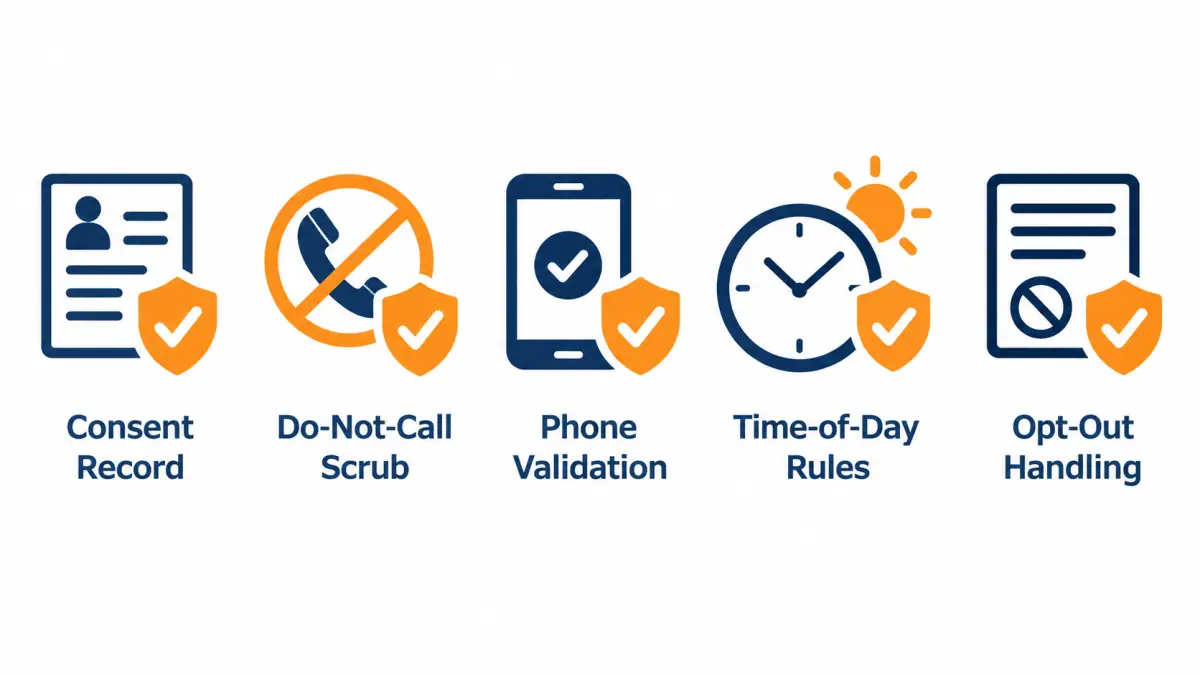
Consent is tied to a moment, a disclosure and a company. Several questions follow:
- Who was named? If the original disclosure named a different company, or a list of partners, it may not support your calls.
- What channel? Consent for calls is not automatically consent for automated texts or prerecorded messages.
- How long ago? Federal rules do not set a simple expiry date for consent, but the older the consent, the harder it is to argue that the person still expects contact, and some state laws and carrier rules add their own expectations.
- Has it been revoked? If the person told any buyer to stop, that matters.
The FCC's guidance on unwanted calls and texts and the FTC's guide to complying with the Telemarketing Sales Rule are the right starting points for your counsel.
On the FCC's one-to-one consent rule: the Eleventh Circuit vacated it on January 24, 2025, so it did not take effect. That removed one federal requirement. It did not validate every shared or aged consent record, and state "mini-TCPA" laws can still apply. Confirm with counsel.
What consent record should travel with the lead
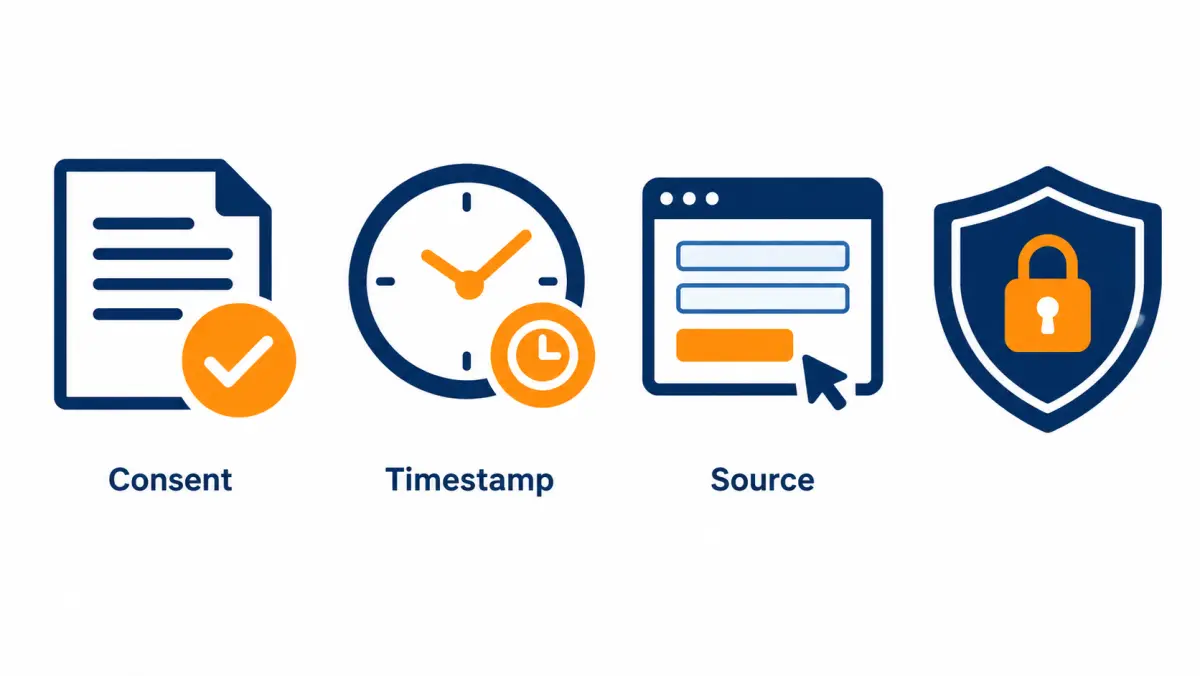
For any lead, fresh or aged, ask the seller for:
- The consent certificate or equivalent record, with timestamp.
- The exact disclosure text the person saw.
- The company name(s) named in that disclosure.
- The URL or form the person used.
- Any record of later opt-outs.
If a seller cannot produce these on request for a sample of records, treat the list as unverified. Our standard for every lead we sell is a timestamped consent record whose disclosure names your company, sent on request. Whether an aged program for your territory meets that standard is confirmed on your call.
Re-permissioning options
When consent is old or does not name your company, some teams use a re-permission step before telemarketing: a manual, non-automated first call or an email asking whether the person wants to hear from you. Whether that approach is appropriate, and which channels can be used for it, is a question for counsel in your states.
DNC scrubbing
Every list should be scrubbed against the National Do Not Call Registry and your own internal do-not-call list before calling, and re-scrubbed on the cadence your counsel recommends for lists worked over time. State DNC lists may also apply. Every lead we deliver is scrubbed against the National Do Not Call Registry before delivery, but a list worked over weeks needs your own ongoing process too.
Privacy: how data was sourced and what is retained
Aged leads raise a privacy question that fresh leads largely do not: how long has this person's data been held, and by how many companies? Search results for aged leads often include privacy services that help people remove their details from lead sellers, which tells you how some homeowners see this market. Ask any seller:
- How was the data collected, and from which forms?
- How long is it retained, and is there a deletion process?
- How do you handle deletion or opt-out requests from consumers?
For our general approach, see TCPA compliance and the guide to consent for purchased solar leads.
What do you receive with an aged lead?
An aged lead usually includes the contact details and form answers captured at the original submission, the submission date or age band, a source label, and a consent record reference. Delivery is typically a CSV file or a batch push into your CRM or dialer, rather than the one-at-a-time real-time feed used for fresh leads.
Fields
| Field group | Typical contents | What to check |
|---|---|---|
| Contact | Name, phone, email, address or ZIP | Phone validation date |
| Property and intent | Homeowner flag, bill range, timeline, all as of submission | Treat as historical, re-confirm on contact |
| Age and source | Submission date, age band, source label | Matches the band you paid for |
| Proof | Consent certificate reference, disclosure text | Names your company? Channel? |
Age band and source labels
Ask for the actual submission date on every record, not only a band. A "90+ day" list could be 91 days or 900. Source labels (for example "comparison site" or "paid social form") help you see which sources produce replies, so you can buy more of what works.
Delivery format and CRM load
Aged leads usually arrive in batches. Before loading:
- De-duplicate against your CRM, your customer list and your internal DNC list.
- Scrub against the National DNC Registry and any applicable state lists.
- Tag every record with source, age band and purchase date.
- Load into a separate pipeline or campaign so aged results do not blur your fresh-lead metrics.
How much do aged solar leads cost?
Aged solar leads are the cheapest lead type per record. ActiveProspect's July 2026 roundup cites The Leads Warehouse at $0.10 to $10 or more per aged lead, against $40 to $120 for real-time leads. Price falls with age. Whether aged inventory is available for your territory, and its terms, is confirmed on your call.
Reported market bands, dated and attributed
| Lead type | Reported range (USD per lead) | Source | As of |
|---|---|---|---|
| Aged lead | $0.10 to $10+ | The Leads Warehouse, as cited by ActiveProspect | July 2026 |
| Real-time lead | $40 to $120 | The Leads Warehouse, as cited by ActiveProspect | July 2026 |
| Shared marketplace lead | $25 to $100 | Enervio, as cited by ActiveProspect | July 2026 |
| Exclusive marketplace lead | $100 to $250 | Enervio, as cited by ActiveProspect | July 2026 |
ActiveProspect calls these directional benchmarks rather than fixed rates. For the full price picture by type, see the average cost of a solar lead.
What moves aged lead prices
- Age. Older is cheaper.
- Exclusivity of the aged sale. An aged record sold to one buyer costs more than one sold to many.
- Filters. Homeowner-only, bill range and territory filters raise the price.
- Consent quality. Records with full, retrievable consent documentation are worth more, and cost more to produce.
- Minimums. Many sellers require minimum order sizes for aged lists.
Our terms
We do not quote aged pricing on this page. Whether aged leads are available in your ZIPs, and at what price and minimum, is confirmed on your call.
What quality controls should aged leads have?
Aged leads should be de-duplicated, phone-validated recently (not just at original submission), scrubbed against the National Do Not Call Registry before delivery, and labelled with true submission dates. Ask what can be returned for credit before you buy, because return terms for aged leads are often narrower than for fresh leads.
De-duplication
Duplicates are common in aged inventory because the same person may have filled in several forms over months. Ask the seller to de-duplicate within the file and against anything they have sold you before, then run your own check against your CRM.
Phone validation
A phone that was valid at submission may be disconnected now. Ask when numbers were last validated. A recent validation pass is one of the most useful things a seller can do for an aged list, because disconnected numbers are pure waste.
What can be returned
Return rules vary. For our fresh leads, credits cover disconnected numbers, wrong contact details and leads outside your filters, reported within 7 days. For any aged program, ask the same three questions in writing: what is returnable, within what window, and how to claim.
How do you work aged solar leads?
Work aged leads with a slower, multi-channel sequence: start with a low-pressure text or email where your consent supports it, call those who respond or engage, use a clear reason to re-open the conversation, and stop after a defined number of touches. Measure cost per appointment, not cost per lead, and keep strict opt-out handling.

Sequencing: text, call, email
A sample sequence for a list in the 91 to 365 day band. Adjust to your consent records and get counsel to approve the channels.
| Step | Day | Channel | Purpose |
|---|---|---|---|
| 1 | Day 0 | Re-introduce: "You asked about solar for your home a few months ago. Is it still on your list?" | |
| 2 | Day 1 | Text (if consent supports it) | Short, named, with a stop option |
| 3 | Day 2 | Call | One attempt, voicemail referencing the email |
| 4 | Day 5 | Something useful: how solar savings work in their utility territory | |
| 5 | Day 8 | Call | Second attempt |
| 6 | Day 14 | Last note, with an easy way to book or opt out | |
| 7 | After | Nurture | Monthly or quarterly email only, until they reply or unsubscribe |
Every message names your company, references the original inquiry and gives a clear way to stop.
Openers that re-open the conversation
Aged prospects usually do not remember the exact form. Openers that work better than a hard pitch:
- "You looked into solar for your place on Maple a few months back. Did you end up going ahead, or is it still something you're thinking about?"
- "I'm calling because rates from your utility have changed since you asked about solar. Would a quick updated estimate be useful?" (Only if true in their area.)
- "If now isn't the time, no problem. Want me to take you off our list?"
That last line costs a few contacts and saves complaints. Record every opt-out immediately.
Offers and angles in a post-25D market
Many aged leads were generated when the 30% federal Residential Clean Energy Credit applied. It does not apply to systems placed in service after 2025, per the IRS. A homeowner who asked in 2024 may still expect it. Your re-engagement script should address that honestly up front: what has changed, what options remain in their market (for example lease or power purchase agreements where offered, state or utility incentives, and bill savings), and a suggestion to talk to their tax advisor about specifics. Leading with an outdated credit is a fast way to lose trust.
Other angles that tend to fit older inquiries:
- Battery and backup. Homeowners in outage-prone areas may care more about backup than bill savings.
- EV charging. A new EV changes the bill and the conversation.
- Rate changes. Only when you can point to a real change in their utility's rates.
Measuring cost per appointment
Track aged lists separately from fresh leads, by source and age band:
| Metric | Formula |
|---|---|
| Reachable rate | Records with a working number or email ÷ records bought |
| Response rate | Replies or two-way calls ÷ records worked |
| Appointment rate | Appointments ÷ responses |
| Cost per appointment | (List cost + labor + messaging cost) ÷ appointments |
| Cost per sale | Total cost ÷ closed jobs |
| Opt-out and complaint rate | Opt-outs or complaints ÷ records worked |
Compare cost per appointment against what you pay for fresh leads and booked appointments. If aged appointments cost about the same and close worse, the list is not cheap.
Stop rules to protect brand and compliance
Set rules before you start, and write them into your dialer and messaging tools:
- Maximum touches per record (for example seven over two weeks), then nurture or stop.
- Immediate, permanent suppression on any opt-out, across all channels.
- Calling hours that respect federal and state limits for the person's location.
- Pause the list if opt-outs or complaints spike above your threshold.
- No prerecorded or artificial-voice messages unless counsel has approved the consent basis.
How do aged leads compare with other lead types?
Aged leads are the lowest-cost entry per record but carry the most work per appointment. Real-time exclusive leads, live transfers and booked appointments cost more per unit and hand over the prospect at progressively later stages. Choose by your team's capacity and the cost per sale you can afford, not by the sticker price.
| Format | Price per unit | Work your team does | Speed | Best fit |
|---|---|---|---|---|
| Aged lead | Lowest | Most: reach, re-qualify, book | Weeks | Setter floors, nurture systems |
| Exclusive real-time lead | Higher | Reach, qualify, book | Minutes | Teams that call fast |
| Live transfer | Higher still | Take the call, book or close | Live | Closers on phones during set hours |
| Booked appointment | Highest | Show up and close | Scheduled | Closer-heavy, setter-light teams |
Aged leads vs exclusive real-time: aged wins on price per lead and loses on contact rate and labor. Aged vs appointments: appointments shift the setter work to the seller. Aged vs live transfer: a transfer is a live conversation now; an aged lead is a chance at one later. For homeowner programs in detail, see exclusive residential solar leads.
How do aged leads fit different installer operations?
Aged leads fit best where labor per dial is cheap and automation carries the first touches. A large setter floor can use them as filler between fresh leads, a mid-size installer can run them through an email and SMS nurture, and a small owner-led team should usually skip them. The scenarios below show the reasoning, not results.
Scenario A: owner-led installer, two sellers
The owner and one rep sell, survey and manage installs. Every hour spent dialing an aged list is an hour not spent on a sat appointment. Even at a very low price per record, the labor math in the earlier illustrative example works against them. A better use of budget is a smaller number of real-time exclusive solar leads or booked appointments, plus a referral program from past customers.
Scenario B: regional installer with a small setter team
Two or three setters work fresh leads in the morning and have spare capacity in the afternoon. A modest aged list from one age band, worked with a fixed sequence, can fill that capacity. The key controls: separate campaign tagging, a hard cap on touches, and a monthly review of cost per appointment against fresh leads. If aged appointments close much worse, shrink the list rather than the fresh budget.
Scenario C: call center or large setter floor
A dialing operation with supervisors, scripts, QA and compliance staff can treat aged leads as a volume source. The risks scale with volume: one weak consent record type or one bad script line repeats across thousands of calls. Operations like this should insist on sample consent audits before every new source, re-scrub schedules set by counsel, and complaint thresholds that pause a list automatically.
Scenario D: installer with a strong email program
Some installers already send a useful monthly newsletter to past inquiries and customers. For them, the cheapest test is often their own old inquiries, which they already have a relationship with, before any purchased aged list. Purchased aged records can follow once the internal list shows what messages get replies.
| Scenario | Aged leads? | Primary channel | Main control |
|---|---|---|---|
| A: owner-led | Usually no | n/a | Protect owner time |
| B: small setter team | Small, controlled test | Calls plus text | Separate tagging, touch cap |
| C: call center | Yes, with audits | Dialer | Consent sampling, complaint pause |
| D: strong email program | Own list first | Opt-out handling |
How should you test aged solar leads?
Test aged leads with a small batch from a single age band and source, worked with a fixed sequence for at least two to three weeks, then compare cost per appointment and cost per sale against your current sources. Decide in advance what result means scale, adjust or stop, so a cheap price does not talk you into a bad source.
Small batch test
- Pick one age band and one source. Mixing them hides what works.
- Confirm documentation. Request the consent record for a random sample before working the list.
- Clean and load. De-dupe, scrub, tag.
- Work every record the same way. Same sequence, same scripts, same setters.
- Run long enough. Aged leads respond over weeks, not hours.
Metrics and decision rules
Write your thresholds down before the test. An example decision table (fill in your own targets):
| Result | Decision |
|---|---|
| Cost per appointment at or below your fresh-lead cost per appointment, and close rate within reach | Scale gradually; test the next age band |
| Cost per appointment higher, but complaints low and close rate solid | Adjust sequence or source; re-test once |
| Complaint or opt-out rate above threshold | Stop the source |
| Consent records missing or not naming your company | Stop and talk to counsel |
If you want to compare aged leads with fresh exclusive leads or appointments for your territory, book a call. Availability for aged leads in your ZIPs is confirmed on that call.
How does lead age change what you can expect?
Each age band behaves differently. Leads under 30 days still carry some live intent but have usually been called hard. Leads from 31 to 180 days respond best to a polite check-in. Leads past a year are reactivation lists where data checks matter more than scripts. Buy and work each band as its own product.
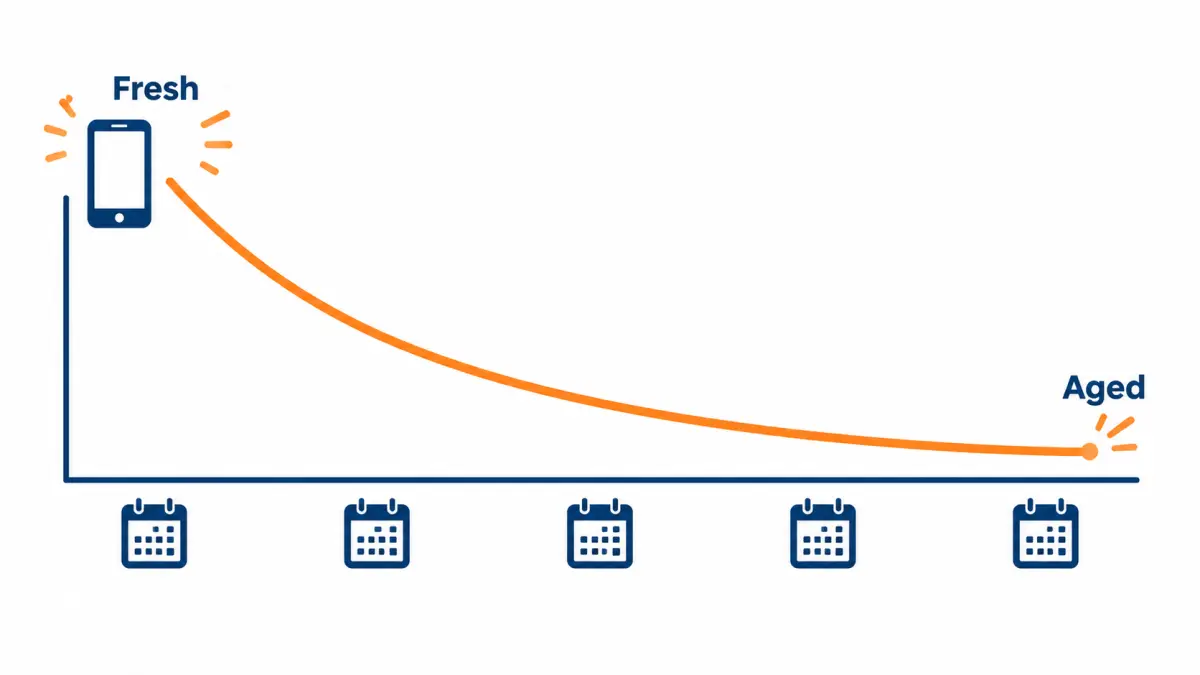
The age bands table near the top of this page gives the short version. This section goes band by band, because the right sequence, script, staffing and budget change as a record gets older. None of the observations below are measured rates from our own data; they are the patterns installers and setter managers describe, and the reasons behind them. Test them against your own numbers.
Band 1: 1 to 30 days
What has happened to the record. The homeowner filled in a form within the last month. If the lead was shared in real time, several companies probably called within the first hour and kept calling for a few days. If the lead went unsold in real time (it did not match any buyer's filters), it may never have been called at all.
What that means for you. These two origins produce completely different lists. A "1 to 30 day" list of resold shared leads can be harder to work than a 120-day list, because the homeowner is tired of solar calls right now. A list of unsold leads in the same band can feel almost fresh. Ask the seller which it is.
How to work it. Treat it close to a fresh lead, but slower: one call attempt, one text where consent supports it, and an email the same day. Open by acknowledging the inquiry and asking whether they have already chosen an installer. If they have, thank them and ask if they want to stay on your list for a future battery or EV charger conversation.
Who it suits. Setter teams with spare capacity, and installers who missed a busy week of fresh leads and want to fill appointments quickly.
What to ask before buying:
- How many buyers received this lead in real time, if any?
- Was it returned by a previous buyer, and for what reason?
- When were the phone numbers last validated?
Band 2: 31 to 90 days
What has happened to the record. The first wave of follow-up is over. Some homeowners have signed with someone, some got quotes they did not like, and some got busy. Many are still somewhere in the middle, with a quote in a drawer and no decision.
What that means for you. This is often the band where a calm, informed check-in does well. The homeowner remembers asking about solar. Plenty of them received a quote that confused them or felt pushy. A setter who asks "did anyone walk you through the numbers in a way that made sense?" has something to offer.
How to work it. Lead with email or text, then call people who engage. Keep a second-opinion angle ready: offer to review a quote they already have. That is a low-pressure reason to talk and puts your closer in front of a homeowner who already wants solar enough to have collected quotes.
Who it suits. Installers with a closer who is good at quote comparisons, and setter teams with a structured sequence.
What to ask before buying:
- Is the age counted from form submission or from the first sale?
- Are records in this band exclusive to you as aged buyers, or sold to many?
- Can you filter by the original bill range or homeowner flag?
Band 3: 91 to 180 days
What has happened to the record. A season has passed. The homeowner's reason for asking (a summer bill spike, a neighbour's install, a sales knock) may have faded. Some have moved or changed numbers. Some decided to wait until "next year".
What that means for you. Contact rates usually drop here, so more of the work is finding the people who are reachable at all. The ones you do reach often need a new reason to think about solar, because the old one has passed.
How to work it. Plan on a multi-week sequence with a mix of channels. Use seasonal hooks if they are true for the area: an upcoming summer, a rate change that has actually been announced by their utility, or a new state or utility incentive. Remember that the 25D federal credit no longer applies to systems placed in service after 2025, so anyone who asked during 2025 may have a picture of the economics that is out of date.
Who it suits. Setter floors with low cost per dial, and installers with automated email and SMS.
What to ask before buying:
- When were these records last phone-validated and DNC-scrubbed?
- Can you provide consent records for a random sample of 10 to 20 records?
- What can be returned for credit, and within what window?
Band 4: 181 to 365 days
What has happened to the record. Most of the people who were going to buy that year have bought. The list is now dominated by people who decided against it, put it off, or became unreachable.
What that means for you. This is nurture territory. Calling every record repeatedly is rarely efficient. A better structure is an email-first approach that sorts the list into people who engage and people who do not, followed by calls only to the first group.
How to work it. Start with a short, useful email (what changed in solar for homeowners in their state this year, or how batteries work with their utility's rates). Call only people who open or reply, within the limits your consent supports. Move everyone else into a monthly or quarterly nurture until they engage or unsubscribe.
Who it suits. Installers with a working email program, and call centers that can segment by engagement.
What to ask before buying:
- What share of the email addresses have been validated recently?
- Do you remove records of people who have asked any buyer to stop contacting them?
- What is your data retention and deletion process?
Band 5: 1 to 2 years
What has happened to the record. Circumstances have often changed. People sold homes, refinanced, had children, retired, lost or changed jobs. Utility rates and local incentives have moved. In some states net metering rules have changed since the inquiry.
What that means for you. Think of these as reactivation leads. The homeowner may have only a vague memory of asking about solar. Your first message has to explain who you are and why you have their details in a way that is honest and specific.
How to work it. Email first, with a clear explanation, an easy opt-out and a reason to reply. Use calls sparingly and only where counsel has approved the consent basis. Expect a lot of bounces and wrong numbers; the cleaning step matters more than the script.
Who it suits. Larger operations with strong data hygiene and compliance staff. Rarely a good fit for small installers.
What to ask before buying:
- Has ownership been re-checked against property records?
- How many times has each record been sold?
- Does the original consent disclosure name your company, or only the seller or a partner list?
Band 6: older than 2 years
What has happened to the record. The consent is old, the data is stale, and the homeowner may have no memory of the inquiry. Some sellers bundle these records in very large, very cheap files.
What that means for you. The price per record can look almost free, but the risk per record is at its highest. A complaint from someone who does not remember asking about solar is more likely here than in any other band.
How to work it. If you buy at all, treat these records as a data source to verify, not a lead list to dial. Many installers decide to skip this band entirely. If you do test it, keep the batch small, use email only until someone engages, and get counsel to review the consent basis first.
Who it suits. Very few installers. Mostly large operations with dedicated compliance and data teams.
Band summary table
| Band | Typical origin mix | Main risk | Best first channel | Typical fit |
|---|---|---|---|---|
| 1 to 30 days | Shared resold, unsold, returned | Prospect fatigue from recent calls | Call plus text | Setter teams with spare capacity |
| 31 to 90 days | Shared resold, unsold | Already signed elsewhere | Email or text, then call | Closers who can review quotes |
| 91 to 180 days | Mixed | Lower reachability | Email and text sequence | Setter floors, SMS programs |
| 181 to 365 days | Mixed | Interest gone | Email to sort, then call | Email-strong installers |
| 1 to 2 years | Reactivation lists | Changed circumstances, old consent | Large operations with compliance staff | |
| Over 2 years | Bulk files | Consent and complaint risk | Email only, if at all | Rarely recommended |
How do you vet a seller of aged solar leads?
Vet an aged lead seller by asking where the records came from, how many times each was sold, what consent record exists and whose name it carries, when phones were last validated and scrubbed, and what can be returned. Then check a random sample yourself before paying for a full list. Sellers with clean inventory welcome this.
The broader process for checking any lead vendor is covered in the guide on how to vet a solar lead provider. This section covers what is specific to aged inventory, where the gaps tend to be larger.
The ten questions to ask in writing
Ask these by email so the answers are on record:
- Origin. How did each record become aged inventory: resold shared lead, unsold real-time lead, returned lead, or reactivation list?
- Times sold. How many buyers received each record in real time, and how many have bought it as aged? Is this aged sale exclusive to me?
- Age definition. Is age counted from the form submission date or from the first sale? Will every record include the actual submission date?
- Consent record. Can you provide, for any record on request, the timestamped consent certificate, the disclosure text the person saw, and the URL of the form?
- Named companies. Does the disclosure name my company, your company, or a list of partners? If a list, how many?
- Channel. Does the consent cover calls, texts, and prerecorded messages, or only some of them?
- Opt-outs. Do you remove people who told any buyer to stop contacting them? How do opt-outs flow back to you?
- Validation. When were phone numbers last validated, and how? When was the list last scrubbed against the National Do Not Call Registry and state lists?
- Returns. What is returnable (disconnected numbers, wrong person, outside filters), within what window, and how do I claim?
- Retention. How long do you keep consumer data, and how do you handle deletion requests?
The sample audit
Before you buy a full list, ask for consent records for a random sample. Pick the records yourself from the file, rather than letting the seller choose. For each one, check:
| Check | Pass looks like | Fail looks like |
|---|---|---|
| Timestamp | Matches the submission date on the record | Missing, or later than the stated date |
| Disclosure text | Readable, specific, names the company you need named | Generic, missing, or names someone else only |
| Form URL | A real page with a form matching the record's fields | Dead link, or a form asking different questions |
| Channel language | Covers the channels you plan to use | Mentions calls only, and you plan to text |
| Contact details | Phone and email look plausible | Obvious fakes, repeated numbers, test entries |
If several sample records fail, stop. If one fails, ask why, and ask for a second sample.
Red flags specific to aged lists
- Huge files at tiny prices with no consent references. The low price usually reflects the risk.
- "We can't share consent records, but we guarantee they're compliant." A guarantee is not a record.
- Age bands with no submission dates. You cannot manage what you cannot see.
- No return policy at all. Even a narrow policy shows the seller stands behind basic data accuracy.
- Records that "match" your territory but include ZIPs you never asked for. A sign of loose filtering.
- Pressure to buy a large minimum before any test. A seller with good inventory can afford a small first order.
- Claims that an aged list is "fresh" or "just like real-time". Age changes the product.
Questions to ask yourself before signing
The seller is only half of the decision. Before you place an order, answer these honestly:
- Do we have the setter hours to work this list to the end of the sequence, without pulling time from fresh leads?
- Can our CRM keep aged records separate, tagged, and reported on their own?
- Does our dialer and texting tool enforce our opt-out list across every channel?
- Has counsel reviewed the consent basis for the channels we plan to use?
- What result in three weeks would make us stop?
If any answer is "not yet", fix that first. The list will still be there.
What does an aged lead cost once labor is included?
The full cost of an aged lead is the list price plus validation, scrubbing, messaging fees and, above all, setter time. Because contact rates are low, labor often costs more per sale than the leads themselves. Model total cost per appointment and per sale before buying, using your own setter wages and dial rates.
The earlier comparison table showed one illustrative example. This section breaks the cost into its parts so you can build your own model. All figures here are illustrative examples for the arithmetic, not market data and not our prices. Plug your own numbers into the solar lead cost calculator or a spreadsheet.
The cost stack
| Cost line | What drives it | How to estimate |
|---|---|---|
| List price | Age band, filters, exclusivity, consent quality | Seller quote |
| Data cleaning | Phone validation, email validation, de-duplication | Per-record fee from your vendor, or staff time |
| DNC scrubbing | National and state registry access, internal list | Your registry access cost plus scrub tool fees |
| Messaging | SMS and email platform fees | Per-message rate times touches |
| Dialer | Seat licences, per-minute charges | Monthly cost divided by records worked |
| Setter labor | Hourly wage plus overhead, dials per hour | Wage times hours spent on the list |
| Management | Supervisor and QA time | Share of supervisor hours |
| Compliance | Counsel review, audits | One-off review cost spread over the test |
Worked example 1: 1,000-record list, small setter team (illustrative)
Assumptions, all illustrative:
- 1,000 records in the 91 to 180 day band at $2 each: $2,000
- Cleaning and scrubbing at $0.10 per record: $100
- After cleaning, 850 records are workable
- Sequence: 3 calls, 3 texts, 3 emails per record
- Setter wage plus overhead: $25 per hour
- Dials per hour on aged lists: 40, so 2,550 dials take about 64 hours: $1,600
- Messaging: 2,550 texts at $0.02 and 2,550 emails at near zero: about $50
- Appointments booked: 15
- Appointments that sit: 9
- Closed jobs: 2
| Line | Cost |
|---|---|
| List | $2,000 |
| Cleaning and scrub | $100 |
| Setter labor | $1,600 |
| Messaging | $50 |
| Total | $3,750 |
| Cost per appointment booked (15) | $250 |
| Cost per sat appointment (9) | about $417 |
| Cost per sale (2) | $1,875 |
On these assumptions the list works. Change two inputs, though, and it looks different: if only 8 appointments are booked and 1 job closes, cost per sale doubles to $3,750. Small tests have wide error bars, which is why the decision rules later on this page matter.
Worked example 2: same list, owner does the calling (illustrative)
The same 1,000-record list, but the owner of a small installer does the dialing because there is no setter.
- The owner's time is worth what they could earn selling and closing elsewhere. Say $100 per hour as an illustrative opportunity cost.
- 64 hours of dialing becomes $6,400 of owner time.
| Line | Cost |
|---|---|
| List, cleaning, messaging | $2,150 |
| Owner time (opportunity cost) | $6,400 |
| Total | $8,550 |
| Cost per sale (2) | $4,275 |
The leads did not get worse. The labor got more expensive. This is the core reason aged leads usually do not suit owner-led shops.
Worked example 3: email-first nurture (illustrative)
An installer with a working email platform sends a three-email sequence to 5,000 records in the 181 to 365 day band and calls only people who engage.
- 5,000 records at $0.50: $2,500
- Cleaning: $500
- Email platform cost for the month: $150
- 2% reply or click and agree to a call: 100 people
- Setter time to call those 100 people several times: 10 hours at $25: $250
- Appointments: 12; sales: 2
| Line | Cost |
|---|---|
| List | $2,500 |
| Cleaning | $500 |
| Email platform | $150 |
| Setter labor | $250 |
| Total | $3,400 |
| Cost per appointment | about $283 |
| Cost per sale | $1,700 |
Labor stays low because email does the sorting. The trade-offs: deliverability risk when mailing old addresses, and the importance of honouring unsubscribes immediately. Mailing a large, old list from your main sending domain can hurt deliverability for your customer emails too, so many teams use a separate sending domain for cold or aged lists.
What a setter hour buys on an aged list
A useful way to think about labor is "appointments per setter hour". It ties together dials per hour, contact rate and booking rate.
| Input (illustrative) | Low | Middle | High |
|---|---|---|---|
| Dials per hour | 30 | 45 | 60 |
| Contact rate per dial | 4% | 7% | 10% |
| Conversations per hour | 1.2 | 3.2 | 6 |
| Appointment rate per conversation | 8% | 12% | 15% |
| Appointments per hour | about 0.1 | about 0.4 | about 0.9 |
| Setter hours per appointment | about 10 | about 2.6 | about 1.1 |
At $25 per hour, that is anywhere from about $28 to about $260 of labor per appointment before the list cost. The middle of that range is where many aged programs end up, but your team could be anywhere in the table. Measure your own dials, contacts and bookings for the first week, then recompute.
Break-even: how much can you afford to pay per aged lead?
Work backwards from the cost per sale you can afford.
- Decide your maximum acquisition cost per sale (for example, what you already pay per sale on fresh leads).
- Subtract expected labor and messaging per sale.
- Divide what is left by the number of leads it takes to make a sale.
Illustrative example: you can afford $2,500 per sale. Labor and messaging on aged leads come to $1,200 per sale. That leaves $1,300 for leads. If it takes 500 aged records to make a sale, the most you can pay is $2.60 per record. If it takes 800, the most you can pay is about $1.60. Any quote above your break-even is a loss before the test starts.
What should setters say on an aged solar lead call?
A good aged-lead call opens by naming your company and the earlier inquiry, asks one easy question about where the homeowner stands now, and offers a clear way off the list. The goal of the first call is a short, honest conversation that sorts the homeowner into book, nurture or stop, not a pitch for a system.
The openers earlier on this page are the short version. Below are full scripts for the most common situations, plus voicemails and objection responses. Adapt the wording to your brand and have counsel review any script used for telemarketing. Never make claims about savings, rates or incentives that you cannot back up for that homeowner's utility and state.

Script 1: first call, 31 to 180 days
Setter: Hi, is this Jordan? This is Sam with [Company], a solar installer here in [area]. A little while back you asked about solar for your home on [street]. I'm just checking in. Did you end up going ahead with anyone, or is it still on the list?
Then branch on the answer.
If "We already went solar":
Congratulations, that's great. I'll mark that so nobody bothers you. One quick thing: some folks add a battery or an EV charger later. Would you want to hear from us if that ever comes up, or would you rather I take you off our list completely?
Record the answer exactly. If they want off the list, suppress them across every channel before you hang up.
If "Still thinking about it":
That's really common. Can I ask what's held it up? Was it the cost, the numbers not making sense, or just timing?
Listen. Then match the response:
- Cost or numbers: "A lot of people get a quote that's hard to read. If you have one, our [closer title] can walk through it with you, no pressure. If you don't, we can do a fresh estimate based on your actual bill. Would a 20-minute appointment this week or next work better?"
- Timing: "Makes sense. When would be a better time to look at it again? I can send you a short note now and check back then."
If "I don't remember asking":
No problem, it was a while ago. The request came through a solar quote form on [date or month]. If you're not interested, I'll take you off our list right now. If you are curious, I'm happy to answer a quick question or two.
Do not argue about whether they filled in the form. If they ask how you got their number, tell them the truth: the source name and the date, as your records show it.
If "Not interested":
Understood. I'll remove you from our list today. Sorry for the bother, and have a good day.
Suppress immediately.
Script 2: quote-review angle
This works well in the 31 to 90 day band, where many homeowners have a quote they have not acted on.
Setter: Hi, this is Sam with [Company]. You looked into solar a couple of months ago. A lot of people we talk to got a quote or two and then got stuck on the numbers. Did that happen to you?
Homeowner: Yeah, we got a couple, but they were all over the place.
Setter: That's really common. They can be hard to compare because of different panel counts, financing terms and production estimates. Our [closer title] does a free side-by-side review. You'd bring the quotes you have, and they'd show you what's actually different between them. Even if you go with someone else, you'd know what you're signing. Would Tuesday evening or Thursday afternoon work better?
This angle respects the homeowner's time and puts your closer in a strong position: the homeowner already wants solar enough to collect quotes.
Script 3: post-25D reset
For records generated while the federal Residential Clean Energy Credit applied, the homeowner may still assume it does. The IRS page on the credit is the reference.
Setter: Hi, this is Sam with [Company]. You asked about solar last year. I'm calling partly because a few things have changed since then, and I'd rather you hear it straight. The federal tax credit for homeowners who buy a system ended for systems placed in service after 2025. Some people assume it's still there. Depending on your situation, there may be other options, like leasing or other programs in [state], and your tax advisor can tell you what applies to you. Would it be useful to get an updated estimate with today's numbers?
Keep this honest. Do not promise a tax outcome, and do not claim local incentives you have not confirmed.
Script 4: battery and backup angle
For homeowners in outage-prone areas, backup can matter more than bill savings.
Setter: Hi, this is Sam with [Company]. You asked about solar for your home a while back. We've been talking with a lot of homeowners in [area] lately about backup power after outages. Is that something you've thought about, or was it mostly about the electric bill?
Only use this angle where outages are a real local concern, and do not overstate what a battery can power.
Voicemail scripts
Keep voicemails short, named and specific. Leave at most one or two per record across the sequence.
Voicemail 1:
Hi Jordan, this is Sam with [Company] in [area]. You asked about solar for your home a while back, and I'm just checking whether it's still something you're looking at. You can call or text me at [number]. If you'd rather not hear from us, just reply "stop" and we'll take you off. Thanks.
Voicemail 2 (last):
Hi Jordan, Sam again from [Company]. I'll stop calling after this one. If solar comes back on your list, my number is [number]. Have a good week.
Do not use prerecorded or artificial-voice voicemail drops unless counsel has approved the consent basis for them.
Objection responses
| Objection | Response that tends to work | What to avoid |
|---|---|---|
| "How did you get my number?" | State the source and date from your record. Offer removal. | Vague answers, or claiming they "must have" filled in a form |
| "I already have solar." | Congratulate, ask about battery or EV interest, offer removal. | Trying to sell a second system |
| "Solar companies keep calling me." | Apologise, offer immediate removal, mention you will only follow up if they want. | Saying "we're different" and continuing the pitch |
| "It's too expensive." | Ask what they were quoted and what options they saw. Offer a quote review or an estimate. | Promising savings without seeing their bill |
| "I'm renting now" or "I sold the house." | Thank them, mark the record, remove them. | Asking for the new owner's details |
| "Call me back later." | Ask for a specific time and channel, and log it. | Calling back the same day without permission |
| "Is this a scam?" | Give your company name, licence or website, and a way to verify. Offer removal. | Getting defensive |
Coaching notes for setter managers
- Listen to recorded calls weekly. Aged-lead calls go wrong in small ways: a rushed opener, a missed opt-out, a promise about savings.
- Score calls on the outcome sort, not only bookings. A setter who correctly sorts 50 people into book, nurture and stop is doing the job, even with few appointments.
- Give setters permission to end calls early. Pressure to book on tired lists leads to bad appointments and complaints.
- Rotate lists between setters carefully. One setter should own a record's sequence so the homeowner hears a consistent voice.
What text and email templates work for aged solar leads?
Messages to aged leads should be short, name your company, reference the earlier solar inquiry, offer one easy next step and include a clear way to opt out. Texts should be sent only where your consent record supports texting, at reasonable hours, and every reply of stop or similar must suppress the record across all channels immediately.
These templates are starting points. Adjust the tone to your brand and get counsel to review anything that will be sent at scale.

Text templates
Text 1, first touch:
Hi Jordan, it's Sam at [Company]. You asked about solar for your home a while back. Still something you're looking at? Reply STOP to opt out.
Text 2, after no reply (3 to 5 days later):
Hi Jordan, Sam at [Company] again. Happy to send a quick updated estimate if useful, or I can take you off our list. Reply STOP to opt out.
Text 3, after a positive reply:
Great, thanks Jordan. Would a 20-minute call Tue evening or Thu afternoon work to go over the numbers? Reply STOP to opt out.
Text 4, confirming an appointment:
Confirmed: [closer name] from [Company] will meet you [day, time] at [address or by video]. Please have a recent electric bill handy. Reply C to confirm or R to reschedule. Reply STOP to opt out.
Practical rules for texts:
- Keep each message under a single SMS segment where you can.
- Avoid link shorteners that carriers associate with spam; use your own domain.
- Send during daytime hours in the homeowner's time zone, within federal and state limits.
- Register your texting campaigns as your messaging provider requires.
Email templates
Email 1, re-introduction
Subject: Your solar question from [month]
Hi Jordan,
A while ago you asked about solar for your home in [city]. I'm Sam, and I work with [Company], an installer based in [area].
I'm writing to check whether solar is still on your list. If it is, I can send an updated estimate based on today's rates and options in [state]. If you've already gone solar or decided against it, just let me know and I'll update our records.
Either way, you can reply to this email or book a time here: [booking link].
Sam [Company] · [phone] · [address]
If you'd rather not hear from us, [unsubscribe link].
Email 2, something useful
Subject: What changed for solar in [state] this year
Hi Jordan,
Quick note with no sales pitch attached. A few things have changed for homeowners looking at solar since you first asked:
- The federal tax credit for homeowner-owned systems ended for systems placed in service after 2025. Your tax advisor can tell you what applies to you.
- [One true, specific change in their state or utility, if you have one.]
- Battery storage has become a bigger part of many quotes, especially where outages are common.
If you'd like an updated estimate, reply here or pick a time: [booking link].
Sam, [Company]
[Unsubscribe link]
Only include the middle bullet if you can point to a real, current change for that utility or state.
Email 3, quote review offer
Subject: Got a solar quote you're unsure about?
Hi Jordan,
Many people who asked about solar when you did ended up with a quote or two that were hard to compare. If that's you, our team does a free side-by-side review: we'll show you what's actually different between the offers, including panel count, production estimate and financing terms.
No obligation, and you're welcome to go with whoever makes the most sense.
Book a 20-minute review: [booking link]
Sam, [Company]
[Unsubscribe link]
Email 4, last note
Subject: Should I close your file?
Hi Jordan,
I haven't heard back, so I'll assume solar isn't a priority right now. I'll stop following up after this.
If it comes back on your list, just reply to this email and I'll pick it up from there.
Thanks, Sam
[Unsubscribe link]
"Should I close your file?" emails often get more replies than anything else in the sequence, because they make it easy to say "not yet" or "actually, yes".
Email deliverability for older lists
Old email addresses bounce more and include more abandoned inboxes. Before mailing an aged list:
- Validate addresses with an email verification tool and remove hard bounces and risky addresses.
- Use a separate sending domain or subdomain so a bad list does not affect your customer emails.
- Warm up slowly. Send small daily volumes at first and increase as engagement holds.
- Watch complaint rates. If people mark your emails as spam, slow down or stop.
- Include a working unsubscribe and honour it promptly, as the CAN-SPAM Act requires for commercial email. The FTC's CAN-SPAM compliance guide covers the basics.
How should you set up your CRM for aged leads?
Set up aged leads in your CRM as a separate source with their own pipeline or campaign, tagged with seller, age band, original submission date and purchase date. Suppress opt-outs across every channel, cap touches automatically, and report aged results apart from fresh leads so a cheap list does not hide a weak cost per sale.

Fields to add before importing
| Field | Why it matters |
|---|---|
| Lead source = "Aged" | Keeps aged results separate from fresh leads |
| Seller name | Lets you compare sellers |
| Age band | Lets you compare bands |
| Original submission date | Lets you calculate true age at contact |
| Purchase date and batch ID | Ties records to an invoice and a test |
| Consent certificate reference | Lets you pull proof quickly if a homeowner asks |
| Consent channels | Records which channels the consent covers |
| Validation date | Shows when the phone and email were last checked |
| Sequence status | Tracks where each record is in your cadence |
| Outcome sort | Book, nurture, stop, wrong number, already solar, sold home |
Import steps
- Export a copy of the raw file and store it unchanged. You may need it to resolve a dispute or a return.
- Normalise fields. Phone numbers in one format, states as two-letter codes, ZIPs as five digits.
- De-duplicate inside the file on phone and email.
- De-duplicate against your CRM: customers, open opportunities, past leads and your internal do-not-contact list.
- Scrub against the National Do Not Call Registry and applicable state lists.
- Tag every surviving record with the fields above.
- Load into a dedicated campaign in your dialer and messaging tools.
- Spot-check 20 records in the CRM after import to make sure fields mapped correctly.
Automations that protect you
- Global opt-out. A stop reply on text, an unsubscribe on email, or a verbal opt-out logged by a setter should suppress the record everywhere.
- Touch cap. Automatically move records to nurture or closed after your maximum number of touches.
- Calling windows. Block calls outside allowed hours in the homeowner's time zone, based on their address rather than their area code.
- Re-scrub reminders. Schedule re-scrubs on the cadence your counsel recommends for lists worked over time.
- Complaint flag. If a setter logs a complaint, alert a manager and pause the record.
Reporting views to build
| View | Shows | Use it to |
|---|---|---|
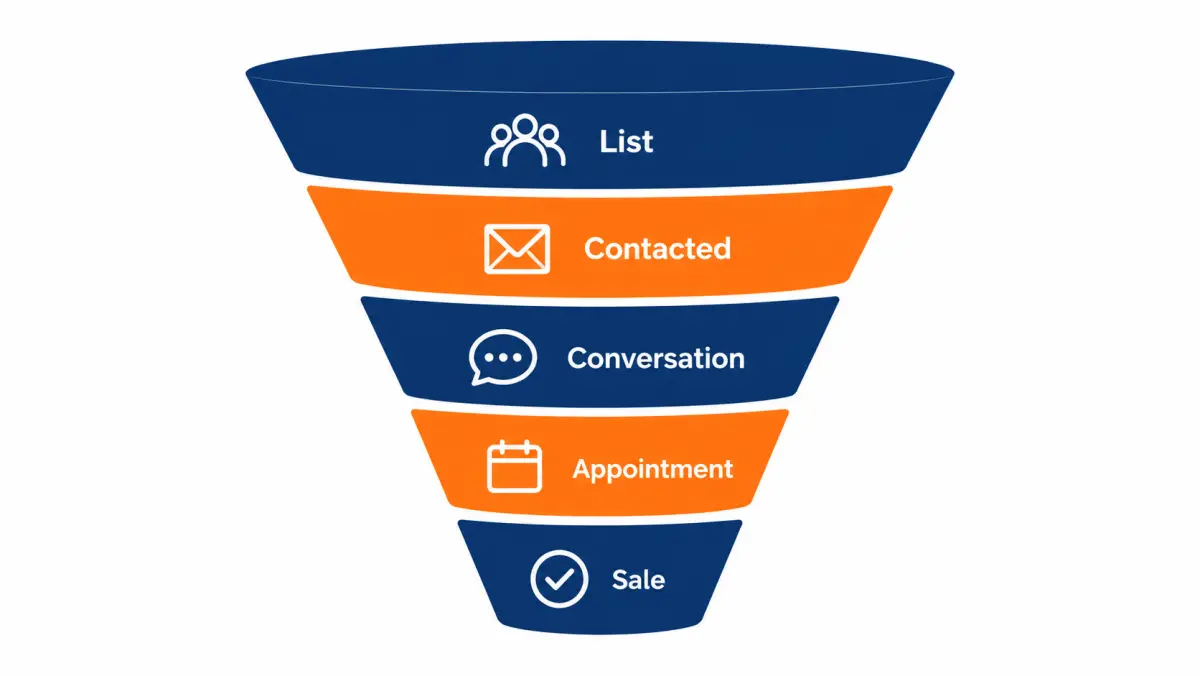
| Aged funnel by batch | Records, reachable, conversations, appointments, sits, sales | Judge each test on its own |
| By age band | Same funnel by band | Find the bands worth buying |
| By seller | Same funnel by seller | Drop weak sellers |
| Outcome sort mix | Share of book, nurture, stop, wrong number, already solar | Spot stale or resold lists |
| Opt-out and complaint rate | Per batch and per week | Trigger pauses |
| Cost per appointment and sale | Including labor | Compare with fresh leads and appointments |
What compliance workflow should you run on an aged list?
Before working an aged list, run a documented workflow: confirm the consent basis with counsel, audit a sample of consent records, scrub against federal, state and internal do-not-call lists, set calling hours by location, enforce opt-outs across channels, and keep records of everything. This is general information as of October 2026, not legal advice.
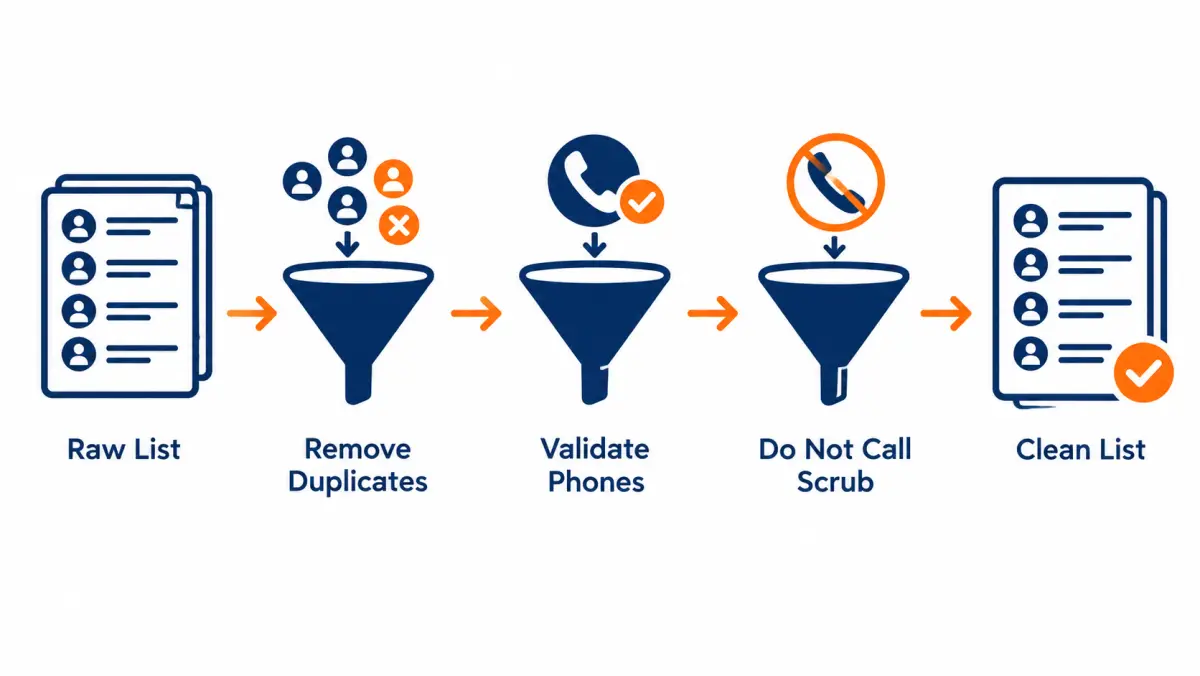
The earlier compliance section explains why consent age and named companies matter. This section turns that into a repeatable checklist you can hand to an operations lead. Your counsel should adapt it to your states and channels. For the wider picture on purchased leads, see the guide to TCPA compliance for solar leads.
Step 1: classify the list before anyone dials
Write down, for each batch:
- Seller, batch ID, number of records, age band.
- How the records became aged inventory (resold, unsold, returned, reactivation).
- Which company or companies the consent disclosure names.
- Which channels the consent language covers.
- Which states the records are in.
This one-page summary is what counsel needs to give you an answer quickly, and what you will want if a complaint ever arrives.
Step 2: counsel review of the consent basis
Ask counsel three specific questions:
- For the channels we plan to use (live calls, texts, email, any prerecorded messages), does this consent language support contact by our company?
- Do any of the states in this list have rules that change the answer, such as state telemarketing registration, state do-not-call lists, calling hour limits or state laws on automated texts?
- If the consent does not support a channel, what first contact, if any, is appropriate to re-permission the homeowner?
Remember that the FCC's one-to-one consent rule was vacated by the Eleventh Circuit on January 24, 2025. That did not settle every question about shared or aged consent, and state laws still apply.
Step 3: sample audit
Pull consent records for a random sample you select. Use the pass and fail table from the vetting section above. Keep the results with the batch summary.
Step 4: scrub and suppress
- National Do Not Call Registry, using your own registry access.
- State do-not-call lists where they apply.
- Your internal do-not-contact list, including every opt-out you have ever received.
- Your existing customers and open opportunities, so they do not get a cold-sounding message.
- Known litigator or high-risk number lists, if your counsel recommends using one.
Step 5: configure tools
- Calling hours by the homeowner's location.
- Global opt-out across call, text and email.
- Touch caps per record.
- Caller ID that displays a number people can call back and reach your company.
- Recording and retention settings that match your state's consent-to-record rules.
Step 6: train the setters
- The scripts, including the opt-out lines.
- What to say when asked how you got their number.
- How to log an opt-out or complaint so it suppresses everywhere.
- What they must never say: savings guarantees, tax promises, false urgency, claims about government programs that do not exist.
Step 7: monitor and pause
- Review opt-out and complaint rates daily during the first week.
- Pause the batch if either crosses the threshold you set in advance.
- Escalate any legal threat or regulator contact to counsel the same day.
Step 8: keep records
Keep the batch summary, sample audit results, scrub logs, sequence settings, and opt-out logs for at least as long as counsel recommends. Records of what you did are often the best defence you have.
Compliance checklist (printable)
| # | Item | Owner | Done |
|---|---|---|---|
| 1 | Batch summary written | Ops lead | ☐ |
| 2 | Counsel reviewed consent language and states | Owner / counsel | ☐ |
| 3 | Random sample of consent records audited | Ops lead | ☐ |
| 4 | National DNC scrub complete | Ops lead | ☐ |
| 5 | State DNC scrubs complete where required | Ops lead | ☐ |
| 6 | Internal do-not-contact suppression complete | Ops lead | ☐ |
| 7 | Calling hours configured by location | Dialer admin | ☐ |
| 8 | Global opt-out tested on call, text and email | Dialer admin | ☐ |
| 9 | Touch cap configured | Dialer admin | ☐ |
| 10 | Setters trained on scripts and opt-out handling | Setter manager | ☐ |
| 11 | Pause thresholds written down | Owner | ☐ |
| 12 | Records retention set | Ops lead | ☐ |
How do aged leads behave in different markets?
Aged leads behave differently by market because the reasons homeowners asked about solar change at different speeds. Where electricity prices are high and rising, interest often survives longer. Where net metering or incentives changed after the inquiry, old expectations need resetting. In heavily canvassed markets, prospect fatigue is the main obstacle. Judge each market on your own test results.
This section describes market types rather than ranking states, because published, comparable conversion data for aged solar leads by state does not exist in a form we can cite. For how lead prices vary by state, see solar lead cost by state. For retail electricity prices by state, the U.S. Energy Information Administration publishes current figures in its Electric Power Monthly.
Market type 1: high and rising electricity prices
When bills keep going up, the original reason for the inquiry is still there months later. Aged leads in these markets often respond to a straightforward "rates have changed since you asked" message, as long as you can point to a real change in that homeowner's utility rates.
How to adjust: lead with an updated estimate based on the current bill. Keep the bill-savings angle central.
Market type 2: net metering or export rules changed after the inquiry
In states or utilities where the value of exported solar power has been cut since the homeowner asked, the economics they were quoted may no longer apply. A homeowner who was told one payback figure may hear a different one now.
How to adjust: be upfront that the rules changed, and explain how a battery or a differently sized system fits the new rules. Do not reuse old savings figures from the original quote.
Market type 3: outage-prone areas
Where storms, wildfire shutoffs or grid strain cause outages, interest in backup power can rise after an event, even among homeowners who decided against solar for bill reasons.
How to adjust: have a battery and backup script ready. Avoid exploiting a recent disaster; a respectful, factual message works better and protects your reputation.
Market type 4: heavily canvassed or saturated markets
In areas where many solar companies knock doors, call and advertise, homeowners may have heard from a dozen installers. Aged leads here carry the most fatigue.
How to adjust: shorter sequences, more email, a stronger opt-out offer, and a clear reason your company is different (local crew, warranty service, reviews you can link to). Track the share of prospects who say "everyone keeps calling me" and stop buying from sellers whose lists produce a lot of it.
Market type 5: newer or under-served markets
Where fewer installers operate, homeowners may have received few or no follow-ups after their inquiry. Aged leads here can be closer to fresh in behaviour.
How to adjust: treat the list like a younger age band. Ask the seller how many buyers covered the area at the time.
Market type 6: high share of renters or recent movers
In areas with high turnover, aged records lose accuracy fastest. The person who asked may no longer live at the address.
How to adjust: re-check ownership against property records before calling where possible, and keep the "I sold the house" outcome in your outcome sort so you can see the effect.
| Market type | Main obstacle | Best angle | Watch metric |
|---|---|---|---|
| High, rising prices | Little; interest persists | Updated estimate | Appointment rate |
| Net metering changed | Outdated expectations | Battery, right-sizing | Sit-to-close rate |
| Outage-prone | Bill-only framing | Backup power | Response rate after events |
| Saturated | Prospect fatigue | Local trust, quote review | Opt-out and complaint rate |
| Under-served | Few | Treat as younger band | Contact rate |
| High turnover | Data decay | Ownership re-check | Share of "sold the house" |
Do aged leads work for commercial solar or batteries?
Aged leads can work for commercial solar and battery storage, but the logic differs. Commercial decisions take months, so an older inquiry is not necessarily stale, while battery interest often follows outages or rate changes. In both cases the record's original fields matter more than its age. Availability of these categories is confirmed on your call.
Aged commercial and C&I inquiries
Commercial buying cycles are long. A business owner who asked about solar six months ago may only now be bringing it to their partners or board. That makes some commercial aged records more valuable than residential records of the same age.
What changes:
- Who you call. The original contact may have changed roles. Ask for the person who handles facilities or energy costs.
- What you need. Utility bills, roof or land details, ownership versus lease of the building, and the decision process.
- How you open. "You asked about solar for [business] in [month]. Is that project still being considered, and who's leading it now?"
- Consent and rules. Business-to-business calling has its own rules, and many commercial contacts give mobile numbers. Ask counsel how your consent records apply.
For the full commercial category, see commercial solar leads.
Aged battery and storage inquiries
Homeowners who asked about batteries often did so after an outage or a rate change. When the next event happens, the interest can return quickly.
What changes:
- Timing. Re-engagement after a real local outage, done respectfully, can get a better response than a random week.
- Existing solar. Many battery prospects already have solar, which changes the sale entirely (retrofit compatibility, existing installer warranties).
- Expectations. Be specific about what a battery can and cannot power. Overpromising leads to cancellations.
Aged inquiries from homeowners who already have solar
Some aged lists include people who later went solar with someone else. These are not useless: some will want a battery, an EV charger, a system expansion, or service on a system whose installer went out of business. Treat them as a separate segment with a different script.
What do aged lead programs look like in practice?
The walkthroughs below are illustrative scenarios built to show decision-making, not case studies of real customers. Each follows a team from buying decision to result review, with the numbers a manager would look at. Use them to plan your own test and to spot the mistakes that usually sink aged programs early.

Walkthrough 1: the regional installer filling afternoon capacity (illustrative)
Setup. A regional installer has three setters who work fresh leads from 8 a.m. to noon. In the afternoons they make follow-up calls but have spare hours. The sales manager wants to fill that time.
Decision. Buy one batch of 800 records from a single seller, age band 31 to 90 days, filtered to the installer's service ZIPs and homeowners only. Before paying, the manager pulls 15 random records and asks for their consent certificates. Fourteen come back clean and name the installer as a permitted company; one is missing. The seller explains and replaces it. Counsel signs off on calls and email; texts are approved only for people who reply to an email first.
Execution. Records are scrubbed and loaded into a separate campaign. Each setter owns a third of the list. Sequence: email day 0, call day 1, call day 4, email day 7, call day 10, final email day 14.
Review at three weeks.
| Metric (illustrative) | Value |
|---|---|
| Records after cleaning | 700 |
| Conversations | 84 |
| Appointments booked | 18 |
| Sat | 12 |
| Sold | 3 |
| Opt-outs | 41 |
| Complaints | 0 |
Decision. Cost per sale including setter time comes in below the installer's cost per sale on fresh shared leads. The manager buys a second batch from the same seller and the same band, and tests the 91 to 180 day band in parallel with a smaller batch.
What made it work. Spare capacity rather than borrowed time, one band, one seller, a consent sample before purchase, and a closer who was good at quote reviews.
Walkthrough 2: the owner who bought a giant cheap file (illustrative)
Setup. An owner-led installer with two sellers sees an offer for 20,000 aged solar records for a very low total price.
What went wrong.
- The file mixed every age band and had no submission dates, only a "90+ days" label.
- No consent records were available; the seller said the list was "fully compliant".
- The owner and one rep started dialing in the evenings.
- Within a week, several people said they had never asked about solar, and one threatened to report the call.
Result. Very few conversations, no sales, a lot of owner time spent, and a stressful conversation with counsel.
Lessons. No dates, no consent records and no seller willing to share a sample are each reason enough to walk away. The size of the file made the problems bigger, not smaller.
Walkthrough 3: the call center that scaled too fast (illustrative)
Setup. A setter operation runs a successful two-week test on 1,000 aged records from a new seller.
Decision. It immediately buys 25,000 records from the same seller across several age bands.
What went wrong. The test batch was from the seller's best band. The large order included older records with different consent language naming only the seller. Opt-out rates climbed in week two. A carrier began filtering the operation's text messages.
Fix. The operation paused the older bands, re-audited consent by band, and moved back to buying one band at a time. It also added a rule: scale by no more than about double the test size per step.
Lesson. A good test only proves the batch you tested. Each new band, seller or consent version is a new test.
Walkthrough 4: the installer that started with its own old inquiries (illustrative)
Setup. An installer has about 3,000 of its own old web inquiries going back three years, plus past customer referrals.
Decision. Before buying any aged list, it runs its own old inquiries through an email-first sequence: a re-introduction, a "what changed this year" note, and a quote-review offer.
Result. The internal list produces a modest number of appointments at almost no list cost. More useful, the installer learns which subject lines get replies and which angles (backup power, in its case) start conversations.
Next step. It buys a small aged batch and uses the proven email copy from day one.
Lesson. Your own old inquiries are the cheapest aged leads you have, and they come with your own consent records. Work them first.
Walkthrough 5: the team that measured the wrong thing (illustrative)
Setup. A sales manager reports to the owner that aged leads cost "under a dollar each" and booked plenty of appointments.
What was missing. Setter hours were not counted. Sit rate was not tracked separately. Several appointments were with people who said yes to get off the phone.
Fix. The owner asks for the funnel by batch, including setter hours and sits. Cost per sat appointment turns out to be close to the price of buying booked appointments, with a lower close rate.
Lesson. Measure cost per sat appointment and per sale, with labor, before deciding an aged program works.
How should closers handle appointments from aged leads?
Closers should treat an aged-lead appointment as a re-qualification meeting first. Confirm ownership, current bill, roof condition and what the homeowner has already been quoted, then reset expectations about incentives and rates before presenting. Aged appointments often sit with more caution and more prior quotes than fresh ones, so preparation matters.

Setter-to-closer handoff notes
Ask setters to fill in these fields for every aged appointment:
| Handoff field | Example note |
|---|---|
| Original inquiry date | "Asked in March via quote form" |
| Why they asked then | "High summer bill" |
| What changed since | "Got two quotes, didn't like the financing" |
| Prior quotes in hand | "Yes, two, will have them at the meeting" |
| Decision makers | "Both spouses will be home" |
| Main concern | "Worried about roof age" |
| Angle that opened the call | "Quote review" |
| Consent and contact notes | "Prefers text, no calls after 6 p.m." |
A closer who walks in knowing the homeowner has two quotes and a roof worry is in a much better position than one who starts from zero.
Re-qualification at the start of the meeting
Aged data was true at submission. Re-check:
- Ownership. Still the owner? Planning to stay?
- Bill. A recent bill, not the range from the form.
- Roof. Age, condition, shading, any planned replacement.
- Prior quotes. What was offered, by whom, and what put them off.
- Financing preferences. Cash, loan, lease or power purchase agreement where offered.
- Incentive expectations. Gently confirm they know the federal 25D credit no longer applies to systems placed in service after 2025, and refer tax questions to their tax advisor.
Presenting to someone who has been quoted before
- Compare honestly. Put your proposal next to theirs line by line: system size, estimated production, equipment, warranty, total cost, financing terms.
- Do not trash competitors. Explain differences; let the homeowner judge.
- Use their own bill. Estimates built on current usage are more credible than a generic savings claim.
- Leave room to decide. Aged prospects often dislike pressure because they have already had it.
Tracking aged appointments separately
Keep aged appointments tagged through to install. You want to know their sit rate, close rate, cancellation rate and average system size, not only how many were booked. If aged appointments close at a similar rate to fresh ones, the program is strong. If they cancel more after signing, look at how setters are framing the first call.
How do you build a long-term nurture program from aged leads?
A long-term nurture program turns the large share of aged records who are "not now" into a list you contact a few times a year with genuinely useful information. It keeps your company in mind for the day they are ready, at a very low cost per record, provided you honour opt-outs and stay within the channels your consent supports.
Most aged records will not book in the first sequence. Some of them will still go solar, sometimes years later. A nurture program is how you stay the company they remember.
What to send
| Month | Topic idea | Purpose |
|---|---|---|
| 1 | What changed for solar in your state this year | Shows you know the local market |
| 3 | How batteries work with your utility's rates | Opens a backup conversation |
| 5 | Before summer: understanding your bill | Ties to rising usage |
| 7 | Customer story from a nearby town (real, with permission) | Social proof |
| 9 | Roof replacement and solar: how to time them | Catches homeowners planning roofs |
| 12 | Year-end note with an easy way to book or unsubscribe | Keeps the list clean |
Only use real stories and real numbers. If you do not have a customer's permission to share their story, do not invent one.
Rules for nurture lists
- Send no more often than you would want to receive.
- Remove hard bounces and long-term non-openers on a schedule, which helps deliverability.
- Suppress unsubscribes immediately and permanently.
- Re-check consent and channel rules with counsel if you plan to add calls or texts to nurture.
- Route any reply to a person within a business day. A nurture reply is a hand-raise.
Measuring nurture
Measure nurture on a longer horizon: replies, booked appointments and sales per thousand records per quarter. Compare that with the cost of the list and the email platform. Many installers find that nurture is where an aged list earns most of its value, months after the first sequence ended.
How do you run a 30-day aged lead test?
Run a 30-day aged lead test by fixing every variable except the list: one seller, one age band, one territory, one sequence, named setters, and written decision rules. Spend the first days on documentation and cleaning, three weeks working the sequence, and the last days on review. Then scale, adjust or stop based on cost per sat appointment and cost per sale.
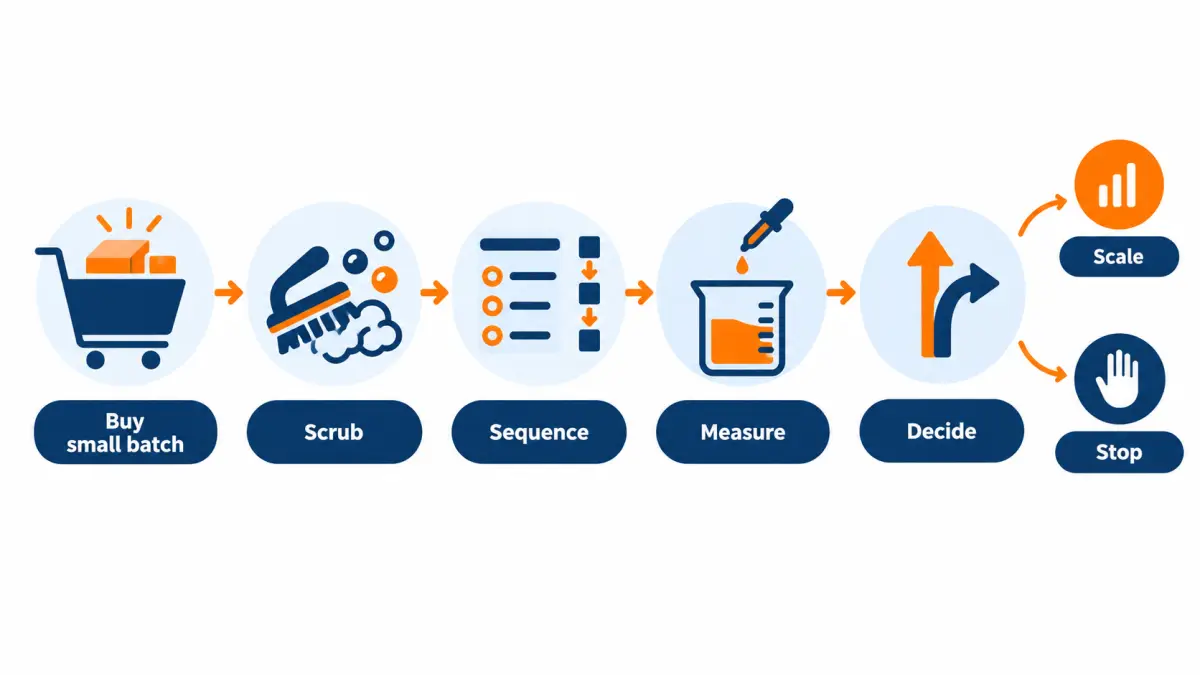
Day-by-day plan
| Days | Task | Output |
|---|---|---|
| 1 to 2 | Send the ten vetting questions; receive written answers | Seller answer sheet |
| 3 to 4 | Choose a random sample; audit consent records | Sample audit table |
| 5 | Counsel reviews consent basis and channels | Approved channel list |
| 6 | Buy the batch; store the raw file | Batch ID, invoice |
| 7 | Clean, de-dupe, scrub, tag, load | Workable record count |
| 8 | Brief setters; test opt-out flows | Training sign-off |
| 9 to 23 | Work the sequence | Daily funnel numbers |
| 9 to 23 | Daily check of opt-outs and complaints | Pause decision if needed |
| 24 to 28 | Finish sequence; move non-responders to nurture | Final funnel |
| 29 to 30 | Review against decision rules | Scale, adjust or stop |
Daily numbers to log
- Dials, texts and emails sent
- Conversations
- Appointments booked
- Opt-outs and complaints
- Outcome sort counts (already solar, sold home, wrong number, not interested, nurture)
- Setter hours spent
Decision rules template
Write your numbers into the blanks before the test starts.
| If | Then |
|---|---|
| Cost per sat appointment ≤ ____ and close rate ≥ ____ | Buy a second batch from the same seller and band, up to about double the size |
| Cost per sat appointment between ____ and ____ | Change one variable (sequence, angle or band) and re-test once |
| Cost per sat appointment > ____ | Stop this seller and band |
| Opt-out rate > ____ or any complaint with legal risk | Pause immediately and review with counsel |
| More than ____ of sample consent records fail | Do not buy, or stop working the batch |
Common test mistakes
- Mixing bands or sellers in one test.
- Letting the best setter work the aged list and comparing against fresh leads worked by everyone.
- Stopping after five days because the first calls were slow.
- Counting booked appointments instead of sat appointments.
- Leaving setter time out of the cost.
What goes wrong with aged leads, and how do you fix it?
Most aged lead problems come from a handful of causes: stale data, lists sold too many times, consent that does not name your company, sequences that are too aggressive, or measurement that leaves labor out. The table and notes below match common symptoms to their likely causes and to the first fix worth trying.

Troubleshooting table
| Symptom | Likely cause | First fix |
|---|---|---|
| Very low contact rate | Stale numbers, no recent validation | Ask seller for validation date; validate yourself before dialing |
| Many "I never asked about solar" | Old consent, poor source, or data errors | Audit consent for those records; stop the source if they fail |
| Many "everyone keeps calling me" | Heavily resold list | Ask how many times records were sold; switch to exclusive aged sales or a younger unsold band |
| Lots of conversations, few appointments | Script pitches too hard, or wrong angle | Switch to quote-review or updated-estimate openers |
| Appointments book but do not sit | Setters booking reluctant people | Coach to sort, not push; add confirmation texts and calls |
| Sits but few closes | Outdated expectations (old incentives, old quotes) | Closer re-qualifies and resets expectations early |
| Rising opt-out rate | Too many touches, poor timing, tired list | Lower touch cap, slow cadence, pause and review |
| Text messages being filtered | Carrier filtering, link shorteners, high opt-outs | Register campaigns, use your own domain, reduce volume |
| Emails landing in spam | Old addresses, high bounces | Validate, use a separate sending domain, warm up slowly |
| Numbers look great, profit does not | Labor not counted | Add setter hours and messaging fees to cost per sale |
| Returns refused | No written return policy | Get return terms in writing before the next order |
When to stop a seller
Stop buying from a seller if any of these happen:
- Consent records cannot be produced for a reasonable sample.
- Records arrive outside your filters and the seller will not credit them.
- Age labels do not match submission dates.
- The same people appear in multiple "different" batches.
- Your complaint rate on their records is clearly higher than on other sources.
When to stop aged leads altogether
Aged leads are not for every installer at every stage. Stop and put the budget elsewhere if, after two fair tests, cost per sale stays above your fresh leads or appointments, or if the work is pulling setters away from fresh leads that close better. Options include exclusive residential solar leads, live transfers and booked appointments. The guide on solar lead ROI shows how to compare them on cost per sale.
Which terms should you know when buying aged solar leads?
These definitions cover the terms most often used in aged solar lead quotes, contracts and conversations. Sellers use some of them loosely, so when a term appears in a quote, ask the seller to define it in writing for your order. Definitions here are general and reflect common industry usage as of October 2026.
| Term | Meaning |
|---|---|
| Aged lead | A lead sold after its original real-time window, usually 30 days or more after submission |
| Age band | A range of ages used to group and price aged leads, such as 31 to 90 days |
| Real-time lead | A lead delivered within seconds or minutes of the form submission |
| Exclusive lead | A lead sold to one buyer only |
| Shared lead | A lead sold to more than one buyer |
| Exclusive aged sale | An aged record sold to one aged buyer, even if it was shared in real time |
| Unsold lead | A record that did not match any real-time buyer's filters and was held |
| Returned lead | A record a previous buyer returned for credit |
| Reactivation list | Old inquiries re-contacted to restart a conversation |
| Consent certificate | A third-party or seller record showing when and how a person gave consent, often with a session replay or form snapshot |
| Disclosure | The consent language shown to the person on the form |
| Named seller | A company named in the disclosure as permitted to contact the person |
| DNC scrub | Removing numbers on do-not-call lists before calling |
| Internal DNC list | Your own list of people who asked you not to contact them |
| Phone validation | A check that a phone number is active and of the expected type |
| Contact rate | Share of records where you reach a person |
| Appointment rate | Share of conversations or contacts that book an appointment |
| Sit rate | Share of booked appointments that actually take place |
| Close rate | Share of sat appointments that sign |
| Cost per appointment | Total cost divided by appointments booked or sat (say which) |
| Cost per sale | Total cost, including labor, divided by closed jobs |
| Touch | Any single call, text, voicemail or email |
| Touch cap | The maximum number of touches allowed per record |
| Sequence or cadence | The planned series of touches over time |
| Nurture | Low-frequency, ongoing contact with people not ready to buy |
| Re-permission | A step to confirm a person wants to hear from you before further marketing |
| Outcome sort | Classifying each record as book, nurture, stop, wrong number and so on |
| Opt-out | A request to stop contact, which should suppress the record across channels |
| 25D credit | The federal Residential Clean Energy Credit, which does not apply to systems placed in service after 2025 |
| TCPA | The Telephone Consumer Protection Act, the main federal law on telemarketing calls and texts |
| TSR | The FTC's Telemarketing Sales Rule, which includes the National Do Not Call Registry rules |
| CAN-SPAM | The federal law on commercial email, including unsubscribe requirements |
What should you ask on your call about aged leads?
On your call, ask whether aged inventory exists for your ZIPs at all, which age bands and sources it comes from, what consent record travels with each record and whose name it carries, what quality checks and return terms apply, and how it compares with fresh exclusive leads for your team size. Availability and terms are confirmed on the call.
A short list to bring:
- Is any aged inventory available in my territory right now? Which bands?
- How did these records become aged, and how many times was each sold?
- Can I see consent records for a sample I choose?
- Which channels does the consent cover?
- When were phones last validated and scrubbed?
- What can be returned, and within what window?
- Given my team (number of setters, closers, current lead sources), would you recommend aged leads, fresh exclusive leads or appointments as the next test?
Our standing offer, for the products we do publish, is simple: no long-term contracts, start with a test batch and scale when the numbers work, real-time delivery to your CRM, dialer, email or SMS, and a timestamped consent record naming your company on every lead we sell, sent on request. Whether an aged program is available, and on what terms, is a separate question answered on the call. Book a call to go through it, or start with the solar lead cost calculator to see what cost per sale you can afford.
Should you work your own old inquiries before buying aged leads?
Yes, in most cases. Your own old inquiries, lost quotes and past no-shows are aged leads you already own, with consent records you control and a homeowner who has heard of your company. Working them first costs almost nothing per record and teaches you which sequences and angles work before you pay for anyone else's list.
What counts as an internal aged lead
| Internal source | Why it is valuable | Watch out for |
|---|---|---|
| Old web inquiries that never booked | Asked you specifically | Consent language on your old forms |
| Appointments that did not sit | Already agreed to meet once | Why they no-showed |
| Sat appointments that did not close | Know your company and pricing | Do not re-pitch the same proposal |
| Signed then cancelled | Wanted solar enough to sign | Handle carefully; ask what went wrong |
| Referral contacts never reached | Warm introduction | Permission from the referrer |
| Past purchased leads you never fully worked | Already paid for | Original consent terms and age |
How internal reactivation differs from buying aged lists
- Consent is yours to check. You can pull your own form history and disclosure versions.
- Context is in your CRM. Notes from the original call make the re-opening message specific.
- Brand familiarity helps. "We met in April about your roof" lands better than a cold re-introduction.
- No seller risk. No question of how many times the record was sold.
A simple internal reactivation sequence
- Segment by outcome: never booked, no-show, sat-not-closed, cancelled.
- Write one email per segment that acknowledges what happened. For a sat-not-closed homeowner: "When we met in April, the timing wasn't right. A few things have changed since then. Would an updated proposal be useful?"
- Call only those who reply or engage, within your consent basis.
- Hand replies to the original closer where possible.
- Move everyone else to nurture.
Once you know what works on your own list, you have a baseline to compare any purchased aged list against.
How do you staff and train setters for aged leads?
Staff aged lists with setters who are patient, curious and comfortable hearing "no" many times an hour, and train them to sort records honestly rather than force appointments. Give them scripts, clear opt-out handling, realistic daily targets based on conversations rather than bookings, and weekly call reviews. Burnout and pressure are the biggest risks on aged lists.
The profile that tends to work
- Calm on the phone, not pushy.
- Comfortable with silence and short calls.
- Good listener who can pick up why the homeowner asked in the first place.
- Careful with data entry, because outcome sorts and opt-outs drive everything downstream.
Training plan for a new aged-list setter
| Day | Focus |
|---|---|
| 1 | Why aged leads behave differently; age bands; how records became aged |
| 1 | Compliance basics from your counsel: consent, opt-outs, calling hours, what never to say |
| 2 | Scripts and branches; role-play the five most common replies |
| 2 | CRM and dialer: outcome sorts, opt-out logging, notes for closers |
| 3 | Shadow an experienced setter on live calls |
| 4 to 5 | Supervised calling with immediate feedback |
| Week 2 | Independent calling with daily review of recordings |
Targets that do not backfire
Targets based only on appointments push setters to book people who will not sit. Better targets for aged lists:
- Conversations per hour.
- Correct outcome sorts (spot-checked by a manager).
- Sat appointments, not booked appointments.
- Zero missed opt-outs.
Keeping setters fresh
Aged lists involve a lot of rejection. Rotate setters between aged and fresh lists during the day if you can, share wins in team meetings, and keep sessions short enough that the tenth call sounds as good as the first.
How do you plan an aged lead budget across the year?
Plan aged lead spend around your setter capacity and seasons, not around the price of the list. Many installers use aged leads to fill quiet periods or spare afternoon hours, keep fresh leads as the main source, and set aside a small monthly test budget for new bands or sellers. Review the mix quarterly using cost per sale.
A simple budgeting approach
- Start from capacity. How many setter hours per month are genuinely spare after fresh leads?
- Convert hours to records. Using your measured dials per hour and sequence length, how many records can those hours work through?
- Price the records. Multiply by your quoted price per record, plus cleaning and messaging.
- Cap the test budget. Keep new sellers or bands to a small share of total lead spend until they prove themselves.
- Review quarterly. Compare cost per sale across aged leads, fresh exclusive leads, live transfers and appointments, and move budget to what works.
Seasonal patterns to plan around
Interest in solar often rises when bills rise, which in many places means summer for cooling-heavy markets and winter for heating-heavy markets with electric heat. Aged records generated in a peak month may respond again when the same season returns. Plan re-engagement waves for the months when bills in your area are highest, and use quieter months for nurture and internal reactivation. These are general patterns; your own CRM history is the better guide for your territory.
Illustrative monthly plan
| Month type | Fresh leads | Aged leads | Nurture | Internal reactivation |
|---|---|---|---|---|
| Peak season | Main focus | Small, proven band only | Monthly email | Light |
| Shoulder season | Steady | Test a new band or seller | Monthly email | Moderate |
| Quiet season | Reduced | Fill spare setter hours | Monthly email | Heavy |
How do aged leads fit with the rest of your lead mix?
Aged leads work best as a supporting source alongside real-time leads, transfers or appointments, not as the only source. They fill spare capacity, feed nurture lists and give setters volume, while fresher sources carry the main sales targets. Compare every source on cost per sale with labor included, and let that number set the mix.
Common mixes by team type
| Team type | Main source | Role of aged leads |
|---|---|---|
| Owner-led, one or two sellers | Booked appointments or real-time exclusive leads | Usually none; work own old inquiries instead |
| Regional installer, small setter team | Real-time exclusive leads | Afternoon filler, one band at a time |
| Large installer, full setter floor | Mix of real-time leads and transfers | Volume source with strict compliance |
| Call center selling appointments | Varies | Core source, with audits and pause rules |
| Installer with strong marketing team | Own inbound plus purchased real-time | Email-first nurture lists |
For the full map of lead types and how to buy each, see the guide to buying solar leads. For a direct comparison of sharing models, see exclusive vs shared solar leads. For the speed side of follow-up on fresh leads, see solar speed to lead.
Signs the mix is off
- Setters spend more hours on aged lists than on fresh leads that close better.
- Cost per sale on aged leads is rising quarter after quarter.
- Opt-outs and complaints from aged lists are causing carrier filtering that hurts fresh-lead texting.
- Closers complain that aged appointments waste their evenings.
Any one of these is a reason to rebalance toward fresher sources.
How do you protect your brand when working aged lists?
Protect your brand on aged lists by being honest about who you are and why you are calling, making it easy to opt out, limiting the number of touches, never overstating savings or incentives, and handling complaints quickly and politely. In small markets, word of mouth travels fast, and one aggressive aged campaign can cost more in reputation than it earns.
Practical rules
- Name your company in every message. No vague "solar program" language.
- Say why you have their details. Source and date, in plain words, when asked.
- Offer the exit early. "If now's not the time, I can take you off our list."
- Stop when asked. Immediately and everywhere.
- No false urgency. No "program ending Friday" unless it is true and documented.
- No invented incentives. Especially after the end of the 25D credit for systems placed in service after 2025.
- Answer complaints the same day. Apologise, remove, and log what happened.
Watch your public reviews
If reviews start mentioning unwanted calls or texts, treat that as a signal from the market. Pause the aged campaign, review recordings, and fix the cause before resuming. Respond to any such review politely, without arguing, and confirm the person has been removed.
Caller ID and number health
High volumes of calls to aged lists can lead carriers and call-labelling apps to flag your numbers. Register your numbers with the main carrier and analytics programs, monitor how your numbers display, keep call volume per number reasonable, and avoid rotating numbers to dodge labels, which can make the problem worse and look deceptive.
What should an aged lead order put in writing?
An aged lead order should state, in writing, the age band and how age is counted, the source types, whether the aged sale is exclusive, the filters applied, the consent record available for each record and whose name it carries, the validation and scrub dates, the return rules, and the seller's data retention and deletion process. Verbal promises do not help in a dispute.
This is a checklist of business terms to raise with the seller, not a contract template. Have counsel review any agreement before you sign it.
Terms to request
| Term | What to get in writing | Why |
|---|---|---|
| Age band | Exact range and whether age counts from submission or first sale | Avoids "90+ days" meaning anything |
| Submission date | Included on every record | Lets you verify the band |
| Source types | Resold shared, unsold, returned, reactivation | Each carries different risk |
| Times sold | Number of prior buyers, real-time and aged | Signals prospect fatigue |
| Exclusivity of aged sale | Sold only to you, or to how many | Affects competition and price |
| Filters | Territory ZIPs, homeowner flag, bill range | Defines what is out of filter for credits |
| Consent record | Certificate reference, disclosure text, form URL, available on request | Your proof if challenged |
| Named companies | Which companies the disclosure names | Determines whether consent covers you |
| Channels | Calls, texts, prerecorded, email | Determines how you can work the list |
| Opt-out handling | How prior opt-outs were removed and how yours flow back | Prevents contacting people who said stop |
| Validation date | When phones and emails were last checked | Disconnected numbers are pure waste |
| Scrub date | When the list was last scrubbed against the National DNC Registry | You still scrub again yourself |
| Returns | What qualifies, window, how to claim | Narrow policies are common for aged leads |
| Retention and deletion | How long data is held; how deletion requests are handled | Privacy expectations and state laws |
| Minimums | Order minimum and whether a test batch is allowed | Protects your first test |
Wording to watch for
- "Compliant" without a definition. Ask which rules, which channels, and what records support the claim.
- "Up to" age ranges. "Up to 90 days old" can mean anything from yesterday to 90 days.
- "Verified leads". Ask verified how, when, and by whom.
- "Exclusive" with no scope. Exclusive in real time, exclusive as aged, or exclusive within a territory?
- "No returns on aged leads". Possible, but then the price and the sample audit carry all the risk.
A note on our own terms
For the products we publish, the terms are on our site: replacement credits for disconnected numbers, wrong contact details or leads outside your filters, reported within 7 days; no long-term contracts; and a timestamped consent record naming your company on every lead, sent on request. Any aged program would carry its own written terms, confirmed on your call.
How do you read a sample aged lead file?
Read a sample aged file the way an auditor would: check that every record has a real submission date inside the promised band, that fields are complete and plausible, that ZIPs fall in your territory, that duplicates are absent, and that consent references can be matched to records. Ten minutes with a spreadsheet can save a bad order.
A ten-minute review
- Sort by submission date. Are all dates inside the band you were quoted? Any dates in the future, or missing?
- Filter by ZIP. Do all records fall in your service ZIPs? Count the ones that do not.
- Check for duplicates. Sort by phone, then by email. Repeated values mean either duplicates or junk.
- Scan names and emails. Look for test entries, obvious fakes, or the same name on many records.
- Check phone formats. Missing digits, repeated digits or obviously invalid area codes are a bad sign.
- Check the homeowner flag and bill range. Are they filled in, and do they match the filters you asked for?
- Match consent references. Pick five records and ask for their consent certificates. Do timestamps match the submission dates?
- Look at the source labels. Are they specific enough to compare sources later?
What the review tells you
| Finding | What it suggests | Action |
|---|---|---|
| All dates in band, clean ZIPs, no duplicates | Careful seller | Proceed to sample consent audit |
| Some out-of-territory ZIPs | Loose filtering | Ask for credits or a re-cut before buying |
| Many duplicates | Poor de-duplication, possibly merged lists | Ask how the file was built; consider walking away |
| Missing or odd dates | Age labels may be unreliable | Do not buy until fixed |
| Obvious fakes or test entries | Weak source quality controls | Walk away |
| Consent timestamps do not match | Records may not be what they claim | Walk away and talk to counsel if you already bought |
Keep the sample
Store the sample file with your batch summary. If the full order differs from the sample in quality, you have something concrete to point to when you ask for credits.
How do aged leads work for different installer sizes over a year?
Over a full year, the role of aged leads tends to grow with team size. Small installers usually limit themselves to their own old inquiries; mid-size installers run a few controlled aged batches in quiet months; large setter operations treat aged leads as a steady, audited source. The illustrative plans below show how each might schedule tests, reviews and stop points.
These plans are illustrative, meant to show structure rather than to predict results.
Small installer (one to three sellers, no setters)
| Quarter | Aged lead activity | Review point |
|---|---|---|
| Q1 | Internal reactivation of own old inquiries by email | Replies and appointments per hundred records |
| Q2 | Monthly nurture email to all old inquiries | Unsubscribes and replies |
| Q3 | No purchased aged leads; focus on fresh leads or appointments | Cost per sale by source |
| Q4 | Year-end "should I close your file?" email to the nurture list | Replies; clean the list |
Mid-size installer (two to five setters)
| Quarter | Aged lead activity | Review point |
|---|---|---|
| Q1 | Internal reactivation; one small purchased batch in one band | Cost per sat appointment vs fresh leads |
| Q2 | If the test passed, a second batch up to about double the size | Opt-out rate, sit rate |
| Q3 | Test a second band or seller in parallel with a smaller batch | Compare bands |
| Q4 | Keep the winning band and seller for quiet months; drop the rest | Annual cost per sale by source |
Large setter operation
| Quarter | Aged lead activity | Review point |
|---|---|---|
| Q1 | Audit all current aged sellers' consent samples; refresh counsel review | Audit pass rate |
| Q2 | Run aged leads as a steady source with automated pause rules | Weekly complaint and opt-out rates |
| Q3 | Rotate out the weakest seller; test one new seller | Seller scorecard |
| Q4 | Annual compliance review; update scripts for any rule or incentive changes | Records retention, training sign-off |
In every case, the review point is the same idea: cost per sale including labor, with complaint and opt-out rates as hard limits.
How do you handle homeowner questions about their data?
Answer data questions plainly: tell the homeowner which company or form the record came from, when, and what details you hold, then offer to remove them. If they ask for deletion, follow your privacy process and pass the request back to the seller where your agreement provides for it. Honest answers defuse most complaints before they start.
Aged leads draw more data questions than fresh leads, because the homeowner may not remember the inquiry and may have heard from many companies since. Prepare setters for the common ones.
Common questions and good answers
| Homeowner asks | Good answer |
|---|---|
| "Where did you get my information?" | "It came from a solar quote form submitted on [date], through [source name]. I can take you off our list right now if you'd like." |
| "Who else has my information?" | "I can only speak for us. If you'd like, I can give you the name of the company we received it from so you can ask them directly." |
| "Delete my information." | "Understood. I'm marking you so we won't contact you again, and I'll pass your request on under our privacy process." |
| "Send me proof I agreed to this." | "I can request the consent record from our files. Can I confirm the best email to send it to?" |
| "I'm going to report this." | "I'm sorry for the bother. I've removed you from our list now." Then log it and tell your manager the same day. |
Internal process behind the answers
- A single place where setters log data questions and deletion requests.
- An owner for those requests, with a target response time.
- A way to pull a consent record quickly by certificate reference.
- A clause in your seller agreement on passing deletion and opt-out requests back.
- Counsel guidance on any state privacy laws that apply to your list, which vary by state and change over time.
Handled this way, a data question becomes a short, polite exchange instead of a complaint, and your records show you acted promptly.
FAQ
What are aged solar leads?
Aged solar leads are solar inquiries sold after their original real-time window, commonly from about 30 days to several years after the person filled in a form. They cost much less per lead than fresh leads because contact and conversion rates are lower.
Are aged solar leads worth buying?
Aged solar leads are worth buying only if your cost per appointment and cost per sale beat your other sources. That usually requires a low-cost setter team or strong text and email reactivation, plus a compliance process for older consent.
How much do aged solar leads cost?
ActiveProspect's July 2026 roundup cites The Leads Warehouse at $0.10 to $10 or more per aged lead. Price falls with age and rises with filters, exclusivity and consent documentation. Availability and terms for your territory are confirmed on your call.
How old are aged solar leads?
There is no standard. Vendors set their own bands, often starting around 30 days and running past a year. Ask for the actual submission date on each record, not only a band.
Is it legal to call aged solar leads?
It can be, depending on the consent given, which company was named, the channel and applicable federal and state rules. Older consent and consent naming another company are common gaps. Confirm with counsel before calling or texting any purchased list.
Do aged leads come with consent?
They should come with a consent record reference, the disclosure text and the timestamp. Ask the seller to produce full records for a random sample before you buy. If they cannot, treat the list as unverified.
How do I convert aged solar leads?
Use a multi-channel sequence over two or more weeks, open by acknowledging the earlier inquiry, address what has changed (such as the end of the 25D credit after 2025), offer an easy opt-out, and measure cost per appointment.
What is the best way to buy cheap solar leads?
Buy small, from one age band and source, with consent records checked, and judge on cost per appointment and cost per sale. A cheap lead that never books is expensive.
How do I avoid buying leads that have been resold many times?
Ask the seller how many times a record has been sold, whether the aged sale is exclusive, and how the lead originally became aged inventory. Track how often prospects say other companies have called.
Aged leads vs real-time leads: which is better?
Real-time leads suit teams that call within minutes and want the best contact rates. Aged leads suit setter and nurture operations that can absorb low contact rates. Compare cost per sale in your own numbers.
What is the difference between an aged lead and an unsold lead?
An unsold lead is a record that did not match any real-time buyer's filters and was held. It is one source of aged inventory. Because it may never have been called, it can behave more like a fresh lead than a resold shared lead of the same age.
How many times should I contact an aged solar lead?
Set a touch cap before you start, for example around seven touches across calls, texts and emails over two weeks, then move non-responders to low-frequency nurture. Stop immediately on any opt-out, and have counsel approve the channels you use.
Which age band of aged solar leads works best?
There is no single answer. The 31 to 180 day bands often respond to a calm check-in or quote-review offer, while older bands suit email-first nurture. Test one band at a time and compare cost per sat appointment and cost per sale.
Can I text aged solar leads?
Only where the consent record covers texts from your company, and within federal and state rules. Many teams start with email and text only people who reply. Confirm with counsel before texting any purchased list.
Should I buy aged solar leads or work my own old inquiries first?
Work your own old inquiries first in most cases. You control their consent records, the homeowner knows your company, and the list costs nothing. It also gives you a baseline for judging any purchased aged list.
What should I measure when testing aged leads?
Track records bought, reachable records, conversations, appointments booked, appointments sat, sales, opt-outs, complaints and setter hours. Judge the test on cost per sat appointment and cost per sale with labor included.
Do aged leads work for commercial solar?
Sometimes. Commercial decisions take months, so an older commercial inquiry can still be live. Confirm who now leads the project, and ask counsel how your consent records apply to business contacts. Availability is confirmed on your call.
Do you sell aged solar leads?
Availability of aged leads for your territory is confirmed on your call. Our exclusive leads are never resold, recycled or sold later as aged leads, so they never become aged inventory.