Exclusive vs Shared Solar Leads: Price, Competition and Cost per Sale
Exclusive vs shared solar leads compared on price, competition, contact rates and cost per sale, with a decision test and what to verify before you buy.
Updated · 83 min read
In this guide (45 sections)
- Which is better, exclusive or shared solar leads?
- What are exclusive and shared solar leads?
- What does the homeowner experience with a shared lead?
- How do exclusive and shared lead prices compare?
- Which costs less per sale, exclusive or shared?
- When do shared solar leads work?
- When do exclusive solar leads win?
- How do you verify a lead is really exclusive?
- How do you run a fair exclusive vs shared test?
- Can you combine exclusive and shared leads?
- Why does consent matter more for shared leads?
- Where do aged leads, live transfers and appointments fit?
- Should you buy exclusive or shared leads? A decision test
- How do exclusive and shared leads differ at each funnel stage?
- Why does speed to lead decide the exclusive vs shared question?
- How sensitive is the break-even to your numbers?
- Which lead type fits your installer size?
- How does job value change the exclusive vs shared decision?
- Does your state or market change the answer?
- How should you work a shared lead differently from an exclusive lead?
- How should you track exclusive vs shared results in your CRM?
- How do you run a hybrid exclusive and shared program day to day?
- How do you audit a vendor's exclusivity claim over 30 days?
- What should the consent disclosure look like on each lead type?
- Which contract terms protect you when buying exclusive or shared leads?
- Illustrative walkthroughs: three installers make the call
- Why do vendors sell both exclusive and shared leads?
- Common myths about exclusive and shared solar leads
- Troubleshooting: what to do when the numbers look wrong
- A 90-day plan for deciding between exclusive and shared leads
- How should you split a fixed lead budget?
- How should you pay reps who work exclusive and shared leads?
- How do you move from shared to exclusive leads, or the reverse?
- Questions to answer before your next lead purchase
- Glossary of exclusive and shared lead terms
- Exclusive vs shared solar leads at a glance
- How do you compare three vendor offers side by side?
- How should setters handle objections on shared and exclusive leads?
- First-call quality checklist for both lead types
- Does the lead's source channel change the comparison?
- What happens to exclusive and shared leads you don't close?
- Signs it is time to change your lead mix
- Step by step: run the comparison with your own numbers
- Where this guide fits with our other buying guides
- FAQ
Exclusive solar leads go to one installer; shared solar leads go to several installers at the same time. Shared leads cost less per lead, often a third to half of the exclusive price according to vendor guides published in 2025 and 2026, but the homeowner gets multiple calls and each buyer's contact and close rates drop. Which one costs less per sale depends on your team, not on the price list. A fast, well-staffed call center can make shared leads profitable. A small team that calls in 20 minutes usually cannot. This guide defines both products, shows what the homeowner actually experiences, lays out published price ranges with sources and dates, and runs a cost-per-sale comparison with a break-even close rate you can calculate for your own business. It also covers how to verify that "exclusive" really means exclusive and why consent scope matters more when a lead has several buyers. Figures are as of October 2026.

Key takeaways (as of October 2026)
- Published ranges: shared leads $25 to $100, exclusive leads $100 to $250+ (ActiveProspect citing Enervio, July 2026; UpLead, October 2026).
- A shared lead breaks even with an exclusive lead when its lead-to-sale rate reaches (shared price ÷ exclusive price) × exclusive lead-to-sale rate. Add labor and the bar rises.
- Shared leads suit teams that call within a minute and sell on price. Exclusive leads suit small teams, premium positioning and high job values.
- Verify exclusivity in writing, including whether the lead is resold later as aged inventory.
Which is better, exclusive or shared solar leads?
Exclusive solar leads are usually better for small and mid-size installers who cannot call within a minute, because they protect contact and close rates. Shared solar leads can be better for high-speed call centers with dialers, price-led offers and tight budgets. Decide by comparing cost per sale with your own rates, not price per lead.
The decision rule in three sentences
If your team calls every lead within two minutes, around the clock, and wins on price, test shared leads. If your team calls in more than a few minutes or sells on design, quality and service, buy exclusive leads. If you cannot tell which describes you, run both side by side for 60 to 90 days and let cost per sale decide.
The rest of this guide explains why that rule holds and how to measure it. For general market prices across all lead types, see the cost per solar lead guide.
What are exclusive and shared solar leads?
Definition. An exclusive solar lead is a homeowner inquiry sold to one installer only. A shared solar lead is the same kind of inquiry sold to two or more installers, usually at the same moment. The difference is the number of buyers, not the source or the form the homeowner filled in.
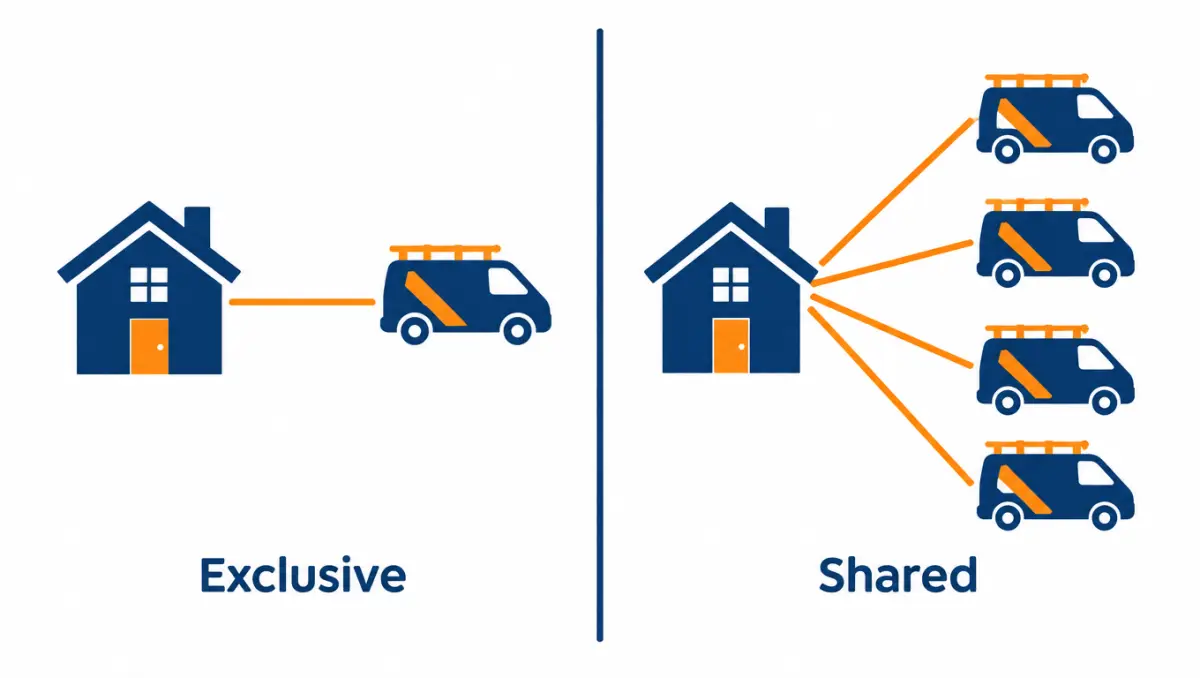
Exclusive
An exclusive lead is delivered to one buyer. No other installer receives that homeowner's request from that vendor. Good exclusive programs also promise the lead will not be resold later. Ours puts it this way: each exclusive lead is sold to one company. It is never resold, recycled or sold later as an aged lead. See buy exclusive solar leads for how that program works.
Shared
A shared lead is sold to several buyers. Vendors set a maximum, and the number varies. LeadGen Economy describes shared leads as typically sold to two or three buyers (updated April 2026). Other programs sell to four or more. The homeowner's form usually says they may be contacted by several companies, sometimes naming them, sometimes referring to "partners."
Real-time shared vs marketplace shared
There are two common shared models:
- Real-time shared (ping-post or round-robin). The lead is sold the moment it is submitted to a fixed number of buyers whose filters match. All buyers get it at once.
- Marketplace shared. Leads are listed in a portal where buyers pick which ones to buy, sometimes after a delay. The buyer count depends on demand and may not be fixed. Marketplace leads may also be older by the time you pick them.
Ask which model a vendor uses. "Shared with up to three buyers in real time" and "listed in a marketplace until sold out" are very different products.
Terms that blur the line
- "Semi-exclusive": usually means a small, capped number of buyers. Get the cap in writing.
- "Exclusive for 30 days": exclusive at first, then resold. That makes it a delayed shared lead.
- "Exclusive in your territory": may mean no other buyer in your ZIP codes, but could still be sold to companies outside your area who serve the same homeowner.
| Criterion | Exclusive | Shared |
|---|---|---|
| Number of buyers | One | Two or more (cap varies) |
| Published price range | $100 to $250+ | $25 to $100 |
| Competition for the homeowner | None from that lead source | Several installers calling at once |
| Speed needed | Fast is better; minutes matter | Seconds matter; first caller wins often |
| Typical pitch | Value, design, service | Often price-led |
| Labor per sale | Lower (fewer leads per sale) | Higher (more leads per sale) |
| Consent scope to check | Names your company | Names every buyer, or covers them clearly |
Price ranges: ActiveProspect citing Enervio (July 31, 2026) and UpLead (updated October 2, 2026). Not our prices.
What does the homeowner experience with a shared lead?
A homeowner who submits a shared lead form often receives calls from several solar companies within minutes. Some answer the first call and ignore the rest. Others stop answering unknown numbers altogether. By the time a slower installer reaches them, the homeowner may already have an appointment, or may be annoyed enough to say no to everyone.
Calls in the first hour
Picture the first hour after a homeowner submits a form on a solar savings site. With an exclusive lead, one company calls, ideally within five minutes, introduces itself by name, references the request, and books a consultation. With a shared lead sold to three buyers, three companies race to dial. The first to connect has a real conversation. The second may reach the homeowner while they are still on the phone with the first, or get a call back later. The third often reaches voicemail, then an unanswered text, then nothing.
This is not a criticism of shared leads; it is the mechanism by which they are cheaper. Each buyer pays for a chance at the homeowner, not for the homeowner's attention.
Price-war behavior
Homeowners who speak to several installers in the same week tend to compare on the simplest number available: price per watt or monthly payment. Installers who sell on equipment quality, warranty terms, workmanship or local reputation have a harder time getting that across when the homeowner is holding three quotes. Closers report more "the other guy was cheaper" objections on shared leads. That pressure shows up in two ways: lower close rates and lower margin on the deals you do close. Both should be in your comparison.
What it does to your brand
Homeowners do not always distinguish between the companies that called them. If one of the buyers is pushy, the homeowner may associate the experience with every company that called. Exclusive leads let your first impression stand alone.
How do exclusive and shared lead prices compare?
Shared solar leads are published at $25 to $100 per lead and exclusive solar leads at $100 to $250 or more, according to ActiveProspect (citing Enervio, July 2026) and UpLead (October 2026). LeadGen Economy lists $35 to $125 for shared leads sold to two or three buyers and $100 to $200+ for exclusive qualified leads (April 2026).
| Source | Shared | Exclusive | Date |
|---|---|---|---|
| ActiveProspect (citing Enervio) | $25 to $100 | $100 to $250 | Jul 31, 2026 |
| UpLead | $25 to $100 | $100 to $250; $100 to $300+ in its comparison section | Updated Oct 2, 2026 |
| LeadGen Economy | $35 to $125 (2 to 3 buyers) | $100 to $200+ | Updated Apr 21, 2026 |
| SolarReviews | $80 to $150 (shared high-intent) | $150 to $300 (exclusive high-intent web) | No exact date shown |
All ranges are vendor-published, not audited, and not our prices. Prices vary by state; see solar lead prices by market.
Vendor-reported close rates, and why to distrust them
Vendors also publish conversion rates for each type. LeadGen Economy lists typical close rates of 8% to 15% for exclusive qualified leads and 3% to 5% for shared leads (April 2026). UpLead's guide states exclusive leads convert to appointments at 40% to 70% and to sales at 8% to 20%, against roughly 10% to appointment and 1% to 5% to sale for shared leads (October 2026).
Treat these as directional at best:
- Each source is a company that sells leads or services to lead buyers.
- None publish sample sizes, time periods or how "close" is defined.
- Most use lead-to-sale rates, which blend contact, set, sit and close into one figure.
- Rates depend heavily on the buyer's speed, script and offer, which vendors do not control.
The ratio between the two is more useful than the absolute numbers. Across these sources, exclusive leads are reported to convert roughly two to four times as often as shared leads. Your own ratio is what you need, and the next section shows how to use it.
Which costs less per sale, exclusive or shared?
Exclusive leads cost less per sale whenever their conversion advantage is larger than their price premium. If an exclusive lead costs 3.5 times as much as a shared lead, shared leads win only if they convert at better than about 1/3.5 of the exclusive rate. Add the labor of working more leads and the shared lead's hurdle rises further.

Adjustable example
Illustrative example. Hypothetical inputs chosen to show the method. They are not benchmarks or results from any vendor, including us.
| Input | Shared (typical speed) | Shared (very fast team) | Exclusive |
|---|---|---|---|
| Price per lead | $45 | $45 | $160 |
| Contact rate | 45% | 65% | 70% |
| Appointment set rate | 25% | 25% | 35% |
| Sit rate | 56% | 56% | 70% |
| Close rate (of sits) | 20% | 20% | 30% |
| Lead-to-sale rate | 1.26% | 1.82% | 5.15% |
| Leads per sale | 79 | 55 | 19 |
| Lead cost per sale | $3,571 | $2,473 | $3,110 |
| Labor at $8 per lead worked | $635 | $440 | $155 |
| Lead plus labor cost per sale | $4,206 | $2,913 | $3,265 |
In this example the typical-speed shared team pays about $940 more per sale than the exclusive buyer once labor is counted. The very fast team, reaching 65% of shared leads, beats exclusive by about $350 per sale. Speed is the swing variable. The $8 labor figure is an assumption for setter time, dialer seats and data costs per lead worked; replace it with your own.
Break-even close rate for shared leads
You can solve directly for the lead-to-sale rate shared leads must reach to match exclusive leads:
Break-even shared lead-to-sale rate = (shared price + labor per lead) ÷ (exclusive price + labor per lead) × exclusive lead-to-sale rate
Using the example inputs: (45 + 8) ÷ (160 + 8) × 5.15% = 0.315 × 5.15% = 1.62%. Shared leads must convert at 1.62% or better, lead to sale, to match the exclusive leads in this example. The typical-speed shared team (1.26%) falls short; the very fast team (1.82%) clears it.
| Shared price | Break-even shared lead-to-sale rate | As a share of the exclusive rate |
|---|---|---|
| $25 | 1.01% | 20% |
| $45 | 1.62% | 32% |
| $65 | 2.24% | 43% |
| $85 | 2.85% | 55% |
| $100 | 3.31% | 64% |
Read it this way: at $100, a shared lead must convert at nearly two-thirds the exclusive rate to break even. Given that published sources report exclusive leads converting two to four times as often, shared leads at the top of the price range rarely make sense unless your own data say otherwise. Cheap shared leads have a lower bar, which is why speed-focused teams buy them.
Margin, not just cost
The comparison above treats every sale as worth the same. If shared leads produce more price-led deals, the margin per sale may also be lower. Multiply cost per sale by your actual margin per deal for each source to see the full picture. Run your own numbers in the cost calculator.
Worked example: running the cost-per-sale math on your own numbers
The cost-per-sale comparison only means something when it uses your team's close rates, not a vendor's averages. This illustrative example shows the steps with placeholder figures so you can repeat them on a spreadsheet in about ten minutes.
Assume you are quoted a shared lead at price S and an exclusive lead at price E, where E is three times S. Pull 90 days of history from your CRM and record, for each lead type you have bought before, four numbers: contact rate, appointment rate from contacts, sit rate from appointments, and close rate from sits.
- Multiply the four rates to get leads-to-sale. Example: shared at 40% x 30% x 60% x 20% = 1.44%; exclusive at 60% x 40% x 70% x 25% = 4.2%.
- Divide price by leads-to-sale. Shared: S / 0.0144 = about 69S per sale. Exclusive: 3S / 0.042 = about 71S per sale.
- Add labour. Shared leads in this example need roughly three times as many leads per sale, which means three times the dialing, texting and CRM work. Price those hours and add them.
- Add the hidden costs. Include discount pressure when a homeowner is comparing several quotes, and the extra cancellations that tend to come with rushed decisions.
In this example the two options look close on lead spend alone, and labour decides the winner. Your numbers may land differently, which is the point of running them.
A few checks keep the math honest:
- Use at least 100 leads per type before trusting a rate; smaller samples swing widely.
- Compare leads bought in the same months and markets, because seasonality moves contact rates.
- Track returns and credits separately so a generous replacement policy is visible rather than buried.
- Re-run the sheet each quarter, since rep turnover changes close rates.
The solar lead cost calculator runs the same chain of rates, and exclusive pricing for your ZIPs is confirmed on your call.
When do shared solar leads work?
Shared solar leads work when your team reaches homeowners before competitors, when your offer competes on price, or when you need cheap volume to learn a new territory. Teams with auto-dialers, round-the-clock coverage and strict speed-to-lead rules can make shared leads produce a lower cost per sale than exclusive leads.
Teams with a speed advantage
If your system dials a new lead in under a minute, and someone is always available to answer, you win a large share of first contacts. That is the profile of a dedicated inside sales floor with a predictive or power dialer and staffed evening and weekend shifts. For these teams, shared leads can deliver contact rates close to exclusive leads at a fraction of the price. Our guide to solar speed to lead covers response-time targets and cadences.
Price-led pitches
If your company sells on lowest price per watt, the homeowner's comparison shopping works in your favor. Shared leads deliver homeowners who are already in shopping mode. A price-led installer can close a homeowner who has three quotes, because yours is the lowest.
Testing new territories
Before committing to exclusive volume in an unfamiliar market, a small batch of shared leads can show you how homeowners there respond to your offer. The data will be noisier than an exclusive test, but the cost of learning is lower. Treat the result as a floor: if shared leads produce any sales, exclusive leads will likely produce more.
Conditions that must hold
- Leads are called within one to two minutes, every time
- You track contact rate by source weekly and act if it drops
- The buyer cap is written into your agreement
- Consent covers your company clearly
- Your margin supports lower-priced deals
When do exclusive solar leads win?
Exclusive solar leads win for small teams, premium-positioned installers and markets with high job values. Without competing callers, contact and close rates are higher, closers face fewer price objections, and fewer leads are needed per sale, which reduces setter labor. Exclusive leads also make lead quality easier to judge, because results reflect your team alone.
Small teams
An owner-operator with one or two closers cannot staff a phone in under a minute all day. Exclusive leads remove the race. A call within five or ten minutes still reaches a homeowner who has not heard from anyone else about that request. For small teams, the time saved by working fewer leads per sale is often worth more than the price difference.
Premium positioning
If you sell premium equipment, longer warranties, in-house crews or design work, you need time to make that case. A homeowner who has only spoken to you will listen. A homeowner holding three quotes may not. Exclusive leads protect the value conversation.
Higher job values
Where jobs include batteries, main panel upgrades or larger systems, each sale is worth more, and the cost of losing a deal to a cheaper competitor is higher. Higher job values also make the exclusive price premium a smaller share of margin. Expensive markets with high average contracts are where exclusive leads most often win on cost per sale.
Cleaner data
With shared leads, a bad week could mean poor lead quality, or it could mean competitors got faster. With exclusive leads, contact and close rates reflect only your team and the leads themselves. That makes vendor evaluation and coaching easier.
How do you verify a lead is really exclusive?
Verify exclusivity by getting it defined in writing, asking how the vendor enforces it, checking whether the lead is resold later, and testing it yourself. Ask homeowners on first contact whether other companies have called about the same request, record the answer in your CRM, and track the rate by vendor.
Questions to ask the vendor
- How many companies receive each lead you sell me, today and in the future?
- Is any lead ever resold, recycled, or sold as aged inventory after delivery to me?
- Do you sell leads from the same form to anyone else, including affiliates or partners?
- Do you buy leads from other generators and resell them? If so, can those generators sell the same lead elsewhere?
- What does the homeowner see on the form about who will contact them?
- Can I see the consent record for a sample lead, with the disclosure text?
- What happens if I find a lead was not exclusive?
Vague answers to questions 2 and 4 are the most common warning signs. A vendor who resells leads from upstream generators may honestly believe a lead is exclusive while the original generator sells it elsewhere.
Audit steps
- Ask the homeowner. Add a field: "Other companies called about this request? Yes / No / Unsure." A rate well above zero on exclusive leads is a red flag.
- Check the consent record. If the disclosure lists several company names or "our partners," the lead was not built for one buyer.
- Look for timing patterns. Homeowners saying they were called "a minute before you" on supposedly exclusive leads is a strong signal.
- Watch for duplicates months later. If you start receiving the same homeowner again as an "aged" lead from any source, the original may have been resold.
- Test with a seed record only if the vendor agrees and counsel approves the method. Never submit fake consent.
Red flags
- "Exclusive" with no written definition
- Exclusive leads priced at shared-lead levels
- A vendor selling large daily volumes at very low prices while promising exclusivity
- Refusal to share consent text or source information
- "Exclusive for a period" language that allows later resale
Our full checklist for vetting solar lead vendors covers source, consent and refund terms in more depth.
How do you run a fair exclusive vs shared test?
Run a fair test by buying both lead types in the same ZIP codes, over the same weeks, with the same scripts and closers, and enough volume to produce 15 to 25 held appointments from each. Route each type to the same response-time rule, track every stage by source, and compare lead plus labor cost per sale after 60 to 90 days.
Test design
- Same territory. Buy both types in the same ZIP list. Comparing shared leads in Texas with exclusive leads in Massachusetts tells you about states, not lead types.
- Same period. Run both at once. Seasonal swings, weather and rate announcements affect both equally that way.
- Same team rules. Apply one speed-to-lead rule to both. If you call exclusive leads faster because they cost more, you are testing your team's behavior, not the leads.
- Enough volume. Size each arm to produce 15 to 25 held appointments. Illustrative example: at a 9% lead-to-held-appointment rate for exclusive leads, that is roughly 170 to 280 leads; shared leads at a lower rate need more.
- Pre-agreed metrics. Write down before you start: contact rate, appointment rate, sit rate, close rate, cost per held appointment, lead plus labor cost per sale, and margin per sale.
- Track labor. Log dial attempts and setter hours by source. Labor is where shared leads hide their real cost.
Reading the results
| Result | Likely meaning | Next step |
|---|---|---|
| Shared contact rate close to exclusive | Your speed advantage is real | Test a higher shared cap and watch for contact decay |
| Shared contact rate far below exclusive | Competitors reach homeowners first | Fix speed or shift to exclusive |
| Similar appointment rates, lower shared close rate | Price competition at the kitchen table | Check margin per sale by source, not only close rate |
| Exclusive leads with "other companies called me" answers | Exclusivity may not be enforced | Raise it with the vendor; request consent records |
| Both types below break-even | Problem is market, offer or team process | Review scripts, pricing and closer performance before buying more |
Common test mistakes
- Stopping after two weeks, before appointments have had time to sit and close.
- Letting the best closer take only exclusive appointments.
- Counting signed contracts that later cancel.
- Changing scripts or offers midway through the test.
- Comparing on lead-to-sale rate without adding labor and margin.
A clean test usually settles the question for your business within one quarter. Repeat it once a year or when your team size, offer or market changes, because the answer moves with them.
Can you combine exclusive and shared leads?
You can combine exclusive and shared leads by assigning each to the team best suited to it and capping shared volume to what your fastest reps can call within a minute. Use exclusive leads for closers' core pipeline and shared leads for a dedicated speed team. Measure each source separately and shift budget toward the lower cost per sale every month.
How to structure a hybrid
- Split by team. Shared leads route to a dialer team measured on speed. Exclusive leads route to setters measured on appointment quality.
- Cap shared volume. Set the daily shared cap at what the speed team can call within a minute. Above the cap, contact rates fall and the economics collapse.
- Split by territory. Use shared leads in high-volume metros where you are fast, exclusive leads in premium or distant ZIP codes.
- Rebalance monthly. Compare lead plus labor cost per sale by source and move budget.
Illustrative example: a team buys 300 exclusive leads and caps shared leads at 10 a day. After 90 days, if exclusive cost per sale is $3,300 and shared is $2,900, they raise the shared cap modestly and watch contact rate. If shared contact falls as volume grows, they bring it back down. The rule is the same either way: move budget to the source with the lower cost per sale until the next measurement says otherwise.
Why does consent matter more for shared leads?
Consent matters more for shared leads because one form must cover every company that calls the homeowner. Under the TCPA, autodialed or prerecorded telemarketing calls and texts to mobile numbers generally require prior express written consent. If the consent does not clearly cover your company, the risk sits with you as the caller. Confirm specifics with counsel.
The rule change you may have heard about
The FCC adopted a "one-to-one consent" rule that would have required each consent to name a single seller. The Eleventh Circuit vacated that rule on January 24, 2025, in Insurance Marketing Coalition v. FCC, so it did not take effect. The underlying consent requirements of the TCPA remain. Some states have their own telemarketing laws with additional requirements. This is not legal advice; confirm with counsel what your consent records must show. The FCC's telemarketing and robocall guidance is the primary source for the federal rules, and the National Do Not Call Registry covers registry obligations.
What to check on shared leads
- Does the disclosure name your company, or refer to an unnamed group of "partners"?
- Is the disclosure clear and visible near the submit button?
- Can the vendor produce the consent record for any lead on request, with a timestamp?
- How many companies does the disclosure cover, and is that consistent with the buyer cap you were told?
What we provide
Every lead we sell carries a timestamped consent record (certificate) whose disclosure names your company. We send it to you on request. Every lead is also scrubbed against the National Do Not Call Registry before delivery. Our guide on TCPA rules for solar lead buyers explains what to keep on file.
Where do aged leads, live transfers and appointments fit?
Aged leads, live transfers and booked appointments sit outside the exclusive-versus-shared choice but follow the same logic. Aged leads are usually shared many times over and cost little. Live transfers and appointments are usually sold to one buyer and cost more because someone else has already done the contact or setting work.
- Aged leads are often former shared or exclusive leads resold weeks or months later. Published ranges run from $0.10 to $10+ (The Leads Warehouse via ActiveProspect, July 2026). Treat them as a separate, high-volume product for dialer teams, and check consent scope carefully. See aged solar leads.
- Live transfers put a screened homeowner on the line. Ask whether the same homeowner is transferred to more than one company. See solar live transfer leads.
- Booked appointments are rarely shared, but ask. An appointment that a homeowner also booked with two competitors is a shared lead with a calendar slot. See solar appointments.
The same verification questions apply to every format: how many buyers, ever, and what does the consent disclosure say.
Should you buy exclusive or shared leads? A decision test
Score your team on speed, staffing, sales approach and margin. Teams that call within two minutes, staff long hours and sell on price score toward shared leads. Teams that call slower, have few setters, sell on value or have high job values score toward exclusive. Mixed scores suggest a capped hybrid test.
| Question | Shared (+1) | Exclusive (+1) |
|---|---|---|
| Median time from lead arrival to first call | Under 2 minutes | Over 2 minutes |
| Phone coverage | Evenings and weekends staffed | Business hours only |
| Dedicated setters | Three or more with a dialer | Fewer than three, or none |
| How you win deals | Lowest price | Value, service, product quality |
| Average job value | Below your market average | Above your market average |
| Brand sensitivity | Low | High; reputation is a key asset |
| Tracking by source | Weekly contact-rate tracking in place | Limited tracking |
How to read it: five or more points for shared, test shared leads with a strict cap. Five or more for exclusive, start with exclusive leads. Anything in between, run a capped hybrid for 60 to 90 days and decide by lead plus labor cost per sale.
When you have your answer, book a call to talk through a test batch. Pricing is confirmed by ZIP on your call, there are no long-term contracts, and you can compare options across where to buy solar leads in our main guide.
How do exclusive and shared leads differ at each funnel stage?
Exclusive and shared leads differ most at the first two funnel stages: contact and appointment setting. Once a homeowner is sitting with your closer, the source matters less, though shared-lead sits often arrive with competing quotes already in hand. Measure each stage separately, because a single lead-to-sale number hides where a shared lead actually loses money.
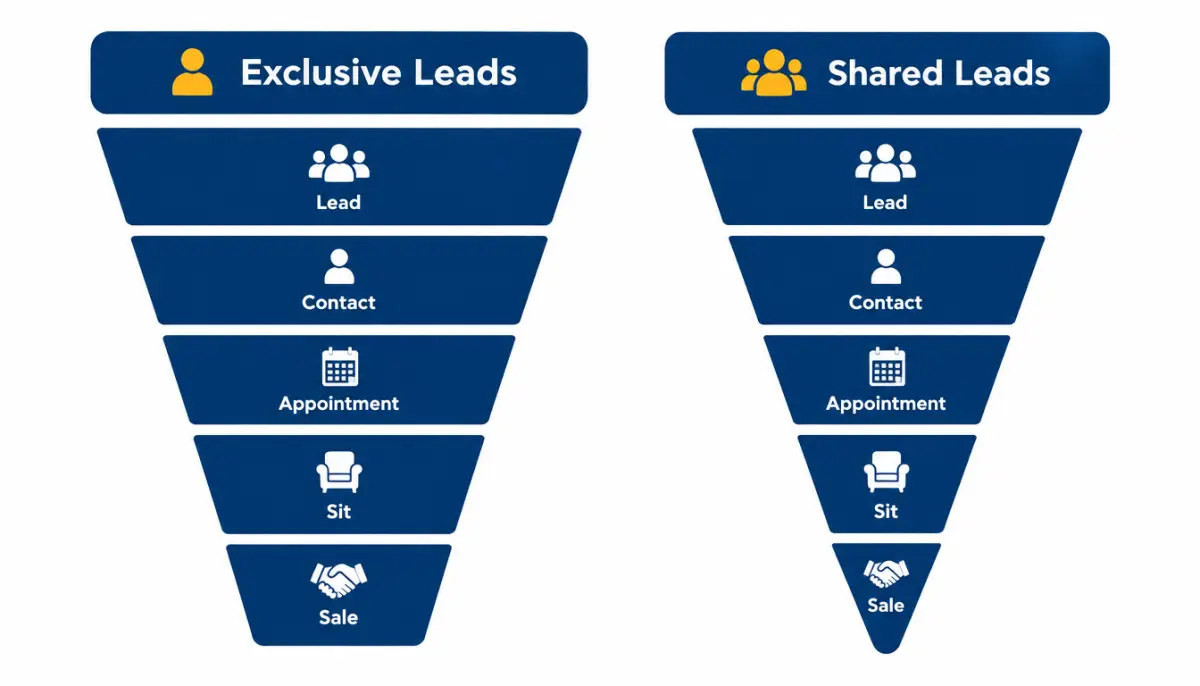
The cost-per-sale table earlier in this guide compresses four rates into one. Pulling them apart shows you which part of your operation decides the exclusive-versus-shared question. The table below follows 1,000 leads from each source through the same illustrative funnel used above.
Illustrative example. Same hypothetical inputs as the adjustable example. Not benchmarks.
| Stage | Shared (typical speed) | Exclusive | Difference |
|---|---|---|---|
| Leads bought | 1,000 | 1,000 | Same count |
| Contacted (45% vs 70%) | 450 | 700 | 250 more conversations from exclusive |
| Appointments set (25% vs 35% of contacts) | 113 | 245 | About 2.2 times as many sets |
| Appointments sat (56% vs 70% of sets) | 63 | 172 | About 2.7 times as many sits |
| Sales (20% vs 30% of sits) | 13 | 51 | About 4 times as many sales |
| Lead spend | $45,000 | $160,000 | Exclusive costs 3.6 times as much |
Two things stand out. First, every stage compounds. A shared lead that is 35% less likely to be reached, then somewhat less likely to book, then somewhat less likely to show, then somewhat less likely to sign, ends up converting at a quarter of the exclusive rate even though no single stage looks dramatic. Second, the price gap (3.6 times) and the conversion gap (4 times) are close to each other in this example. That is why the decision is often close, and why small changes in your speed or show rate flip the answer.
Stage 1: contact rate
Contact rate is where shared leads lose the most ground. On a shared lead, the homeowner has just submitted one form and is about to get calls from several companies. Whoever reaches them first usually gets a real conversation; the second and third callers often get voicemail, a "someone already called me" brush-off, or a blocked number. On an exclusive lead, a call at minute ten is still the first call the homeowner gets about that request.
What to track: contacted leads divided by leads delivered, by source, by week. Define "contacted" as a two-way conversation with the person who submitted the form, not a voicemail left or a text sent.
Stage 2: appointment set rate
Set rate falls on shared leads for a second reason beyond speed. By the time your setter reaches the homeowner, a competitor may already have offered a quote, a free design or a site visit. Your setter is now asking for a second appointment, which is a harder ask than the first. Homeowners who have already booked with someone else frequently decline or say they will "call back after the first quote."
What to track: appointments set divided by contacts, by source. If shared set rate is much lower than exclusive set rate even when your speed is good, your opening is not separating you from the first caller.
Stage 3: sit rate
Sit rate (or show rate) measures whether the homeowner keeps the appointment. Shared-lead appointments cancel more often because the homeowner may have already received a number from a competitor and decided they have enough information. Confirmation calls, a text the morning of the visit, and a short reason to keep the appointment ("I'll bring your roof layout and the utility rate comparison") help on both sources, but matter more on shared leads.
What to track: sits divided by sets, by source, and cancellations with the stated reason.
Stage 4: close rate
Close rate is the stage where exclusive and shared leads look most alike, because by now you are in a conversation with a homeowner who chose to sit with you. The difference shows up in what you have to give away. Shared-lead sits are more likely to include a competing proposal on the table, which pushes the conversation toward price. That affects margin as much as close rate, which is covered in the margin section later in this guide.
What to track: closed deals divided by sits, by source, plus average contract value and gross margin per deal by source.
Why stage data beats lead-to-sale data
Vendors quote lead-to-sale rates because they are simple. For your own decision, the stage view is more useful because it tells you what to fix:
- Shared contact rate low, other stages normal: you have a speed problem. Fix routing and staffing before deciding shared leads do not work.
- Shared set rate low, contact rate fine: you have an opening-script problem. You reach people but do not give them a reason to book a second visit.
- Shared sit rate low: you have a confirmation problem, or the homeowner already has quotes. Tighten confirmation and shorten the time from set to sit.
- Shared close rate fine but margin low: you are winning on price. Decide whether that is a business you want.
- All shared stages low: the product may simply be oversold. Check the buyer count in writing.
Why does speed to lead decide the exclusive vs shared question?
Speed decides the question because on a shared lead the first company to reach the homeowner captures most of the opportunity, while on an exclusive lead a slower call still arrives first. If your team cannot reliably call within a minute or two, the main thing a shared lead's lower price buys you is a lower chance of reaching anyone.

This guide does not quote a "you lose X% per minute" statistic because the studies usually cited are old, cover other industries, or come from vendors without published methods. You do not need one. Your own CRM can tell you exactly how contact rate changes with response time for each lead source. Our speed-to-lead guide covers how to set that up and the follow-up rules that protect conversion; this section covers only how speed interacts with the exclusive-versus-shared choice.
Measure your real response time, not your target
Most installers believe they call faster than they do. Pull the last 200 leads and compute, for each one, the minutes between the delivery timestamp and the first outbound dial. Then look at the distribution, not the average:
| Response-time bucket | Share of your leads | Contact rate in that bucket |
|---|---|---|
| Under 1 minute | Fill in | Fill in |
| 1 to 5 minutes | Fill in | Fill in |
| 5 to 30 minutes | Fill in | Fill in |
| 30 minutes to 4 hours | Fill in | Fill in |
| Next day or later | Fill in | Fill in |
Leads that arrive at 7:40 pm on a Saturday tend to land in the bottom buckets for small teams. If a large share of your leads sit in the slower buckets, that share is what you are really buying when you buy shared leads.
How speed changes the break-even
Using the earlier example, the break-even shared lead-to-sale rate is 1.62%. A shared lead at your typical speed converted at 1.26%; a very fast team converted at 1.82%. The only thing that changed between those two columns was contact rate, from 45% to 65%. You can solve for the contact rate a shared lead needs, holding the other stages constant:
Break-even shared contact rate = break-even lead-to-sale rate ÷ (set rate × sit rate × close rate)
In the example: 1.62% ÷ (25% × 56% × 20%) = 1.62% ÷ 2.8% = 58%. If your team reaches fewer than 58 of every 100 shared leads, exclusive leads cost less per sale in this example. If you reach more, shared leads win. Run the same calculation with your own downstream rates. It turns a vague debate into one number you can monitor weekly.
After-hours and weekend leads
Lead flow does not follow your office hours. Homeowners often fill out forms in the evening and on weekends. For exclusive leads, an after-hours lead called at 8:15 the next morning is still yours alone, so the delay costs some contact rate but not the opportunity. For shared leads, a competitor with a night shift or an offshore setter has already called. Ask any vendor for the hour-of-day distribution of lead delivery in your territory, then compare it with your staffed hours. Some vendors let you pause delivery outside set hours; if you buy shared leads, use that setting.
Speed is a cost, too
Fast response is not free. A team that answers every shared lead within a minute needs coverage at all delivery hours, a dialer that pops leads instantly, and setters who are idle enough to take the next lead immediately. Idle capacity is the price of speed. When you compare sources, the labor line should include that coverage, not just talk time. This is why the $8 per lead labor figure in the example is a placeholder: a true speed team may cost more per lead worked, which raises the shared break-even.
How sensitive is the break-even to your numbers?
The break-even shared conversion rate moves with four inputs: shared price, exclusive price, labor per lead worked and your exclusive lead-to-sale rate. Higher exclusive prices and higher labor costs move the answer in opposite directions. The tables below show how far the break-even shifts, so you can see which input matters most for your business before you test.
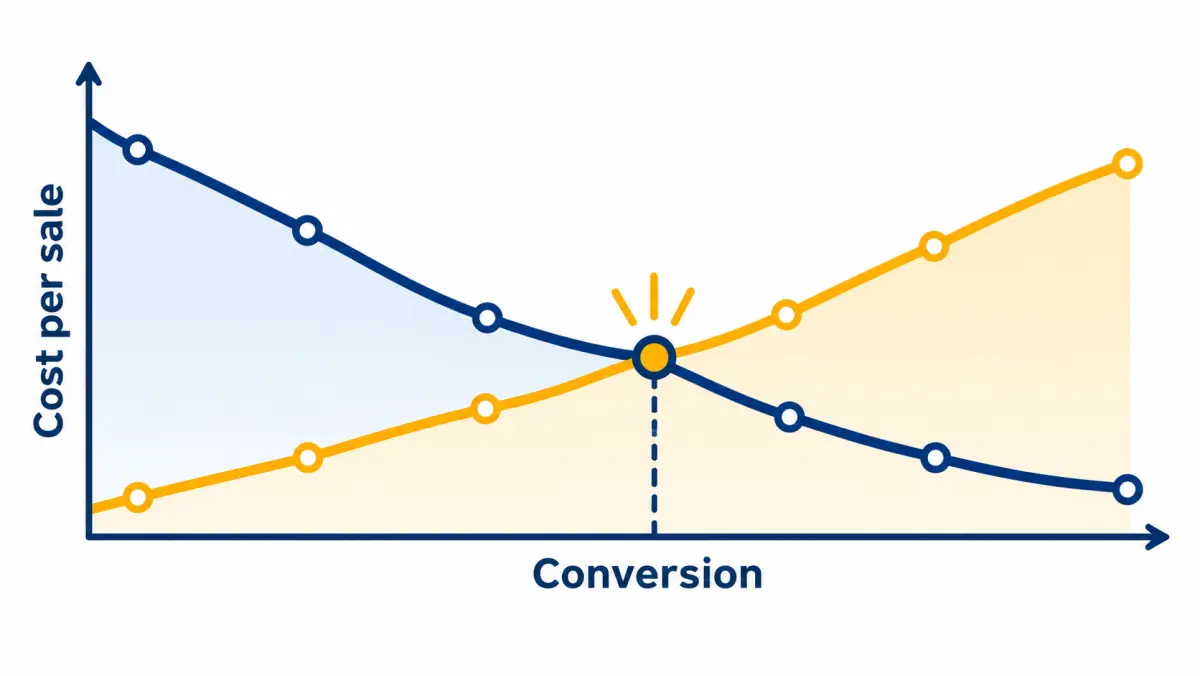
All tables use the same formula: (shared price + labor) ÷ (exclusive price + labor) × exclusive lead-to-sale rate. Every figure is an illustrative calculation, not a market benchmark.
Exclusive price and exclusive conversion
Holding the shared price at $45 and labor at $8 per lead worked:
| Exclusive price | Exclusive L2S 3% | Exclusive L2S 5% | Exclusive L2S 8% |
|---|---|---|---|
| $120 | 1.24% | 2.07% | 3.31% |
| $160 | 0.95% | 1.58% | 2.52% |
| $200 | 0.76% | 1.27% | 2.04% |
| $250 | 0.62% | 1.03% | 1.64% |
Read across a row: the better you convert exclusive leads, the higher the bar a shared lead must clear. Read down a column: the more exclusive leads cost, the lower the bar. A team converting exclusive leads at 8% and paying $120 for them needs shared leads to convert at 3.31% just to match, which is at the top of vendor-reported shared ranges. A team converting exclusive leads at 3% and paying $250 needs shared leads to reach only 0.62%.
The practical lesson: your exclusive conversion rate is the most important number in this decision. Teams that already convert exclusive leads well have the least to gain from shared leads, because every exclusive sale they give up is expensive to replace.
Labor per lead worked
Holding shared at $45, exclusive at $160 and exclusive L2S at 5.15%:
| Labor per lead worked | Break-even shared L2S | Share of exclusive rate |
|---|---|---|
| $0 (owner calls, no cost counted) | 1.45% | 28% |
| $8 | 1.62% | 32% |
| $15 | 1.77% | 34% |
| $25 | 1.95% | 38% |
Labor raises the bar for shared leads because you work more of them per sale. Owner-operators sometimes leave labor out because they make the calls themselves. That understates the cost: an hour spent dialing shared leads is an hour not spent on site surveys, proposals or installs.
Shared buyer count
Price is the visible variable, but the number of buyers per shared lead drives conversion. A lead sold to two buyers and a lead sold to five buyers might carry similar prices from different vendors, yet the five-buyer lead puts you in a much harder race. When comparing shared offers, write down the maximum buyer count for each and treat it as part of the price. A $40 lead with a three-buyer cap and a $35 lead with no stated cap are not comparable until you know the second number. Our guide to vetting solar lead providers lists the contract terms that pin this down.
Which input to measure first
If you have limited time to measure, measure in this order:
- Your exclusive lead-to-sale rate over at least 100 leads. It sets the bar.
- Your real response-time distribution. It predicts shared contact rate better than any vendor claim.
- Fully loaded labor per lead worked, including dialer seats, data and idle coverage.
- Shared buyer count in writing from each vendor.
With those four numbers you can predict, before spending a dollar on shared leads, whether they are likely to beat exclusive leads for your team.
Which lead type fits your installer size?
Owner-operators and small crews usually get a lower cost per sale from exclusive leads because they cannot call fast enough to win shared races. Teams with dedicated setters sit near the break-even and should test. Call centers with dialers, night coverage and price-led offers are the buyers most likely to make shared leads pay. The scenarios below show the math for each.
Each scenario below is an illustrative example built on the same hypothetical funnel used earlier in this guide (shared $45, exclusive $160, exclusive lead-to-sale 5.15%). Only the team's speed, budget and labor change. None of these are real companies or results.
Owner-operator: one person selling and installing

The owner-operator sells, designs, runs crews and answers the phone. Leads arrive while they are on a roof, at a permit office or with another customer. A realistic response time is somewhere between thirty minutes and a few hours.
Illustrative example, $3,000 monthly lead budget:
| Shared | Exclusive | |
|---|---|---|
| Price per lead | $45 | $160 |
| Leads per month | 67 | 19 |
| Contact rate (slow response) | 30% | 70% |
| Lead-to-sale rate | 0.84% | 5.15% |
| Expected sales per month | 0.56 | 0.97 |
| Leads to call per month | 67 | 19 |
With the same $3,000, exclusive leads produce close to twice as many expected sales and require calling about a quarter as many people. For an owner whose time is the scarcest input, the second number matters as much as the first: 48 extra shared leads a month is many hours of dialing, voicemail and follow-up texts that produce little.
Verdict for this size: start with exclusive leads in a tight radius around your base. Use a small budget and a narrow ZIP list so you can call every lead the same day. Revisit shared leads only if you add a dedicated person on the phone.
Small team: owner plus one setter
A small installer with one in-house setter during business hours can call most daytime leads within five to ten minutes but misses evenings and weekends. Contact on shared leads improves, though not to call-center levels.
Illustrative example, $8,000 monthly lead budget, $8 labor per lead worked, shared contact rate 50%:
| Shared | Exclusive | |
|---|---|---|
| Leads per month | 178 | 50 |
| Lead-to-sale rate | 1.40% | 5.15% |
| Expected sales | 2.5 | 2.6 |
| Lead spend | $8,000 | $8,000 |
| Labor | $1,422 | $400 |
| Lead plus labor per sale | about $3,780 | about $3,260 |
Expected sales are almost identical, but shared leads need more than three times the calling and cost about $500 more per sale once labor is counted. One setter cannot absorb 178 leads a month and still follow up properly on the ones who answer.
Verdict for this size: exclusive leads as the core. If you want to test shared leads, cap them at what your setter can call within two minutes during staffed hours and pause delivery outside those hours.
Growing installer: three to six setters and a dialer
At this size you have a real inside sales function, a CRM with routing, maybe an evening shift. This is where the answer becomes genuinely uncertain and a structured test pays off. Your shared contact rate could land anywhere from the mid-40s to the mid-60s depending on coverage and discipline. Revisit the break-even contact rate from the speed section: in the example, 58% is the line.
Verdict for this size: run the controlled test described earlier in this guide. Put the fastest two setters on shared leads, keep the rest on exclusive, and compare lead plus labor cost per sale after 60 to 90 days.
Call center or high-volume sales organization

A call center with a predictive or power dialer, 12-plus hours of coverage, and a pitch built around price and financing can reach shared leads quickly enough to make them work.
Illustrative example, $20,000 monthly lead budget, $8 labor per lead worked, shared contact rate 65%:
| Shared | Exclusive | |
|---|---|---|
| Leads per month | 444 | 125 |
| Lead-to-sale rate | 1.82% | 5.15% |
| Expected sales | 8.1 | 6.4 |
| Lead plus labor per sale | about $2,910 | about $3,260 |
Here shared leads produce more sales and a lower cost per sale. The call center's structural speed advantage is exactly what the shared model rewards.
Verdict for this size: shared leads can be a core source, alongside exclusive leads for premium territories and higher-value products. Watch contact rate weekly. If volume growth pushes response times up, the advantage disappears quickly.
Multi-market regional installer
Regional installers often have strong teams in one or two metros and thinner coverage elsewhere. One lead type for the whole footprint rarely fits. A common pattern is shared leads in the home metro where the inside team is fastest and brand awareness is highest, and exclusive leads in satellite markets where the local rep also runs site surveys and cannot answer instantly. Measure cost per sale by market and by source, not just by source.
New installer with no conversion data
If you have never bought leads, you do not have an exclusive conversion rate to anchor the break-even. Start with a small exclusive batch, because it gives you a cleaner read of your own funnel without competitors distorting it. Once you have 100 or more worked exclusive leads, you know your baseline and can judge whether a shared test is worth running. Starting with shared leads first tends to produce discouraging numbers that tell you more about the competition than about your sales process.
How does job value change the exclusive vs shared decision?
Higher job values favor exclusive leads because each lost sale costs more and because shared-lead sales tend to be negotiated down on price. When average contract value or margin per deal is high, a few extra points of close rate or a few hundred dollars of retained margin per deal outweigh a large difference in lead price.
The cost-per-sale comparison treats every sale as equal. In practice, how a homeowner arrives affects what they buy and what they pay. A homeowner talking to one installer has time to hear about batteries, panel upgrades, roof work and service plans. A homeowner comparing four quotes from four callers tends to compare a headline price per watt.
Net margin per sale by source
Illustrative example. Margin assumptions are hypothetical and chosen to show the method.
| Shared (fast team) | Exclusive | |
|---|---|---|
| Lead plus labor cost per sale | $2,913 | $3,265 |
| Assumed gross margin per sale | $7,000 | $9,000 |
| Margin after acquisition cost | $4,087 | $5,735 |
In this example the shared source wins on cost per sale by about $350, but loses about $1,650 per sale on what remains after acquisition. If your own data show a margin gap anywhere near that size, the cheaper lead is the more expensive source. If your data show no margin gap, cost per sale is the right measure.
Where margin gaps come from
- Discounting to beat a competing quote. On shared leads the homeowner often has another proposal in hand.
- Smaller systems. Price-shopping homeowners tend to buy the minimum system that meets their goal.
- Fewer add-ons. Batteries, EV chargers and electrical upgrades get less airtime in a price comparison.
- Higher cancellation after signing. Homeowners who signed under price pressure may cancel when a competitor comes back lower. Track cancellations by source.
After 25D: why the value conversation matters more
As of October 2026, the residential clean energy credit (Section 25D) is no longer available for systems placed in service after 2025, so homeowners can no longer count on a 30% federal credit to make the numbers work. That shifts the sale toward lease and PPA options, utility-rate arguments, batteries and financing. Those conversations take time and trust, which is easier to build when you are the only installer on the line. Our guide on solar leads after the 25D credit covers how the sale itself has changed; for the IRS details see the Residential Clean Energy Credit page. The short version for this decision: if your pitch depends on a longer value conversation, weight exclusive leads more heavily.
Battery and storage add-on leads
Some vendors sell leads from homeowners who already have solar and want storage, or who are asking specifically about backup power. These buyers have a narrower set of providers to choose from and longer conversations to have. If you buy storage-focused leads, ask the same exclusivity questions, and expect exclusivity to matter more because the job value is higher and the sale is more technical.
Commercial leads
Commercial and C&I solar leads are rarely sold as shared products in the same way residential leads are, and the sale is long, multi-stakeholder and relationship-driven. A business owner contacted by three installers in an hour is unlikely to respond well. For commercial work, treat exclusivity as a baseline requirement and spend your evaluation effort on qualification instead. See commercial solar leads for that product.
Does your state or market change the answer?
Your market changes the answer through three levers: how many installers compete for each homeowner, how much a typical job is worth, and how expensive each lead is locally. Crowded, price-competitive metros reward speed and can suit shared leads for fast teams. Thinner or premium markets usually favor exclusive leads. Lead prices themselves vary widely by state.
This section does not rank states, because competitor counts and close rates by state are not published in a form we can verify. Instead, use these questions to place each of your markets.
Questions to place a market
| Question | Points toward shared | Points toward exclusive |
|---|---|---|
| How many installers advertise in this market? | Many; homeowners expect several quotes | Few; one strong offer can win |
| Typical system size and price | Smaller, standardized | Larger, more custom, often with storage |
| Your brand awareness here | High; homeowners recognize your name on a callback | Low; you need time to build trust |
| Distance from your office or crews | Close; fast site surveys | Far; slower follow-up |
| Utility rates and net metering policy | Simple, well understood | Complex; needs explanation |
| Lead price locally | Shared much cheaper than exclusive | Small gap between the two |
The last row deserves attention. In some markets the gap between shared and exclusive prices is narrower than the national ranges suggest, and when the gap narrows the break-even for shared leads rises toward the exclusive rate. See solar lead prices by market for state-level context.
Testing a new territory
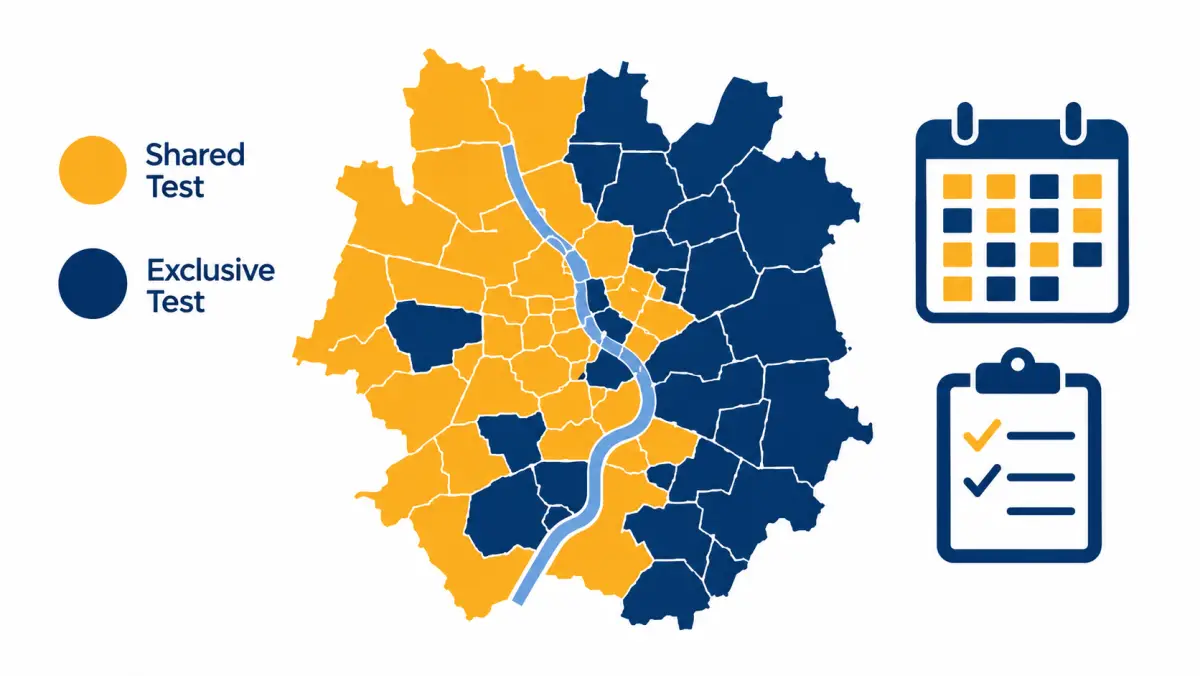
New territories are where shared leads are most often recommended, because they are cheap and the downside is limited. That reasoning holds only if you can work the leads quickly. A better approach for most installers:
- Pick a contained ZIP list. Choose ZIPs within a reasonable drive of where you can run site surveys.
- Buy a small exclusive batch first. It tells you whether homeowners in this territory respond to your offer, without competitors muddying the result.
- Add a capped shared batch if your team is fast. Run it in the same ZIPs during the same weeks so the comparison is fair.
- Read stage data, not just sales. In a new territory, sales take longer. Contact and set rates after 30 days are an early signal; cost per sale after 90 days is the decision.
- Expand the ZIP list from what worked. Grow the radius around the ZIPs that produced sits, not around your office.
Seasonality
Lead volume and homeowner attention shift through the year, and utility bill spikes in summer or winter can lift demand. The decision does not change with the season, but your capacity does. If your team is booked solid in peak months, slower response times will hurt shared leads more than exclusive leads. Some installers reduce shared volume when installation crews are fully scheduled and inside sales also handle customer service.
How should you work a shared lead differently from an exclusive lead?
Work shared leads for speed and differentiation: call instantly, acknowledge the homeowner may hear from others, and give a specific reason to choose you. Work exclusive leads for depth: you can take a little more time, ask better discovery questions and build the appointment around their goals. Using one script for both wastes the advantage of each.
The scripts below are starting points. Adapt them to your offer, and have counsel review anything you say about financing, savings or incentives. Never imply a homeowner is obligated to talk to you, and honor any request to stop calling immediately.
Shared lead: first-call opening
The homeowner may already have heard from another company, or will in the next few minutes. Your goal is to be the clearest, most useful call, not the loudest.
"Hi, is this [first name]? This is [your name] with [company], a local solar installer in [town]. You asked about solar for your home a few minutes ago, so I wanted to reach you right away. You may get calls from a few companies; that's normal with these request forms. I'll be quick and tell you how we're different, and if it's not a fit, no problem. Do you have two minutes?"
Why it works: it names the situation honestly, which lowers the homeowner's guard, and it asks permission. It also sets up a contrast with the next caller.
Differentiation line (pick one that is true for you):
- "We do our own installs with our own crews, so the person who designs your system is accountable for how it goes on your roof."
- "We've been installing in [county] since [year], and you can drive by homes we've done."
- "Our proposals show the cost with and without a battery, so you can compare apples to apples with anyone else you talk to."
Booking close:
"The fastest way to get a real number is a short visit where we look at your roof and your last 12 months of bills. I have [day] at [time] or [day] at [time]. Which works better?"
Offer two specific times close together. On shared leads, the appointment you set for next week often loses to the competitor who set one for tomorrow.
Shared lead: when the homeowner says "someone already called"
"That makes sense, and it's smart to compare. A lot of people get two or three quotes. What did they tell you so far? ... OK. When we put ours together, we'll show the same things side by side so you can compare easily. Would [day] at [time] work to get you a second number?"
Do not criticize the other company. Ask what they heard and position your visit as the comparison.
Exclusive lead: first-call opening
On an exclusive lead you are the only installer calling about that request, so you can spend the first call on discovery rather than racing.
"Hi, is this [first name]? This is [your name] with [company] in [town]. You asked about solar for your home, and I'm the person who'll help you figure out whether it makes sense. Is now still a good time for a few questions?"
Discovery questions:
- "What got you looking at solar right now?" (Bills, outages, a neighbor's system, a new EV.)
- "Roughly what do your electric bills run in summer and winter?"
- "Do you own the home, and how long do you plan to stay?"
- "Have you thought about a battery for backup, or mostly about lowering the bill?"
- "Who else in the household would want to be part of the conversation?"
Booking close:
"Based on what you've told me, the next step is a visit where we design around your roof and your usage. I'd like [spouse/partner] there too, since it's a big decision. What day works for both of you?"
Getting all decision-makers to the appointment matters on both lead types, but you have time to ask for it on an exclusive lead.
Follow-up cadence by lead type
| Timing | Shared lead | Exclusive lead |
|---|---|---|
| First attempt | Immediately on delivery | As fast as possible; within minutes during staffed hours |
| If no answer | Second call within a few minutes, then a text if consent covers texts | Second call later that hour, then a text if consent covers texts |
| Day 1 | Two to three more attempts | Two attempts at different times of day |
| Days 2 to 7 | Daily attempts, then reduce | Daily attempts with a value-focused message |
| After 7 days | Move to a light nurture or stop | Longer nurture; the lead is still yours alone |
The tail of the cadence is where exclusive leads keep paying. A shared lead that has gone quiet for a week has usually chosen someone else. An exclusive lead that has gone quiet may simply be busy, and a respectful follow-up three weeks later can still produce an appointment. Check what your consent covers before texting or using automated calls, and stop on request.
How should you track exclusive vs shared results in your CRM?
Track every lead with its source, lead type, delivery time, first-dial time and outcome at each funnel stage. Then report lead plus labor cost per sale by source each month. Without those fields you cannot tell whether shared leads failed because of the product or because of your speed, and the exclusive-versus-shared decision becomes guesswork.

Fields to add or confirm
| Field | Why it matters |
|---|---|
| Vendor | Compare vendors, not just lead types |
| Lead type (exclusive, shared, aged, transfer, appointment) | The core comparison |
| Stated max buyer count | Lets you compare shared offers fairly |
| Delivery timestamp | Starting point for speed measurement |
| First dial timestamp | Response time per lead |
| First two-way contact timestamp | Contact rate and time to contact |
| "Other companies called?" (yes/no/unknown) | Exclusivity check on every lead |
| Appointment set / sat / closed | Stage rates |
| Contract value and gross margin | Margin by source |
| Cancellation after signing | Quality of the sale by source |
| Replacement requested and approved | Real delivered cost |
Monthly report
Build one report and look at it the same day every month:
| Metric | Shared | Exclusive | Notes |
|---|---|---|---|
| Leads delivered | |||
| Median response time | Use median, not average | ||
| Contact rate | |||
| Set rate (of contacts) | |||
| Sit rate (of sets) | |||
| Close rate (of sits) | |||
| Lead spend after credits | |||
| Labor cost (leads worked × labor per lead) | |||
| Sales | |||
| Lead plus labor cost per sale | Decision metric | ||
| Average gross margin per sale | Tie-breaker | ||
| Cancellations |
Use credits-adjusted spend. Replacement credits for bad numbers or out-of-area leads lower the real cost of a source, so a vendor with a clean replacement process may cost less than its price suggests. Our replacement terms are simple: replacement credits for disconnected numbers, wrong contact details, or leads outside your filters, reported within 7 days. A prospect who isn't interested, doesn't answer, doesn't get financing approved or doesn't buy is not covered.
Sample size
Small samples mislead in both directions. A few lucky shared sales in month one can make them look excellent; a slow month can make exclusive leads look poor. As a rule of thumb, wait until each source has at least 100 worked leads and enough appointments that one more or one fewer sale would not change your conclusion. Do not change routing, scripts or staff partway through a comparison unless you change them for both sources.
Attribution traps
- Re-submissions. A homeowner who filled out forms on two vendors' sites may arrive as both an exclusive lead and a shared lead. Assign the sale to the first delivery and flag duplicates.
- Referrals from lead customers. A neighbor referral from a lead-sourced install is valuable but not a lead sale. Track it separately.
- Rep cherry-picking. If reps can choose which leads to call, they will call the exclusive leads first. Enforce routing rules, or the shared numbers will look worse than they are.
How do you run a hybrid exclusive and shared program day to day?
Run a hybrid program by routing each lead type to the team built for it, capping shared volume at what you can call within a minute, and rebalancing budget monthly on lead plus labor cost per sale. The rules must live in your CRM routing, not in reps' judgment, or exclusive leads get the attention and shared leads go stale.
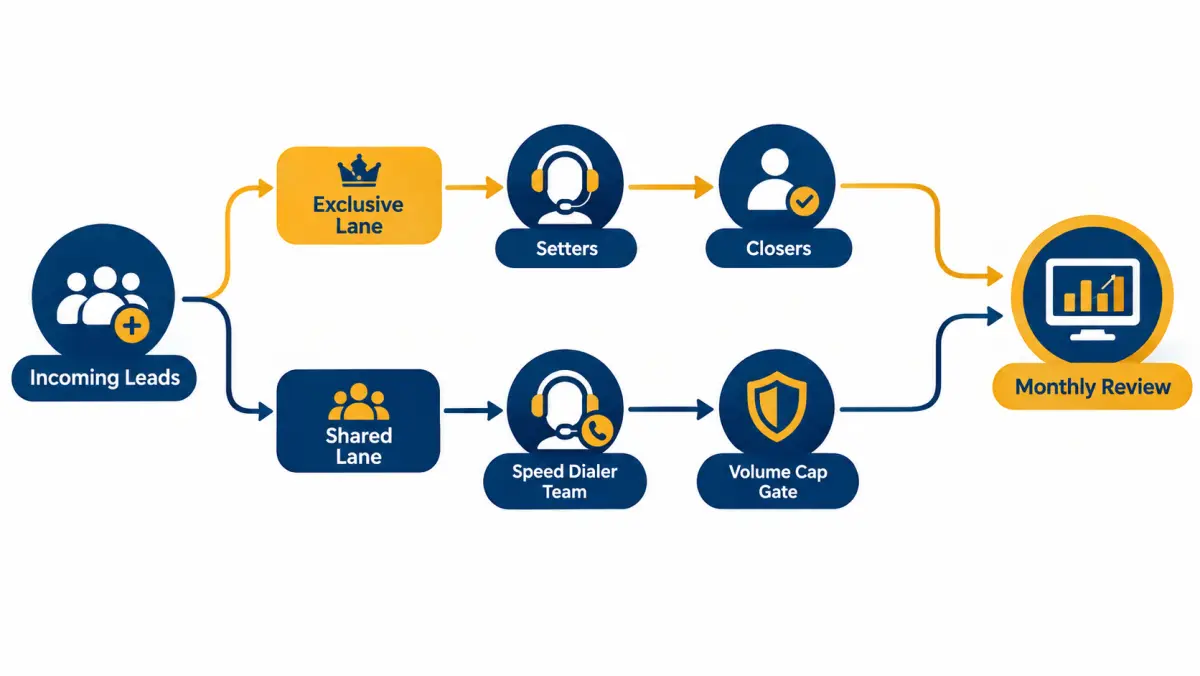
The earlier hybrid section outlines the structure. This section turns it into operating rules.
Routing rules
- Tag on arrival. Every lead is tagged with vendor and lead type from the delivery payload, not entered by hand.
- Shared leads go to the speed queue. The dialer pops shared leads to the next available speed-team rep immediately. If no rep is available within your threshold, the lead goes to a backup rep, not to a shared inbox.
- Exclusive leads go to the setter queue. Setters work them in order of arrival with a target first-dial time you can sustain.
- Both queues book into one closer calendar. Closers should not know or care which source an appointment came from until after the sit; that keeps their effort even.
- Pause shared delivery outside staffed hours. If your vendor supports delivery schedules, use them. A shared lead delivered at 11 pm to an empty office is mostly wasted money.
Volume caps
Set the daily shared cap from capacity, not budget:
Daily shared cap = speed-team reps on shift × leads one rep can open within a minute per hour × staffed hours
Then cut that number by a margin for breaks and longer conversations. If you set the cap from the budget instead ("we have $15,000 for shared leads this month"), volume will exceed your speed and contact rate will fall. Raise the cap only after contact rate holds steady at the current level for several weeks.
Monthly rebalance
| If this happens | Do this |
|---|---|
| Shared cost per sale below exclusive and contact rate stable | Raise shared cap modestly, recheck in a month |
| Shared cost per sale below exclusive but margin per sale much lower | Hold volume; compare margin after acquisition cost |
| Shared contact rate falling as volume rises | Cut shared cap back to the last stable level |
| Exclusive cost per sale rising | Check vendor, ZIP mix and setter performance before blaming the lead type |
| Both sources worse | Look at your own funnel (scripts, confirmation, closer) before changing vendors |
Who owns what
- Sales manager: routing rules, caps, monthly report.
- Speed team lead: response-time dashboard, daily shared contact rate.
- Setter lead: exclusive follow-up cadence, confirmation calls.
- Owner or finance: budget split by source, margin by source.
Clear ownership prevents the most common hybrid failure: nobody notices that shared response times slipped from one minute to fifteen until the month's numbers come in.
How do you audit a vendor's exclusivity claim over 30 days?
Audit exclusivity by combining three sources of evidence: the contract language, the consent disclosure on each lead, and what homeowners tell your team on first contact. Log all three for every lead over 30 days. A vendor whose leads repeatedly mention other callers, or whose disclosures name several companies, is not selling exclusive leads regardless of the label.
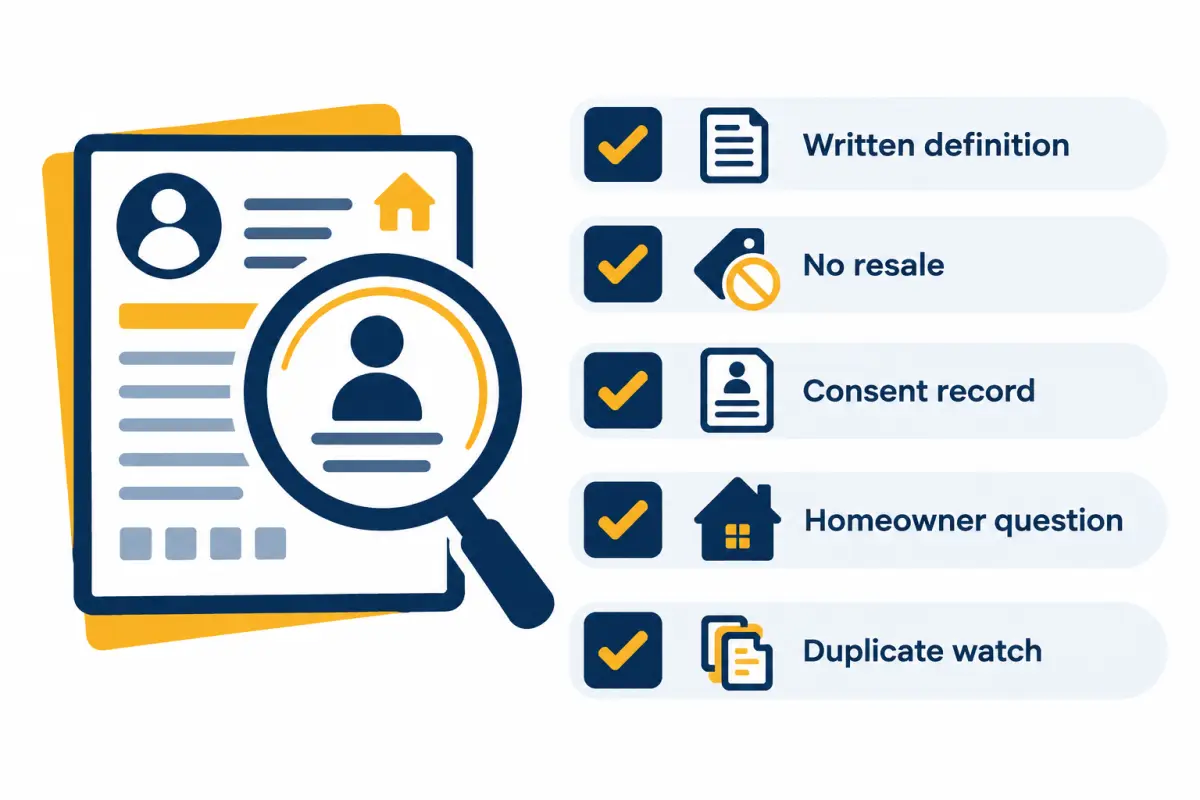
The verification section earlier lists the questions and red flags. This section is the worksheet you can run.
Week 0: paperwork
| Check | Pass | Fail |
|---|---|---|
| Contract defines "exclusive" | One buyer, ever, including no later resale | Vague, or limited to "at time of delivery" |
| Resale as aged inventory | Expressly prohibited | Silent or permitted |
| Max buyers stated (shared offers) | A number in writing | "Varies" |
| Consent record available | Per lead, on request, with timestamp | Only "on file," not produced |
| Replacement policy | Written reasons, window, process | Verbal only |
| Source disclosure | Vendor explains how leads are generated | Refuses to describe sources |
If you cannot pass most of these before buying, you cannot audit the product afterward. Our own exclusivity term reads: "Each exclusive lead is sold to one company. It is never resold, recycled or sold later as an aged lead." Ask other vendors for language at least that specific.
Weeks 1 to 4: lead-by-lead log
For every lead, your setters record:
- Did the homeowner mention other companies calling about this request? Ask neutrally: "Have you heard from anyone else about this yet?"
- Does the homeowner remember the form? Not remembering is a quality signal, not an exclusivity signal, but log it.
- Does the consent disclosure name your company? Pull it for a sample of leads, ideally every lead in the first two weeks.
- How many companies does the disclosure name or cover?
Day 30: read the log
- Exclusive leads where homeowners mention other callers: a handful can be explained by homeowners who filled out several forms on different sites. A steady pattern is a problem. Bring the specific leads to the vendor and ask for an explanation in writing.
- Disclosures naming many companies on "exclusive" leads: the form was built for multiple buyers. Even if only you received this lead, the vendor's model allows sharing.
- Shared leads with more callers than the stated cap: your setters' notes will show it. Ask for credits or a revised cap.
Ongoing spot checks
After the first month, keep the "anyone else called?" question in your script and review the answers quarterly. Exclusivity can erode quietly when a vendor's volume drops and it starts filling orders from other sources.
What should the consent disclosure look like on each lead type?
On an exclusive lead, the consent disclosure should clearly cover your company as the party who will contact the homeowner. On a shared lead, it must clearly cover every company that will call, which is harder to do well. As of October 2026 the FCC one-to-one rule is vacated, but TCPA consent requirements remain; confirm specifics with counsel.
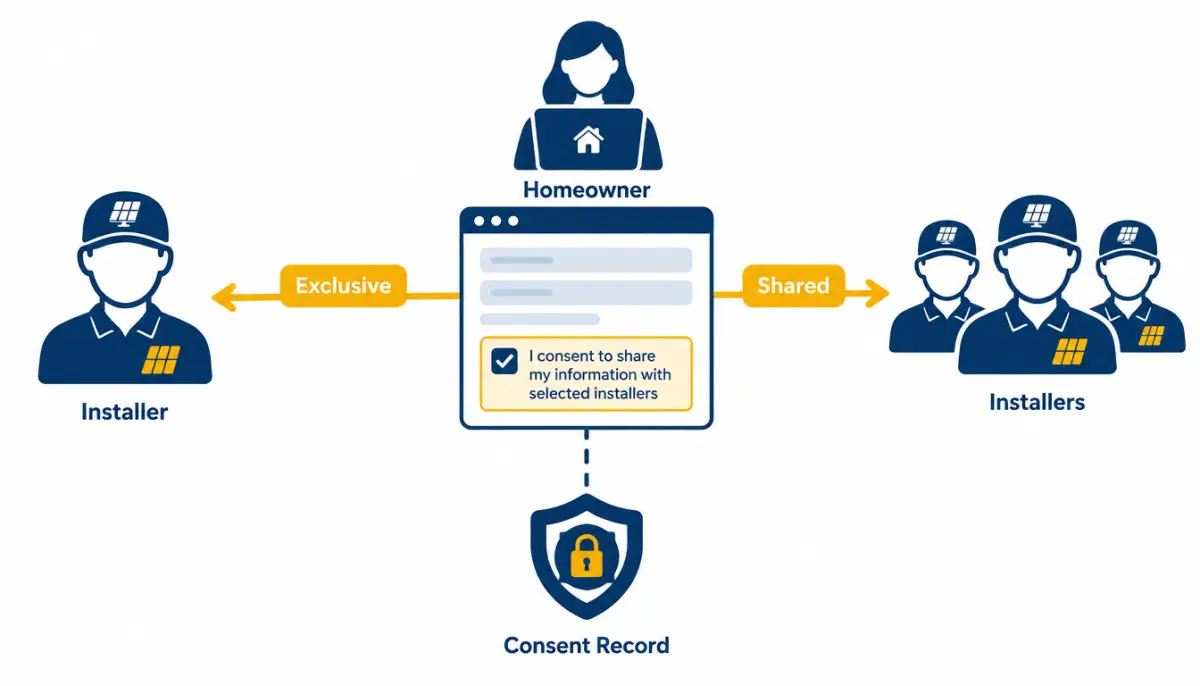
This is not legal advice. Your counsel should decide what your consent records must show. The points below are operational: what to look at so you can bring the right questions to counsel. Our TCPA guide for solar lead buyers covers the rules in more depth.
Exclusive lead disclosure: what to look for
- Your company is named, or clearly identified, as a party who may contact the homeowner.
- The disclosure states the contact methods (calls, texts, and whether automated technology or prerecorded messages may be used).
- It appears near the submit button, in readable text, not behind a link.
- The record includes a timestamp, the page or form version and the homeowner's submitted details.
Shared lead disclosure: extra questions
- Does it name each buyer, or does it refer to "partners," "marketing partners" or a linked list?
- If a linked list, how many companies are on it, and is your company on the version the homeowner saw?
- Does the number of companies covered match the buyer cap you were sold?
- Would a reasonable homeowner reading it understand that several solar companies will call?
Why the vacated rule still matters to buyers
The one-to-one consent rule would have required consent to be given to one seller at a time. It was vacated by the Eleventh Circuit on January 24, 2025, so it did not take effect. Some lead sellers still describe it as live; some buyers assume its vacatur means consent no longer matters. Neither is right. The broader TCPA prior express written consent requirements for certain calls and texts still apply, and some states impose their own telemarketing requirements. Shared leads simply put more pressure on a single disclosure to do more work. The FTC's Telemarketing Sales Rule guidance is another primary source worth reading alongside the FCC material.
What we provide on every lead
Every lead we sell carries a timestamped consent record whose disclosure names your company, available on request, and every lead is scrubbed against the National Do Not Call Registry before delivery. Other quality checks we run before delivery: phone number validated, homeowner status self-reported then checked against property records, and duplicate-checked against leads already sent to you.
Which contract terms protect you when buying exclusive or shared leads?
Protect yourself with written terms that define exclusivity or the shared buyer cap, ban later resale, describe the consent record you receive, set replacement reasons and a window, and avoid long lock-ins. Buy a test batch first. If a vendor will not put these terms in writing, the price comparison between exclusive and shared offers is meaningless.
Clause checklist
| Term | Exclusive offer | Shared offer |
|---|---|---|
| Definition | Sold to one buyer only, never resold or recycled | Sold to no more than [N] buyers, ever |
| Aged resale | Prohibited | Disclose whether and when leads are resold |
| Consent | Per-lead record naming your company, produced on request | Per-lead record covering all buyers, produced on request |
| Filters | ZIPs, homeowner status, other filters you set | Same, plus confirmation that filters apply before sharing |
| Replacement | Reasons, window, process in writing | Same; ask whether shared leads get the same terms |
| Delivery | Real-time to CRM or dialer; schedule controls | Same; delivery schedule controls matter more |
| Volume and caps | Daily and monthly caps you control | Same |
| Term | Test batch, no long-term contract | Same |
Our own terms: no long-term contracts, start with a test batch and scale when the numbers work, with real-time delivery to your CRM, dialer, email or SMS. Pricing is confirmed by ZIP on your call.
Questions that reveal more than the contract
- "If I stop buying, what happens to the leads in my ZIPs?" (Do they get sold to someone else as shared or aged leads?)
- "What share of your volume is exclusive versus shared?" (A mostly-shared vendor with a small exclusive line may be selling overflow.)
- "Can I see a sample consent record from this exact form?"
- "How do you handle a homeowner who submits on two of your sites?"
Illustrative walkthroughs: three installers make the call
These walkthroughs are illustrative examples, not real companies or results. Each shows how an installer might apply the method in this guide, using hypothetical numbers, so you can see the reasoning rather than just the formula.
Walkthrough 1: the five-person installer who tried shared leads first
A five-person installer in a suburban market buys 200 shared leads at a low price because the budget is tight. The owner and one office manager make the calls between other tasks. After six weeks, they have reached 70 homeowners, set 12 appointments, sat 6 and closed 1.
What went wrong: the funnel shows contact at 35%, which is far below the break-even contact rate the team would need. Most of the other stages are not terrible; the team simply loses the race on most leads.
What they change: they switch to a small exclusive batch in a tighter ZIP list and track the same stages. Contact rises because no one else is calling first, and the office manager can follow up the next morning without losing the lead. The cost per lead rises sharply, but the number of calls needed per sale falls by more.
Lesson: a poor shared test usually measures speed, not demand. Before concluding that leads do not work in your market, check where in the funnel the loss happened.
Walkthrough 2: the dialer team that outgrew its cap
A call-center style installer runs shared leads at a capped 25 a day with three speed reps and sees a lower cost per sale than its exclusive leads. Management doubles the cap to 50 without adding reps. Within two weeks, median response time climbs from under a minute to several minutes during peaks, and contact rate drops.
What they change: they cut the cap back, add a fourth rep for evening hours, then raise the cap in steps of five while watching contact rate. Shared leads stay profitable at a volume the team can actually serve.
Lesson: shared lead economics depend on capacity. The cap is the control that keeps them profitable.
Walkthrough 3: the premium installer weighing margin
A premium installer that sells high-efficiency panels with batteries tests shared leads alongside exclusive leads. After 90 days, shared leads show a slightly lower lead plus labor cost per sale. But shared deals are smaller, fewer include storage, and two of them cancel after a competitor returns with a lower price.
What they decide: they compare margin after acquisition cost, find exclusive leads well ahead, and stop buying shared leads. They redirect the budget to exclusive leads in neighborhoods where their past installs cluster.
Lesson: cost per sale is the starting point. For value-led installers, margin per sale after acquisition cost is the decision.
Why do vendors sell both exclusive and shared leads?
Vendors sell both because the same production cost can be recovered from one buyer at a high price or from several buyers at lower prices. Shared selling lets a vendor earn more per homeowner and sell into markets where few buyers will pay exclusive prices. Knowing the vendor's incentives helps you ask the right questions about each product.
The vendor's math
Producing a lead costs roughly the same whether it is sold once or several times: advertising, landing pages, forms, verification and compliance. What changes is revenue. A vendor that sells one lead to three buyers at a third of the exclusive price earns about the same as one exclusive sale, and if it can sell to four or five buyers it earns more. That is why shared leads are not simply "cheaper exclusive leads." They are a different revenue model, and the vendor's incentive is to maximize the number of buyers per lead within what buyers will tolerate.
Exclusive selling has its own incentive problem. When volume in a territory is short, a vendor may be tempted to fill exclusive orders from lower-quality sources, buy leads from other vendors and resell them, or quietly sell exclusive leads again later as aged leads. Each of these is a reason the audit steps in this guide exist.
Signs of a well-run exclusive program
- The vendor will tell you how leads are generated and from which channels, in general terms.
- Volume in your ZIPs is limited and the vendor says so, instead of promising unlimited volume.
- Consent records are produced on request, per lead, without delay.
- The contract states no later resale.
- Replacement reasons are specific and written.
Signs of a well-run shared program
- The maximum number of buyers is fixed and written.
- Leads are delivered to all buyers at the same moment, or the vendor explains its order.
- Consent disclosures clearly cover every buyer.
- Delivery schedules let you pause outside your staffed hours.
- Pricing reflects the buyer count: a two-buyer lead costs more than a four-buyer lead.
"Semi-exclusive" and capped products
Some vendors offer leads sold to exactly two buyers, or leads that are exclusive for a set period and then shared. These can be reasonable middle options, but evaluate them with the same break-even formula. A two-buyer lead is a shared lead with a smaller race. A lead that becomes shared after 24 hours is an exclusive lead with an expiry, and its value depends on your team calling within that window.
Common myths about exclusive and shared solar leads
Most myths about exclusive and shared leads come from looking at one number in isolation: price per lead, a vendor's close-rate claim, or one bad month. The corrections below each point back to cost per sale, measured with your own team, as the number that settles the question.
"Shared leads are just cheaper versions of the same lead"
The homeowner and the form may be identical, but the situation is not. A shared lead puts you in a race with other installers, so its conversion depends on your speed relative to theirs. You are buying a chance at the homeowner, priced for the fact that others hold the same chance.
"Exclusive leads always convert better, so they are always worth it"
Exclusive leads usually convert better, but whether they are worth the premium depends on the size of the conversion advantage relative to the price difference. A very fast team with a price-led offer can produce a lower cost per sale from shared leads, as the call-center scenario shows.
"If shared leads didn't work for us, leads don't work in our market"
A failed shared test often measures speed rather than demand. Check contact rate and response time before giving up on paid leads in a territory. An exclusive test in the same ZIPs will tell you more about local demand.
"Vendor close rates tell you what you'll get"
Published close rates come from companies that sell leads or services, without sample sizes or definitions. They are useful mostly for the ratio between exclusive and shared performance. Your own numbers after 100 leads are worth more than any published range.
"Exclusive means no one else will ever call the homeowner"
Exclusive means the vendor sold that request to one buyer. Homeowners often submit forms on several sites, so another installer may call about a different submission. That is normal and does not by itself mean the vendor broke exclusivity. A pattern across many leads is different.
"The one-to-one consent rule means shared leads are banned"
The FCC's one-to-one consent rule was vacated by the Eleventh Circuit on January 24, 2025, so it did not take effect. Shared leads are not banned by that rule. TCPA consent requirements still apply, and the disclosure must work for every buyer. Confirm specifics with counsel.
"Cheaper leads let us scale faster"
More leads only scale sales if you can work them at the same quality. Scaling shared volume past your speed capacity reduces contact rate and can raise cost per sale even as lead count grows. Scale is a staffing question first.
Troubleshooting: what to do when the numbers look wrong
When exclusive or shared results look worse than expected, find the funnel stage where the drop happens before changing vendors or lead types. Most problems trace to response time, routing, scripts or confirmation, which you control. Change one thing at a time and measure the same stage again over the next few weeks.
| Symptom | Likely cause | First thing to check | Fix to try |
|---|---|---|---|
| Shared contact rate far below exclusive | Slow response, after-hours delivery | Response-time distribution by hour | Pause shared delivery outside staffed hours; route to speed team only |
| Exclusive contact rate low | Bad data or slow follow-up | Disconnected numbers and wrong-person rate | Request replacements for invalid data; tighten first-day cadence |
| Contact fine, set rate low on shared | Opening sounds like every other caller | Call recordings from shared leads | Add an honest "you may hear from others" line and a real differentiator |
| Set rate fine, sit rate low | Appointment too far out, no confirmation | Days from set to sit | Offer sooner times, confirm the day before and morning of |
| Sit rate fine, close rate low on shared | Competing quotes on the table | Closer notes on competing proposals | Bring a comparison sheet; decide your floor on price |
| Close rate fine, margin low on shared | Discounting to win | Average discount by source | Set discount limits by source; reconsider shared volume |
| Cancellations high on shared | Signed under price pressure | Reasons for cancellation | Strengthen post-sale follow-up; compare after-cancel cost per sale |
| Homeowners on exclusive leads mention other callers | Multiple form submissions or resale | Pattern by vendor and date | Raise specific leads with the vendor in writing |
| Both lead types underperform | Internal funnel problem | Closer and setter performance by rep | Coach or reassign before changing lead sources |
| Costs per sale swing month to month | Small sample | Number of worked leads | Wait for at least 100 worked leads per source |
When to switch lead type, and when not to
Switch lead type when you have a clean comparison, enough volume, and a consistent gap in lead plus labor cost per sale across at least two measurement periods. Do not switch after one bad month, after a change in staff, or when the drop clearly sits in a stage you control. A lead type that looks worse because your best setter left will look better again when you replace them.
A 90-day plan for deciding between exclusive and shared leads
A 90-day plan gives you enough worked leads to compare exclusive and shared sources fairly. Spend the first two weeks measuring your baseline and setting up tracking, the next ten weeks running both sources under fixed routing rules, and the last stretch reading cost per sale and margin. Then commit your budget split for the next quarter.
Days 1 to 14: set up
- Add the CRM fields listed in the tracking section.
- Measure your current response-time distribution and exclusive funnel if you have one.
- Calculate your fully loaded labor cost per lead worked.
- Compute the break-even shared lead-to-sale rate and break-even contact rate with your own numbers.
- Get written terms from each vendor: exclusivity definition or buyer cap, consent records, replacement policy.
- Decide routing: which reps work which lead type, and what the shared daily cap is.
Days 15 to 75: run
- Buy both lead types in the same ZIPs, during the same weeks.
- Keep routing, scripts and staffing constant. If you must change something, change it for both sources.
- Review response time and contact rate weekly. Fix speed problems immediately; they are not part of the test.
- Log "anyone else called?" on every lead.
- Request replacements promptly for leads that qualify.
Days 76 to 90: decide
- Compute lead plus labor cost per sale by source, using credits-adjusted spend.
- Compare margin after acquisition cost by source.
- Check sample size. If either source has fewer than about 100 worked leads, extend the test rather than deciding.
- Set next quarter's budget split. Move budget toward the source with the lower cost per sale or higher margin after acquisition cost, in steps rather than all at once.
After 90 days
Keep the monthly report running. The answer can change when your team grows, a key setter leaves, a competitor adds a night shift, or a vendor's quality shifts. Re-test whenever a major input changes. You can model scenarios in the solar lead cost calculator before you commit budget, and if you want to talk through a test batch for your ZIPs, book a call.
How should you split a fixed lead budget?
Split a fixed budget by starting with the source your team can work best, then moving money in steps toward whichever source produces the lower lead plus labor cost per sale. Never fund shared leads beyond the volume your fastest reps can call within a minute, and keep enough exclusive volume to protect your closers' calendars.
Step-by-step allocation
- Fund your closers' calendars first. Estimate how many sits each closer can run per week and work backward to the number of exclusive leads needed at your exclusive funnel rates.
- Add shared leads only up to your speed cap. Use the daily shared cap formula from the hybrid section.
- Hold back a test reserve. Keep a small share of the budget for testing a new vendor, territory or product.
- Rebalance monthly. Move budget in steps toward the lower cost per sale, then confirm contact rate holds before moving more.
Illustrative allocation example
Illustrative example. Hypothetical inputs. An installer has $12,000 a month and two closers who can each run eight sits a week (about 64 sits a month in total).
- At the earlier exclusive funnel rates (70% contact, 35% set, 70% sit), each exclusive lead produces about 0.17 sits. Filling 64 sits would take about 373 exclusive leads, or roughly $60,000 at $160. The budget cannot fill the calendar from exclusive leads alone.
- $12,000 buys 75 exclusive leads, producing about 13 sits.
- If the team has a speed rep who can work 10 shared leads a day within a minute, that is about 220 shared leads a month on weekdays, costing about $9,900 at $45. At 65% contact, 25% set and 56% sit, those produce about 20 sits.
The installer cannot buy both at full volume within $12,000. A reasonable starting split might be $6,000 exclusive (about 37 leads, about 6 sits) and $6,000 shared (about 133 leads, about 12 sits at fast-team rates), then rebalance on cost per sale after 60 to 90 days. The point of the example is the method: start from closer capacity and speed capacity, not from the price list.
Check the math with your own funnel. If your shared contact rate is closer to 45% than 65%, the shared sits in this example fall by about a third and the split should lean further toward exclusive leads.
How should you pay reps who work exclusive and shared leads?
Pay reps so that each lead type gets the behavior it needs: speed on shared leads and thorough follow-up on exclusive leads. A single commission per appointment set tends to push reps toward the easier exclusive leads and away from fast shared dialing. Measure and reward response time and contact rate for the speed team, and sit and close outcomes for setters.
What goes wrong with one plan for both
If setters earn the same bonus per appointment regardless of source, they will rationally spend time where appointments come easiest. On a mixed queue that means exclusive leads first, shared leads later, which is exactly the order that destroys shared economics. If reps can pick leads, the shared numbers in your report will reflect neglect rather than the product.
Structures that fit each lead type
| Role | Lead type | What to reward | What to watch |
|---|---|---|---|
| Speed rep | Shared | Median response time, contact rate, sets | Booking low-quality appointments to hit numbers |
| Setter | Exclusive | Sits (not just sets), confirmation rate | Slow first dial because "the lead isn't going anywhere" |
| Closer | Both | Closes and margin, regardless of source | Discounting more on shared sits |
Reward sits rather than sets wherever possible. An appointment that does not happen costs your closer a time slot and costs you the lead.
Fairness when reps rotate
If the same reps work both lead types on different days, normalize targets by source. A shared-lead day will produce fewer sets than an exclusive-lead day even with perfect work. Set targets from each source's recent average so reps are not penalized for the queue they were assigned.
How do you move from shared to exclusive leads, or the reverse?
Move between lead types gradually, keeping the old source running at reduced volume while the new one ramps, so your closers' calendars stay full and you can compare results directly. Change routing and scripts at the same time as the source, because a team built for shared racing works exclusive leads differently, and the reverse.
From shared to exclusive
Installers usually make this move when shared contact rates fall or margin per sale disappoints.
- Start with your best ZIPs. Buy exclusive leads where your past sits and installs cluster.
- Retrain the opening. Drop the racing language and add discovery questions. Setters used to shared leads often rush exclusive leads unnecessarily.
- Extend the cadence. Exclusive leads justify longer follow-up, so add later touches you previously skipped.
- Expect higher cost per lead and fewer leads. Judge the move on cost per sale after enough volume, not on lead count in the first week.
- Reduce shared volume in steps as exclusive appointments fill the calendar.
From exclusive to shared
Installers usually make this move when they add a dialer team or move to a price-led offer.
- Build speed before buying. Dialer, routing, coverage hours and a backup rep must be in place first.
- Set the daily cap from capacity using the formula in the hybrid section.
- Rewrite the opening with the honest "you may hear from others" line and a real differentiator.
- Shorten the gap from set to sit. Offer same-day or next-day appointments where possible.
- Keep exclusive leads in premium territories until shared results are proven.
What not to do
Do not switch everything in one week. A sudden change in source, script and staffing at once makes it impossible to know what caused the result, and an empty calendar for two weeks while the new source ramps can cost more than the savings.
Questions to answer before your next lead purchase
Answer these questions with numbers before buying, and the choice between exclusive and shared leads usually becomes obvious. If you cannot answer most of them, the first purchase should be a small exclusive test batch designed to produce those numbers, not a large order of either type.
About your team
- What is our median response time to a new lead during staffed hours? After hours?
- How many leads can our fastest reps open within a minute per hour?
- What is our exclusive lead-to-sale rate over the last 100 or more worked leads?
- What is our fully loaded labor cost per lead worked?
- How many sits can our closers run each week?
About our offer
- Do we win mostly on price, or on design, service and product?
- What is our average gross margin per sale, and does it differ by lead source?
- How often do sales include storage or other add-ons?
About the vendor
- What exactly does "exclusive" mean in the contract? Is later resale prohibited?
- For shared offers, what is the maximum number of buyers, in writing?
- Can we get a sample consent record from the form our leads will come from?
- What are the replacement reasons, window and process?
- Can we pause delivery outside our staffed hours?
About our market
- How many installers compete for homeowners in our ZIPs?
- How large is the gap between shared and exclusive prices locally?
- Can we reach every lead's address for a site survey within a reasonable time?
Glossary of exclusive and shared lead terms
These are the terms used in this guide and in vendor contracts. Definitions vary between vendors, so treat this glossary as a starting point and get the vendor's own definition in writing for any term that affects price, exclusivity or replacement.
| Term | Meaning in this guide |
|---|---|
| Exclusive lead | A homeowner request sold to one buyer only, with no later resale |
| Shared lead | A homeowner request sold to two or more buyers, usually at the same time |
| Buyer cap | The maximum number of companies a shared lead can be sold to |
| Semi-exclusive lead | A lead sold to a small fixed number of buyers, often two |
| Timed exclusive | A lead exclusive for a set period, then sold to others |
| Aged lead | A lead resold days, weeks or months after it was first delivered |
| Real-time lead | A lead delivered within moments of the homeowner submitting the form |
| Contact rate | Two-way conversations divided by leads delivered |
| Set rate | Appointments booked divided by contacts |
| Sit rate | Appointments kept divided by appointments booked |
| Close rate | Sales divided by sits |
| Lead-to-sale rate | Sales divided by leads delivered; the product of the four stage rates |
| Labor per lead worked | Setter time, dialer seats, data and coverage cost divided by leads worked |
| Lead plus labor cost per sale | (Lead spend + labor) divided by sales; the main decision metric |
| Break-even rate | The shared lead-to-sale rate at which shared and exclusive cost the same per sale |
| Margin after acquisition cost | Gross margin per sale minus lead plus labor cost per sale |
| Consent record | The timestamped evidence of what the homeowner agreed to and which companies it covers |
| Replacement credit | A credit for a lead that fails written criteria, such as a disconnected number |
| Response time | Minutes from lead delivery to first outbound dial |
| Speed team | Reps dedicated to calling shared leads instantly |
Exclusive vs shared solar leads at a glance
The summary below brings the comparison into one place. Shared leads cost less per lead and reward speed and price-led selling. Exclusive leads cost more per lead and reward value-led selling, small teams and higher job values. The deciding number for your business is lead plus labor cost per sale, and for value-led installers, margin after acquisition cost.
| Factor | Shared leads | Exclusive leads |
|---|---|---|
| Published price range (vendor sources, as of October 2026) | Roughly $25 to $150 | Roughly $100 to $300 |
| Who calls the homeowner | Several installers, often within minutes | One installer |
| Biggest funnel loss | Contact and set rates | Usually data quality, if anything |
| Team it suits | Fast dialer teams with long coverage | Owner-operators, small teams, value-led sellers |
| Response-time sensitivity | Very high | Moderate |
| Margin pressure | Higher; competing quotes common | Lower |
| Follow-up value after day 7 | Low | Still meaningful |
| Consent disclosure | Must cover every buyer | Must cover your company |
| What to verify | Buyer cap in writing, consent scope | No resale, consent names you |
| Best measured by | Lead plus labor cost per sale, contact rate | Lead plus labor cost per sale, margin |
Price ranges are compiled from the vendor sources cited in the pricing section and are not our prices. For a view of the whole market, including where each product fits, see where to buy solar leads. For the exclusive product itself, including delivery and filters, see exclusive solar leads, and for how to calculate the return on any source, see solar lead ROI.
How do you compare three vendor offers side by side?
Compare vendor offers by converting each one into an expected lead plus labor cost per sale, using the vendor's price and buyer cap with your own funnel rates. A cheap shared offer with no buyer cap, a mid-priced two-buyer offer and an exclusive offer can all be ranked on one line once you estimate contact rate for each from your response time.
Worksheet
Illustrative example. Hypothetical vendors and inputs. The installer's downstream rates on exclusive leads are 35% set, 70% sit and 30% close. On shared leads they use 25% set, 56% sit and 20% close. Labor is $8 per lead worked. Contact rates are the installer's estimates from their own response-time data, adjusted for how many competitors call each lead.
| Vendor A: shared, cap not stated | Vendor B: shared, two buyers | Vendor C: exclusive | |
|---|---|---|---|
| Price per lead | $35 | $70 | $160 |
| Estimated contact rate | 40% | 58% | 70% |
| Set × sit × close | 2.8% | 2.8% (assumed same as shared) | 7.35% |
| Lead-to-sale rate | 1.12% | 1.62% | 5.15% |
| Leads per sale | 89 | 62 | 19 |
| Lead plus labor per lead | $43 | $78 | $168 |
| Lead plus labor cost per sale | about $3,840 | about $4,800 | about $3,260 |
In this example the two-buyer offer, often presented as the safe middle option, is the most expensive per sale because its price is high relative to its conversion gain. The cheapest offer comes second, and the exclusive offer wins. A different team with faster response would see different contact rates, and possibly a different ranking. That is the point of the worksheet: plug in your own estimates instead of trusting the label.
Getting better contact-rate estimates
The weakest input in the worksheet is the estimated contact rate for offers you have not bought yet. Improve it in three ways:
- Use your own history. If you have bought shared leads before, use the contact rate you achieved at similar response times.
- Adjust for buyer count. Fewer buyers per lead usually means better contact at a given speed, but by how much depends on how fast the other buyers are, which you cannot see. Treat any adjustment as a guess to be replaced by test data.
- Run a small batch. The cheapest way to get a real number is a capped test of 50 to 100 leads from each vendor, worked under the same routing rules.
What the worksheet cannot capture
- Margin per sale. Add a row for margin after acquisition cost if your data show a gap by source.
- Data quality. A vendor with many disconnected numbers will show a low contact rate regardless of speed. Use replacement credits to correct spend, and compare invalid-data rates separately.
- Volume. A vendor that can only deliver a few exclusive leads a week in your ZIPs may not fill your calendar. Cost per sale is not the only constraint; supply is another.
How should setters handle objections on shared and exclusive leads?
Setters handle objections best when they acknowledge the homeowner's situation honestly and offer a specific, low-pressure next step. On shared leads the most common objections concern other companies calling and quote fatigue. On exclusive leads they concern timing and uncertainty. The lines below are starting points to adapt, not scripts to read word for word.
Always respect a request to stop calling. Record it immediately and remove the number from all queues, including any vendor or dialer lists your team controls.
Shared-lead objections
"I've already had three calls about this."
"I'm sorry about that; these request forms often go to a few companies. I'll keep this short. The only thing I'd suggest is getting at least two real proposals so you can compare. If we can be one of those, I can look at your roof from satellite now and come by [day] with numbers. If not, I'll leave you alone."
"I already booked with someone else."
"Good, that's a smart first step. When you get their proposal, it helps to have a second one to compare against. We put ours in a format that makes comparison easy. Would [day after their visit] work?"
"Just email me a price."
"I can send you a rough range by email, but a real number depends on your roof and your usage, and anyone who gives you an exact price without those is guessing. Can I ask two quick questions so the range I send is useful?"
"How did you get my number?"
"You filled out a request for solar information on [site or form name if known] a few minutes ago, and we're one of the local installers that request went to. If you'd rather not hear from us, I'll make a note right now."
Be truthful about the source. If you do not know which site the homeowner used, say so, and check the consent record afterward.
Exclusive-lead objections
"I'm just starting to look."
"That's the best time to talk, before you're comparing a stack of quotes. No commitment; I can put together a design so you know what's possible on your roof. Would a short visit next week work, or would you rather start with a phone review of your bills?"
"I need to talk to my spouse."
"Absolutely, it's a decision you should make together. Let's find a time when you're both home so you can hear the same information. What evening works best?"
"Solar doesn't make sense without the tax credit, right?"
"The 30% federal homeowner credit ended for systems placed in service after 2025, so the math is different now. For some homes it still works through lower bills, financing, or lease and PPA options; for others it doesn't. That's exactly what a design visit tells you. I'd rather show you real numbers than guess."
Do not promise savings or incentive amounts on the phone. Have counsel and your finance partners approve any language about financing or savings.
"Call me in a month."
"Will do. I'll put a note to call on [date]. In the meantime, can I send a short checklist of what to gather, like your last 12 months of bills? It'll make that call quicker."
On an exclusive lead, a scheduled callback in a month is still a live opportunity. Put it on the calendar and honor it.
First-call quality checklist for both lead types
A first-call checklist keeps your comparison fair: if one lead type gets better calls than the other, your exclusive-versus-shared results measure your team's effort, not the product. Review a sample of recorded calls from each source every week against the same list, and coach the gaps before reading the month's cost-per-sale numbers.
| Check | Shared lead | Exclusive lead |
|---|---|---|
| First dial within target response time | Within a minute where possible | Within your staffed-hours target |
| Confirmed speaking with the person who submitted | Yes | Yes |
| Referenced the request honestly | Yes, including that others may call | Yes |
| Stated a specific differentiator | Required | Helpful |
| Asked at least two discovery questions | Short version | Full version |
| Asked for all decision-makers at the visit | Yes | Yes |
| Offered two specific near-term times | Required | Recommended |
| Logged "anyone else called?" | Yes | Yes |
| Recorded any stop-calling request | Immediately | Immediately |
| Set confirmation reminders | Yes | Yes |
Score each sampled call and track the average by source and by rep. If shared-lead calls score much lower, fix the calls before concluding the leads are worse.
Does the lead's source channel change the comparison?
The channel that produced a lead, such as search, social media or a comparison site, affects intent and contact rates for both exclusive and shared leads, so compare like with like. An exclusive social lead and a shared search lead differ in two ways at once. Ask each vendor which channels feed each product before reading your results.
Why channel matters
Homeowners who search for solar installers and fill out a form are usually further along than homeowners who tap an ad in a social feed. Comparison and quote sites often promise several quotes up front, so their leads tend to be sold to several buyers by design, and homeowners expect multiple calls. A lead labelled "exclusive" that came from a multi-quote site may still find a homeowner expecting several companies, because that is what the site told them.
Questions to ask about channel
- Which channels produce the exclusive leads in my ZIPs, and which produce the shared leads?
- Does the form tell the homeowner how many companies will contact them?
- Are any leads bought from other vendors and resold? If so, how is exclusivity guaranteed?
- Can I filter or tag leads by channel so I can measure them separately?
Reading results by channel
If you can tag leads by channel, add a channel column to your monthly report. A shared program that looks poor overall may perform acceptably from one channel and badly from another. Likewise an exclusive program may hide a weak channel that drags down the average. Cut the weak channel before you judge the lead type.
What happens to exclusive and shared leads you don't close?
Leads you do not close keep different value depending on type. An exclusive lead you worked well remains a relationship only your company holds, so long-term nurture can still produce sales months later. A shared lead that went quiet has usually chosen another installer, and the same homeowner may also be resold as an aged lead to many others.
Nurturing unclosed exclusive leads
Exclusive leads that did not book or did not sign are an asset. Many homeowners delay decisions for reasons unrelated to your offer: a roof replacement, a move, a change in household finances, or waiting to see how utility rates change. A light, respectful nurture keeps your company in mind:
- A check-in after a few weeks with one useful piece of information, such as how a recent utility rate change affects their bill.
- A seasonal note before peak bill months.
- An invitation to see a nearby install, if you have one.
Only contact homeowners in ways their consent covers, honor opt-outs immediately, and confirm your nurture approach with counsel.
Nurturing unclosed shared leads
Shared leads that did not respond in the first week rarely recover, because a competitor usually got there first. A short nurture is still worth running if consent allows, but expect lower returns, and do not let shared nurture crowd out exclusive follow-up for your setters' time.
The aged-lead question
Unclosed shared leads are often resold later as aged leads, sometimes many times. That affects you in two ways. First, homeowners you reached as shared leads may get another wave of calls weeks later from aged-lead buyers, which can sour them on solar calls altogether. Second, when you evaluate an exclusive offer, a written ban on later resale protects the long-term value of the leads you paid a premium for. If the vendor will resell your exclusive leads as aged inventory, part of what you paid for disappears after delivery. See aged solar leads for how that product works on its own terms.
Counting long-tail sales
When you compare cost per sale, decide how far out you count sales. A 90-day window favors fast-closing shared leads slightly; a 6- or 12-month window gives exclusive leads credit for slower deals that came from patient follow-up. Pick one window, use it for both sources, and note it on the report. If you change it later, recalculate past months so the trend stays comparable.
Signs it is time to change your lead mix
Change your lead mix when your own data show a sustained gap in cost per sale or margin between sources, or when a major input changes, such as team size, response time, offer or vendor quality. The signals below are prompts to re-run the comparison, not automatic triggers to switch.
Signs to shift toward exclusive leads
- Shared contact rate has fallen for several weeks despite stable staffing.
- Setters report that most shared homeowners have already booked with someone else.
- Average discount on shared-lead sales has grown.
- Cancellations after signing are higher on shared-lead deals.
- You lost a fast setter or night coverage and response times have slipped.
- Your offer has moved toward storage, premium equipment or longer value conversations.
Signs to test more shared volume
- You added dialer capacity or extended staffed hours.
- Your shared contact rate has held above your break-even contact rate for two or more months.
- Exclusive supply in your ZIPs cannot fill your closers' calendars.
- Your offer competes mainly on price and financing.
- Margin per sale is similar across sources.
Signs the problem is not the lead type
- Both sources fell at the same time.
- The drop sits in sit rate or close rate on both sources.
- A key rep or closer changed recently.
- A vendor changed its sources or volume in your ZIPs.
In each case, go back to the stage-by-stage report before changing your budget split. The lead type is only one of several things that move your cost per sale, and it is the one you can change least precisely.
Step by step: run the comparison with your own numbers
You can run the full exclusive-versus-shared comparison in six steps with a spreadsheet and your CRM: gather stage rates, price each source, add labor, compute cost per sale, find the break-even and check margin. The walkthrough below uses blank inputs and one worked line so you can copy the method directly.
Step 1: collect your stage rates
From your CRM, pull contact, set, sit and close rates for each source over the same period. If you have never bought shared leads, use your exclusive downstream rates and estimate shared contact from your response-time distribution. Write the estimate down as an estimate.
Step 2: price each source honestly
Use the price you actually pay after replacement credits. If a vendor credits back invalid leads, divide total spend after credits by leads you were able to work.
Step 3: add labor
Multiply your hourly sales cost (wages, payroll costs, dialer seats, data tools and idle coverage) by the hours spent working leads, then divide by leads worked. Use the same figure for both sources unless one clearly takes longer per lead.
Step 4: compute lead plus labor cost per sale
Lead plus labor cost per sale = (price per lead + labor per lead) ÷ lead-to-sale rate
Illustrative worked line: a shared lead at $50 with $10 labor and a 1.5% lead-to-sale rate costs (50 + 10) ÷ 0.015 = $4,000 per sale. An exclusive lead at $150 with $10 labor and a 5% rate costs (150 + 10) ÷ 0.05 = $3,200 per sale.
Step 5: find the break-even
Break-even shared lead-to-sale rate = (shared price + labor) ÷ (exclusive price + labor) × exclusive lead-to-sale rate
Using the worked line: (50 + 10) ÷ (150 + 10) × 5% = 0.375 × 5% = 1.875%. The shared source at 1.5% falls short; it would need to convert at about 1.9% to match.
Step 6: check margin
Subtract each source's cost per sale from its average gross margin per sale. If shared deals carry less margin, the gap widens further. If margins are equal, step 4 is your answer.
Repeat the six steps every quarter, or whenever response time, staffing, pricing or your offer changes. The solar lead cost calculator does the arithmetic if you prefer not to build the sheet yourself.
Where this guide fits with our other buying guides
This guide focuses only on the choice between exclusive and shared leads and the cost-per-sale method for making it. Other guides cover the products, prices and rules around that choice in more depth, so you can follow the topic you need without repeating the same material here.
- The product: exclusive solar leads covers what our exclusive leads include, how filters and delivery work, and how to start a test batch.
- The wider market: where to buy solar leads compares lead types, delivery models and vendors.
- Prices: the cost per solar lead guide and solar lead prices by market cover published ranges in more detail.
- Return on spend: solar lead ROI turns cost per sale into return on investment.
- Vendor checks: how to vet solar lead providers covers the full due-diligence process.
- Compliance: TCPA rules for solar lead buyers explains consent and calling rules. Confirm specifics with counsel.
- Speed: the speed-to-lead guide covers response-time systems.
- Other formats: aged solar leads, live transfers and solar appointments.
To run the numbers for your own team, use the solar lead cost calculator. To discuss a test batch in your ZIPs, book a call; pricing is confirmed by ZIP on your call.
FAQ
What is the difference between exclusive and shared solar leads?
An exclusive solar lead is sold to one installer only. A shared solar lead is sold to two or more installers, usually at the same time. Shared leads cost less per lead, but buyers compete for the homeowner, which lowers contact and close rates. Exclusive leads cost more but give one company the homeowner's attention.
Are exclusive solar leads worth it?
Exclusive solar leads are worth it when their higher conversion outweighs their higher price, which is common for small teams, premium installers and high job values. Compare cost per sale, including setter labor. In our illustrative example, a $160 exclusive lead cost less per sale than a $45 shared lead worked at typical speed.
How many companies get a shared solar lead?
It depends on the vendor. LeadGen Economy describes shared leads as typically sold to two or three buyers (April 2026), and some programs sell to four or more. Marketplace models may not fix the number. Always get the maximum buyer count written into your agreement before buying.
Do shared solar leads convert?
Shared solar leads do convert, but at lower rates than exclusive leads. Vendor sources report shared lead-to-sale rates of roughly 1% to 5% against 8% to 15% or more for exclusive leads (LeadGen Economy; UpLead, 2026). Teams that call within a minute convert shared leads far better than slower teams.
Is a shared lead ever better than an exclusive lead?
Yes. A shared lead can produce a lower cost per sale for teams with a strong speed advantage, price-led offers, or a need for cheap test volume in a new territory. It works when the shared lead's conversion rate clears the break-even rate calculated from both prices and your labor cost.
How do I know a lead is exclusive?
Get exclusivity defined in writing, including a promise of no later resale. Ask homeowners on first contact whether other companies called about the same request and track the answer by vendor. Review the consent disclosure: if it names several companies or unnamed partners, the lead was not built for one buyer.
What is a break-even close rate for shared leads?
It is the lead-to-sale rate at which shared leads cost the same per sale as exclusive leads: (shared price + labor per lead) ÷ (exclusive price + labor per lead) × exclusive lead-to-sale rate. With a $45 shared lead, $160 exclusive lead, $8 labor and a 5.15% exclusive rate, it is 1.62%.
Are shared leads riskier for TCPA compliance?
Shared leads can carry more consent risk because one form must cover every caller. The FCC's one-to-one consent rule was vacated in January 2025, but TCPA consent requirements still apply. Check that the disclosure clearly covers your company and that the vendor can produce the record. Confirm specifics with counsel.
Why are exclusive solar leads more expensive?
Exclusive leads cost more because the vendor collects revenue from one buyer instead of several for the same production cost. Producing the lead costs about the same either way. The higher price buys the homeowner's undivided attention, which typically lifts contact and close rates and reduces the number of leads your team must work per sale.
What contact rate do shared leads need to beat exclusive leads?
Divide the break-even shared lead-to-sale rate by your shared set, sit and close rates multiplied together. In this guide's illustrative example, shared leads needed about a 58% contact rate to match exclusive leads. Below that, exclusive leads cost less per sale; above it, shared leads win. Use your own rates.
Are two-buyer shared leads a good middle option?
Sometimes. A two-buyer lead gives you a smaller race than a lead sold to four or five companies, but it usually costs more. Run it through the same cost-per-sale math. In our illustrative vendor comparison, the two-buyer offer was the most expensive per sale because its price rose faster than its conversion.
Should a small solar company buy shared leads?
Most small companies get a lower cost per sale from exclusive leads, because they cannot call shared leads within a minute around the clock. If a small team wants to test shared leads, cap volume at what one fast setter can handle during staffed hours and pause delivery outside them.
How long should I test exclusive vs shared leads before deciding?
Plan on 60 to 90 days and at least 100 worked leads per source. Keep routing, scripts and staffing the same for both sources during the test. Decide on lead plus labor cost per sale, and check margin after acquisition cost if you sell on value rather than price.