Solar Lead Call Scripts: Word-for-Word Scripts by Lead Type, Objections, Voicemail and SMS
Solar lead call scripts for 2026: word-for-word setter scripts by lead type, voicemail and SMS templates, an objection library, post-25D talk tracks and compliance notes.
Updated · 81 min read
In this guide (30 sections)
- What is a solar lead call script and what should it do?
- How do you match the script to the lead type?
- What is the best call script for a fresh exclusive solar lead?
- What call script works best for shared solar leads?
- How should you script calls to aged solar leads?
- What do you say when you receive a solar live transfer?
- How should you handle inbound calls from solar ads?
- How do you confirm a booked solar appointment so it actually sits?
- What call script works for commercial solar leads?
- Which scripts work for battery, backup power and add-on conversations?
- How should you script reactivation calls to old pipeline?
- What voicemail and text templates work for solar leads?
- How do you handle solar objections on the phone?
- How should solar sales scripts change after the 25D credit ended?
- What compliance checks should every solar call script pass?
- How do you hand off from setter to closer without losing the deal?
- How do you coach reps to a solar call script?
- How do call scripts differ by installer size and team setup?
- How do scripts change by market and state?
- What email templates support a solar call script?
- What does a good call sound like compared with a bad one?
- How do you handle tricky situations on solar calls?
- How do you fix a script that is not booking appointments?
- What scripts work for callbacks, no-shows and reschedules?
- Can AI voice agents or automation use these solar scripts?
- What does a one-page solar call script cheat sheet look like?
- Glossary of solar call script terms
- Putting it together: a 30-day plan to roll out new call scripts
- Sources and disclaimers
- FAQ
A solar lead call script is the set of words your setter or closer uses to turn a lead record into a booked, sat appointment. This guide gives you complete, word-for-word scripts for every lead type you are likely to buy or generate (fresh exclusive web leads, shared leads, aged leads, live transfers, inbound calls, booked appointments and commercial leads), plus voicemail and SMS templates, an objection library, talk tracks for the post-25D market and the compliance checks every script should pass. Everything is current as of October 2026.

A note on who wrote this and why. We sell solar leads, so we have a stake in your team converting them. A great lead with a bad first call is a wasted lead, and it usually gets blamed on the lead. The scripts here are built to be used on any lead, from any source, including ones you generate yourself. They are starting points: adapt the wording to your company, your products and your market, and have your compliance lead and counsel review any script before your team uses it. Nothing on this page is legal advice.
Key takeaways
- The job of the first call is to book a qualified next step, not to sell solar. Scripts that try to close on the phone lose appointments.
- Each lead type needs its own opener. A fresh web lead, a two-year-old aged lead and a live transfer start the conversation from completely different places.
- Anchor every conversation on the homeowner's electric bill and their reason for asking, not on panels, credits or your company history.
- Since the federal 25D homeowner credit ended for systems placed in service after 2025, reps need a calm, accurate one-sentence correction ready. Do not promise savings or tax outcomes on the phone.
- Every script needs a compliance layer: consent context, calling hours, opt-out handling, recording notices where required and do-not-call checks. Confirm the specifics with counsel.
- Scripts only work if you coach to them. Record calls, score them weekly and change one line at a time.
What is a solar lead call script and what should it do?
A solar lead call script is a structured talk track that moves a homeowner from "I filled out a form" to "I have a confirmed appointment with the right decision makers present." A good script confirms identity and consent context, earns a minute of attention, qualifies on ownership, roof and bill, handles the first objection, and books a specific time.
Scripts get a bad reputation because people picture a rep reading a wall of text in a flat voice. That is not what a working solar sales script looks like. A useful script is closer to a map: it has a fixed opener, a fixed set of questions you must ask, a few branches for common answers, and a fixed close. The words between those anchors can be the rep's own.
The four jobs of a first call
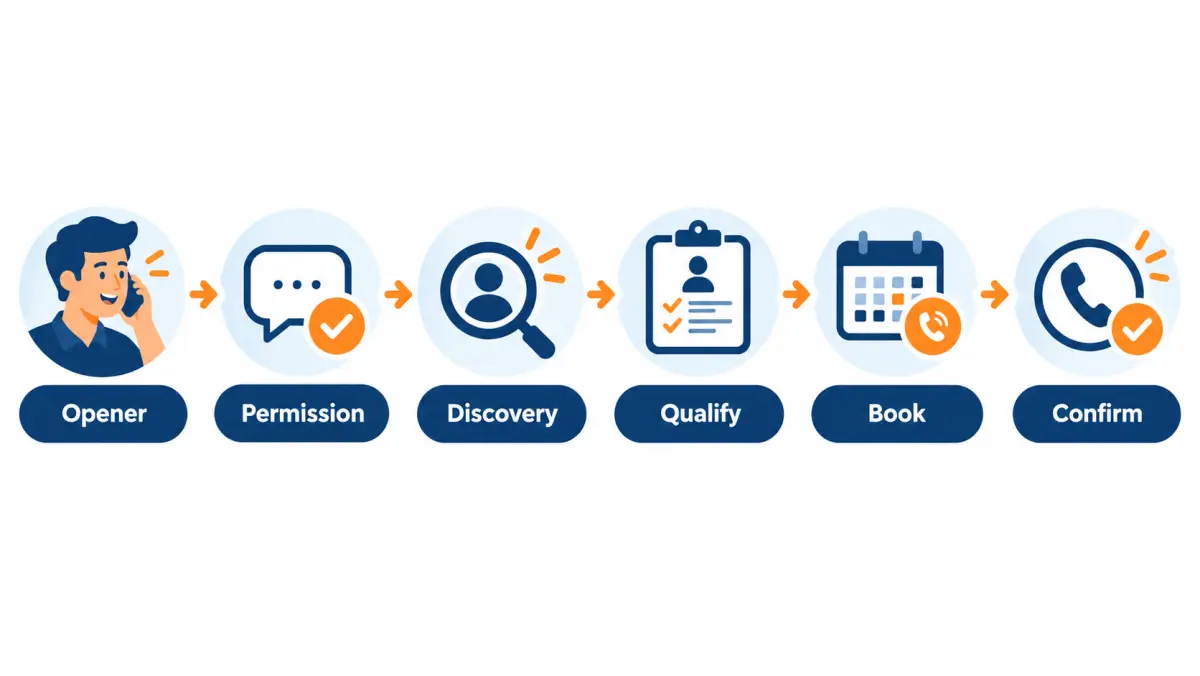
Every first call on a solar lead has four jobs, in this order:
- Re-establish context. Remind the homeowner who you are and why you are calling, in a way that links to something they did ("you asked about solar on our site a few minutes ago").
- Earn the right to ask questions. Ask permission for a minute or two. People who agree to a short conversation are more relaxed than people who feel ambushed.
- Qualify. Confirm ownership, decision makers, roof basics, approximate bill, and timeline. The exact list depends on what your closers need to run a good appointment.
- Book the next step. Offer two specific times, confirm who will attend, and tell them what happens next.
Everything else (company history, panel brands, financing details, savings estimates) belongs at the appointment, where a consultant can look at the roof and the actual bill. Setters who drift into those topics on the first call tend to get pulled into a phone quote, and a phone quote is easy for the homeowner to compare and dismiss.
Setter scripts vs closer scripts
Most installers split the work between two roles. The setter (also called an appointment setter, inside sales rep or SDR) makes first contact and books the meeting. The closer (also called a consultant, energy advisor or project developer) runs the appointment and asks for the sale. The scripts in this guide are mainly setter scripts, with a few closer scripts where the closer takes the first call (live transfers and inbound calls, for example).
| Role | Main script goal | Typical length of call | What they must not do |
|---|---|---|---|
| Setter | Book a qualified appointment | 3 to 10 minutes | Quote prices, promise savings, discuss tax outcomes |
| Closer on a live transfer | Qualify and book, or run a short discovery and set a design call | 10 to 25 minutes | Rush to a proposal before seeing the bill and roof |
| Closer at the appointment | Present a proposal and ask for the decision | 45 to 120 minutes | Pressure, misstate financing, misstate incentives |
| Confirmation caller | Confirm the appointment and reduce no-shows | 2 to 4 minutes | Re-qualify so hard the homeowner cancels |
Durations above are illustrative ranges from common practice, not measured benchmarks. Measure your own.
What a script should never contain
Before you write a single line, decide what your scripts will not say. This list protects you legally and keeps trust high:
- No guaranteed savings figures ("you'll save $200 a month") on a first call. Savings depend on the roof, usage, rate plan, product and financing, none of which the setter has verified.
- No tax credit promises. The federal 25D credit for homeowners ended for systems placed in service after 2025. If a homeowner asks about tax benefits, the script should send them to their tax advisor.
- No claims to be from the utility, a government program or a "solar rebate office." Impersonation claims are a fast way into an enforcement action. Say your company name.
- No "free solar" language unless your product is literally free, which it is not. If you sell leases or PPAs, say "little or nothing upfront" and explain there is a monthly payment.
- No pressure on people who say stop. An opt-out request ends the marketing conversation.
We go deeper on each of these in compliance notes for solar call scripts.
How do you match the script to the lead type?
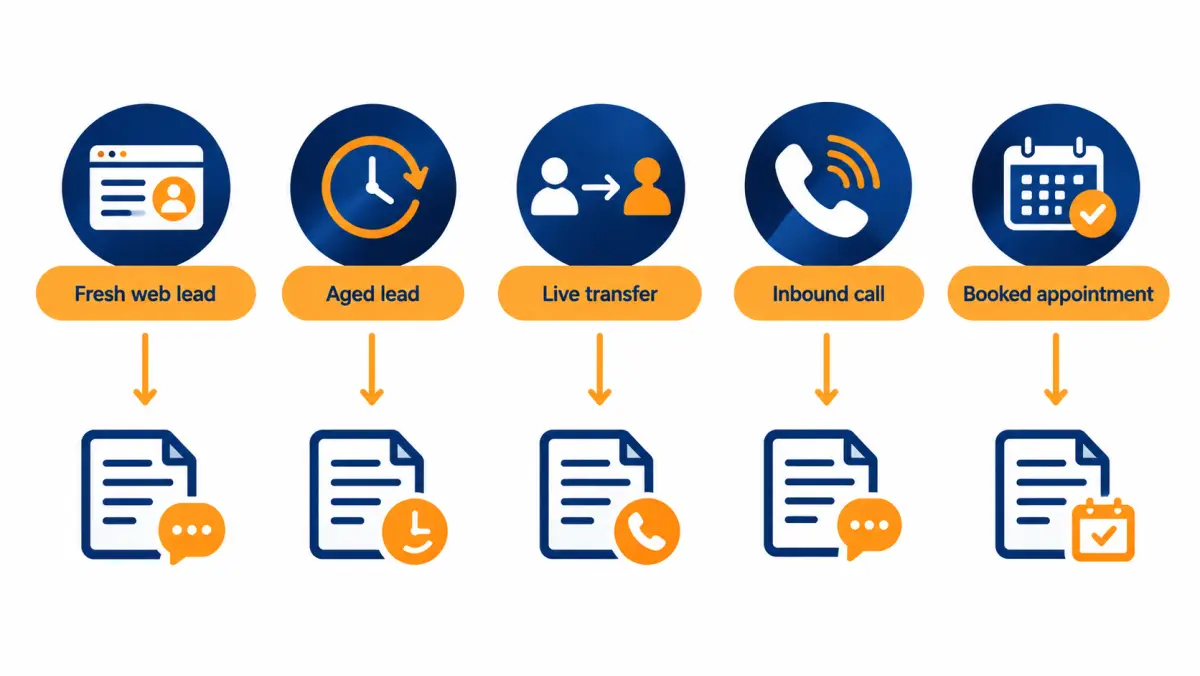
Match the script to how the homeowner entered your pipeline and how much time has passed. A fresh exclusive lead expects your call; a shared lead may have heard from three companies already; an aged lead may not remember asking; a live transfer is already talking to someone. The opener, consent context and qualifying depth all change with the lead type.
If you are buying leads, you probably have more than one type in your CRM at once. Many teams make the mistake of using one script for everything. That wastes the advantage of a fresh lead and burns the goodwill of an aged one. For a broader comparison of what each lead type is and when it fits your team, see our guide to buying solar leads.
Lead type to script map
| Lead type | Homeowner's state of mind | Opener focus | Qualifying depth on first call | Primary goal |
|---|---|---|---|---|
| Fresh exclusive web lead (under an hour old) | Expects a call, mild curiosity | Remind them of their request | Medium | Book appointment within 48 hours |
| Fresh shared lead | May have had several calls already | Stand out quickly, be the calm one | Light, then book | Be the first appointment booked |
| Aged lead (30 days to a year or more) | May not remember asking | Permission and memory jog | Light | Re-open interest, book or nurture |
| Live transfer | On the line, just screened | Warm handoff, confirm what was said | Medium to deep | Book or run discovery now |
| Inbound call | Called you, high intent, wants answers | Answer their question, then qualify | Medium | Book appointment on the call |
| Booked appointment (from a vendor) | Agreed to meet, may not know you | Confirm and introduce | Light verification | Reduce no-show risk |
| Commercial lead | Busy, gatekept, multiple decision makers | Respect time, ask for the right person | Deep but staged | Book a site or discovery meeting |
| Website chat or callback request | Wanted a specific answer | Answer first | Light | Book |
Questions to ask before you write any script
Write these answers down for each lead source. They change the words your setters say:
- What did the homeowner see before they submitted? Read the landing page or ad yourself. If the form said "See if your home qualifies," your opener should refer to that.
- What does the consent disclosure say? Does it name your company? Does it cover calls and texts? Does it mention automated technology? Ask your vendor for a sample consent record. See our guide to solar leads TCPA compliance for what to check.
- What fields came with the lead? If the record includes a bill range, roof shade and homeowner status, the setter should confirm rather than re-ask from scratch.
- How old is it? A lead under five minutes old gets the fresh script. A lead over 30 days gets the aged script.
- Is it exclusive or shared? Shared leads call for a faster, shorter call. The exclusive vs shared solar leads guide covers the tradeoffs.
Script variables to set up in your CRM
Most dialers and CRMs can merge fields into a script screen. Set up these variables so reps are not hunting for details during the call:
| Variable | Example value | Where it is used |
|---|---|---|
| {first_name} | Dana | Opener |
| {rep_name} | Chris | Opener, voicemail, SMS |
| {company} | [Your Company] | Every touch |
| {source_context} | "on our website a few minutes ago" | Opener, consent context |
| {bill_range} | "$150 to $200" | Qualifying confirmation |
| {city} | Phoenix | Rapport, territory check |
| {lead_age_days} | 0 | Script selection |
| {closer_name} | Jordan | Booking close |
| {slot_a}, {slot_b} | "Tuesday at 6" / "Thursday at 2" | Booking close |
Pulling {source_context} straight from the vendor's lead record matters. Saying "you asked about solar on a home-improvement site last Tuesday" lands better than a vague "you showed interest in solar."
What is the best call script for a fresh exclusive solar lead?
The best script for a fresh exclusive lead is short and confident: name yourself and your company, tie the call to the request they just made, ask for two minutes, confirm ownership and the rough bill, uncover why they asked, and offer two appointment times. Because nobody else bought the lead, you can take a few extra minutes on discovery.
Fresh exclusive leads are the easiest calls you will make all week, which is why it hurts most when they go wrong. The homeowner asked for information minutes ago and is probably still near their phone. The common failure is not rudeness; it is a setter who sounds unsure why they are calling, or who over-talks before asking a single question.
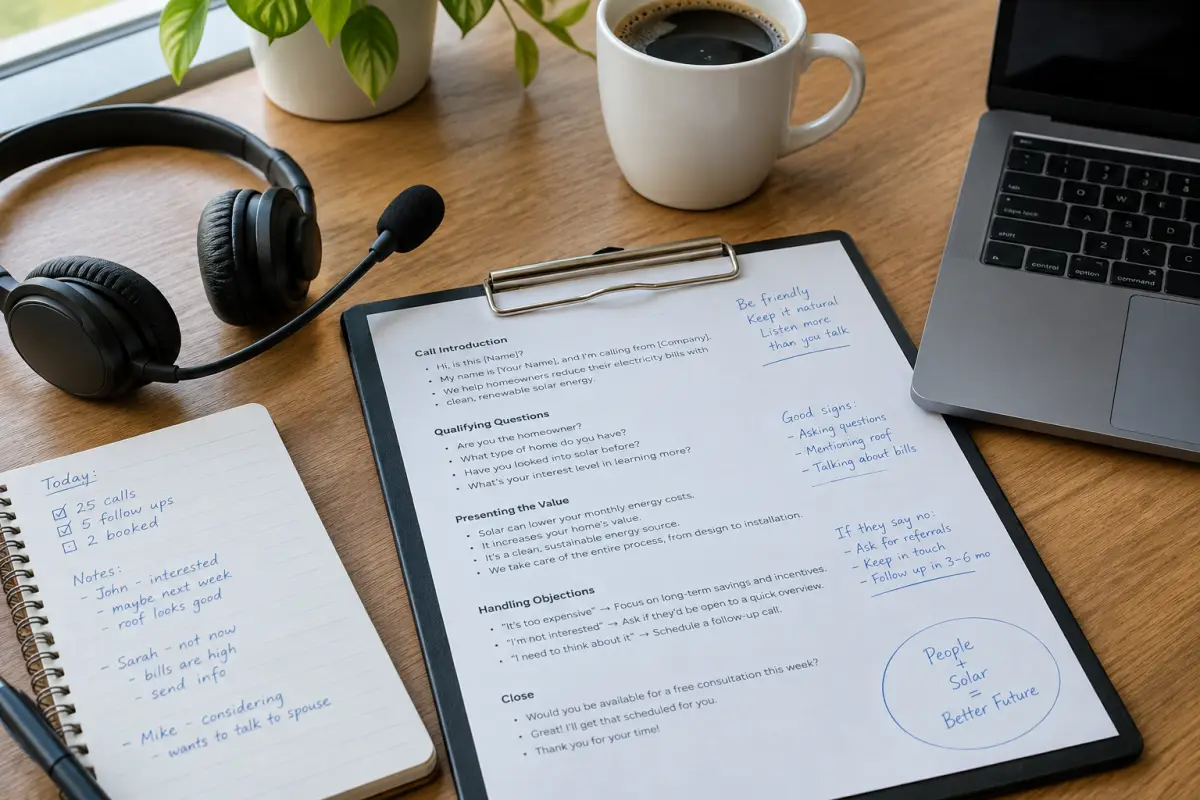
Full script: fresh exclusive residential lead
The bracketed notes are instructions to the rep, not words to say.
Rep: Hi, is this {first_name}?
Homeowner: Yes, who's this?
Rep: Hi {first_name}, this is {rep_name} with {company}. You asked about solar for your home {source_context}, so I'm following up like you requested. Is now an okay time for two quick minutes?
[If no: "No problem. What's a better time today or tomorrow, morning or evening?" Book the callback for a specific time and end the call.]
Homeowner: Sure, I've got a couple minutes.
Rep: Thanks. I'll keep it short. Can I ask what got you looking at solar right now?
[Listen. Common answers: high bills, a neighbor got panels, rate increase letter, new EV, outages, planning to stay in the home. Write down their exact words. You will repeat them at the booking close.]
Homeowner: Honestly, our bill went crazy this summer.
Rep: You're not the only one I've heard that from this month. Roughly what were you paying at the worst point, and what's a normal month?
Homeowner: Around three-forty in August. Normally maybe one-eighty.
Rep: Got it, so somewhere around one-eighty on average with summer spikes. And just to confirm, you own the home, right?
Homeowner: Yes.
Rep: Is anyone else on the title or anyone who'd want to be part of a decision like this?
Homeowner: My wife.
Rep: Good to know. Two quick roof questions. About how old is the roof, if you know? And is it mostly sunny or are there big trees shading it?
Homeowner: Roof's maybe eight years old. A tree in the back but the front gets sun all day.
Rep: That helps. Here's how this works. The next step is a meeting with one of our energy consultants, {closer_name}. {closer_name} will pull satellite images of your roof, look at your actual usage from a recent bill, and show you the options, including ways to go solar with little or nothing upfront, so you can see whether it actually beats what you pay now. If it doesn't make sense, {closer_name} will tell you that too. It usually takes about an hour and it works best with both of you there. Would {slot_a} or {slot_b} be better?
Homeowner: Thursday evening probably.
Rep: Thursday at six works. Will your wife be able to join?
Homeowner: Yeah, she's home by then.
Rep: Perfect. I'll send you a text right now with {closer_name}'s name and the time. If you can, have a recent electric bill handy, paper or a screenshot from the utility app. Is this the best number to text?
Homeowner: Yes.
Rep: Great. Last thing: if anything changes, just reply to that text and we'll move it. Anything you want {closer_name} to look at specifically?
Homeowner: Mostly whether it'll actually lower the bill.
Rep: I'll put that at the top of the notes. Thanks {first_name}, talk soon.
Why each part of the script is there
| Script line | What it does | What happens if you skip it |
|---|---|---|
| "You asked about solar {source_context}" | Links the call to their action and the consent context | Homeowner thinks it is a cold call and hangs up |
| "Is now an okay time for two quick minutes?" | Gives control back, lowers defenses | Rushed, irritated homeowner |
| "What got you looking at solar right now?" | Finds their motive in their own words | You pitch features they do not care about |
| Bill question with "worst month" and "normal month" | Gets a realistic range, not just the scary number | Closer arrives with wrong expectations |
| Ownership and decision maker | Avoids appointments that cannot close | One-legged appointments, renters |
| Roof age and shade | Flags reroof or shade issues early | Closer drives out to an unbuildable roof |
| "If it doesn't make sense, they'll tell you" | Builds trust, lowers pressure | Homeowner expects a hard sell and no-shows |
| Two specific times | Makes saying yes easy | "I'll check my schedule" and no booking |
| Text confirmation with bill reminder | Sets up the show and the appointment quality | No-shows, appointments without a bill |
Qualifying questions bank for residential leads
Your closers decide which of these are mandatory. Keep the mandatory list to six or fewer on the first call; the rest can be confirmed by text or at the appointment.
Ownership and decision makers
- "Do you own the home?"
- "Is anyone else on the title?"
- "Who else would want to weigh in on a decision like this?"
- "Is this your primary residence?"
Roof and property
- "Roughly how old is the roof?"
- "What's it made of, shingle, tile, metal?"
- "Does it get sun most of the day, or is there a lot of shade?"
- "Any plans to replace the roof in the next few years?"
- "Is there an HOA?"
Usage and bill
- "What's a normal monthly electric bill? And the highest month?"
- "Who's your utility?" (Confirm against your territory.)
- "Any big changes coming, like an EV, a pool, a heat pump or a home addition?"
Motivation and timeline
- "What got you looking at solar now?"
- "If the numbers made sense, when would you want something installed?"
- "Have you gotten any quotes yet?"
Payment preference (light touch)
- "Some people prefer to own the system, others prefer a monthly plan with little or nothing upfront. Do you lean one way?"
Avoid asking about credit scores or income on the first call. If your financing partner needs a soft credit check, the closer can explain that properly at the appointment with the required disclosures.
Branches for common answers on the first call
If they say "I just wanted a price."
Rep: Totally fair. The honest answer is the price depends on your roof size, your usage and whether you'd own it or go with a monthly plan, so anyone who gives you a number over the phone is guessing. What I can do is get you a real number. {closer_name} can look at your roof and your bill and give you exact pricing. Would {slot_a} or {slot_b} work for that?
If they say "Can you just email me something?"
Rep: I can send you an overview, sure. The trouble is a general brochure won't tell you what your own house would look like, and that's what you actually asked for. How about I send the overview now and we put fifteen minutes on the calendar for {closer_name} to walk you through your actual numbers? Then you can decide if it's worth a full meeting.
This offers a shorter, lower-commitment meeting as a fallback. Many teams book a 15 to 20 minute virtual "numbers review" when a full in-home appointment is too big a step.
If they say "My spouse handles that."
Rep: Makes sense. Since it's a decision for the house, I'd rather set a time when you're both around than have you repeat everything later. When are you both usually home in the evening?
If the bill is very low.
Rep: That's a pretty efficient house. Solar tends to make the most sense when the bill is higher, so I want to be straight with you, it may not pencil out. Are there any changes coming, like an EV or more people moving in? [If no, offer to keep them on a check-in list and end the call politely. Do not force an appointment your closer cannot close.]
If they rent.
Rep: Thanks for telling me. Solar on the roof generally needs the owner to sign off. Do you know if your landlord would be open to it? [If no, thank them and end. Mark as disqualified, not "not interested," so your lead vendor reporting stays accurate. Check whether your vendor's replacement terms cover leads outside your filters.]
The booking close, three ways
Different homeowners respond to different closes. Train reps on all three.
- Two-option close. "Would Tuesday at six or Thursday at two work better?" Default for most calls.
- Motive close. "You said the August bill was the reason you started looking. Let's get {closer_name} out before next summer's bills so you have real numbers. Does Tuesday evening work?"
- Small step close. "Let's not commit to a big meeting yet. {closer_name} can do a 15-minute screen-share to show you what your roof could fit. Tomorrow at noon or after work?"
What call script works best for shared solar leads?
For shared leads, speed and differentiation matter most. Call within minutes, keep the opener under ten seconds, acknowledge that they may be hearing from several companies, and offer something specific the others might not, such as a firm appointment time or a no-pressure numbers review. Book quickly and confirm by text before a competitor does.
A shared lead has been sold to more than one company. That is not hidden; most shared-lead sellers state how many buyers a lead may go to. It means the homeowner's phone may ring three or four times in the first fifteen minutes. The first rep to sound calm and useful usually gets the appointment. The ones who follow get "I already talked to someone."
Full script: shared residential lead
Rep: Hi {first_name}, {rep_name} with {company}. You asked for solar quotes online a few minutes ago. You might be getting a few calls, so I'll be quick and you can tell me if I'm the wrong fit. Got one minute?
Homeowner: Yeah, my phone's been ringing.
Rep: I bet. Here's the short version of us: we're a local installer in {city}, we do the design and the installation ourselves, and our consultants show you the numbers and leave, no same-day pressure. Can I ask two questions to see if it's worth your time?
Homeowner: Go ahead.
Rep: You own the home? And roughly what's a normal electric bill?
Homeowner: Yes. Around two hundred.
Rep: That's worth a look. I can get a consultant to you {slot_a} or {slot_b}, and they'll bring a full design based on satellite images of your roof. Which is better?
Homeowner: Another company said they'd send someone tomorrow.
Rep: That's fine, and honestly comparing two quotes is smart. Keep that one. If you add ours, you'll have something to compare it to. Want {slot_b} so it's after theirs?
The last line is deliberate. Telling a homeowner to keep a competitor's appointment and compare sounds counterintuitive, but it lowers resistance and gets you on the calendar. Trying to talk them out of the other meeting usually loses both.
What to say only if it is true
Shared-lead calls tempt reps to exaggerate differences. Only say things your company can back up:
| Claim | Say it only if |
|---|---|
| "We're local" | You have an office or crew in the area |
| "We install ourselves, no subcontractors" | You do not subcontract installs |
| "No pressure, no same-day signing" | Your closers are actually trained and paid this way |
| "We've installed in your neighborhood" | You can name the general area if asked |
| Specific warranty terms | You can show them in writing |
Speed rules for shared leads
- Route shared leads to an auto-dialer queue that calls within the first minute.
- If no answer, voicemail plus text immediately, then a second call within five minutes. See voicemail and SMS templates.
- Cap the first call at five minutes unless the homeowner wants to talk. Book first, qualify more on the confirmation call.
- Do not keep calling every ten minutes. Several calls in an hour from the same company after a homeowner is clearly already irritated burns the lead. Our solar speed to lead guide covers cadence rules in detail.
Shared-lead objections you will hear in the first 20 seconds
"I've already had five calls."
Rep: I'm sorry, that's annoying. I'll make it worth thirty seconds or let you go. Do you want to compare a couple of quotes, or have you already picked someone?
"I already booked with someone."
Rep: Good, that's a smart first step. A lot of people like a second quote to compare against. If you want one, I can do {slot_b}. If not, no problem, I'll take you off our list.
"Which company are you again?"
Rep: {company}, local installer here in {city}. You'll get a text from me right after this with my name so you can keep us straight.
Mark "already booked" leads in your CRM and schedule a polite follow-up for a few days after the competitor's appointment date, if your consent and calling rules allow it. Homeowners sometimes come back when the first quote disappointed them.
How should you script calls to aged solar leads?
Aged lead scripts should start with permission and a memory jog, not a pitch. Many aged leads do not remember asking about solar, so name your company, describe when and roughly where they asked, ask if they are still interested, and accept a no gracefully. Your goal is to find the minority whose situation has changed and book them.
Aged leads are older lead records, often 30 days to a year or more past their first sale. They are cheaper per record for a reason: intent fades, phone numbers change and homeowners may already have installed panels. Before you dial any aged list, confirm two things with your vendor and counsel: that the consent on the record covers your company and the way you plan to contact them, and that the list has been scrubbed against the National Do Not Call Registry and your internal do-not-call list. Our page on aged solar leads covers how to evaluate them; availability for your territory is confirmed on the call.
Full script: aged residential lead
Rep: Hi, is this {first_name}?
Homeowner: Who's calling?
Rep: This is {rep_name} with {company}, a solar installer here in {city}. A while back, it looks like {source_context_aged}, you asked for information about solar for your home. I'm checking in to see if that's still something you're thinking about, or if I should close out your file. Either answer is fine.
[Pause. Let them answer. The "close out your file" line gives them an easy out and, oddly, makes many people more willing to talk.]
Homeowner: Oh, yeah, I kind of forgot about that. We never did anything.
Rep: That's really common. Did anything stop you back then, or did it just slide?
Homeowner: We got one quote and it seemed expensive. Then life got busy.
Rep: Makes sense. A few things have changed since then, some in your favor, some not. On the downside, the federal homeowner tax credit ended for systems finished after 2025. On the plus side, there are more ways to do it with little or nothing upfront now, and your bills may look different too. What's your electric bill running these days?
Homeowner: Higher, for sure. Two-twenty, two-thirty.
Rep: Okay. And you're still in the same house and still own it?
Homeowner: Yes.
Rep: Then it might be worth a fresh look. Not a sales pitch, just updated numbers so you know where you stand. Our consultant can do it in person or as a 20-minute video call. Which would you prefer?
Homeowner: Video, I guess.
Rep: Easy. {slot_a} or {slot_b}?
Pacing an aged lead campaign
Aged lists reward patience more than volume. Work them in small batches your setters can finish with a full, polite cadence, rather than loading thousands of records into a dialer and hammering them. Start with the newest records in the batch, since those homeowners are the most likely to remember their request, and track results by lead age band (for example 30 to 90 days, 90 to 180 days, older) so you learn where your cutoff should be. If a band produces mostly wrong numbers, "already installed" or "did not request," stop buying that band. Keep your aged script calm and short: the homeowner owes you nothing, and the ones whose situation has changed will tell you quickly when you give them an easy way to say so.
Variables for aged lead scripts
Set {source_context_aged} from the lead record and keep it honest. Examples: "back in the spring, on a home services website" or "last year, when you filled out a form about solar savings." If you do not know when or where, say "a while back you asked for information about solar." Do not invent details.
Aged lead disposition codes
Aged leads produce more dispositions than fresh ones. Use specific codes so you can measure the list:
| Code | Meaning | Next action |
|---|---|---|
| Booked | Appointment set | Confirmation flow |
| Re-nurture | Interested later, gave a timeframe | Scheduled callback at that time |
| Already installed | Has solar | Remove from solar campaigns; possibly battery campaign if consent covers it |
| Moved / not owner | No longer owns the home | Remove |
| Wrong number / disconnected | Bad data | Remove; log for vendor credit per your contract terms |
| Not interested | Clear no | Remove from campaign |
| Do not call | Asked not to be called | Add to internal DNC immediately; confirm processes with counsel |
| No answer | No contact after full cadence | Stop calling per your cadence rules |
What changes in the aged script vs the fresh script
| Element | Fresh lead | Aged lead |
|---|---|---|
| Opener | "You asked a few minutes ago" | "A while back you asked" plus permission to close file |
| Expectation | They expect a call | They do not |
| Discovery | Why now? | What stopped you? What changed? |
| 25D mention | Only if asked, or if they bring up the credit | Usually up front, because their memory of solar pricing may include the old credit |
| Booking ask | Full appointment | Lighter step: video call or numbers review |
| Accepted outcome | Book or callback | Book, re-nurture, or clean removal |
What do you say when you receive a solar live transfer?
On a live transfer, greet the homeowner by name, thank the transferring agent, and restate what the agent captured so the homeowner does not repeat themselves. Then confirm the two or three facts that matter most to your closer, uncover motive, and either book an appointment or run a short discovery on the spot.
A live transfer is a phone call where the seller's agent has screened a homeowner and then connects them, still on the line, to your team. The homeowner has already given some time to a stranger, so your first ten seconds must make them feel the handoff was worth it. A clumsy "So, what can I do for you?" forces them to start over and is the most common reason transfers fall apart. For how the product works and what to check before you buy it, see our page on solar live transfer leads.
Full script: receiving a live transfer
Transfer agent: I have {first_name} on the line. Homeowner in {city}, bill about two hundred, roof about ten years old, interested in lowering the bill. {first_name}, I'm connecting you with {rep_name} now.
Rep: Thanks, {agent_name}. Hi {first_name}, this is {rep_name} with {company}. Thanks for staying on the line. {agent_name} told me you own your home in {city}, your bill runs about two hundred, and you'd like to see if solar can bring that down. Did I get that right?
Homeowner: Yep.
Rep: Great, then I won't make you repeat yourself. Can I ask what made you want to look at it now?
Homeowner: We're getting an electric car next year.
Rep: That's a great time to look, because your usage will go up. Do you know roughly how many miles you drive a day?
Homeowner: Maybe forty.
Rep: Okay, I'll note that so the design accounts for it. Who else is part of the decision?
Homeowner: Just me, I'm single.
Rep: Easy. Here's what I'd suggest. I can pull up satellite images of your roof right now and give you a rough idea of how many panels fit, then we set a time for a full proposal with exact pricing. Or if you're short on time, we can just set the proposal meeting. Which do you prefer?
Live transfer quality checks to run on every call
Use the first two minutes to verify the screening. If facts do not match what the agent said, note it. Your vendor agreement should define what counts as a qualified transfer and what you can dispute; check the dispute window and process before you start buying.
| Check | Question | If it fails |
|---|---|---|
| Identity | "Is this {first_name}?" | Note mismatch |
| Ownership | "And you own the home at {address}?" | Disqualify, log for dispute if the contract covers it |
| Awareness | "Did {agent_name} explain I'm with a solar installer?" | Explain clearly; note screening issue |
| Interest | "Are you looking at solar for this home?" | Note screening issue |
| Duration | Track total talk time | Compare against the contract's billable duration rule |
Live transfer rules for your team
- Answer within a few rings. Transfers that hit voicemail are often still billable under some contracts. Read yours.
- Never put a transfer on hold to find a closer. If no one is available, the transfer should route to a backup or not be accepted.
- Log the agent's summary in the CRM during the handoff so it is not lost.
- Record the call if your recording notice and state law allow it. See the compliance section.
How should you handle inbound calls from solar ads?
An inbound caller dialed you, so answer their question first, then qualify. Greet with your company name, ask how you can help, answer briefly and accurately, then ask permission to ask a few questions so you can give a real answer. Book the appointment before the call ends, because inbound intent drops quickly once they hang up.
Inbound calls (pay per call, or calls from your own ads, mailers and website) are the highest-intent conversations you get. The caller chose to call. The common mistake is treating them like an outbound lead, launching into qualifying questions before acknowledging why they called.

Full script: inbound call
Rep: Thanks for calling {company}, this is {rep_name}. How can I help?
Caller: Hi, I saw an ad about solar and I wanted to know how much it would cost for my house.
Rep: Happy to help with that. The honest answer is it depends on your roof, your electric usage and whether you'd buy the system or use a monthly plan, so I don't want to throw out a random number. If you give me two or three minutes, I can ask a few questions and get you to a real quote. Is that okay?
Caller: Sure.
Rep: Great. Can I get your name and the address of the home?
Caller: Pat, 123 Elm.
Rep: Thanks, Pat. Do you own the home?
Caller: Yes.
Rep: What's your typical electric bill, roughly?
Caller: Around one-fifty.
Rep: And what got you interested in calling today?
Caller: My neighbor got solar and says his bill is like twenty bucks.
Rep: That's a good reason to look. Every house is different, so we'll see what yours looks like. Our consultant can show you your exact numbers. Would {slot_a} or {slot_b} work?
Inbound call answer bank
Inbound callers ask direct questions. Give short, honest answers and steer to the appointment. Check every answer with your own operations and counsel before using it.
| Caller question | Short answer |
|---|---|
| "How much does solar cost?" | "It depends on the roof, usage and how you pay. Our consultant gives exact pricing for your home." |
| "Is it free?" | "No. Some plans have little or nothing upfront, but there's a monthly payment. We'll show you how it compares to your bill." |
| "Is there still a tax credit?" | "The federal homeowner credit ended for systems finished after 2025. For your own tax situation, please check with a tax advisor." |
| "How long does installation take?" | Give your typical range for permitting and install, and say it varies by city and utility. |
| "Do you do batteries?" | Answer honestly for your company. |
| "Are you the utility?" | "No, we're {company}, an independent installer." |
| "Can you send someone today?" | Give your earliest real slot. Do not promise what scheduling cannot deliver. |
When the inbound caller is not a fit
Rep: Thanks for being upfront. From what you've told me, solar probably isn't the right fit right now [because you're renting / your roof needs replacing first / we don't cover your area]. [If roof: "If you replace the roof, call us back and we'll take a look."] I'd rather tell you that now than waste your time.
How do you confirm a booked solar appointment so it actually sits?
Call or text to confirm within an hour of booking, again the day before, and again a few hours before the appointment. The confirmation call introduces the closer, confirms all decision makers will attend, reminds them to have a bill ready and gives an easy way to reschedule. Reschedules are better than no-shows.
If you buy appointments, the vendor's setter booked the meeting, and the homeowner may not remember your company name. Your first call is an introduction and a confirmation. For what a solar appointment product includes and how to evaluate it, see our page on solar appointments.
Full script: confirmation call for a vendor-booked appointment
Rep: Hi {first_name}, this is {rep_name} with {company}. I'm calling about your solar consultation on {appointment_day} at {appointment_time}. I'm on the team that will be meeting with you, and I just wanted to introduce myself and make sure everything still works. Is that time still good?
Homeowner: Oh, right. Yes, I think so.
Rep: Great. Your consultant will be {closer_name}. Just a couple quick things so the meeting is useful. Will {spouse_or_co_owner} be able to be there too?
Homeowner: Yes, she'll be home.
Rep: Perfect. And if you can have a recent electric bill handy, paper or on the app, {closer_name} can show you real numbers instead of estimates. Does that work?
Homeowner: Sure.
Rep: Last thing, what made you want to look into solar? I want to make sure {closer_name} focuses on what matters to you.
Homeowner: We just want lower bills, and we're worried about rates going up.
Rep: Got it, I'll note that. I'll send a text with {closer_name}'s name and photo so you know who's coming. If anything changes, just reply to the text and we'll move it. See you {appointment_day}.
Confirmation sequence timeline
| When | Channel | Content |
|---|---|---|
| Within an hour of booking | Call, then text | Introduce, confirm, decision makers, bill reminder |
| Day before | Text | Reminder with closer name, time, reschedule option |
| Morning of | Text or call | "Still good for 6 pm?" |
| 30 to 60 minutes before | Text from closer | "On my way, see you at 6" (in-home) or meeting link (virtual) |
| If no response to two touches | Call | Friendly check; offer reschedule |
All texts need consent that covers texting and must honor opt-outs. Keep reminders transactional and specific to the appointment the homeowner booked.
When the homeowner wants to cancel on the confirmation call
Rep: No problem at all, thanks for letting me know. Is it the timing, or have you decided solar isn't for you right now?
[If timing: "Let's find a better time. Would next {day} work?"]
[If decided against: "Understood. Can I ask what changed? It helps us get better." Then thank them and close it out. If you bought the appointment, check your vendor's appointment policy on reporting cancellations.]
If you buy appointments from us, here is the policy in plain words: if a confirmed appointment doesn't sit because the prospect no-shows or doesn't match your filters, report it within 7 days of the scheduled time and we replace it. Other vendors' policies vary; read them before you start.
What call script works for commercial solar leads?
Commercial solar scripts must respect the prospect's time and find the actual decision maker. Open by naming the request, ask who owns energy costs, qualify on building ownership, roof, annual electricity spend and decision process, and book a discovery or site meeting. Expect multiple calls, multiple stakeholders and longer timelines than residential.
Commercial leads come from business owners, facilities managers, property managers, farms, nonprofits and public entities. The person who filled out the form is often not the person who signs. The setter's job is to map the decision, not to win it on the first call. Our commercial solar leads page covers how these leads are qualified and sold.

Full script: commercial inbound or web lead
Rep: Hi, is this {first_name}?
Prospect: Speaking.
Rep: {first_name}, this is {rep_name} with {company}. You asked about solar for {business_name} {source_context}. I know you're busy, so I'll take three minutes to see if it's worth a proper meeting. Is now okay, or is there a better time today?
Prospect: Now's fine, quickly.
Rep: Thanks. What's driving the interest, cost, sustainability goals, something else?
Prospect: Our electric costs keep climbing and ownership wants to cut overhead.
Rep: Understood. Does the business own the building, or lease it?
Prospect: We own it.
Rep: Good. Roughly what does the facility spend on electricity a year, or per month if that's easier?
Prospect: I'd have to check, a lot.
Rep: No problem, a ballpark helps, and the exact number can come from twelve months of bills later. What kind of roof is it, and roughly how old?
Prospect: Flat, membrane, replaced maybe five years ago.
Rep: That's helpful. Who besides you would be involved in a decision like this, ownership, finance, a board?
Prospect: The owner and our CFO.
Rep: Makes sense. Here's what I'd suggest. A 30-minute discovery call with our commercial project developer, you, and if possible the CFO. We'd look at your bills, your roof from satellite and your goals, and tell you whether a full site assessment makes sense. Can we do {slot_a} or {slot_b}? And could you send twelve months of bills before then?
Commercial qualifying checklist
| Topic | Question | Why it matters |
|---|---|---|
| Ownership | "Do you own or lease the building?" | Tenants need landlord approval and the lease term matters |
| Spend | "Annual electricity spend, roughly?" | Project size and fit |
| Roof | "Type, age, and any planned replacement?" | Roof replacement may need to come first |
| Land | "Any open land or parking for ground mount or carports?" | Alternatives if the roof is limited |
| Decision makers | "Who signs off, and who influences?" | Plan the meeting attendees |
| Process | "Do you need multiple bids or a formal RFP?" | Timeline and paperwork |
| Financing preference | "Would you consider owning, financing, or a PPA?" | Product path |
| Tax position | "Does the business usually have tax liability?" | Relevant to how business tax incentives may apply; send them to their tax advisor |
| Timeline | "Is there a budget cycle or deadline we should know about?" | Fit to fiscal calendar |
Commercial projects may still qualify for business energy incentives that are separate from the homeowner 25D credit. Rules changed in 2025 and depend on timing and project specifics. Setters should not discuss eligibility; the developer and the client's tax advisor should.
Gatekeeper script
Receptionist: {business_name}, how can I help?
Rep: Hi, this is {rep_name} with {company}. {first_name} asked us about solar for the building. Could you put me through, or is there a better time to reach them?
Receptionist: What's this regarding?
Rep: A follow-up on their request about solar and electricity costs for the facility. If {first_name}'s not available, who handles the building's utility bills?
Keep it factual. Do not imply a prior relationship that does not exist.
Which scripts work for battery, backup power and add-on conversations?
Battery and backup scripts should start from the homeowner's real concern, outages, rate structures or existing solar, and avoid promising backup duration or savings on the phone. Qualify on existing system, outage history, critical loads and utility rate plan, then book a consultant to size the system. Treat existing-solar customers and new-solar prospects as two different scripts.
Interest in batteries shows up in three ways: a new solar prospect asks about backup, an existing solar owner wants storage, or an outage-driven prospect who is not thinking about solar at all wants backup power. Each needs a different opener.
Script: existing solar owner asking about batteries
Rep: Hi {first_name}, {rep_name} with {company}. You asked about adding a battery to your solar system. I have a few quick questions so our consultant can bring the right options. Do you have a couple minutes?
Homeowner: Sure.
Rep: Who installed your current system, and roughly when?
Homeowner: Another company, about five years ago.
Rep: Okay, that's fine, we work with systems we didn't install too [only say this if true]. What's the main thing you want the battery to do, keep the lights on in an outage, use more of your own solar at night, or both?
Homeowner: Outages. We lost power for two days last winter.
Rep: That's rough. When the power's out, what are the must-haves? Fridge, internet, medical equipment, heat, well pump?
Homeowner: Fridge, furnace fan, internet.
Rep: Got it. Our consultant will look at your panel, your current system and those loads and show you options. Would {slot_a} or {slot_b} work? If you can, have your inverter model handy, it's usually on a label on the box near your meter.
Script: outage-driven prospect, no solar yet
Rep: You asked about backup power for your home. Are you mainly thinking about outages, or is lowering your bill part of it too?
[If outages only: qualify loads and outage history, book a backup consultation. If both: run the fresh exclusive script and note backup interest.]
Never quote hours of backup on the phone. Backup duration depends on battery size, loads and weather.
How should you script reactivation calls to old pipeline?
Reactivation scripts re-open conversations with homeowners who already met your team or got a quote but did not buy. Lead with what has changed (their bill, products, financing options, the post-25D market), ask what held them back, and offer an updated proposal. Keep it short and respectful of their earlier decision.
Your own CRM is often full of quoted-but-not-sold homeowners. These are not purchased leads; they are past prospects. The consent rules for calling them depend on your prior relationship and how they were captured, so check with counsel before running a reactivation campaign.
Script: quoted but not sold
Rep: Hi {first_name}, {rep_name} with {company}. {closer_name} met with you back in {month} about solar. I'm not calling to push, just to check whether anything has changed on your side, and to let you know a few things have changed on ours. Do you have a minute?
Homeowner: I guess.
Rep: Thanks. When you met with {closer_name}, what was the main reason you held off?
Homeowner: It was more than we wanted to spend.
Rep: That's fair. Since then, [only state what is true: new financing partner / monthly plan option / panel pricing update / new battery option]. Would it be useful to see an updated proposal side by side with the old one? It'd take about 20 minutes on a video call.
Reactivation segments and openers
| Segment | Opener angle |
|---|---|
| Quoted, said "too expensive" | New payment options, updated pricing |
| Quoted, said "bad timing" | Check-in, timing may have changed |
| Quoted, went with a competitor | Do not re-pitch solar; consider battery or service if relevant and permitted |
| Appointment no-show | "We missed you last time; want to reschedule?" |
| Did not qualify (roof) | "Did you end up replacing the roof?" |
| Did not qualify (credit/financing) | Only if you have a genuinely different option; avoid repeated credit-related contact |
What voicemail and text templates work for solar leads?
Voicemails should be 20 to 30 seconds and name you, your company, why you are calling and a callback number, with no pitch. Texts should name your company in the first line, refer to the homeowner's request, offer one clear action and include opt-out instructions. Send texts only with consent that covers texting and within allowed hours.
Most first calls on solar leads do not connect. Voicemail and text do a lot of the work in the first 48 hours. The solar speed to lead guide covers when to send each; this section gives you the words, by lead type and by attempt.
Voicemail templates
Fresh lead, attempt 1
Hi {first_name}, this is {rep_name} with {company}. You asked about solar for your home {source_context}, so I'm calling to help. I'll send you a text from this number too. You can reach me at {callback_number}. Thanks.
Fresh lead, attempt 2 (same day)
Hi {first_name}, {rep_name} again from {company}, following up on your solar request. If it's easier, just reply to my text with a good time to talk. {callback_number}.
Fresh lead, attempt 3 (day 2 or 3)
Hi {first_name}, {rep_name} from {company}. I've tried a couple of times about your solar request and don't want to bug you. If you're still interested, call or text {callback_number}. If not, no worries, just let me know and I'll close your file.
Aged lead
Hi {first_name}, this is {rep_name} with {company}, a local solar installer. A while back you asked about solar for your home. I'm checking whether that's still something you're thinking about. Call or text me at {callback_number}. If not, just let me know and I'll update your file.
Missed live transfer callback
Hi {first_name}, {rep_name} with {company}. We got disconnected while you were talking with our team about solar. Sorry about that. Call me back directly at {callback_number}, or reply to my text with a good time.
Appointment confirmation, no answer
Hi {first_name}, {rep_name} with {company}, calling to confirm your solar consultation {appointment_day} at {appointment_time} with {closer_name}. If that still works, no need to call back. If you need to change it, call or text {callback_number}.
Commercial
Hi {first_name}, {rep_name} with {company}, following up on your request about solar for {business_name}. I'd like to set up a short call to see if a full assessment makes sense. I'm at {callback_number}, and I'll send a short email too.
Voicemail rules
- Keep to 20 to 30 seconds. Say the number twice only if your team finds callbacks drop otherwise; test it.
- Do not leave pricing, savings or credit claims.
- Do not use prerecorded voicemail drops without checking with counsel. Prerecorded and artificial voice messages carry their own consent requirements under the TCPA.
- Use a local or recognizable caller ID that you are authorized to use, and make sure callbacks reach a person or a clear voicemail box.
SMS templates
Texts should be sent only where your consent covers texting. Include your company name and an opt-out line in the first message of a conversation and periodically after. Ask counsel how your state's rules affect frequency, hours and content.
Fresh lead, right after first call attempt
Hi {first_name}, it's {rep_name} with {company}. You asked about solar for your home and I just tried calling. When's a good time to talk for 5 minutes? Reply STOP to opt out.
Fresh lead, if no reply after a few hours
{first_name}, quick question so I can help: roughly what's your monthly electric bill? Reply with a number and I'll tell you if solar is worth a look. – {rep_name}, {company}
Booking offer by text
I can have our consultant {closer_name} show you real numbers for your home {slot_a} or {slot_b}. Which works? – {rep_name}, {company}
Appointment confirmation
You're set for {appointment_day} at {appointment_time} with {closer_name} from {company}. Please have a recent electric bill handy. Need to change it? Just reply here. Reply STOP to opt out.
Day-before reminder
Reminder: {closer_name} from {company} will see you tomorrow at {appointment_time}. Reply C to confirm or R to reschedule.
Aged lead, first text
Hi {first_name}, {rep_name} with {company}, a local solar installer. A while back you asked about solar for your home. Still interested, or should I close your file? Reply STOP to opt out.
Shared lead, differentiation text
Hi {first_name}, {rep_name} with {company} (local installer, {city}). You're probably getting a few calls about your solar request. If you want a second quote to compare, I can book {slot_a} or {slot_b}. Reply STOP to opt out.
After a no-show
Hi {first_name}, {closer_name} stopped by at {appointment_time} and missed you. No problem, things come up. Want to pick a new time? – {rep_name}, {company}
Breakup text (last in sequence)
Hi {first_name}, I'll stop reaching out about solar. If you want to pick it back up later, just text this number. Thanks! – {rep_name}, {company}
SMS do's and don'ts
| Do | Don't |
|---|---|
| Name your company in the first text | Send texts that look like they come from the utility or a government program |
| Refer to the homeowner's request | Use "free solar" or "government program" language |
| Ask one question per text | Send long paragraphs or multiple links |
| Honor STOP and similar replies immediately | Keep texting after "stop," "no," "remove me" |
| Respect quiet hours (check state rules) | Text late at night or very early |
| Keep a record of every text and reply | Text from reps' personal phones outside your system |
A seven-day contact sequence using these templates
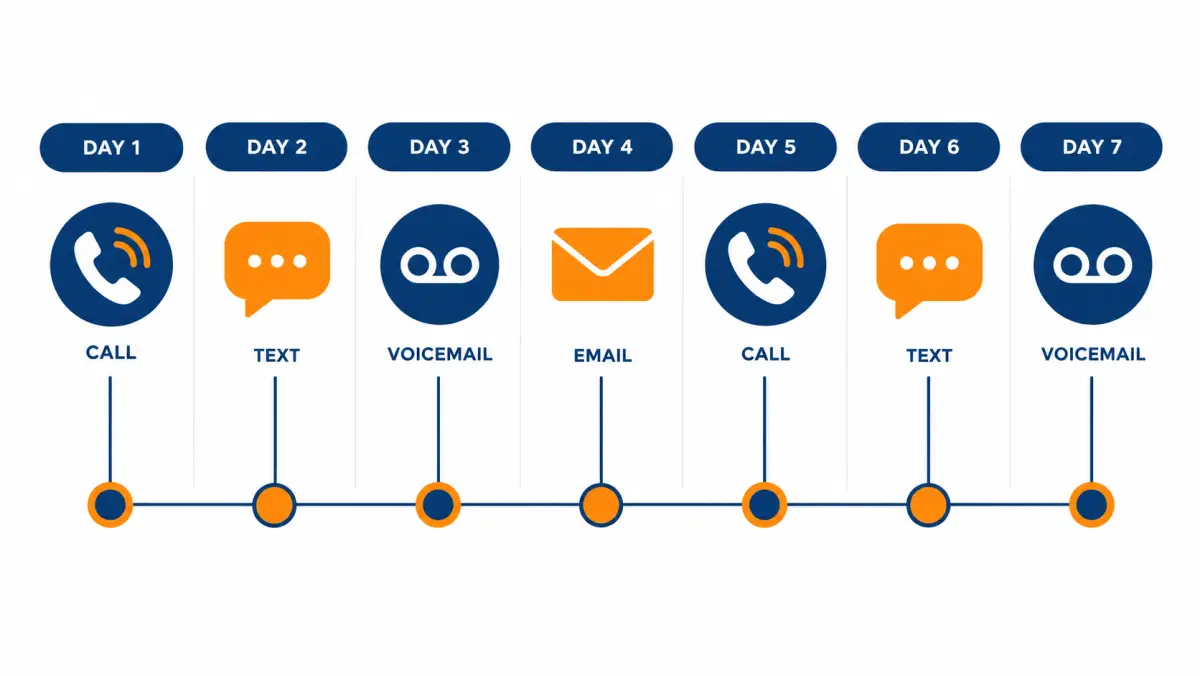
This is an illustrative sequence for a fresh exclusive lead. Adjust to your consent records, state rules and team capacity.
| Day | Touches |
|---|---|
| Day 1 | Call within minutes; voicemail 1; text 1; call again within 5 minutes; afternoon call; text 2 (bill question) if still no contact |
| Day 2 | Morning call; voicemail 2; evening call |
| Day 3 | Midday call; booking offer text |
| Day 4 | Email with company intro and booking link |
| Day 5 | Evening call; voicemail 3 |
| Day 7 | Breakup text |
| After day 7 | Move to a low-frequency nurture if consent covers it, or close |
How do you handle solar objections on the phone?
Handle solar objections with a repeatable loop: listen fully, acknowledge the concern, ask one clarifying question to find what is behind it, respond briefly and honestly, check whether that helped, and return to the next step. Most first-call objections are about time, trust or money, and most are best answered by booking a meeting where real numbers exist.
Objection handling is where scripts earn their keep. A rep who has practiced the top twenty objections stays calm and keeps the conversation going. A rep who has not gets defensive, argues or gives up. The library below is grouped by category. Each entry has what is usually behind the objection, a response you can adapt, and what not to say.
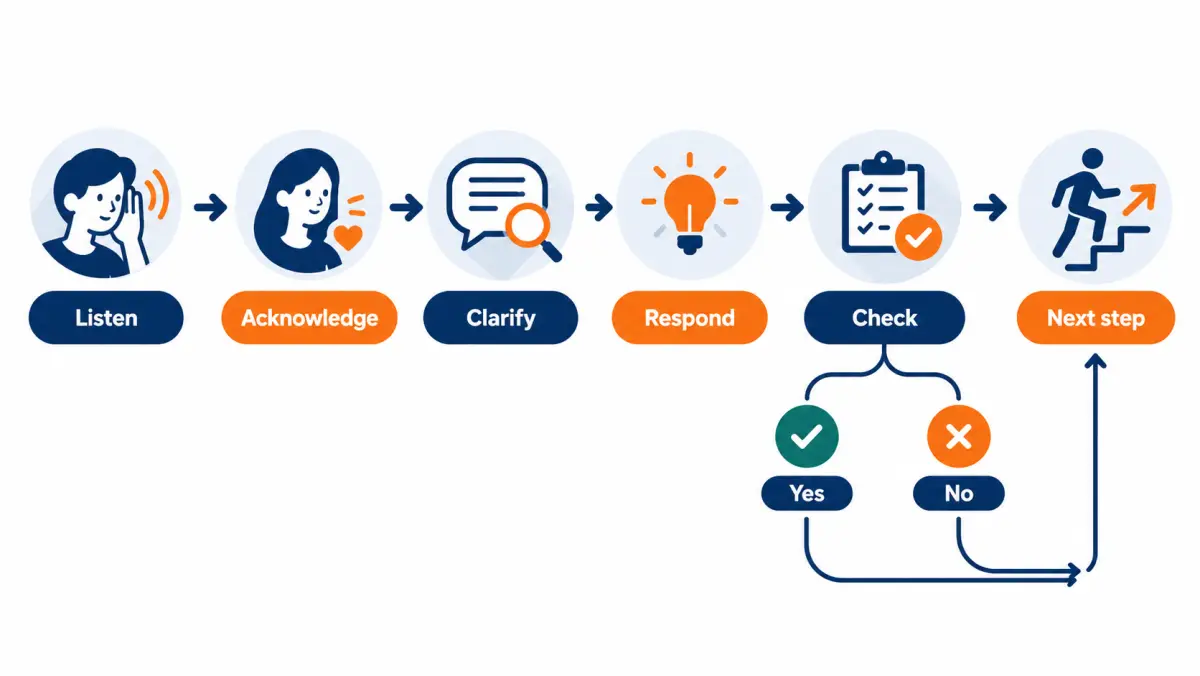
The objection loop (LACRC-N)
| Step | What you do | Example words |
|---|---|---|
| Listen | Let them finish. Do not interrupt. | (silence) |
| Acknowledge | Show you heard it. | "That's fair." / "I hear that a lot." |
| Clarify | Ask what's behind it. | "When you say expensive, compared to what?" |
| Respond | Answer briefly, honestly. | One to three sentences. |
| Check | Confirm it helped. | "Does that make sense?" |
| Next step | Return to booking. | "So would Tuesday or Thursday work?" |
A rule that saves a lot of calls: answer an objection a maximum of twice. If the homeowner raises the same objection a third time, it is a real no for now. Thank them, offer a callback or close the file.
Time and interest objections
1. "I'm busy right now."
- Behind it: Bad timing, or a polite brush-off.
- Response: "No problem. Is later today or tomorrow better, morning or evening?" Book a specific callback time.
- Don't: Keep talking "real quick." You lose the callback too.
2. "I'm not interested."
- Behind it: Could be a reflex, could be real. If they filled out a form recently, it is often a reflex.
- Response: "Understood. Just so I don't bother you again, was it more that the timing's off, or you've decided solar isn't for you?" If decided: thank them and close. If timing: ask when to check back.
- Don't: Argue or say "but you filled out a form."
3. "I didn't fill anything out."
- Behind it: Forgot, someone else in the household filled it out, or the lead data is wrong.
- Response: "Sorry for the confusion. Our records show a request about solar for this address {source_context}. Could someone else in the house have filled it out? Either way, I'm happy to take you off our list." If they want off, remove them immediately.
- Don't: Insist. Log the response; if it happens often from one source, raise it with your vendor and review the consent records.
4. "Just send me information."
- Behind it: Wants to avoid a meeting, or genuinely prefers to read.
- Response: "Happy to. Brochures don't show your own numbers, though. Can I send the overview and put a 15-minute screen-share on the calendar so you can see your house?"
- Don't: Send the brochure and never follow up.
5. "I'm just looking / just researching."
- Behind it: Early stage, low urgency.
- Response: "Good, research is smart. Part of research is seeing what your own roof and bill would look like. That's what the consultation does, no commitment."
- Don't: Push urgency that does not exist.
6. "Call me back in a few months."
- Behind it: Real timing (moving, renovating, finances) or a brush-off.
- Response: "Happy to. What's happening between now and then? I'll make a note so I call at the right time." Schedule the callback for a specific date.
- Don't: Schedule a vague "follow up later."
Trust objections
7. "Is this a scam?"
- Behind it: Bad experiences with solar calls, news stories.
- Response: "It's a fair question; there are some bad actors out there. We're {company}, a licensed installer [say this only if true; state your license if your state issues one]. You can look us up, and nothing gets signed on the phone. Our consultant will show you everything in writing."
- Don't: Get offended.
8. "Are you with the utility / the government?"
- Behind it: Confusion from other callers or ads.
- Response: "No, we're {company}, an independent solar installer. We're not the utility and not a government program."
- Don't: Blur the line. This is a compliance issue, not just a sales one.
9. "How did you get my number?"
- Behind it: Surprise or privacy concern.
- Response: "You requested information about solar {source_context}, and that request came to us. If you'd prefer we not call, I'll remove you right now."
- Don't: Be vague. Know the source and consent details before you dial.
10. "I've had bad experiences with solar salespeople."
- Behind it: Pressure tactics, broken promises.
- Response: "I'm sorry to hear that. What happened?" Listen. "Our consultants show the numbers and leave the proposal with you. No same-day signing required [only if true]."
- Don't: Bad-mouth the other company by name.
11. "My neighbor had problems with their installer."
- Behind it: Fear of install quality or service issues.
- Response: "That's worth asking about. What kind of problems? Our consultant can walk you through who does our installs, how warranties work, and who you call if something goes wrong."
12. "I don't want anyone coming to my house."
- Behind it: Privacy, time, pressure concerns.
- Response: "Totally fine. We can do it as a video call; you'll see the design on screen."
Money objections
13. "It's too expensive."
- Behind it: Sticker shock from a previous quote, or an assumption.
- Response: "Compared to what, a quote you got, or just a feeling?" Then: "There are ways to do it with little or nothing upfront, where you pay monthly instead. Whether that beats your current bill depends on your house. That's what the consultant figures out."
- Don't: Quote a price or promise a lower monthly payment on the phone.
14. "I can't afford it right now."
- Behind it: Cash constraint, or uncertainty about financing.
- Response: "Understood. Some options don't require money upfront; you'd swap part of your electric bill for a solar payment. If it doesn't beat what you pay now, it's not worth doing. Want to see the comparison?"
15. "What's the catch with no-money-down?"
- Behind it: Healthy skepticism.
- Response: "Good question. With a lease or power purchase agreement, a company owns the panels and you pay a monthly amount or a rate for the power. There's a contract term, and some have an annual price increase. Our consultant will walk you through every term so you can read it before deciding."
- Don't: Say "there is no catch."
16. "I want to pay cash, can you just give me a price?"
- Response: "Cash buyers usually get the best value. To give you a real price, we need roof measurements and usage. The consultant can give you an exact cash price at the appointment."
17. "I heard solar doesn't pay off anymore."
- Behind it: News about the 25D credit ending, net metering changes.
- Response: "Some of the math did change, the federal homeowner credit ended after 2025, and in some areas the utility pays less for extra power. For some homes it doesn't pay off. For others, it still does. The only way to know for yours is to look at your bill and roof."
18. "I'm worried about my credit."
- Response: "That's understandable. The consultant will explain exactly what's needed for each payment option before anything is run, and you decide whether to go ahead."
- Don't: Discuss credit scores or approval odds on the setter call.
Property and timing objections
19. "My roof needs replacing."
- Response: "Thanks for mentioning it. Putting panels on a roof that needs replacing soon usually isn't a good idea. Do you have a timeline for the roof? Some installers can coordinate both; ours [does / doesn't]."
20. "We might move in a few years."
- Behind it: Fear of being stuck with a system or contract.
- Response: "That matters. If you own the system, it typically stays with the house. If it's a lease, the new owner usually takes it over through a transfer process. The consultant can explain how that works so you can weigh it."
21. "I have trees / shade."
- Response: "Shade matters. Our consultant can check satellite images first, and if it's not a fit, we'll say so before anyone drives out."
22. "My HOA won't allow it."
- Response: "Many HOAs have rules about how panels look rather than banning them, and some states limit what HOAs can restrict. The consultant can look at your HOA's rules with you." [Confirm your state's rules before using the second clause.]
23. "I'm waiting for better technology."
- Response: "Panels do keep improving, slowly. The question is whether the savings you'd get starting now outweigh waiting. We can show you the numbers either way."
24. "I'm waiting for the tax credit to come back."
- Response: "Nobody can promise that it will. What we can do is show you the numbers today, without the credit, so you can decide with real information."
Decision-maker objections
25. "I need to talk to my spouse."
- Response: "Absolutely, it's a household decision. Let's set the appointment for a time you're both home so you hear the same thing."
26. "My spouse isn't interested."
- Response: "That's fair. What's their main concern? If it's cost, the meeting is where they'd see whether it saves money. If they'd rather not, I understand."
27. "My parents/landlord own the house."
- Response: "Thanks. We'd need the owner involved. Would they be open to a conversation?" If no, close politely.
Competitor and experience objections
28. "I already got a quote."
- Response: "Good, that gives you something to compare. Want a second opinion? Our consultant can look at the same roof and show you how ours compares, including terms."
29. "I already went with another company."
- Response: "Congrats on going solar. I'll take you off our list. Good luck with the install." Close.
30. "Another company said they could do it cheaper."
- Response: "They may be able to. Price per watt, equipment, warranties and contract terms can all differ. If you'd like, our consultant can line them up side by side."
31. "I already have solar."
- Response: "Thanks for telling me. Are you happy with it? Some homeowners with solar look at adding a battery or expanding." [Only continue if the homeowner is open and your consent covers this.]
Process objections
32. "How long is the appointment?"
- Response: "About an hour in person, or 30 to 45 minutes on video. It's mostly looking at your actual numbers."
33. "Can you just do it over the phone?"
- Response: "We can do it on video, so you can see the design. Phone-only makes it hard to show you the roof layout."
34. "Will I be pressured to sign?"
- Response: "No. The consultant will leave you the proposal. Take your time." [Only if true.]
35. "Why do you need my electric bill?"
- Response: "So the design matches how much power you actually use. Without it, any number is a guess."
Objection practice drill
Run this in a weekly team meeting. Fifteen minutes is enough.
- Pick three objections from the library.
- One rep plays the homeowner with a hidden motive written on a card (for example, "You're actually worried about moving in two years").
- A second rep runs the LACRC-N loop. They must clarify before responding.
- The rest score: Did the rep find the hidden motive? Did they return to a next step? Did they say anything non-compliant?
- Swap roles. Repeat.

How should solar sales scripts change after the 25D credit ended?
After 25D, scripts should correct the credit once, calmly and accurately, then move to the bill and the payment paths that still work: cash, loans, and third-party-owned options such as leases and PPAs. Setters should not estimate tax outcomes. Closers need clear, written explanations of every term so homeowners can compare options without the old 30% anchor.
The federal Residential Clean Energy Credit (Section 25D) does not apply to systems placed in service after December 31, 2025, per the IRS page on the Residential Clean Energy Credit. Homeowners who heard about "30% back" from a neighbor, an older ad or another installer still bring it up on calls in 2026. Our guide to solar leads after the 25D credit covers the market and lead-economics side. This section is about the exact words for different situations on the phone.
The one-sentence correction, by role
| Role | When to say it | Words |
|---|---|---|
| Setter | Only if the homeowner raises a credit, or for aged leads up front | "Just so you have current info, the 30% federal homeowner credit ended for systems finished after 2025. For your own taxes, a tax advisor is the right person to ask. What we can show you is how today's options compare to your bill." |
| Live transfer closer | Early, before any numbers | "Quick heads-up before we look at numbers: the federal homeowner credit ended after 2025, so anything you saw with 30% off doesn't apply. We'll compare options without it." |
| Appointment closer | In the proposal walkthrough | "This proposal doesn't include the federal homeowner credit because it ended for systems placed in service after 2025. Here's how each payment option compares to your current bill." |
| Confirmation caller | Only if asked | "Your consultant will cover incentives and payment options in detail; the federal homeowner credit ended after 2025." |
Scenario scripts for post-25D conversations
Scenario A: the homeowner was quoted last year with the credit
Homeowner: Last year someone told me it'd be about thirty percent less after the tax credit.
Rep: Right, that was true for systems finished by the end of 2025. It ended after that, so the same system would cost more today if you're buying it. A lot of people are looking at monthly plans now instead, where you don't need the credit to make it work. Would it help to see both side by side?
Scenario B: the homeowner thinks solar is "not worth it" anymore
Homeowner: I read solar doesn't make sense without the credit.
Rep: For some homes, that's true, and if it's true for yours, our consultant will tell you. It depends a lot on your bill and your utility. What's your typical bill?
Scenario C: the homeowner asks whether the installer gets a credit on a lease
Homeowner: If I lease, does the company get a tax break?
Rep: Business tax rules are separate from the homeowner credit, and how they apply depends on the company and the project. The consultant can explain how the lease pricing works, and for anything about your own taxes, a tax advisor is the best source.
Do not speculate about the leasing company's tax position, and do not suggest a lease is "cheaper because they get the credit." That kind of claim can be wrong and misleading.
Scenario D: the homeowner wants to wait for a new credit
Rep: I can't predict what Congress will do, and I wouldn't want you to make a decision based on a guess. If you'd like, we can put real numbers in front of you now and you can decide whether to act or wait.
Scenario E: the homeowner asks about state or utility incentives
Rep: Some states and utilities have their own programs, and they change. Our consultant will check what's available for your address at the appointment.
Make sure your closer actually checks. The DSIRE database run by the N.C. Clean Energy Technology Center is a common starting point for state and utility programs.
Explaining leases and PPAs on the phone
Setters should not explain lease and PPA economics in depth, but they need a simple, accurate sentence when a homeowner asks.
Homeowner: What's the difference between buying and a monthly plan?
Rep: When you buy, with cash or a loan, you own the panels. With a lease or a PPA, another company owns them and you pay a monthly amount or a rate for the power they make. Leases and PPAs usually have little or nothing upfront and a long contract, and some have a yearly price increase. The consultant will show you the full terms in writing for each option.
What closers must cover in writing after 25D
This is a checklist for your proposal process, not a phone script. Have counsel review your disclosures.
- Total cost or total payments over the term for each option.
- Whether pricing includes any incentive, and which one.
- Lease and PPA escalator, term, transfer process and end-of-term options.
- Loan rate, term, fees and what happens if a dealer fee is included.
- That tax questions go to the homeowner's tax advisor.
- That savings estimates depend on assumptions (usage, rates, production), and what those assumptions are.

What compliance checks should every solar call script pass?
Every solar call script should pass checks for consent context, calling hours, do-not-call handling, caller identification, opt-out handling, recording notices where required, honest claims and texting rules. These rules come from the federal TCPA and Telemarketing Sales Rule plus state laws. Rules vary by state and change, so confirm with counsel before using any script.
This section is a set of practical checks, not legal advice. Telemarketing law is a specialist area and solar is a frequent target of complaints and lawsuits. Our solar leads TCPA compliance guide goes deeper on consent and vendor checks. For primary sources, start with the FCC's telemarketing and robocalls guidance and the FTC's Telemarketing Sales Rule.
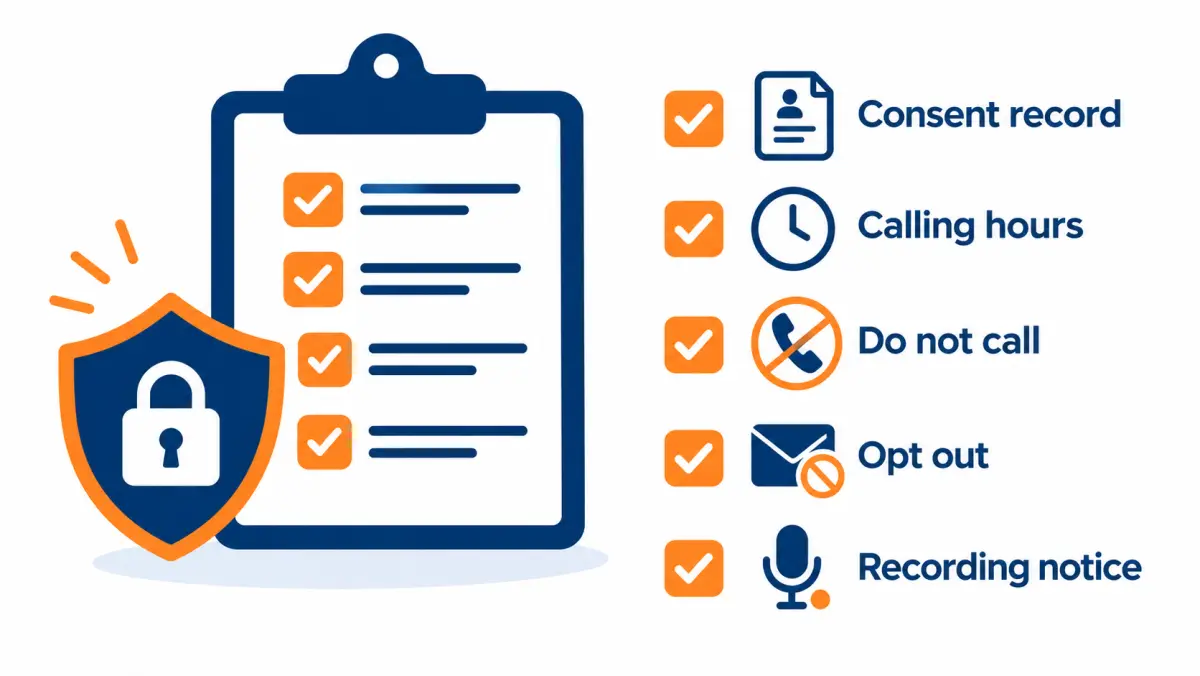
Script compliance checklist
| Check | What to look for in the script | Notes to confirm with counsel |
|---|---|---|
| Caller identification | Rep states their name and company early | Federal and some state rules require identifying the seller |
| Purpose | Rep says the call is about solar for their home | Some states require stating purpose at the outset |
| Consent context | Script references the homeowner's request | Consent must cover your company and the method used (calls, texts, automated technology) |
| Do-not-call | Process to check National DNC and internal DNC before dialing; handle "don't call me" immediately | Exemptions and timing rules vary |
| Calling hours | Dialer enforces allowed hours in the homeowner's time zone | Federal limits plus stricter state windows |
| Opt-out | Script has a clear line for "take me off your list" | Honor promptly across all channels |
| Recording notice | Script includes a notice if you record and the state requires it | Some states require all-party consent to record |
| Truthful claims | No savings guarantees, no tax promises, no impersonation of utility or government | Also check state consumer protection and solar-specific laws |
| Texting | Consent covers texts; texts include identification and opt-out | Quiet hours and frequency limits vary by state |
| Prerecorded / AI voice | Not used without appropriate consent | The FCC has treated AI-generated voices as artificial voices under the TCPA |
| Caller ID | Accurate, authorized number displayed | Spoofing rules apply |
As of October 2026, note one change that affects lead buyers: the FCC's "one-to-one consent" rule, which would have required consent to name a single seller, was vacated by the U.S. Court of Appeals for the Eleventh Circuit on January 24, 2025. That does not make vague, multi-company consent safe. It is still best practice to buy leads whose consent disclosure names your company, and state laws may be stricter. Every lead we sell carries a timestamped consent record (certificate) whose disclosure names your company, and we send it to you on request.
Compliance lines to build into scripts
Recording notice (if you record and state law requires notice)
"Just so you know, this call may be recorded for quality and training."
Opt-out handling
Homeowner: Take me off your list.
Rep: Understood, I'll remove you right now. You won't hear from us again about this. Sorry for the bother.
Then actually do it: add the number to your internal do-not-call list and stop all campaigns. Do not ask "are you sure?" or try one more pitch.
Identity when asked
"I'm {rep_name} with {company}. Our number is {callback_number} and our address is {company_address}."
Correcting a homeowner who thinks you are the utility
"I want to be clear, we're not the utility or a government program. We're {company}, a private solar company."
Calling-hour rule of thumb
Federal rules prohibit telemarketing calls before 8 a.m. or after 9 p.m. local time at the called party's location, and several states set narrower windows or restrict certain days. The safest approach is to configure your dialer with the strictest window that applies to each state you call, and to ask counsel for a current state-by-state table. Do not rely on reps to remember.
Practical compliance habits for call teams
- Script review cycle. Have counsel review scripts when you launch, when you change lead sources and at least once a year.
- Dialer settings audit. Check time-zone and calling-hour settings monthly.
- DNC hygiene. Scrub before every campaign; sync internal DNC across dialer, SMS platform and CRM.
- Call recording QA. Listen for compliance lines in your weekly coaching (see the scorecard below).
- Vendor consent records. Spot-check consent certificates from every lead source. If a source's records are missing or do not name your company, stop calling those leads and ask for an explanation.
- Complaint log. Track "I never asked for this" responses by source. A spike is a signal to investigate.
How do you hand off from setter to closer without losing the deal?
A clean handoff gives the closer everything the setter learned, in the homeowner's own words, before the appointment. Use a fixed handoff note format in your CRM covering motive, bill, roof, decision makers, objections raised and promises made. The closer should open the appointment by repeating the motive back, so the homeowner feels heard rather than re-qualified.
Many appointments that "didn't close" were lost before the closer arrived. The setter learned that the homeowner's real worry was moving in three years, and the closer never knew. A structured handoff fixes that.
Handoff note template
APPOINTMENT: {date} {time}  |  In-home / Video
HOMEOWNER: {first_name} {last_name}  |  Co-owner: {name or none}  |  Both attending: Y/N
ADDRESS: {address}  |  Utility: {utility}
LEAD SOURCE: {vendor / campaign}  |  Lead type: exclusive / shared / aged / transfer / inbound
MOTIVE (their words): "{quote}"
BILL: normal ${x}, peak ${y}, any big usage changes: {EV, pool, etc.}
ROOF: age {x}, material {x}, shade {low/med/high}, HOA {Y/N}
PAYMENT LEAN: own / monthly / unsure
OBJECTIONS RAISED: {list}
PROMISES MADE BY SETTER: {e.g., "closer will check if battery fits"}
OTHER QUOTES: {Y/N, which, when}
COMPLIANCE: consent record on file Y/N, recording notice given Y/N
Closer's appointment opener
Closer: Hi {first_name}, I'm {closer_name}. Thanks for having me. {rep_name} mentioned your August bill was what got you looking, and that you mainly want to know whether this actually lowers what you pay. Is that still the main thing?
Homeowner: Yes, exactly.
Closer: Great, then that's what we'll focus on. Can I see a recent bill? I'll start with your usage, then show you the roof design, then the options side by side. If at any point it doesn't make sense, tell me.
That opener does three things: it proves the company listened, it sets an agenda, and it gives the homeowner permission to say no, which tends to make the meeting more relaxed.
Promises setters may and may not make
| Setters may promise | Setters must not promise |
|---|---|
| A specific consultant and time | Any savings amount |
| That the consultant will bring a design | Any price |
| That the meeting has no obligation | Approval for financing |
| That they will text a confirmation | Tax outcomes or credits |
| That the consultant will check a specific question | Installation dates |
How do you coach reps to a solar call script?
Coach to scripts by recording calls, scoring a sample every week against a short scorecard, and changing one script line at a time based on what the recordings show. Pair new reps with role-play before live calls. Track booking rate and show rate per rep and per lead source so you can tell a script problem from a lead problem.
A script on paper is a hypothesis. Recordings tell you whether it works. Most teams that "tried scripts and they didn't work" never listened to enough calls to know which line failed.
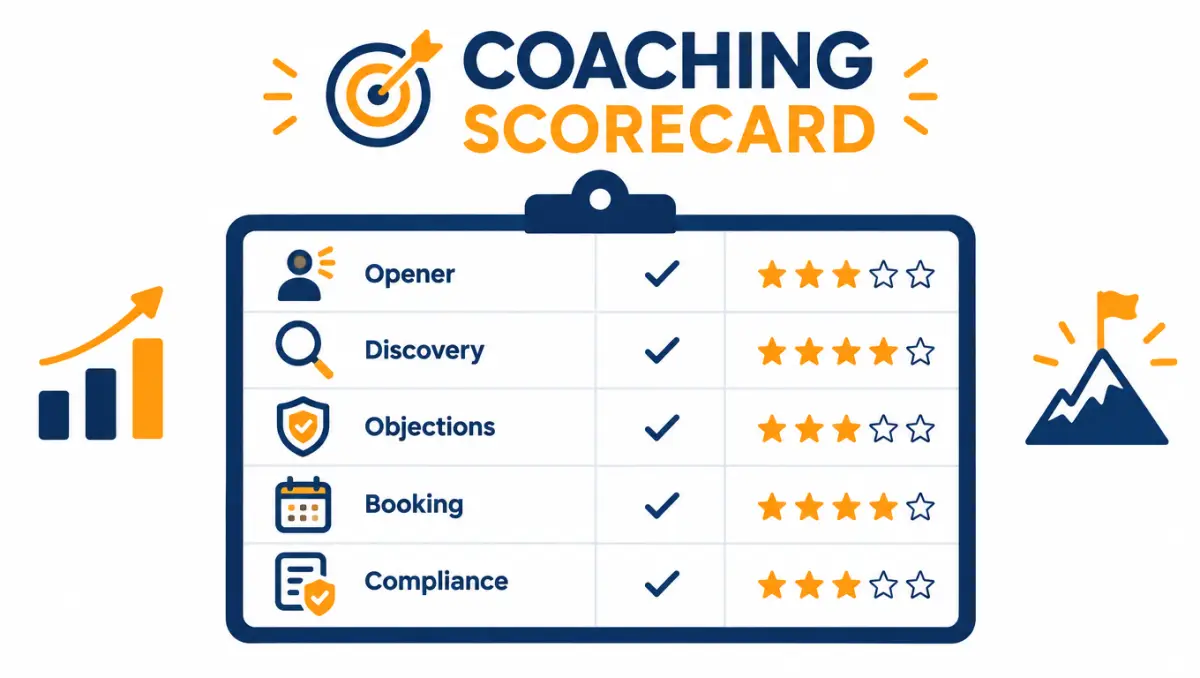
Weekly call scorecard
Score five recorded calls per rep per week. Use a simple 0 to 2 scale for each row (0 = missed, 1 = partial, 2 = done well).
| Area | What "2" looks like |
|---|---|
| Opener | Name, company, request context and permission within the first 15 seconds |
| Motive discovery | Asked why now and wrote down their words |
| Qualifying | Covered every mandatory question without sounding like a form |
| Listening | Talked less than the homeowner in discovery |
| Objection handling | Clarified before responding; answered no more than twice |
| Booking close | Offered two specific times; confirmed decision makers |
| Next-step setup | Bill reminder, confirmation text, reschedule path |
| Compliance | Identification, no prohibited claims, opt-out handled properly, recording notice if required |
| Tone | Calm, unhurried, friendly |
A rep averaging below 1 in any row gets a focused drill on that row next week. Do not coach everything at once.
Metrics to read alongside the scorecard
| Metric | Definition | What it tells you |
|---|---|---|
| Contact rate | Leads with a live conversation ÷ leads worked | Speed, cadence and data quality |
| Booking rate | Appointments booked ÷ contacts | Script and rep skill |
| Show (sit) rate | Appointments sat ÷ booked | Confirmation process and booking quality |
| Close rate | Sales ÷ sits | Closer skill, pricing, lead fit |
| Cost per sale | Lead spend ÷ sales | Overall economics |
If contact rate is low across all reps for one source, it is probably a data or speed issue. If booking rate is low for one rep but fine for others on the same source, it is coaching. If show rate drops, look at the confirmation script and the booking close (were they pressured into a time?). Our solar lead ROI guide shows how these rates combine into cost per sale, and you can model your own funnel with the solar lead cost calculator.
How to test a script change
- Pick one line to change, for example the opener permission question.
- Write version B.
- Split reps or alternate leads by day so each version gets similar leads from the same sources.
- Run until each version has enough calls that one bad day does not swing the result. For small teams that may take several weeks.
- Compare booking rate and show rate, not just "how it felt."
- Keep the winner; test the next line.
Changing five lines at once tells you nothing about which change helped.
New rep onboarding plan for scripts
| Day | Activity |
|---|---|
| Day 1 | Read all scripts; listen to ten recorded calls (good and bad) |
| Day 2 | Role-play the fresh lead script ten times; compliance lines drill |
| Day 3 | Role-play the top 15 objections; shadow live calls |
| Day 4 | Make live calls on fresh leads with a coach listening |
| Day 5 | Review recordings with coach; score with the scorecard |
| Week 2 | Add shared and aged scripts; daily 15-minute role-play |
| Week 3 | Add live transfers and inbound if the rep will take them |
| Week 4 | Full independent workload; weekly scorecard reviews |
Tone and pacing notes
Words matter less than delivery on the phone. A few habits that make the same script sound better:
- Slow down in the first ten seconds. People decide whether to stay on the line almost immediately. A rushed opener sounds like a robocall.
- Use the homeowner's name once or twice, not every sentence.
- Ask, then stop talking. Silence after a question is fine. Filling it with more pitch lowers the quality of the answer.
- Lower your pitch at the end of the booking question. "Would Tuesday or Thursday work better?" said flatly sounds confident; said with a nervous upturn it sounds like you expect a no.
- Smile while you dial. It sounds corny. It does change the voice.
How do call scripts differ by installer size and team setup?
Script structure stays the same across team sizes, but who uses which script and how much the call covers changes. A solo owner-operator runs short setter-plus-closer calls. A mid-size team splits setters and closers with strict handoffs. A large call center needs tighter scripts, stronger compliance controls and more A/B testing. Illustrative setups follow.
These walkthroughs are illustrative examples, not case studies of real companies. Use them to think through your own setup.
Illustrative: solo owner-operator, one crew
The owner answers inbound calls and returns web leads between installs. There is no setter.
- Script used: A shortened fresh-lead script, with one change: the owner books themselves. "I'm the owner, so I'll be the one coming out. Would Tuesday at five or Thursday at five work?"
- Biggest risk: Speed to lead. The owner is on a roof when leads arrive. Fix: an auto-text right away (if consent covers it) saying "{company} here, I'm on a job and will call you by {time}," then a real call at that time.
- Lead type fit: Booked appointments or inbound calls often fit better than raw leads, because the owner cannot dial quickly. See buying solar appointments.
Illustrative: mid-size installer, two setters and four closers
- Script used: Full setter scripts for fresh and shared leads; confirmation script owned by setters; closers use the appointment opener and proposal checklist.
- Biggest risk: Handoff quality and no-shows. Fix: the handoff note template, required before a booking counts.
- Coaching: Sales manager scores five calls per setter weekly; monthly closer ride-alongs.
- Lead type fit: Fresh exclusive leads plus a small aged-lead test for slow weeks.
Illustrative: large team or call center, 20+ setters
- Script used: All lead-type scripts, managed in the dialer with variables. Compliance lines locked and not editable by reps.
- Biggest risk: Compliance drift and inconsistent quality. Fix: automated dialer controls for calling hours and DNC, QA team scoring a sample of calls daily, script change control with counsel sign-off.
- Testing: Formal A/B tests by lead source.
- Lead type fit: Mixed portfolio. Uses live transfers for peak hours if closers are available.
Illustrative: commercial-only developer
- Script used: Commercial script and gatekeeper script; email follow-up after each call.
- Biggest risk: Wrong contact, long cycles. Fix: stakeholder map in CRM; scripts aimed at booking a discovery call rather than a full proposal.
How do scripts change by market and state?
Scripts change by market mainly in what the setter can say about utilities, rate plans and local rules, and in compliance details such as calling hours, recording consent and texting limits. Build a short market sheet per state or utility territory that setters can glance at, and keep claims general enough that they stay accurate.
Market sheet template
| Field | Example entry |
|---|---|
| Utilities served | List utilities in your territory |
| Net metering / export summary | One sentence your closers have verified, dated |
| Common local motives | High summer bills, outages, EV adoption, rate plan changes |
| HOA notes | Any state law on HOA solar restrictions, verified by counsel |
| Calling window | Strictest applicable window for the state |
| Recording consent | One-party or all-party; notice line required Y/N |
| Texting notes | State-specific rules flagged by counsel |
| Permitting time (your experience) | Range from your own projects |
Adjusting the opener for market motives
Use what you hear on calls, not assumptions. If most homeowners in a territory bring up outages, train the "what got you looking" follow-up to explore backup. If most bring up summer bills, the bill question should ask about the worst month. Revisit the market sheet every quarter.
Do not tell homeowners that rates "will go up X% next year" unless you can cite a filed rate case or official source and date it. Prefer: "A lot of folks in {city} have told me their bills have gone up. Has that been your experience?"
What email templates support a solar call script?
Email supports calls; it rarely replaces them. Use short, plain emails that name your company, refer to the homeowner's request, and offer one action, usually booking a time. Send them after missed calls, after booking to confirm, and as a final check-in. Include your physical address and an unsubscribe option, as commercial email rules require.
The federal CAN-SPAM Act sets basic rules for commercial email, including an accurate sender, a non-deceptive subject line, a physical postal address and a working opt-out. The FTC's CAN-SPAM compliance guide is the reference.
Email 1: after missed first calls
Subject: Your solar request, {first_name}
Hi {first_name},
I'm {rep_name} with {company}. You asked about solar for your home {source_context}, and I tried calling a couple of times.
The next step is a short consultation where {closer_name} looks at your roof and electric bill and shows you real numbers, including options with little or nothing upfront. No obligation.
You can pick a time here: {booking_link}
Or just reply with a good time to call.
{rep_name} {company} | {callback_number} | {company_address}
Don't want these emails? {unsubscribe_link}
Email 2: booking confirmation
Subject: Confirmed: solar consultation {appointment_day} at {appointment_time}
Hi {first_name},
You're booked with {closer_name} on {appointment_day} at {appointment_time} [at your home / on video: {link}].
To make it useful:
- Have a recent electric bill handy (paper or app).
- If anyone else is part of the decision, please invite them.
Need to change the time? Reply to this email or text {callback_number}.
{rep_name}, {company}
Email 3: final check-in
Subject: Should I close your solar file?
Hi {first_name},
I haven't been able to reach you about your solar request, and I don't want to keep bothering you. If you're still interested, reply "yes" and I'll find a time. If not, no reply needed and I'll close your file.
Thanks, {rep_name}, {company}
Commercial email after a first call
Subject: Next step on solar for {business_name}
Hi {first_name},
Thanks for the time today. As discussed, the next step is a 30-minute discovery call with {developer_name}, our commercial project developer, on {date} at {time}.
If you can, please send twelve months of electric bills before the call, and invite {CFO / owner} if they'd like to join.
{rep_name}, {company}
What does a good call sound like compared with a bad one?
The difference between a booked appointment and a hang-up is usually visible in the first 30 seconds and the last 30 seconds. Good calls connect to the homeowner's request, ask before pitching and close with specific times. Bad calls open with a company monologue, pitch before qualifying and end with "when are you free?" The annotated examples below show both.
These are illustrative examples written for training, not transcripts of real calls.
Illustrative weak call
Rep: Hi, is this Sam? Hi Sam, my name's Alex and I'm calling from {company}, we're one of the leading solar companies in the state, we've been in business for over ten years and we have an A-plus rating, and we're helping homeowners in your area save thousands of dollars on their electric bills with zero-down solar. Have you ever thought about going solar?
Homeowner: Uh, I think I filled something out. I'm kind of busy.
Rep: Totally, this'll be super quick. So with the new programs you could basically get solar for free and just pay less than your current bill. What's your bill?
Homeowner: I don't know, around one-fifty. Look, I've got to go.
Rep: Okay, when are you free for one of our guys to come out?
Homeowner: I'll call you back.
What went wrong:
- 25 seconds of company monologue before any question.
- No mention of the homeowner's own request until they raised it.
- "Free" and "save thousands" claims that are inaccurate and risky.
- "New programs" is vague and can imply a government program.
- Ignored "I'm busy" instead of booking a callback.
- Open-ended "when are you free?" close.
Illustrative strong call
Rep: Hi, is this Sam? Sam, this is Alex with {company}. You asked about solar for your home on our site about ten minutes ago. Is now an okay time for two minutes, or is later better?
Homeowner: I'm kind of busy.
Rep: No problem. Would later this afternoon or this evening be better?
Homeowner: Evening, after seven.
Rep: Seven-fifteen? I'll call this number.
Homeowner: Fine.
Rep: Great, I'll send a quick text so you know it's me. Talk then.
What went right:
- Context and permission in the first ten seconds.
- Accepted "busy" and booked a specific callback.
- Under 40 seconds; no claims made; easy yes.
A booked callback is a win. The rep has kept the lead warm, gained permission for a specific time and sent a text that puts a name to the number.
How do you handle tricky situations on solar calls?
Tricky calls, such as reaching the wrong person, talking with someone who seems confused or vulnerable, a language barrier, an angry homeowner or a homeowner who calls back asking who you are, need set responses that put honesty and respect ahead of the booking. Write these into your scripts so reps do not improvise under pressure.
The wrong person answers
Rep: Hi, is {first_name} available?
Other person: They're not here. Who's this?
Rep: This is {rep_name} with {company}. I'm following up on a request {first_name} made. When's a good time to reach them?
Do not describe the request in detail to someone else, and do not try to qualify or book the other person unless they say they own the home and want to talk about it themselves.
The homeowner seems confused or vulnerable
If a homeowner seems confused about who you are, why you called or what they agreed to, slow down and do not book. A booking made with someone who does not understand the call is a no-show at best and a complaint at worst.
Rep: I think I may have caught you at a bad time. I'm with {company}, a solar company, and I'm not with your utility. Is there someone in your family you'd like to be part of this conversation? I'm happy to call back when they're around.
Train reps to flag these calls for a manager review. Many states have specific protections for older consumers in home solicitation and contract rules; ask counsel what applies to your scripts and your closers' in-home process.
Language barrier
If your team has a rep who speaks the homeowner's language, offer a transfer: "Would you be more comfortable speaking in {language}? I can have {rep_name_2} call you." If not, keep it simple, offer to send a written summary, and avoid booking a meeting the homeowner may not fully understand. If you serve a market with many non-English speakers, consider whether contracts and disclosures must be provided in that language; some states have rules on this, so confirm with counsel.
Angry homeowner
Homeowner: I've had ten calls today, stop calling me!
Rep: I'm sorry, I'll make sure we don't call again. I'm removing your number now.
End the call. Add the number to your internal do-not-call list. Log the source. If one lead source produces many angry responses, that may be a sign the leads are shared more widely than you were told or that consent capture is weak. Raise it with the vendor.
Homeowner calls back and asks "who is this?"
Make sure inbound calls to the number your reps dial from are answered with your company name, or reach a voicemail greeting that names the company. Then:
Rep: Thanks for calling back. This is {company}, a solar installer. We called about a request for solar information for your home. Can I get your name so I can pull it up?
Homeowner asks for the consent record
Homeowner: Prove I asked for this.
Rep: Fair enough. Our records show a request on {date} from {source_context}. I can have our office send you a copy of the record. In the meantime, would you like me to take you off our list?
Know where your consent records are and who sends them. Every lead we sell comes with a timestamped consent record, and we send it to you on request. Other vendors' practices vary; ask before you buy.
How do you fix a script that is not booking appointments?
Diagnose a weak script by finding where calls drop: the opener (hang-ups in the first 15 seconds), discovery (homeowners give short, guarded answers), objections (calls end after the first objection), or the close (good conversations that end without a time). Listen to recordings for the drop point, then change only that part of the script.
Script troubleshooting table
| Symptom | Likely cause | Script fix |
|---|---|---|
| Many hang-ups in first 15 seconds | Opener sounds like a cold call or robocall | Lead with the homeowner's request and ask permission; slow down |
| "I didn't fill anything out" is common | Source context missing or wrong; possible consent issue | Add specific {source_context}; review consent records with vendor |
| Short, guarded answers in discovery | Questions feel like an interrogation | Start with motive ("what got you looking?") before facts |
| Calls end after first objection | Rep responds without clarifying, or argues | Drill LACRC-N; limit to two answers per objection |
| Good conversations, no booking | Weak or open-ended close | Two specific times; motive close |
| Bookings but low show rate | Pressured bookings; no confirmation; missing decision makers | Confirmation script; decision-maker question; easier reschedule path |
| Closers say appointments are unqualified | Setter skipping mandatory questions | Lock mandatory questions in the dialer script screen |
| High complaint rate | Claims, cadence or consent issues | Compliance review with counsel; audit cadence and sources |
| Same script works on one source, fails on another | Lead source quality or type mismatch | Use the right lead-type script; evaluate the source (see how to vet solar lead providers) |
When it is the lead, not the script
Sometimes the script is fine and the leads are poor. Signs: contact rates are low for every rep on one source, many numbers are disconnected, homeowners do not remember asking, or a lot of records fall outside your filters. Track these by source, not just overall.
For leads you buy from us, replacement credits cover disconnected numbers, wrong contact details, or leads outside your filters, within 7 days. Not covered: a prospect who isn't interested, doesn't answer, doesn't get financing approved, or doesn't buy. To request a credit, reply to the lead notification (or email us) with the reason; approved credits apply to your next batch. Whatever vendor you use, know their terms so your reps disposition leads in a way that supports valid credit requests.
Disposition codes that make lead-quality reviews possible
| Code | Use when |
|---|---|
| Contacted – booked | Appointment set |
| Contacted – callback set | Specific callback time scheduled |
| Contacted – not interested | Clear no after conversation |
| Contacted – not qualified (renter) | Does not own home |
| Contacted – not qualified (roof/shade) | Property not suitable |
| Contacted – outside filters | Outside the ZIPs or criteria you bought |
| Bad data – disconnected | Number not in service |
| Bad data – wrong person | Number does not belong to the named homeowner |
| Did not request | Homeowner says they never asked |
| DNC request | Asked not to be contacted |
| No contact – cadence complete | Full sequence finished without contact |
Consistent codes turn "these leads are bad" into a specific, fixable conversation with your vendor.
Illustrative example: diagnosing a script with disposition data
Here is how a manager might use the codes above to fix a script instead of arguing about lead quality. The numbers below are illustrative, made up to show the method, not benchmarks.
A setter team works a batch of shared leads for two weeks. Booking is lower than the manager expects. Before changing anything, the manager pulls the disposition report for the batch and sorts it by code.
Step 1: separate data problems from script problems. If "Bad data – disconnected," "Bad data – wrong person" and "Did not request" make up a large share of outcomes, the issue sits with the source, and the conversation belongs with your vendor. No opener can fix a wrong number. In this example those codes are a modest share, so the manager moves on.
Step 2: find where reached homeowners drop. The manager listens to ten recorded calls coded "Contacted – not interested." In most of them, the homeowner says no within the first thirty seconds, right after the setter mentions "a free solar quote." The opener sounds like every other company that called that day.
Step 3: change one line, not the whole script. The team rewrites the opener to reference what the homeowner actually asked about and to ask permission before qualifying: "You asked about lowering your electric bill with solar. I've got two quick questions to see if your roof is even a fit. Is now okay?" Every other part of the script stays the same so the test is clean.
Step 4: track the same codes on the next batch. If "not interested" falls and "not qualified" rises, the new opener is working: homeowners are staying on long enough for real qualification. If nothing moves, the problem is likely timing or speed to lead, not words.
Step 5: write down the result. Add the tested line, the date and the outcome to your script change log so the next manager does not undo it.
A short checklist for any script fix:
- Confirm the data-quality codes are not the main cause.
- Listen to real calls in the problem code before rewriting.
- Change one section at a time.
- Compare the same codes across batches from similar sources.
- Re-check compliance language after every edit and confirm with counsel when wording changes.
What scripts work for callbacks, no-shows and reschedules?
Callback, no-show and reschedule scripts should be short, warm and free of guilt. Open by referencing the time you agreed or the appointment that was missed, assume something came up, and offer two new times. A homeowner who reschedules is still a live opportunity; one who feels scolded usually stops answering.
These calls are easy to overlook because they feel like admin. They are often where a team's show rate is won or lost.
Scheduled callback script
Rep: Hi {first_name}, it's {rep_name} with {company}. You asked me to call back around now about your solar request. Is this still a good time?
Homeowner: Yeah, go ahead.
Rep: Thanks for making the time. Last time you mentioned {their_words}. Let me ask a few quick questions and then we'll find a time for {closer_name} to show you real numbers.
Repeating something they said on the first call proves you listened and that this is not a random cold call. If the homeowner does not answer the scheduled callback, leave a short voicemail referencing the agreed time and send a text offering two new times.
No-show script (same day)
Rep: Hi {first_name}, {rep_name} with {company}. {closer_name} stopped by at {appointment_time} and missed you. No worries at all, things come up. Would you like to pick a new time? We have {slot_a} or {slot_b}.
Homeowner: Sorry, I forgot completely.
Rep: Happens to everyone. Let's do {slot_b}. I'll send a reminder the day before and the morning of, so it's on your radar.
No-show script (after two missed appointments)
Rep: Hi {first_name}, {rep_name} with {company}. We've missed each other a couple of times, and I don't want to keep booking times that don't work for you. Is solar still something you want to look at, or should we pause for now?
This gives the homeowner an honest exit. Some will say "pause," which saves your closers' drive time. Some will re-commit, and those appointments tend to hold better because the homeowner chose them out loud.
Reschedule request by text
Homeowner (text): Can we move tomorrow?
Rep (text): Of course. Would {slot_a} or {slot_b} work better? – {rep_name}, {company}
Respond fast. A reschedule request answered hours later often turns into a cancellation.
After the booking: asking for a referral
Some teams ask for referrals at the end of a booking call. It can work, but keep it light and do not ask for neighbors' phone numbers to call without their own consent.
Rep: One last thing, totally optional: if any friends or neighbors have asked you about solar, feel free to pass along my number. Happy to help them too.
Asking the homeowner to share your number keeps the contact initiated by the referred person, which is cleaner from a consent standpoint than collecting their numbers. Confirm your referral program with counsel.
Callback and no-show metrics
| Metric | What to watch |
|---|---|
| Scheduled callbacks kept | Share of callbacks where the homeowner answered at the agreed time |
| Same-day no-show recovery | Share of no-shows rebooked within 48 hours |
| Second-appointment show rate | Whether rebooked appointments sit |
| Pause requests | Volume of "pause" outcomes after the two-miss script |
These numbers tell you whether your confirmation sequence and your booking close are doing their jobs, and they are easy to track if reps use consistent disposition codes.
Can AI voice agents or automation use these solar scripts?
Automation can help with routing, reminders and script prompts on a rep's screen, but using AI-generated or prerecorded voices to call homeowners raises separate consent requirements under the TCPA. Before deploying any AI caller or voicemail drop, confirm with counsel that your consent records cover artificial or prerecorded voice calls in every state you call.
In February 2024 the FCC issued a declaratory ruling that AI-generated voices in calls are "artificial" voices under the TCPA, which means the consent rules for artificial and prerecorded voice calls apply to them. Many vendors now sell AI setters for solar. Treat their claims about performance as vendor claims until you measure them yourself, and check the legal side first.
Ways automation can safely support a human-run script, subject to your own compliance review:
| Use | How it helps | Caution |
|---|---|---|
| Dialer script screens | Shows the right script by lead type and age | Keep compliance lines locked |
| Auto-text after missed call | Fast first touch | Consent must cover texts; quiet hours |
| Appointment reminders | Reduces no-shows | Keep transactional; honor opt-outs |
| Call transcription and scoring | Speeds up coaching | Recording notice and consent rules |
| Lead routing | Gets fresh leads to available reps | Prioritize by lead age |
| Real-time prompt cards | Shows objection responses during calls | Reps still need to sound natural |
What does a one-page solar call script cheat sheet look like?
A one-page cheat sheet puts the opener, mandatory questions, booking close, top objections and compliance lines on a single screen or printed card. Reps glance at it during calls instead of reading a full script. Update it when your full scripts change, and keep the compliance lines word-for-word.
Printable cheat sheet (fresh residential lead)
OPENER "Hi {first_name}, {rep_name} with {company}. You asked about solar for your home {source_context}. Is now okay for two quick minutes?"
MOTIVE "What got you looking at solar right now?" (Write their words.)
MUST-ASK
- Own the home?
- Who else decides?
- Normal bill / worst month?
- Roof age, shade?
- Utility?
- Timeline if the numbers work?
BOOK "Next step is {closer_name} showing you real numbers for your house. {slot_a} or {slot_b}?" Confirm: both decision makers, bill handy, text confirmation.
TOP OBJECTIONS
- Busy → "Later today or tomorrow, morning or evening?"
- Just a price → "Real price needs roof + bill. {closer_name} brings exact pricing."
- Send info → "Sure, plus 15 minutes on video to see your own numbers?"
- Too expensive → "Compared to what? Some options have little or nothing upfront."
- Spouse → "Let's pick a time you're both home."
- 30% credit → "Ended for systems finished after 2025. Tax questions go to your tax advisor."
COMPLIANCE
- Say name + company.
- No savings, price or tax promises.
- Not the utility, not a government program.
- "Take me off" = remove now, end call.
- Recording notice if required in this state.
Glossary of solar call script terms
These are the terms used throughout this guide, defined the way solar sales teams use them on the phone and in the CRM.
| Term | Meaning |
|---|---|
| Setter | Rep who makes first contact and books appointments |
| Closer / consultant | Rep who runs the appointment and asks for the sale |
| Opener | The first 10 to 15 seconds of a call |
| Source context | The specific description of where and when the homeowner made their request |
| Discovery | Questions to find the homeowner's motive and situation |
| Mandatory questions | The qualifying questions every booked appointment must answer |
| Booking close | The question that asks for a specific appointment time |
| Two-option close | Offering two specific times rather than an open question |
| Live transfer | A screened homeowner connected to your team while still on the line |
| Inbound call | A call the homeowner places to you from an ad or listing |
| Aged lead | A lead record older than its first sale window, often 30 days or more |
| Shared lead | A lead sold to more than one company |
| Exclusive lead | A lead sold to one company only |
| Sit / show | An appointment where the homeowner and decision makers attend |
| One-legger | An appointment where only one of the decision makers attends |
| Disposition | The outcome code a rep records after each call |
| Cadence | The planned sequence of calls, texts, voicemails and emails |
| Breakup text | The final message in a sequence, offering to close the file |
| DNC | Do Not Call: the National Do Not Call Registry or your internal list |
| Consent record / certificate | Timestamped proof of the homeowner's request and the disclosure they saw |
| TCPA | Telephone Consumer Protection Act, the main federal law on telemarketing calls and texts |
| TSR | The FTC's Telemarketing Sales Rule |
| 25D | The federal Residential Clean Energy Credit, ended for systems placed in service after 2025 |
| PPA | Power purchase agreement: homeowner pays for power produced by a system a third party owns |
| Escalator | Annual price increase in a lease or PPA |
Putting it together: a 30-day plan to roll out new call scripts
Roll out new scripts in stages: write and review them in week one, train with role-play in week two, run them live with daily call reviews in week three, and measure booking and show rates by lead type in week four. Then keep one line under test at all times.
| Week | Tasks | Owner |
|---|---|---|
| 1 | Pick lead-type scripts from this guide; adapt wording; build CRM variables; compliance review with counsel; set dialer calling-hour rules | Sales manager, compliance lead |
| 2 | Role-play daily; objection drills; record practice calls; finalize cheat sheet | Sales manager, reps |
| 3 | Go live; score five calls per rep; fix the single biggest drop point | Sales manager |
| 4 | Compare booking and show rates by lead type and source against your prior month; pick the first A/B test | Sales manager, owner |
| Ongoing | Weekly scorecards; monthly script review; quarterly market sheet update; annual counsel review | Team |
If your scripts are solid and the bottleneck is the volume or quality of conversations, the next decision is about lead supply. Our guide to buying solar leads compares exclusive, shared, aged, live transfer and appointment options, and the solar lead cost calculator helps you work out what a lead is worth to your team given your booking, sit and close rates. When you are ready to talk about leads for your territory, book a call. It is a 30-minute strategy call; territory availability is confirmed by ZIP code on your call, and pricing is confirmed by ZIP on your call. There are no long-term contracts: start with a test batch, and scale when the numbers work.
Sources and disclaimers
- IRS, Residential Clean Energy Credit: status of the Section 25D credit for systems placed in service after 2025.
- FCC, Telemarketing and Robocalls: consumer and business guidance on TCPA rules, calling hours and do-not-call.
- FTC, Telemarketing Sales Rule: federal telemarketing rules on disclosures and misrepresentation.
- FTC, CAN-SPAM Act: A Compliance Guide for Business: commercial email requirements.
- National Do Not Call Registry: donotcall.gov.
- N.C. Clean Energy Technology Center, DSIRE: database of state and utility incentives.
- Eleventh Circuit, Insurance Marketing Coalition v. FCC, decided January 24, 2025, vacating the FCC's one-to-one consent rule.
All scripts on this page are examples for training and adaptation. They are not legal, tax or financial advice. Telemarketing, texting, recording and consumer protection rules vary by state and change over time; have your compliance lead and counsel review every script before use. Durations, sequences and team setups described here are illustrative, not measured benchmarks.
FAQ
What should I say on the first call to a solar lead?
Say your name and company, tie the call to the homeowner's request ("you asked about solar for your home a few minutes ago"), and ask if now is a good time for two minutes. Then ask what got them looking, confirm ownership, decision makers, bill and roof basics, and offer two specific appointment times. Do not quote prices, savings or tax credits on the first call.
How long should a solar setter call be?
Most first calls that end in a booking take a few minutes. Shared-lead calls should be shorter, because speed matters more; live transfers and inbound calls can run longer because the homeowner is already engaged. Measure booking rate by call length on your own recordings rather than relying on a fixed target.
What is the best solar appointment setting script?
The best solar appointment setting script is the one that matches the lead type. Fresh exclusive leads need a confident follow-up script with discovery; shared leads need a fast, differentiated opener; aged leads need a permission-based memory jog; live transfers need a warm handoff that repeats what the agent captured. All of them end with a two-option booking close.
How do I handle "it's too expensive" on a solar call?
Ask what they are comparing it to, a previous quote or an assumption. Then explain briefly that there are options with little or nothing upfront where they pay monthly instead, and that whether any option beats their current bill depends on their roof and usage. Offer the appointment as the way to find out. Never quote a price or promise savings on the phone.
Should setters mention the end of the 25D tax credit?
Only when it comes up, or up front for aged leads who may remember older pricing. Use one calm sentence: the federal homeowner credit ended for systems placed in service after 2025, and tax questions go to a tax advisor. Then return to the bill and the payment options that still work.
Can I use the same script for aged and fresh solar leads?
No. Fresh leads expect your call and respond to "you asked a few minutes ago." Aged leads often do not remember asking, so they need a permission-based opener that offers to close their file, a "what stopped you before?" discovery question and a lighter booking ask such as a short video call.
Do I need consent to text solar leads?
Marketing texts generally need consent that covers texting, must identify your company, must honor opt-outs and must respect quiet hours, and some states add stricter rules. Check that your lead's consent record covers texts from your company and confirm your texting program with counsel before sending.
Should we record solar sales calls?
Recording is one of the best coaching tools, but some states require every party's consent to record. Add a recording notice line to your scripts where required and confirm your setup with counsel. Use recordings for weekly scorecards and script testing.
What is a good booking rate for solar leads?
Booking rates vary widely by lead type, source, speed to lead and rep skill, and there is no reliable public benchmark that applies across markets. Measure your own booking rate (appointments ÷ contacts) by lead source and rep, and use it to compare scripts and vendors over time.
How many times should a solar setter answer the same objection?
Twice at most. If the homeowner raises the same objection a third time, treat it as a real no for now: thank them, offer a specific callback date if they want one, or close the file. Pushing past that point damages trust and raises complaint risk.