The Best Solar Lead Sources in 2026: Paid Social, Search, Door-Knocking, Referrals, Events, Bought Leads and Appointments Compared
The best solar lead sources compared for 2026: Facebook, Google Ads, door to door, referrals, events, bought leads and appointments on cost per sale, speed and compliance.
Updated · 84 min read
In this guide (30 sections)
- What counts as a solar lead source
- Best solar lead sources at a glance
- How to compare lead sources on cost per sale
- Paid social: Facebook solar leads
- Paid search: Google Ads solar leads
- Door to door solar leads
- Solar referral leads
- Events and home shows
- Purchased solar leads
- Solar appointments and live transfers
- Which solar lead sources are fastest
- Consent and compliance by lead source
- Which solar lead sources scale
- How to build a solar lead source mix
- Lead source scorecard and tracking template
- Facebook solar leads playbook
- Google Ads solar leads playbook
- Door to door solar leads playbook
- Referral and event playbook
- Purchased leads and appointments playbook
- Solar lead sources by market and situation
- Common mistakes when choosing solar lead sources
- Glossary of lead source terms
- Build or buy: owned channels vs bought leads
- Illustrative walkthroughs: three installers choose their sources
- A 90-day plan for testing a new lead source
- Hiring an agency or partner for owned channels
- Organic local search: the slow eighth source
- FAQ
- Sources, methodology and last updated
The best solar lead sources for most installers in 2026 are the ones that produce a closed job at a cost per sale your margin can carry, at a speed your team can handle, with consent records you can defend. No single channel wins on all four. This guide compares seven of them side by side so you can build a mix that fits your company, as of October 2026.

The seven channels are paid social (mostly Facebook and Instagram), paid search (mostly Google Ads), door-to-door canvassing, customer and partner referrals, events and home shows, purchased leads from a lead generator, and booked appointments (including live transfers, which sit between a lead and an appointment). We compare them on four things that decide whether a channel pays: what drives its cost per sale, how quickly it produces revenue, what consent and compliance work it carries, and how far it scales before it breaks.
A disclosure first. We sell solar leads and appointments. That gives us a stake in one of the seven channels, so this guide tries hard to be fair to the other six. In plenty of situations a referral program or your own Google Ads account will beat anything you can buy, and we say so where it applies. Where we quote a cost figure from a third party, we link the source and give its date. Where we use numbers to show how the math works, we label them as an illustrative example. We do not publish our own prices; pricing is confirmed by ZIP on your call.
Key takeaways
- Compare solar lead sources on cost per closed sale, not cost per lead. A cheap lead from a slow channel can cost more per job than an expensive appointment.
- Referrals usually have the lowest cost per sale and the highest close rate, but they cannot be turned up on demand. Treat them as the base of the mix, not the growth engine.
- Facebook solar leads are cheap and plentiful but low in intent. They work when you have fast setters and a strong nurture process.
- Google Ads solar leads carry higher intent and a higher click price. They reward tight geography, good landing pages and someone who manages the account weekly.
- Door to door solar leads give you full control and fast feedback, but the channel runs on recruiting and training, and local permit and cooling-off rules apply.
- Purchased leads and appointments are the fastest way to add volume in a new territory. Their risk sits in definitions, consent records and replacement terms, so get those in writing.
- Run every channel through the same scorecard. Scale what is cheapest per sale at the volume you need, and cut what is not.
What counts as a solar lead source
A solar lead source is any channel that puts a homeowner or business owner who has shown interest in solar in front of your sales team. Sources differ in who creates the interest (you or a third party), who has the first conversation, and who owns the data and the consent. Those three differences drive cost, speed and risk.
It helps to sort the seven channels into two groups before comparing them.
Owned channels are the ones you run yourself: your own Facebook and Instagram ads, your own Google Ads account, your own canvassing team, your referral program and your event calendar. You keep the data, every lead is exclusive by definition, and the consent language on your forms is yours. You also carry the full cost of building and running each channel, including people, software, creative and the learning curve.
Bought channels are the ones where a third party creates the interest and sells you the result: raw leads (exclusive, shared or aged), live transfers, inbound calls and booked appointments. You pay per unit, you start quickly, and you skip the build. You also depend on the seller's traffic sources, consent capture and definitions, which is why the vetting work matters so much. Our main guide to buying solar leads covers the product types in detail; this post compares them with the owned channels.
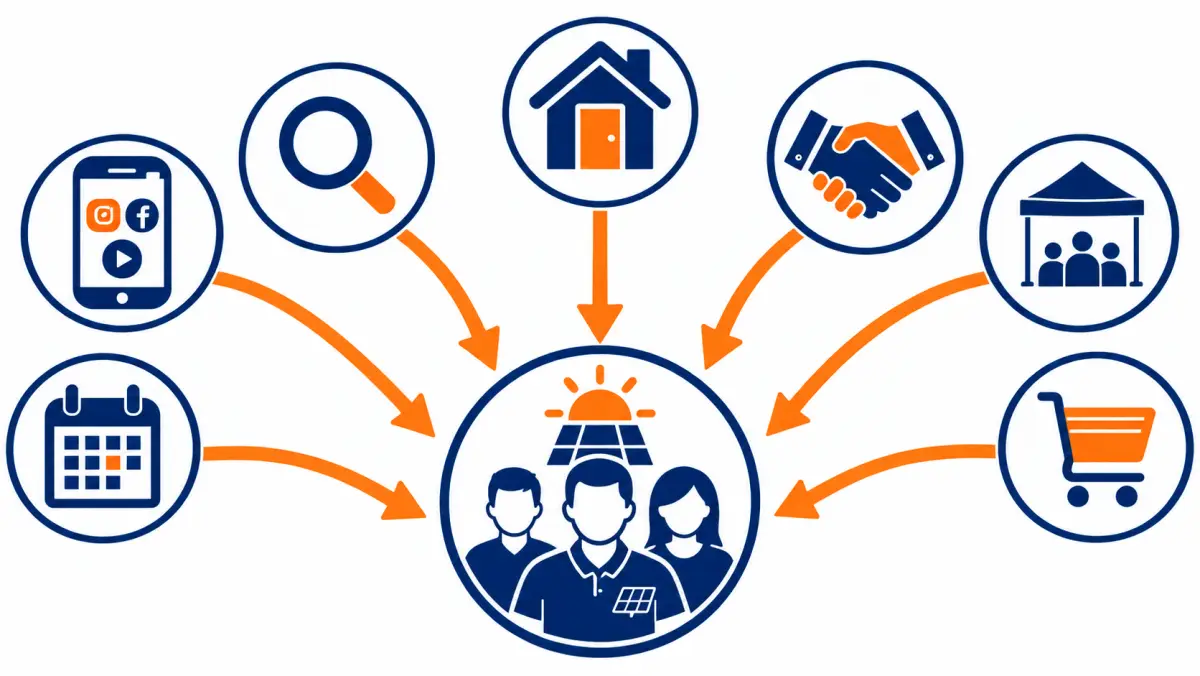
The four comparison criteria
We use the same four criteria for every channel in this guide.
- Cost per sale drivers. Not a price, but the levers that move cost per closed job up or down: the unit cost, the contact rate, the appointment and sit rates, the close rate, and the hidden costs (staff time, software, management, travel, cancellations).
- Speed. Two kinds: how long before the channel produces its first sale (time to first revenue), and how quickly a lead goes cold once it arrives (decay speed).
- Consent and compliance. What permission you need to contact the person, who captured it, how you would prove it, and which rules apply to the channel (federal telemarketing rules, state mini-TCPA laws, local soliciting permits, door-to-door sales rules, ad platform policies). This guide explains the issues; it is not legal advice, so confirm with counsel.
- Scalability. How much more volume the channel can produce if you double the budget, and what breaks first: ad costs, recruiting, the size of your customer base, the event calendar, or the seller's supply in your ZIP codes.
Why cost per lead misleads
Every channel reports a cost per lead, and almost every channel defines "lead" differently. A Facebook lead form, a Google Ads call, a door knock that ended in a scheduled visit, a neighbor's phone number passed on by a customer and a booked appointment are five different things. Comparing their unit prices is like comparing the price of flour with the price of bread.
Cost per sale fixes this by pushing every channel to the same finish line. The formula is simple:
Cost per sale = total channel cost ÷ closed sales from that channel
"Total channel cost" means all of it: media spend or lead purchases, plus the wages and commissions of setters who work that channel, plus software, agency fees, event booth fees, travel and the time your managers spend running it. We walk through the full model, with a spreadsheet layout, in our solar lead ROI guide, and you can plug your own numbers into the solar lead cost calculator.
Best solar lead sources at a glance
The best solar lead sources for a typical residential installer are referrals for cost per sale, purchased appointments and live transfers for speed, Google Ads for high-intent volume you own, and Facebook for cheap volume when your setters are fast. Door-knocking and events fit companies willing to recruit and manage field staff. The table below summarises the trade-offs.
| Channel | Main cost per sale driver | Time to first sale | Lead decay speed | Who captures consent | Scalability |
|---|---|---|---|---|---|
| Paid social (Facebook, Instagram) | Contact and sit rates on low-intent leads | Weeks (creative and form testing) | Very fast | You (your form, your disclosure) | High, limited by creative fatigue and audience size |
| Paid search (Google Ads) | Click price and landing page conversion | Weeks to a few months | Fast | You | Medium, capped by local search volume |
| Door-to-door canvassing | Rep productivity and turnover | Weeks once reps are trained | Medium (face-to-face interest fades within days) | Your rep, in person; follow-up calls need their own consent | Medium, limited by recruiting and management |
| Referrals (customers, partners) | Size of customer base and how often you ask | Months (needs installed customers) | Slow (trust carries over) | The referred person, ideally directly to you | Low to medium, grows with installs |
| Events and home shows | Booth cost and follow-up discipline | Weeks to months (event calendar) | Fast after the event | You, at the booth, on a sign-up form | Low, limited by the calendar |
| Purchased leads (exclusive, shared, aged) | Unit price times contact rate | Days | Very fast for fresh leads | The seller; you must be able to get the record | High, limited by seller supply in your ZIPs |
| Appointments and live transfers | Unit price and the sit definition | Days | Set for you; no-show risk instead | The seller | Medium to high, limited by seller supply |
Qualitative ratings are our editorial judgement for a typical US residential installer, not measured benchmarks. Your results will depend on territory, offer and team.
Published cost ranges, with dates
Most channels have no reliable public price for solar specifically. Where a dated public source exists, it is listed below. Treat every figure as context for your own test, not a forecast.
| Channel | Figure reported | Source | Date of source or data | Notes |
|---|---|---|---|---|
| Exclusive purchased solar lead | $100 to $250 | ActiveProspect | Published July 31, 2026 | Directional range attributed to Enervio |
| Shared purchased solar lead | $25 to $100 | ActiveProspect | Published July 31, 2026 | Vendor-reported range |
| Booked solar appointment | $150 to $500 | ActiveProspect | Published July 31, 2026 | Attributed to Enervio |
| Live transfer or inbound call | $100 to $300+ | ActiveProspect | Published July 31, 2026 | Attributed to The Leads Warehouse |
| Door-to-door set appointment (bought) | $200 to $400+ | ActiveProspect | Published July 31, 2026 | Attributed to The Leads Warehouse |
| Search ads, home services subcategories (not solar) | Median cost per lead from about $29 (pools and spas) to about $101 (roofing and gutters) | LocaliQ | Page updated Feb 23, 2026; data May 2020 to June 2021 | Old data and no solar category; use only as a floor for comparison |
As of October 2026. None of the ad-platform figures are specific to solar. Solar keywords and audiences often price differently from general home improvement.
Notice two things in that table. First, the ad-platform figures are for broad home-service categories, not solar. Second, an ad-platform "lead" is a form fill or call that you still have to contact, qualify and set, while a purchased appointment has had some of that work done. That is why the rest of this guide compares channels on cost per sale.
Quick decision guide
If you only have a minute, match your situation to the line below, then read the channel section that follows it.
| If this describes you | Start with | Then add |
|---|---|---|
| Owner sells and installs; nobody calls leads fast | Referrals and booked appointments | Live transfers during set hours |
| One or two fast setters with spare time | Exclusive purchased leads or paid social | Paid search once someone can manage it |
| Closers have open calendars, setters are full | Booked appointments | Live transfers |
| Entering a new territory with no brand | Purchased leads and appointments | Paid search, then referrals as installs complete |
| Dense suburbs, experienced field manager available | Door-to-door | Referrals from door-sourced customers |
| Large customer base, little marketing | A structured referral program | Paid search and organic local search |
| Long sales cycles, business buyers | Partner referrals and targeted outreach | Commercial purchased leads where available |
Two rules apply to every row. First, fix your time to first call before adding raw lead volume from any source. Second, run each new source through the same scorecard so the decision to keep or cut it rests on cost per net sale, not on how busy the channel feels.
How to compare lead sources on cost per sale
To compare solar lead sources fairly, convert each one to cost per closed sale by tracing a batch of leads through five stages: contact, appointment set, appointment sat, proposal, and close. Multiply the stage rates together to get a lead-to-sale rate, then divide the fully loaded cost per lead by that rate.
The five-stage funnel works for every channel, including the ones that do not feel like "leads." A door knock that ends in a scheduled visit enters at the appointment-set stage. A referral who calls you directly enters at contact with a very high contact rate. A purchased appointment enters at set and is judged on sit rate.
The funnel math in one formula
Lead-to-sale rate = contact rate × set rate × sit rate × close rate
Cost per sale = fully loaded cost per lead ÷ lead-to-sale rate
Illustrative example: a channel costs $60 per lead fully loaded. Your team contacts 60 percent of those leads, sets an appointment with 35 percent of contacts, 70 percent of appointments sit, and you close 25 percent of sits. The lead-to-sale rate is 0.60 × 0.35 × 0.70 × 0.25 = 0.0368, or about 3.7 percent. Cost per sale is $60 ÷ 0.0368 ≈ $1,630.
Now a second channel costs $300 per booked appointment, 75 percent sit, and you close 25 percent of sits. The appointment-to-sale rate is 0.75 × 0.25 = 0.1875. Cost per sale is $300 ÷ 0.1875 = $1,600. The two channels land in the same place despite a fivefold difference in unit price. These are illustrative numbers, not benchmarks; your own stage rates decide the answer.
What "fully loaded" means for each channel
| Channel | Costs people forget to include |
|---|---|
| Paid social | Creative production, ad management time or agency fee, setter wages, SMS and dialer software, the cost of leads with bad numbers |
| Paid search | Agency or in-house management, landing page tools, call tracking, wasted clicks from loose match types, negative keyword upkeep |
| Door-to-door | Recruiting, training time, rep turnover, manager overrides, travel, permits, tablets and canvassing software |
| Referrals | Referral rewards, the admin time to track and pay them, the time to ask, customer events |
| Events | Booth fees, display materials, staff hours on weekends, travel, giveaways, the follow-up calling time |
| Purchased leads | Setter wages and dialing time, leads you cannot get credited, CRM and dialer seats |
| Appointments and live transfers | Closer travel to appointments that do not sit, disputed sits, setter time spent confirming |
The cost of your own people is the line most often left out, and it is the line that most often flips a decision. A channel that looks cheap on media spend can be the most expensive per sale once setter hours are counted.
Track by source from day one
You cannot compare channels you do not tag. Every record in your CRM should carry a source field (channel), a sub-source field (campaign, vendor, event name, canvassing team), and timestamps for each funnel stage. Put the tag on the lead when it enters, not when it closes, or you will lose the dead leads that tell you the true cost. Our speed to lead guide covers how to timestamp the first-response stage, which is where most channels win or lose.
Paid social: Facebook solar leads
Facebook solar leads are form fills or messages from people who saw a solar ad in their Facebook or Instagram feed. They are usually the cheapest leads per unit you can generate yourself, and the lowest in intent, because the person was scrolling rather than searching. Cost per sale depends almost entirely on how fast and how often your team follows up.
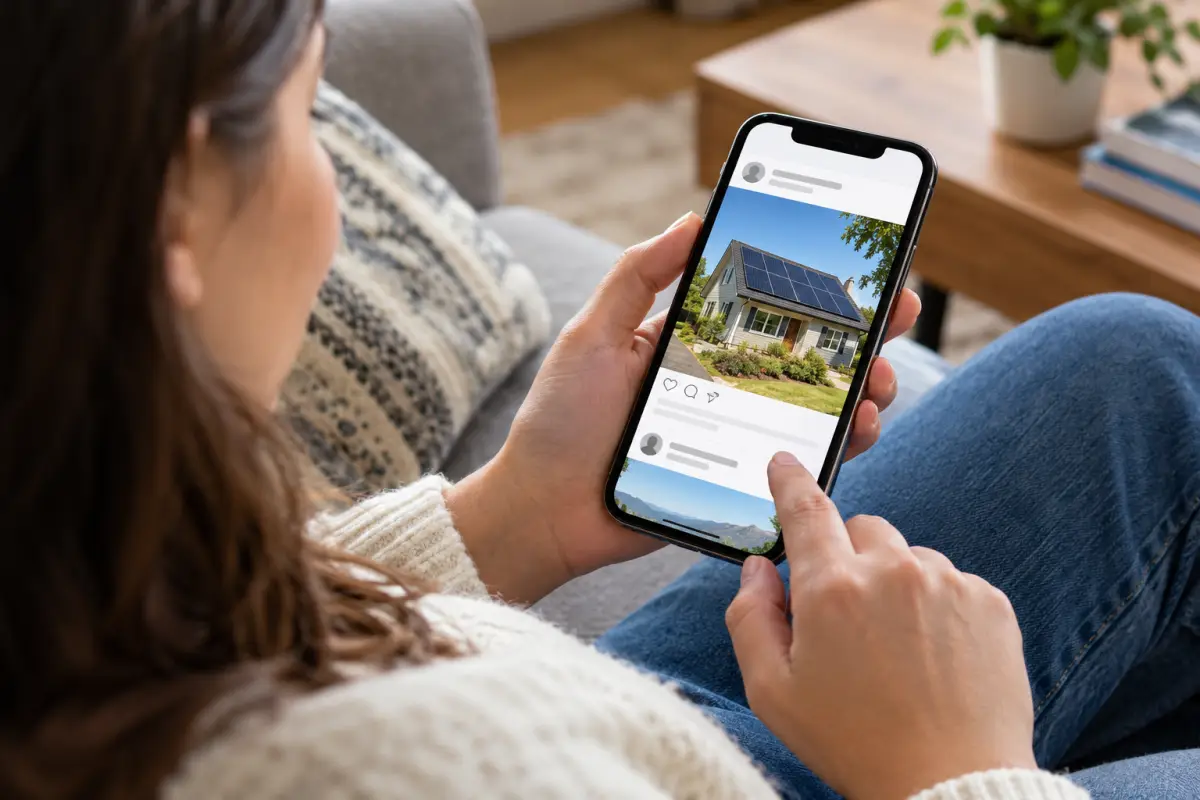
Paid social interrupts people. Someone opens Instagram to look at photos of a friend's dog, sees an ad about lowering their electric bill, taps it, and fills in a pre-populated form in a few seconds. That low friction is the channel's strength and its weakness. You get volume, and much of it comes from people who were mildly curious for about eight seconds.
Cost per sale drivers for Facebook solar leads
- Form type. Instant forms inside Facebook are faster to complete and cheaper per lead, but they produce more low-intent and mistyped submissions. A form on your own landing page adds friction, which lowers volume and usually raises lead quality. Many installers test both.
- Qualifying questions. Every question you add lowers volume and raises quality. Homeowner status, roof shade, average electric bill and zip code are the usual filters. Higher-intent forms ask for the bill amount as a range, which is easy to answer and screens out renters and tiny bills.
- Contact rate. Social leads go cold quickly because the interest was shallow. Teams that call within minutes and follow up across several days typically see far better contact rates than teams that call once the next morning. Measure yours.
- Creative fatigue. Audiences in a single metro area are finite. The same ad shown to the same people for weeks gets more expensive per lead. Plan to refresh creative regularly.
- Setter capacity. The unit cost of a Facebook lead is only part of the cost. If one setter spends several hours dialing a batch of social leads to set two appointments, those hours belong in the cost per sale.
Speed of the Facebook channel
Time to first sale is usually a few weeks: a week or two to launch and get past the platform's learning phase, then the time it takes your normal sales cycle to close the first deals. Decay speed is very fast. A social lead that is not reached within the first hour or so often never answers. That makes Facebook solar leads a poor fit for a company where the owner calls back after dinner.
Consent and compliance on paid social
When you run your own ads, you own the consent. That means your form needs a clear disclosure, placed next to the submit button, that names your company and says how you will contact the person (calls, texts, and whether automated technology is used). Federal rules on automated calls and texts come from the Telephone Consumer Protection Act, enforced by the FCC, and several states have their own stricter laws. Keep a record of each submission with the timestamp, the disclosure text shown and the page or form version. Our TCPA compliance guide for solar leads explains what that record should contain. Confirm your disclosure language with counsel.
Ad platform policy matters too. If your ads promote financing, loans or payment plans, Meta may treat them as a special ad category with restricted targeting. Check Meta's current advertising standards before launching a financing-led campaign, because the rules have changed more than once.
How far Facebook solar leads scale
Facebook scales well on volume. Doubling the budget will usually produce more leads, though rarely twice as many at the same cost, because the platform has to reach further into less-responsive audiences. The thing that breaks first is usually your setting team, not the ad account. If you double social lead volume without adding setters, contact rate falls and cost per sale rises.
When Facebook solar leads are the right source
- You have at least one dedicated setter who can call new leads within minutes during business hours.
- You have an SMS and email nurture sequence that runs for weeks, not days.
- You are in a market with enough homeowners that a metro-level audience will not fatigue in a month.
- You can make simple video and image creative, or pay someone who can.
When to avoid it
- Nobody can call leads quickly.
- You expect most leads to be ready to buy this week.
- You do not have the setup to keep consent records for each submission.
Illustrative example: a small team on Facebook
A four-person residential installer runs its own Facebook campaign with an instant form and three qualifying questions. These numbers are illustrative only. Over a month the company spends $4,000 on ads and receives 100 leads ($40 per lead in media). One setter, costing $4,500 a month fully loaded, spends about half her time on the batch, so $2,250 of setter cost belongs to this channel. Total channel cost is $6,250.
The setter contacts 50 leads, sets 15 appointments, 10 sit, and the closer signs 2. Cost per sale is $6,250 ÷ 2 = $3,125. If the same team improved contact rate to 65 percent through faster first calls and a text sequence, and everything else held, they would contact 65, set about 20, sit 13 or 14, and close about 3. Cost per sale would drop to roughly $2,080 without spending a dollar more on ads. On this channel, the follow-up process moves cost per sale more than the ad budget does.
Paid search: Google Ads solar leads
Google Ads solar leads come from people who typed a solar-related search, such as "solar installers near me" or "cost of solar panels for my house," and clicked your ad. Intent is higher than on social because the person was looking, and the click price is higher to match. Cost per sale depends on tight geography, careful keywords and a landing page that converts.

Search captures demand instead of creating it. That is the key difference from social. The homeowner has already decided solar is worth looking into. Your job is to show up, look credible and make it easy to ask for a quote. The volume is limited by how many people in your service area search each month, which is why search alone rarely fills a large installer's calendar.
Cost per sale drivers for Google Ads solar leads
- Keyword intent. "Solar installer near me" and "solar company [city]" are commercial. "How do solar panels work" and "free solar panels" are not. Broad match without tight negative keywords pulls in research traffic and people looking for free programs.
- Geography. Target the ZIP codes you actually serve. A radius around your office often includes areas with poor solar economics, renters or utilities with unfavorable net metering.
- Landing page conversion. A dedicated page with a short form, a phone number, local proof (installs in the area, license numbers, reviews) and a clear next step converts far better than a home page.
- Call handling. A large share of search leads arrive as phone calls. Missed calls during business hours are leads you paid for and lost. Track calls and listen to recordings.
- Competition. National lead generators and large installers bid on the same terms. In competitive metros, click prices can be high enough that only well-run accounts break even.
Speed of the search channel
Time to first sale is usually a few weeks to a few months. Search campaigns can produce clicks on day one, but it takes a while to find the right keywords, prune waste and get conversion tracking right. Decay is fast but not as fast as social. A homeowner who searched and filled in a form is usually comparing two or three companies at once, so the first credible callback has the advantage.
Consent and compliance on paid search
The consent rules are the same as for social: your form, your disclosure, your records. Calls that the homeowner places to you are inbound and do not need prior consent for the call itself, though any later automated texts or calls you make do. If you use call tracking that records calls, check your state's call recording consent rules; some states require all parties to agree. Confirm with counsel.
Google also has advertiser verification and policies on financial services claims. If your ads mention "no cost" or "free" solar, be careful. The FTC has warned consumers about misleading solar sales claims, including promises about tax credits and "free" panels (FTC consumer guidance on solar). After the 25D homeowner credit ended for systems placed in service after 2025, any ad copy that still leans on that credit is out of date and may mislead. Our solar leads after 25D guide covers how the pitch has changed.
How far Google Ads solar leads scale
Search scales until you run out of searches. In a metro area, there are only so many people looking for a solar installer in a given month. Once you are showing for most relevant searches, more budget mainly pays for higher positions or broader terms with lower intent. Many installers find search becomes a steady, mid-sized channel rather than a growth engine. Combining search with Local Services Ads, where available in your category and area, and with organic local search can add volume.
When Google Ads solar leads are the right source
- You serve a defined area with enough search volume to matter.
- You or a contractor can manage the account weekly: search terms, negatives, bids, ad copy.
- You have a fast landing page and someone answering the phone during business hours.
- You want leads you own outright, with consent you control.
When to avoid it
- Your territory is rural with little search volume.
- Nobody will look at the search terms report.
- You expect search to deliver dozens of jobs a month on its own in a small market.
Illustrative example: a mid-size installer on Google Ads
A twelve-person installer spends $10,000 a month on search plus a $1,500 management fee. These numbers are illustrative only. The account produces 80 leads (forms and qualified calls), or about $144 per lead including management. Setter time on the batch is about $1,500. Total channel cost is $13,000.
Because search leads are warmer, contact rate is 75 percent (60 contacts), set rate 45 percent (27 sets), sit rate 75 percent (20 sits) and close rate 30 percent (6 sales). Cost per sale is $13,000 ÷ 6 ≈ $2,170. Compare that with the Facebook example: a higher cost per lead, a similar cost per sale, and fewer setter hours per sale. Which is better depends on whether setter hours or ad dollars are scarcer for you.
Facebook solar leads vs Google Ads solar leads
| Factor | Facebook and Instagram | Google search |
|---|---|---|
| How interest starts | You interrupt the person in a feed | The person searches for solar |
| Typical intent | Low to medium | Medium to high |
| Cost per lead (media) | Usually lower | Usually higher |
| Contact rate | Usually lower | Usually higher |
| Volume ceiling | High, limited by audience fatigue | Capped by local search volume |
| Skills needed | Creative, testing, fast follow-up | Keywords, negatives, landing pages, call handling |
| Best for | Teams with fast setters and a long nurture | Teams that want warmer leads and can manage the account |
The two channels work well together. Search catches people who are ready now. Social builds a pool of people who are curious, and some of them later search for you by name. Many installers who run both see branded search grow after social campaigns launch, though you should check your own data before crediting one channel for the other.
Door to door solar leads
Door to door solar leads are conversations a canvasser starts at a homeowner's front door, usually ending in a scheduled appointment with a closer or, in some companies, a same-visit pitch. The channel gives you full control over the message and fast feedback, but cost per sale is driven by rep productivity, training and turnover, and local permit and cooling-off rules apply.

Door-knocking has been a core solar sales channel for years, especially for companies that sell in dense suburban neighborhoods with good roofs. It works because a face-to-face conversation builds trust faster than a phone call, and because a rep can see the roof, the shade and the meter before anyone books a visit. It also has a reputation problem. Aggressive canvassers and misleading door pitches have drawn complaints and local restrictions in many places, so the channel rewards companies that train hard and supervise closely.
Cost per sale drivers for door-to-door
- Doors per hour and conversations per door. A canvasser's day is a funnel of its own: doors knocked, doors answered, conversations, appointments set. Small changes at each step compound.
- Territory selection. Neighborhoods with owner-occupied homes, unshaded south- or west-facing roofs and high electric bills produce more appointments per hour. Many companies use roof and property data to pick streets before sending reps out.
- Pay structure. Canvassers are often paid per appointment that sits, per sale, or a base plus bonus. The structure changes both cost and behavior. Paying only on set appointments, with no sit requirement, tends to produce soft appointments.
- Turnover. Recruiting and training a canvasser takes time and money. If most new reps quit in their first month, that training cost lands on the few who stay. Turnover is often the single largest hidden cost in a door-to-door program.
- Management. Field managers, ride-alongs, route planning and nightly reporting are real costs. A door team without daily management usually drifts toward low productivity quickly.
- Appointment quality. Door-set appointments are often booked for the same evening or the next day, which helps sit rates. But a homeowner who agreed to a visit to get a canvasser off the porch may not be home when the closer arrives.
Speed of the door-to-door channel
Time to first sale can be short once you have trained reps in the field, sometimes within the first couple of weeks. Building the team is the slow part. Decay speed is medium. Interest sparked at the door fades within days, so the best programs book the closer visit within 24 to 48 hours and confirm it by text or call.
Consent and compliance for door-to-door
Door-to-door carries its own set of rules, distinct from telemarketing.
- Local soliciting permits. Many cities and counties require door-to-door sellers to register, carry a permit or badge, and knock only during set hours. Some neighborhoods and HOAs post no-soliciting signs, and some local rules make those signs enforceable. Check every municipality you work in.
- Cooling-off period. The FTC's Cooling-Off Rule gives buyers three days to cancel many sales made at their home, and requires the seller to give notice of that right. Several states add their own, sometimes longer, cancellation rights for home solicitation sales or for solar contracts specifically. Your contracts and closers need to follow both.
- Follow-up calls and texts. A homeowner who chats with a canvasser has not automatically agreed to receive automated calls or texts. If your follow-up uses automated dialing or texting, capture written consent with a clear disclosure, for example on the rep's tablet, and keep the record. Confirm the requirements with counsel.
- State solar consumer protection laws. Several states have passed rules on solar sales practices, disclosures and contract terms, often prompted by door-to-door complaints. These change often; check your state's consumer protection office and utility commission before launching.
How far door-to-door scales
Door-to-door scales with people, not money. To double output you need to roughly double the number of productive reps and the managers who support them. Recruiting is the bottleneck for most companies. The channel also has a geographic ceiling: once your reps have knocked the good streets in a territory, returns fall until enough time has passed to knock them again.
When door to door solar leads are the right source
- You sell in dense neighborhoods with suitable roofs.
- You have, or can hire, a field manager who has run a canvassing team before.
- You can recruit steadily and accept that many recruits will not last.
- Your closers can run same-day or next-day appointments.
When to avoid it
- Your territory is spread out or rural.
- You cannot supervise reps daily.
- Your markets have strict soliciting rules you cannot comply with efficiently.
Illustrative example: a door team of six
These numbers are illustrative only. A company runs six canvassers and one field manager. Over a month, total cost is $36,000 (wages, bonuses, manager pay, tablets and software, recruiting ads, permits and travel). The team sets 120 appointments. 60 percent sit (72 sits) and closers sign 22 percent (about 16 sales). Cost per sale is $36,000 ÷ 16 = $2,250.
Now suppose two of the six reps quit mid-month and their replacements take three weeks to become productive. Appointments fall to 95, sits to 57, sales to about 12 or 13, while cost barely moves because recruiting and training costs rise. Cost per sale climbs to about $2,880. That swing, driven by turnover rather than the market, is why door programs live or die on retention.
Buying door-set appointments instead
Some companies buy appointments set by a third-party canvassing team rather than building their own. ActiveProspect reported door-to-door appointments at $200 to $400 or more, attributed to The Leads Warehouse (ActiveProspect, July 31, 2026). That moves recruiting and training to the seller, but it also moves control of the pitch. Ask how the appointment was set, how long after the knock the visit is scheduled, whether both decision makers agreed to attend, and what the seller's canvassers said about price and savings. A canvasser who over-promised savings can turn your closer's visit into an argument. Our solar appointments guide covers sit definitions and replacement terms in depth.
Solar referral leads
Solar referral leads are introductions to potential buyers from your existing customers, employees or business partners such as roofers, electricians and real estate agents. They usually have the highest close rate and lowest cost per sale of any source, because trust transfers from the referrer. The limit is volume: referrals grow with your customer base and cannot be switched on at will.

A neighbor who has had solar on their roof for a year, and who can show their utility bill, is more persuasive than any ad. That is why referrals tend to close well. They also arrive with fewer objections about the company's legitimacy, because someone the prospect knows has already vetted you. The weakness is that most installers treat referrals as something that happens to them rather than something they run.
Cost per sale drivers for solar referral leads
- How often you ask. The single largest driver. Companies that ask at specific moments (after the install, at permission to operate, after the first lower bill, at an annual check-in) get more referrals than companies that hope.
- Customer experience. Referrals reflect how the install went. Missed dates, messy jobs and slow permission to operate kill referrals. A clean install, a clear handoff and a quick answer when the monitoring app shows a fault build them.
- Reward structure. Many installers pay a referral reward when a referred customer installs. Size and timing matter less than people think; the ask and the experience matter more. Check your state's rules on referral payments and any licensing implications, and confirm with counsel.
- Partner referrals. Roofers, electricians, HVAC contractors, real estate agents and mortgage professionals meet homeowners at decision points. A partner program needs a simple handoff process, quick feedback to the partner, and a fair split. It also needs clear rules about who contacts the homeowner and how.
- Tracking and payout admin. If referrals are tracked on sticky notes, rewards get paid late or not at all, and customers stop referring.
Speed of the referral channel
Time to first sale is slow if you are new: you need installed, happy customers before anyone refers. For an established installer, a referral program can produce results within a month of launching, because the customer base already exists. Decay speed is slow. A referred prospect's trust lasts longer than the interest of a social ad clicker, though a prompt call still matters.
Consent and compliance for referrals
Referrals are not automatically consented leads. A customer giving you their neighbor's phone number does not mean the neighbor has agreed to receive marketing calls or texts from you. The safest approach is to have the referred person contact you, or to have the referrer introduce you with the prospect's agreement and then capture the prospect's own consent before any automated follow-up. Manual, one-off calls to a referred person carry different rules from automated campaigns, and state laws vary. Confirm your process with counsel.
Referral rewards can raise their own questions, such as tax reporting for larger payments and state rules on paying unlicensed people for sales referrals. Get advice before launching a large partner program.
How far referrals scale
Referrals scale with your installed base and with how well you run the program. An installer with a few hundred happy customers and a good ask can get a steady flow each month. An installer with a few dozen customers cannot rely on referrals to grow. That is the main reason referrals are best seen as the base of a mix: they lower your blended cost per sale, while other channels supply growth.
How to run a referral program that produces
- Pick the ask moments. Install day, permission to operate, first bill, six months, one year. Put each in your CRM as a task.
- Script the ask. Short and specific. "Who on your street has asked you about the panels?" works better than "Do you know anyone?"
- Make it easy. A text the customer can forward, a short referral link with a form that captures the prospect's own consent, or a printed card with a code.
- Close the loop. Tell the referrer when you contacted their friend and when the reward is on its way. People refer again when they see it worked.
- Track by referrer. Some customers refer five people. Treat them as partners: invite them to events, thank them in person.
- Report referral cost per sale monthly. Include rewards, admin time and any events. It is usually your benchmark for every other channel.
Referral ask script (sample)
"Now that you've seen your first bill, I'd love to ask a favor. Have any neighbors or friends asked you about the panels? If you send them this link, they can request a quote and we'll take care of them the same way. And if they go ahead, we'll send you [reward] as a thank-you."
Adjust the reward line to whatever your program offers and your counsel approves.
Illustrative example: a referral program at a mid-size installer
These numbers are illustrative only. An installer with 400 past customers runs a structured referral program. In a month it receives 25 referrals. Contact rate is 90 percent (22 or 23 contacts), set rate 60 percent (about 14 sets), sit rate 85 percent (12 sits) and close rate 40 percent (about 5 sales). Costs are $1,000 rewards paid per sale ($5,000), plus $1,000 of admin and setter time. Cost per sale is $6,000 ÷ 5 = $1,200.
That is lower than any of the paid examples above, which is typical of referrals. But 5 sales a month will not keep a twelve-person installer busy. The referral program lowers blended cost per sale; it does not replace other sources.
Events and home shows
Events and home shows put your team in front of homeowners at home and garden shows, county fairs, farmers markets, big-box store tables and community events. They produce face-to-face conversations and sign-ups at a predictable cost, but volume depends on the event calendar, and cost per sale depends almost entirely on how quickly and persistently you follow up after the event.

Events feel productive. The booth is busy, people take brochures, the sign-up sheet fills. The test comes the following week, when your setters start calling. Many event leads were collected from people who stopped for a free tote bag, so the post-event process decides the outcome.
Cost per sale drivers for events
- Event fit. A home and garden show draws homeowners in a buying mood. A street festival draws everyone. Pick events where attendees own homes in your service area.
- Booth cost and staffing. Booth fees, display materials, travel and weekend staff hours all count. A multi-day show can cost more in staff time than in booth fees.
- Qualification at the booth. A short tablet form with homeowner status, ZIP and a rough bill amount filters out a lot of waste. Capturing the prospect's own consent for follow-up on the same form solves a compliance problem at the source.
- Same-week follow-up. Event leads decay quickly once people return to normal life. Call within a day or two, while the conversation is fresh.
- Booking at the event. The strongest event programs book appointments on the spot rather than collecting names, so the event acts like a door knock with the homeowner coming to you.
Speed of the events channel
Time to first sale depends on the calendar. If the next good show is in two months, that is your time to first lead. Seasonal patterns matter too: home shows cluster in spring and fall in many markets. Decay is fast after the event.
Consent and compliance for events
The good news is that you control the sign-up form. Use a clear disclosure next to the signature or submit button that names your company and the contact methods. Paper sign-up sheets make consent hard to prove, so a tablet form that stores a timestamp and the disclosure shown is better. Giveaway entries are a common trap: a person entering a raffle has not necessarily agreed to sales calls unless the form says so clearly. Confirm with counsel.
How far events scale
Events scale poorly. There are only so many good shows in a region per year, and each needs staff on weekends. Most installers treat events as a supplement that also builds brand recognition in a new territory, rather than a core lead source.
Illustrative example: one weekend home show
These numbers are illustrative only. A company pays $3,000 for a booth at a two-day spring home show, plus $2,000 for staff, materials and travel. The team captures 80 sign-ups and books 10 appointments on the spot. After the show, setters reach 40 of the remaining 70 sign-ups and set 8 more. Of the 18 appointments, 13 sit, and closers sign 4. Total cost, including $500 of post-show setter time, is $5,500. Cost per sale is $5,500 ÷ 4 = $1,375.
The same show, with no on-the-spot booking and follow-up calls starting a week later, might produce half the appointments and two sales, doubling cost per sale. As with Facebook, the process after the lead arrives drives the result more than the channel itself.
Purchased solar leads
Purchased solar leads are homeowner or business records bought from a lead generator, priced per lead and sold as exclusive (one buyer), shared (several buyers) or aged (older records resold at a discount). They are the fastest way to add volume without building a channel, and cost per sale depends on unit price, how fast you call, and whether the seller's consent records and replacement terms hold up.

When you buy leads, you are paying someone else to run the paid social, search or other traffic and to capture the form. You skip the build: no ad accounts, no landing pages, no creative testing. In exchange, you accept a unit price that includes the seller's margin, and you depend on the seller's choices about traffic sources, qualifying questions, consent language and how many other companies receive the same record.
The three types of purchased leads
| Type | What it is | Main cost per sale driver | Speed requirement |
|---|---|---|---|
| Exclusive lead | Sold to one company only | Unit price and your contact rate | High: call within minutes |
| Shared lead | Sold to several companies at once | Who calls first | Very high: you are racing other buyers |
| Aged lead | An older record resold after its first sale window | Dialing hours per contact | Low urgency, but heavy dialing |
We compare exclusive and shared leads with sensitivity tables in exclusive vs shared solar leads, and cover the aged category, including when it works, on our aged solar leads page. Availability of aged leads for your territory is confirmed on the call.
Cost per sale drivers for purchased leads
- Unit price. Published ranges from ActiveProspect (July 31, 2026) put exclusive solar leads around $100 to $250 and shared leads around $25 to $100 (ActiveProspect). Prices vary a lot by state, ZIP code and filters. Our solar lead cost guide keeps a dated, sourced table, and solar lead cost by state breaks prices down by market.
- Contact rate. Purchased leads, like your own ad leads, decay quickly. The company that calls first usually gets the conversation. This matters most for shared leads.
- Filters. Homeowner only, minimum bill, roof type, credit or financing questions, ZIP codes. Tighter filters raise unit price and usually raise conversion. Test them.
- Replacement terms. A written definition of an invalid lead (wrong number, disconnected, outside filters, duplicate) and a replacement window determine how much bad data you end up paying for.
- Source transparency. Leads from a seller's own campaigns behave differently from leads bought from a chain of affiliates. Ask where the traffic comes from.
Speed of purchased leads
Purchased leads have the shortest time to first sale of any channel in this guide except appointments. You can sign up with a vendor, set filters and start receiving leads within days. That makes them useful for entering a new territory, filling a seasonal gap or testing a market before committing to an owned channel. Decay is very fast for fresh leads, so the speed advantage only holds if your team calls quickly.
Consent and compliance for purchased leads
When you buy leads, the seller captured the consent, but you make the calls. That means you need to be able to produce a consent record for every lead you contact: a timestamp, the disclosure text the homeowner saw, the page where it appeared, and evidence that the disclosure named your company or covered it clearly. The FCC rule that would have required one-to-one consent (one seller per consent) was vacated by the Eleventh Circuit on January 24, 2025, but many buyers and sellers still treat named-seller consent as the safer practice, and state laws vary. Our TCPA compliance guide explains the record and the questions to ask. Confirm with counsel.
For our own product, the relevant terms are these. Each exclusive lead is sold to one company. It is never resold, recycled or sold later as an aged lead. Every lead carries a timestamped consent record (certificate) whose disclosure names your company. We send it to you on request. Before delivery, each lead goes through these checks: phone number validated before delivery; homeowner status self-reported, then checked against property records; duplicate-checked against leads already sent to you; and scrubbed against the National Do Not Call Registry.
How far purchased leads scale
Purchased leads scale as far as the seller's supply in your ZIP codes. In large solar markets, supply is usually deep. In smaller markets or tightly filtered territories, a single vendor may not deliver the volume you want, and adding vendors adds management work and the risk of overlapping leads. Scaling also stresses your setting team in the same way as Facebook: more leads without more setters means slower first calls and a lower contact rate.
How to vet a purchased lead source
The key questions are short:
- Where does the traffic come from, and does the seller run it or buy it?
- Is the lead exclusive, and what stops it being resold later?
- Can I see a sample consent record, and does the disclosure name my company?
- What counts as an invalid lead, how do I report it, and how long do I have?
- What checks happen before delivery?
- How is the lead delivered (CRM, dialer, email, SMS), and how fast?
- Can I start with a test batch, with no long-term contract?
Our full checklist, with red flags and scoring, is in how to vet solar lead providers. On our side, there are no long-term contracts: start with a test batch, scale when the numbers work. Delivery is real-time to your CRM, dialer, email, or SMS. Replacement credits cover disconnected numbers, wrong contact details, or leads outside your filters, within a 7-day window. Not covered: a prospect who isn't interested, doesn't answer, doesn't get financing approved, or doesn't buy. To request a credit, reply to the lead notification (or email us) with the reason; approved credits apply to your next batch.
Illustrative example: exclusive leads for a new territory
These numbers are illustrative only. An installer expanding into a neighboring county buys 50 exclusive leads at an assumed $150 each ($7,500). Setter time on the batch is $1,500. Total cost is $9,000. The team contacts 65 percent (about 32), sets 40 percent of contacts (13), 75 percent sit (about 10), and closers sign 25 percent (about 2 or 3). Call it 2.5 sales on average across months. Cost per sale is $9,000 ÷ 2.5 = $3,600.
That is higher than the referral and event examples, and it is typical of a first batch in a new market. The value here is speed and information: within a month, the installer knows how the county converts, which ZIPs perform, and whether to invest in owned channels there. If the second and third batches improve contact rate through faster calling, cost per sale falls toward the levels of the owned channels. If they do not, the installer has learned that cheaply compared with building a canvassing team in the county.
Solar appointments and live transfers
Booked solar appointments are meetings on your calendar with a homeowner who agreed to a consultation, set by a third party. Live transfers are screened homeowners connected to your closer by phone in real time. Both move the contacting and setting work to the seller, so the main cost per sale drivers become unit price and the definitions of a sat appointment or billable call.

Appointments and live transfers suit companies whose bottleneck is setting, not closing. If you have closers with free calendar space and nobody to call raw leads quickly, paying more per unit to skip the setting stage can lower cost per sale. If you have a strong setting team, raw leads may be cheaper per sale because your team does the setting at a lower internal cost.
Cost per sale drivers for appointments and transfers
- Unit price. ActiveProspect (July 31, 2026) reported booked solar appointments at roughly $150 to $500 (attributed to Enervio) and live transfers or inbound calls at $100 to $300 or more (attributed to The Leads Warehouse) (ActiveProspect).
- Sit definition. What counts as a sat appointment: both decision makers present, a minimum length, a homeowner who matches your filters. A loose definition raises your real cost per sit. One vendor's analysis argues that the sit definition clause is a main reason the advertised price per appointment differs from the real cost per sit (Elevarus, 2026). That is a vendor's view, not an independent benchmark, but the point is easy to check in your own contracts.
- Billable call definition. For live transfers, most sellers charge once a call passes a set length. Your real cost is the price divided by the share of billable calls that become real conversations.
- No-show and replacement terms. For our booked-appointment program, the policy reads: if a confirmed appointment doesn't sit because the prospect no-shows or doesn't match your filters, report it within 7 days of the scheduled time and we replace it.
- Closer readiness. A live transfer only works if a closer picks up immediately. Missed transfers are paid for and wasted.
Our pages on solar appointments and solar live transfer leads cover contracts, sit definitions and transfer handling in depth.
Speed of appointments and transfers
These are the fastest channels to first sale. Appointments can be on your calendar within days of starting, and transfers arrive on day one. Decay is replaced by a different risk: no-shows for appointments, and short or poorly screened calls for transfers.
Consent and compliance for appointments and transfers
The seller captured the consent and made the setting call, so the seller's own telemarketing practices matter to you. Ask how the seller contacted the homeowner, what consent record supports that contact, and whether its callers follow the FTC's Telemarketing Sales Rule and Do Not Call requirements. For live transfers, ask whether calls are recorded and whether recordings are available for disputes. Confirm with counsel.
How far appointments and transfers scale
Both scale as far as the seller's capacity in your territory. Appointments are limited by the seller's setters and lead supply. Live transfers are limited by your closers' availability as well, because every transfer needs someone to answer at that moment. Many installers use appointments to fill specific calendar gaps rather than as their only source.
Illustrative example: appointments for a closer-heavy team
These numbers are illustrative only. An installer has three closers with spare capacity and no setters. It buys 30 appointments at an assumed $300 each ($9,000). 70 percent sit (21), with replacements for no-shows reported in the window, and closers sign 25 percent (about 5). Closer travel and time on appointments that do not sit add $500. Cost per sale is $9,500 ÷ 5 = $1,900.
If the same installer bought raw leads instead, it would need to hire and train a setter first. Until then, its closers would be dialing leads in between appointments, and its contact rate would suffer. For this team, appointments win. For a team with two experienced setters, raw exclusive leads might win. The comparison only works with your own numbers.
Which solar lead sources are fastest
The fastest solar lead sources to first sale are live transfers and booked appointments, followed by fresh purchased leads, then paid search and paid social, then door-to-door once a team is trained. Referrals and events are slowest to start. Speed has two parts: time to first revenue, and how fast each lead goes cold after it arrives.
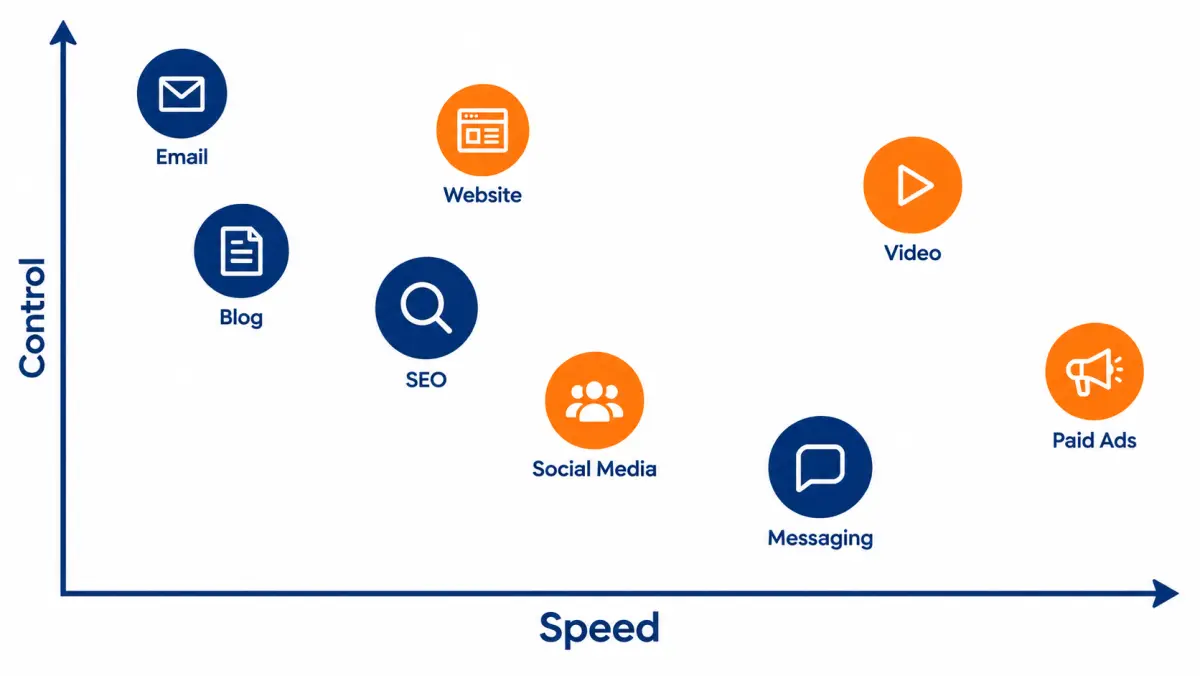
Speed matters for different reasons at different times. A new installer with crews and no pipeline needs revenue in weeks, not quarters. An established installer with a seasonal dip needs to fill the next six weeks of install slots. A company entering a new territory needs to learn how that market converts before committing a canvassing team or an ad budget. Each of those situations points to a different channel.
Time to first sale by channel
| Channel | Setup work before the first lead | Typical time to first lead | What slows it down |
|---|---|---|---|
| Live transfers | Agree terms, set call routing and hours | Days | Closer availability during transfer hours |
| Booked appointments | Agree terms, share calendar and filters | Days | Seller's setting capacity in your ZIPs |
| Purchased leads | Agree terms, set filters, connect CRM | Days | Your dialing speed once leads arrive |
| Paid search | Account, keywords, landing page, tracking | One to two weeks for leads; longer to tune | Learning which search terms convert |
| Paid social | Ad account, creative, forms, consent text | One to two weeks for leads; longer to tune | Platform learning phase, creative testing |
| Door-to-door | Recruit, train, permits, territory plan | Weeks | Recruiting and training reps |
| Events | Book booth, materials, staff | Depends on calendar | Next suitable event date |
| Referrals | Installed customer base, ask process | Months for a new company; weeks for an established one | Size of your customer base |
The time to first lead is not the time to first sale. Add your normal sales cycle, which for residential solar includes the consultation, proposal, financing approval and contract signing. Then add the time to install and get paid, which depends on permitting and interconnection in each jurisdiction.
Lead decay by channel
Decay is how fast a lead's chance of conversion falls with every hour you wait. It is fastest for leads where interest was brief and the homeowner is talking to other companies, and slowest for leads where trust was already present.
- Very fast decay: shared purchased leads, Facebook leads, fresh exclusive leads. Call within minutes. Our speed to lead guide covers the research and the operational setup.
- Fast decay: Google Ads leads, event sign-ups. Call the same day, ideally within the hour for forms.
- Medium decay: door-set appointments. Book the visit within a day or two and confirm.
- Slow decay: referrals. A prompt call still helps, but trust holds for days or weeks.
- Different risk: appointments and transfers, where the seller handles the first contact and your risk shifts to no-shows and screening quality.
Speed and team structure
Your team's structure decides which fast channels you can use. A company with a dedicated setter on the phones from 8 a.m. to 7 p.m. can take advantage of fresh purchased leads and paid social. A company where the owner is also the closer and the installer cannot. For that owner, appointments, transfers during set hours, and referrals fit better than raw leads. If you are unsure, track your current median time to first call for a week. If it is over an hour, fix that before buying more raw leads from any source.
Consent and compliance by lead source
Consent and compliance work differs by solar lead source mainly in who captures the permission to contact the homeowner. In owned channels you write the disclosure and keep the record. In bought channels the seller captures it and you must be able to produce it. Door-to-door and events add local soliciting and cooling-off rules. This is general information, not legal advice; confirm with counsel.
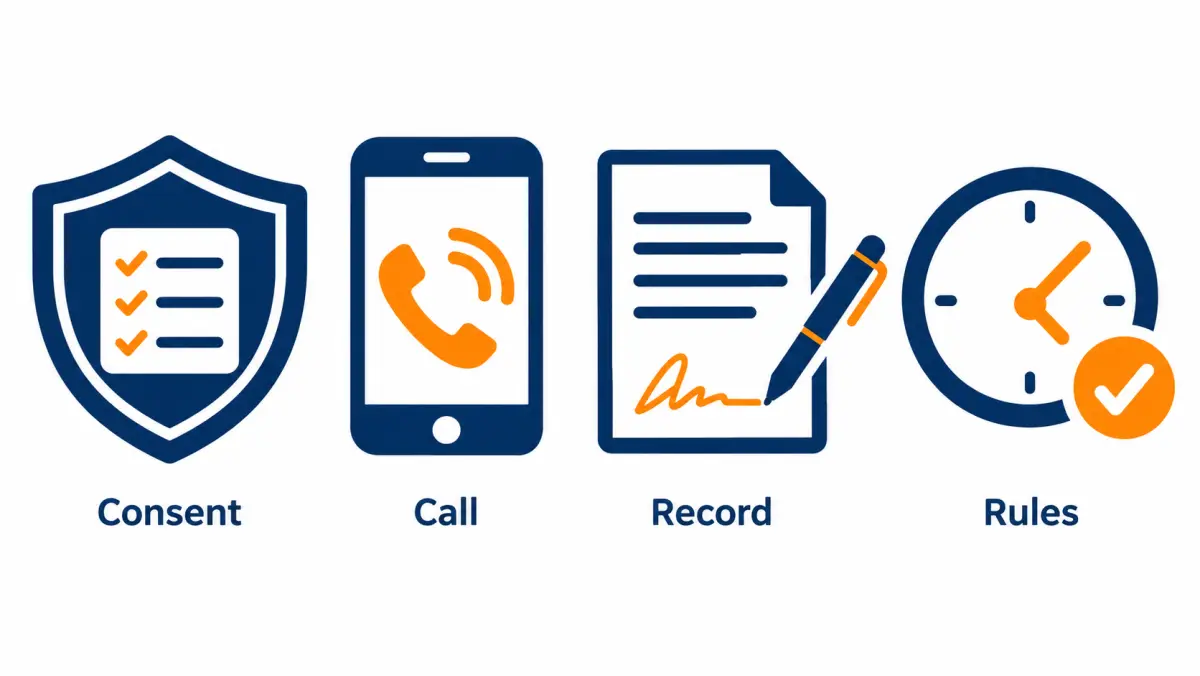
Compliance is not a side issue in solar marketing. Calling and texting rules under the Telephone Consumer Protection Act allow private lawsuits with statutory damages per call or text, and several states have added their own laws, some stricter than the federal rules. Solar has been a frequent target of these suits. The rules change, too: the FCC's one-to-one consent rule for lead generators was vacated by the Eleventh Circuit on January 24, 2025, and state laws continue to shift. Build your channel mix with the compliance load of each channel in mind.
Compliance load by channel
| Channel | Who captures consent | Records you should keep | Channel-specific rules to check |
|---|---|---|---|
| Paid social | You | Form submission with timestamp, disclosure text, form version, IP or device data where lawful | Ad platform policies, special ad categories for financing, state telemarketing laws |
| Paid search | You | As above, plus call recordings if you record | Call recording consent laws, ad policies on financial claims |
| Door-to-door | Your rep in person; written consent needed for automated follow-up | Signed or tablet-captured consent for calls and texts, permit records | Local permits and hours, no-soliciting rules, FTC Cooling-Off Rule, state home solicitation laws |
| Referrals | The referred person, ideally directly | The prospect's own form or written consent before automated contact | Rules on referral payments, state telemarketing laws |
| Events | You, at the booth | Tablet or form consent with timestamp and disclosure | Giveaway and sweepstakes rules if you run a raffle |
| Purchased leads | The seller | The seller's consent record for each lead, on request | Whether the disclosure names your company, state laws, DNC scrubbing |
| Appointments and transfers | The seller | Consent record, call recordings where available | Seller's telemarketing practices under the FTC Telemarketing Sales Rule |
Practices that apply to every channel
- Scrub against Do Not Call lists. The National Do Not Call Registry and your internal do-not-call list apply to telemarketing calls regardless of where the lead came from, subject to exceptions that require documentation. Keep your internal list current and honor opt-outs quickly.
- Honor opt-outs across channels. A homeowner who texts STOP should stop receiving texts and, under recent FCC rules, may have revoked consent for other automated contact too. Make sure opt-outs flow to every system you use.
- Respect calling hours. Federal rules and many state laws limit the hours you can call. Some states are stricter than federal rules.
- Keep records for years, not months. Lawsuits can arrive long after the call. Ask counsel how long to keep consent records and call logs.
- Write it down. A short internal policy that says how each channel captures, stores and produces consent makes audits and disputes much easier.
The FCC's consumer guidance on unwanted calls and texts and the FTC's Telemarketing Sales Rule guide are good starting points for your team. For the solar-specific details, see our TCPA compliance guide and our TCPA compliance page.
Which solar lead sources scale
Purchased leads, paid social and appointments scale furthest with money, because adding budget adds volume quickly. Paid search scales until local search volume runs out. Door-to-door scales with recruiting rather than budget. Referrals scale with your installed base, and events scale with the calendar. Every channel eventually stresses your own team, which is usually what breaks first.
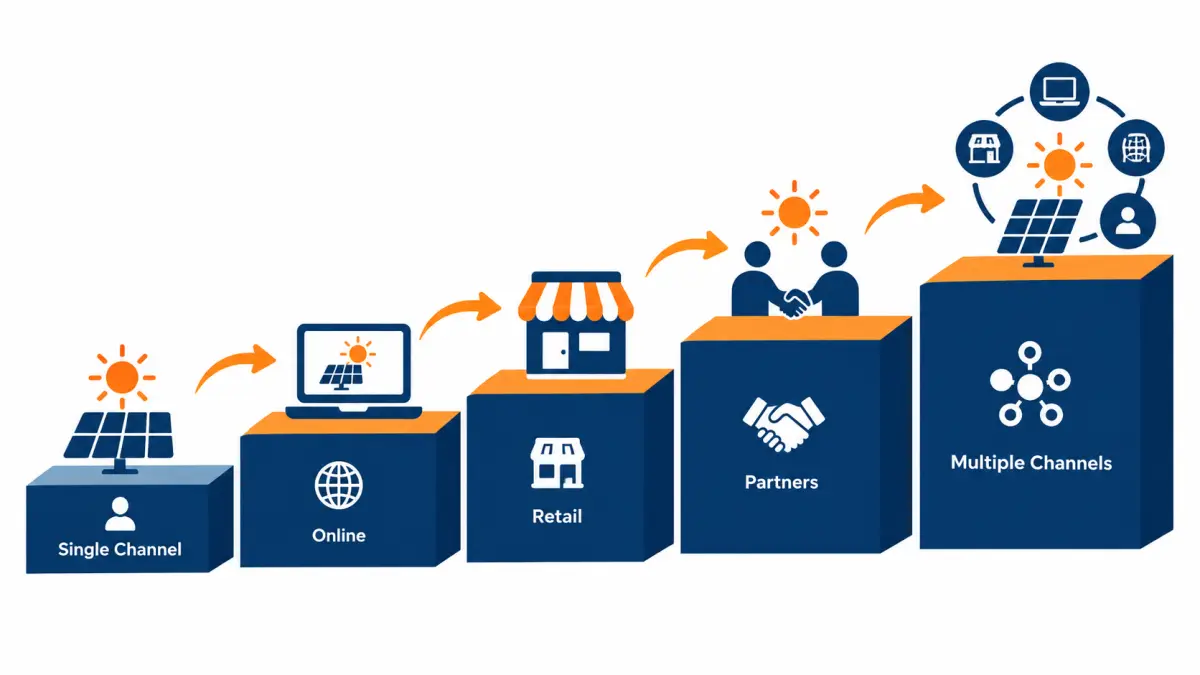
Scaling is where many installers get hurt. A channel that produced a good cost per sale at a small volume often produces a worse one at double the volume, for three reasons. The extra volume comes from less responsive audiences or less suitable ZIP codes. Your team's response time slips as volume rises. And management attention spreads thinner. Plan for cost per sale to rise as you scale any single channel, and measure the change rather than assuming it.
What breaks first in each channel
| Channel | What usually breaks first when you double volume |
|---|---|
| Paid social | Setter capacity, then creative fatigue |
| Paid search | Search volume in your area; extra spend buys lower-intent clicks |
| Door-to-door | Recruiting and field management |
| Referrals | You cannot double volume quickly; it grows with installs |
| Events | The calendar; there are only so many good shows |
| Purchased leads | Setter capacity, then seller supply in your ZIPs |
| Appointments and transfers | Closer capacity, then seller supply |
Scaling with marginal cost per sale
When you decide whether to add budget to a channel, look at marginal cost per sale, not average. Marginal cost per sale is the extra cost divided by the extra sales from the last increase in spend.
Illustrative example: at $10,000 a month, your Google Ads account produces 6 sales ($1,667 per sale average). At $15,000, it produces 8 sales. The average is $1,875, but the extra $5,000 bought only 2 extra sales, a marginal cost of $2,500 per sale. If your purchased-lead channel is producing sales at $2,200, the next $5,000 is better spent there, even though Google's average still looks cheaper. These numbers are illustrative; your own data decides.
Scaling your team alongside your sources
Every channel ends up on your team's desk. Before adding volume, check three ratios:
- Leads per setter per day. If setters cannot make a first call within minutes to every new lead, more leads will not help.
- Appointments per closer per week. If closers are full, more appointments mean rushed meetings or longer gaps before the visit, and sit rates fall.
- Installs per crew per month. If crews are booked months out, signed customers wait, cancellations rise and referrals suffer.
The right time to add a lead source is when the existing sources are capped and your team has room. The right time to add people is when good leads are going uncalled.
How to build a solar lead source mix
A good solar lead source mix pairs a low-cost base (referrals, and later organic local search) with one or two channels you can scale on demand (purchased leads, appointments, paid search or paid social), chosen to fit your team's speed and skills. Start with what your team can respond to quickly, measure cost per sale by source monthly, and move budget toward the cheapest sales at the volume you need.

There is no universal best mix. A two-person installer and a 200-person installer face different bottlenecks, and the best source for one may be the worst for the other. What follows is a framework, then a set of starting mixes by company type, then the monthly routine that keeps the mix honest.
A five-step framework for choosing sources
- Name your bottleneck. Is it lead volume, setting capacity, closing capacity, install capacity, or cash? The bottleneck decides which channel helps. If closers are idle, appointments help. If setters are idle, raw leads help. If crews are booked out, more leads of any kind will not help.
- Set a target cost per sale. Work backward from your gross margin per job. If a job leaves $8,000 of gross margin before marketing (illustrative), decide how much of that you are willing to spend to win it. Every channel is judged against that number.
- Pick a base and a lever. The base is the channel with the lowest cost per sale that you cannot scale quickly, usually referrals. The lever is the channel you can turn up and down, usually purchased leads, appointments or paid ads.
- Test in controlled batches. One new channel or vendor at a time, with a fixed budget, a fixed time window and a scorecard. Our buy solar leads guide covers how to structure a vendor test batch.
- Review monthly, decide quarterly. Look at cost per sale by source every month, but give a new channel at least one full sales cycle before cutting it, unless the early numbers are clearly broken (very low contact rate, invalid data, consent problems).
Starting mixes by installer size
These are starting points, not prescriptions. They describe which sources tend to fit each company type, based on the bottlenecks that type usually faces.
Owner-operator or very small installer (one to five people)
The owner sells, manages installs and answers the phone. Nobody can call a new lead within five minutes at 2 p.m. on a Tuesday.
- Base: referrals from every past customer, with a written ask process. A complete Google Business Profile and steady reviews.
- Lever: booked appointments or live transfers during set hours, so the owner spends time in front of homeowners rather than dialing.
- Avoid for now: shared leads and high-volume Facebook campaigns, which reward speed the owner cannot provide.
- Watch: cash flow. Appointment and lead costs land before install payments arrive.
Small installer (five to twenty people)
There may be one or two salespeople and a part-time setter or office manager.
- Base: referrals, partner referrals from roofers and electricians, and local search.
- Lever: exclusive purchased leads if a setter can call quickly; appointments if not. Paid search if someone can manage it weekly.
- Test: one or two local events a year in the core territory; a small Facebook campaign once the setter has time.
- Watch: setter capacity. Hire a dedicated setter before scaling raw lead volume.
Mid-size installer (twenty to one hundred people)
A real sales team with setters and closers, an operations team and several crews.
- Base: a structured referral program with tracking and rewards; organic local search.
- Levers: paid search and paid social run in-house or by an agency, plus purchased leads and appointments from one to three vetted vendors.
- Test: a small door-to-door team in the densest neighborhoods, if a manager with canvassing experience is available.
- Watch: overlap between sources. The same homeowner can arrive from your Facebook ad and a vendor's lead. Dedupe on entry and decide which source gets credit.
Large or multi-state installer (one hundred people and up)
Multiple territories, a marketing team, a call center or large setting team.
- Base: referrals and brand search across markets.
- Levers: all paid channels in-house, door-to-door teams in suitable markets, and purchased leads and appointments to fill specific territories or seasons.
- Test: new vendors in small batches against in-house cost per sale, territory by territory.
- Watch: compliance at scale. More channels and vendors mean more consent records to manage and more exposure if one fails.
Commercial solar installers
Commercial solar sales cycles are long, buyers are businesses with several decision makers, and project values are large. The channel mix differs.
- Base: referrals from past clients, contractors, engineers and energy consultants.
- Levers: targeted outreach to building owners and facility managers, industry events, and purchased commercial leads where available.
- Less useful: consumer-focused Facebook campaigns and door-to-door.
- More on this: our commercial solar leads page.
A worked mix for one year (illustrative)
These numbers are illustrative only. A small installer with eight people starts the year with referrals producing about two sales a month and nothing else. The owner sets a target cost per sale of $2,500 and a goal of eight sales a month.
| Quarter | Change | Sales per month (illustrative) | Blended cost per sale (illustrative) |
|---|---|---|---|
| Q1 | Formalize referral ask process; launch Google Business Profile review requests | 3 | $1,100 |
| Q2 | Add booked appointments from one vendor, 15 per month | 5 to 6 | $1,700 |
| Q3 | Hire a setter; add 40 exclusive leads per month; keep appointments | 8 | $2,100 |
| Q4 | Launch small Google Ads campaign; cut whichever bought source has the worst cost per sale | 8 to 9 | $2,000 |
The blended cost per sale rises as paid sources are added, which is normal. The owner's question is whether each added sale costs less than the $2,500 target, which is a marginal-cost question. In this illustration, it does.
Lead source scorecard and tracking template
A lead source scorecard is a monthly table with one row per channel or vendor and columns for cost, leads, contact rate, sets, sits, sales, cost per lead, cost per sit and cost per sale. It turns arguments about which source is better into a measured comparison. Keep it simple enough to update in an hour, and use the same definitions for every source.
The scorecard columns
| Column | Definition |
|---|---|
| Source | Channel (paid social, paid search, door, referral, event, purchased, appointment) |
| Sub-source | Campaign, vendor, team, event or referral partner |
| Total cost | Media or purchase cost plus assigned staff time, software, fees and rewards |
| Leads | Records that entered your CRM in the month |
| Valid leads | Leads after removing invalid records credited by the seller or filtered by you |
| Contacts | Valid leads you spoke with |
| Sets | Appointments set |
| Sits | Appointments that happened with the decision makers present |
| Sales | Signed contracts |
| Cancellations | Signed contracts cancelled within the cancellation period |
| Net sales | Sales minus cancellations |
| Cost per valid lead | Total cost ÷ valid leads |
| Cost per sit | Total cost ÷ sits |
| Cost per net sale | Total cost ÷ net sales |
| Median time to first call | For raw leads only |
Rules that keep the scorecard honest
- Count from the lead's entry month. A lead that arrives in March and closes in May belongs to March's batch. Otherwise channels with long cycles look worse than they are.
- Use net sales. Channels with high-pressure first contact can produce more cancellations. Count them.
- Assign staff time. Even a rough split, such as "setter spends 40 percent of her time on purchased leads," is better than leaving staff out.
- Keep the same definitions everywhere. If "sit" means both decision makers present for one source, it means the same for all.
- Note sample sizes. Five sales from a source in a month is a small number. Look at three-month rolling figures before making big cuts.
Sample scorecard (illustrative)
The figures below are illustrative only and are not benchmarks.
| Source | Total cost | Valid leads | Contacts | Sits | Net sales | Cost per sit | Cost per net sale |
|---|---|---|---|---|---|---|---|
| Referrals | $6,000 | 25 | 22 | 12 | 5 | $500 | $1,200 |
| Google Ads | $13,000 | 78 | 60 | 20 | 6 | $650 | $2,167 |
| $6,250 | 95 | 50 | 10 | 2 | $625 | $3,125 | |
| Exclusive leads (Vendor A) | $9,000 | 48 | 32 | 10 | 2.5 | $900 | $3,600 |
| Appointments (Vendor B) | $9,500 | 30 | 30 | 21 | 5 | $452 | $1,900 |
| Home show | $5,500 | 80 | 50 | 13 | 4 | $423 | $1,375 |
Reading this illustrative table, the owner would keep referrals and the home show, keep appointments, keep Google Ads, and work on Facebook and Vendor A's contact rates before cutting them, since both lose most leads at the contact stage. Contact rate is a team problem as much as a source problem.
Our solar lead cost calculator does the per-row math, and the solar lead ROI guide adds the margin and payback layers.
Facebook solar leads playbook
To run Facebook solar leads profitably, pair a simple lead form that filters out renters and small bills with fast follow-up and a multi-week nurture sequence. Most of the work is not in the ad account. It is in the first five minutes after a form arrives and in the weeks of texts and calls that follow, which decide whether a cheap lead becomes a sale.
This section is a practical setup for an installer running its own campaigns. If you hire an agency, use it as a checklist for what the agency should be doing.
Campaign setup checklist
- Objective. Use a lead or conversion objective that optimizes for submissions, not clicks or reach.
- Geography. Target the ZIP codes you serve. Exclude areas where your utility economics are poor or where you do not install.
- Audience. Start broad within your geography and let the platform find responders. Narrow targeting by interests often raises costs without improving lead quality. Test, don't assume.
- Creative. Short video of a real install in your area, a homeowner talking about their bill (with written permission), or a simple image of a local home with panels. Avoid stock images that look like every other solar ad.
- Copy. Lead with the homeowner's problem (rising electric bills, outages) and a concrete next step (a free roof and bill review). Avoid claims you cannot support, such as "free panels" or promises of a specific savings amount.
- Form. Three to five questions: homeowner status, ZIP, average monthly electric bill (as ranges), roof shade (yes, some, a lot), and preferred contact time. Add a consent disclosure next to the submit button that names your company. Confirm the language with counsel.
- Tracking. Send each submission to your CRM in real time with the campaign, ad set and ad names, the timestamp and the consent text version.
Ad angles after the 25D credit
With the residential 25D credit gone for systems placed in service after 2025, ads that lean on "30 percent federal tax credit" are out of date. Angles that still work include utility bill savings, protection from rate increases, battery backup during outages, lease and power purchase agreement options where available, and state or utility incentives you can document. Check every claim against current program rules. The DSIRE database lists state and utility incentives, and our solar leads after 25D guide covers the pitch in more depth.
The first five minutes
- Lead arrives in CRM; system sends an immediate text that names your company and says a person will call shortly.
- Setter calls within five minutes during business hours. If no answer, leave a short voicemail and send a second text.
- Lead enters a sequence: calls at varied times over the next few days, texts and emails over several weeks.
- Leads that say "not now" go into a long-term monthly nurture rather than being deleted.
Sample first-call opener for a social lead
"Hi, is this [first name]? This is [name] with [company]. You asked about solar for your home on Facebook a few minutes ago, and I wanted to catch you while it's fresh. I've got two quick questions to see if your roof is a good fit. Is now an OK time?"
Keep it short. A social lead often does not remember filling in the form, so remind them where it came from in the first sentence.
Nurture sequence outline
| Day | Touch |
|---|---|
| 0 | Instant text, call within minutes, voicemail, second text |
| 1 | Morning call, afternoon call, text with a short local install video |
| 2 | Call at a different time of day |
| 3 | Email with a plain explanation of how a bill review works |
| 5 | Call and text |
| 7 | Text asking a simple yes or no question ("Still want a look at your roof?") |
| 14 | Email with a local customer story, used with permission |
| 21 | Call |
| 30 and monthly after | Short email or text with useful content; easy opt-out |
Every automated text and call depends on valid consent and honoring opt-outs. Keep the sequence within the contact methods your disclosure covered.
Troubleshooting Facebook solar leads
| Symptom | Likely cause | First fix |
|---|---|---|
| Many fake or mistyped numbers | Instant form too easy | Add a review screen or move to a landing page form |
| Low contact rate | Slow first call, or calls only once | Measure time to first call; add a multi-day call cadence |
| Lots of renters | Homeowner question missing or easy to skip | Make homeowner status a required qualifying question |
| Cost per lead rising each week | Creative fatigue | Rotate new creative; test a new angle |
| Appointments but few sits | Weak confirmation | Confirm by text the day before and the morning of |
| Sits but few sales | Leads not qualified on bill size or roof | Tighten bill range and shade questions |
Google Ads solar leads playbook
To run Google Ads solar leads profitably, build a tightly themed account around commercial-intent searches in the ZIP codes you serve, use strong negative keywords, send traffic to a fast local landing page, and treat phone calls as first-class leads. Review the search terms report weekly. Most wasted spend comes from searches you never meant to buy.
Account structure
Group keywords by intent so each group can have matching ads and landing pages.
| Ad group theme | Example search themes | Notes |
|---|---|---|
| Local installer | solar installers near me; solar company in [city] | Highest intent; protect budget here first |
| Cost and quote | solar panel cost for home; solar quote [city] | Commercial intent; landing page should offer a quote |
| Battery and backup | home battery backup; solar with battery [city] | Useful in outage-prone areas |
| Brand | your company name | Cheap and protects against competitors bidding on your name |
| Competitor | other installers' names | Use carefully and check trademark policy; often low conversion |
Negative keyword starter list
Add negatives for searches that rarely buy from an installer: free solar panels, solar panel jobs, solar panel DIY, solar panels for RV, portable solar, solar generator, solar lights, solar panel cleaning, how do solar panels work, solar panel recycling, used solar panels, solar internship, solar stock. Add more from your own search terms report every week.
Landing page checklist
- Loads quickly on a phone.
- Headline that names your area ("Solar installation in [county]").
- A short form: name, phone, email, address or ZIP, bill range, homeowner yes or no, plus a consent disclosure that names your company.
- A click-to-call phone number answered during business hours.
- Local proof: licenses, photos of local installs, reviews from customers who agreed to be quoted.
- A clear explanation of what happens next ("We'll call within 15 minutes during business hours to schedule a free roof and bill review").
- No claims you cannot support.
Call handling for search leads
Search sends a lot of phone calls. Treat them like the most valuable leads you get, because the homeowner is on the line now.
- Route calls to someone who can book an appointment, not to a voicemail.
- Track calls by campaign with call tracking numbers so you can see which keywords produce bookings.
- Listen to a sample of calls each week. Missed calls, long hold times and unprepared answers show up quickly.
- If you record calls, check your state's consent rules for recording.
Weekly account routine
- Review search terms; add negatives; add new keywords that converted.
- Check that conversion tracking is firing for forms and calls.
- Look at cost per lead and cost per booked appointment by ad group.
- Pause ads and keywords that spend without booking.
- Check budget pacing so the account is not running out by noon.
Troubleshooting Google Ads solar leads
| Symptom | Likely cause | First fix |
|---|---|---|
| Many clicks, few leads | Landing page too slow or unclear | Speed it up; shorten the form; add a phone number |
| Leads from outside your area | Location setting includes people "interested in" your area | Target people physically in or regularly in your locations |
| Lots of DIY and job seekers | Broad match without negatives | Add negatives weekly; tighten match types |
| Calls missed | No one answering at peak times | Route to a backup line or answering service that books |
| Strong leads, few sales | Slow callback or weak first conversation | Measure callback time; coach the first call |
Door to door solar leads playbook
To run door to door solar leads well, choose streets with suitable homes before reps go out, train a short, honest conversation, book the closer visit within 24 to 48 hours, capture written consent for any automated follow-up, and manage reps daily with simple numbers. Permits, local hours and cooling-off rules come first.
Before reps knock
- Permits. Register with each municipality that requires it. Give reps their badges and a copy of the permit.
- Territory. Use property data and roof imagery to choose streets with owner-occupied homes and good roofs. Plan routes in advance.
- Training. Product basics, the company's story, local utility rates, what the company can and cannot promise, how to answer common questions, and how to leave politely.
- Honesty rules. No claims about specific savings, no claims about expired tax credits, no impersonating utilities or government programs. Write these down and enforce them.
The door conversation (sample outline)
"Hi, I'm [name] with [company]. We're installing solar for a couple of homes in the neighborhood, and I'm stopping by to see if anyone else wants a free look at whether their roof makes sense for solar. Do you know roughly what your electric bill runs in summer?"
If the homeowner is interested: ask two or three qualifying questions (homeowner, bill range, roof condition), explain the next step, and book a visit when both decision makers can attend. Capture consent for texts and calls on the tablet with a clear disclosure. If not interested: thank them and leave. A polite exit protects the company's name on that street.
Daily numbers to track per rep
| Metric | Why it matters |
|---|---|
| Doors knocked | Effort |
| Doors answered | Timing and territory |
| Conversations | Opening skill |
| Appointments set | Qualifying and booking skill |
| Appointments sat | Appointment quality |
| Sales from the rep's appointments | The real output |
Review these every evening. A rep with many conversations and few sits is booking soft appointments. A rep with few conversations needs help with the opening or is working the wrong streets.
Retention habits
- Pay promptly and transparently.
- Pair new reps with a strong rep for the first week.
- Set achievable first-week targets.
- Celebrate first appointments and first sales.
- Move reps between territories so no one is stuck on streets that have been knocked out.
Referral and event playbook
Referral and event programs produce the cheapest sales when they are run as systems with set ask moments, simple sign-up tools that capture the prospect's own consent, fast follow-up and visible thanks. Most installers already have the raw material, happy customers and local events. What is usually missing is the process.
Referral program setup
- Write a one-page program description. Who can refer, what counts as a referral, what the reward is, when it is paid, and any limits. Have counsel review it.
- Build a referral form. A short page where the referred person enters their own details and agrees to be contacted, with a field for who referred them.
- Create the ask moments in your CRM. Tasks for the installer or salesperson at install day, permission to operate, first bill and one year.
- Give customers something to share. A short text with the referral link, a card in the welcome packet, a yard sign where customers want one.
- Report monthly. Referrals received, sales, rewards paid, cost per sale, and top referrers.
Partner referrals
Roofers, electricians, HVAC contractors, real estate agents and home inspectors meet homeowners when they are making decisions about the house. A partner arrangement works best when it is simple: a shared referral form, a fast response, a report back to the partner on each referral, and a fair, documented split. Check state rules on paying referral fees, especially to people who are not licensed contractors, and get the arrangement reviewed.
Event checklist
- Before: Choose events where attendees own homes in your area. Book early for good booth placement. Prepare a tablet sign-up form with consent disclosure, a calendar for on-the-spot bookings, and simple displays (a panel, a battery, photos of local installs).
- During: Staff with at least one person who can book appointments. Ask two qualifying questions before taking details. Book visits on the spot when possible.
- After: Call every sign-up within one business day. Confirm booked visits the day before. Enter every sign-up into the CRM with the event as the source.
- Review: Cost per sit and cost per sale per event. Keep the events that work; drop the ones that only produce tote-bag traffic.
Purchased leads and appointments playbook
To get the most from purchased leads and appointments, start with a small test batch, set filters and definitions in writing, connect delivery straight to your dialer or CRM, call raw leads within minutes, confirm appointments twice, and report invalid leads inside the replacement window. Then judge the vendor on cost per sale after a full sales cycle.
Test batch plan
| Step | What to do | What to write down |
|---|---|---|
| 1. Define the product | Lead type, exclusivity, filters, ZIPs | The seller's written definitions |
| 2. Agree terms | Invalid lead definition, replacement window, delivery method | Contract or written terms |
| 3. Get a sample consent record | Before the first lead | Whether the disclosure names your company |
| 4. Connect delivery | CRM, dialer, email or SMS | Test a lead end to end |
| 5. Set your response rule | Who calls, how fast, how many attempts | Median time to first call |
| 6. Run the batch | A fixed number of leads or appointments | Every stage in the scorecard |
| 7. Report invalids | Inside the window, with reasons | Credits received |
| 8. Decide | After a full sales cycle | Cost per net sale vs target |
Questions for the first vendor call
- Where does your traffic come from, and do you run it yourselves?
- What exactly makes a lead exclusive, and what happens to it after I receive it?
- What checks happen before delivery?
- What is your definition of an invalid lead, and how long do I have to report it?
- For appointments: what counts as a sit, and what happens if the homeowner does not show?
- For transfers: what is the minimum call length for billing, and can I hear recordings?
- Can I get consent records on request, and how quickly?
- Is there a minimum commitment or long-term contract?
You can bring the same questions to us. You can book a call to go through filters, territory availability and pricing for your ZIP codes; pricing is confirmed by ZIP on your call.
Handling purchased leads in your team
- Route instantly. Leads should land in the dialer queue, not an inbox.
- Call fast. Within minutes during business hours.
- Work a cadence. Several attempts across several days, mixing calls and texts within the consent you have.
- Log every outcome. Wrong number, disconnected, not the homeowner, not interested, call back, set. The log is your evidence for replacement requests and your data for vendor comparisons.
- Report invalids promptly. Inside the replacement window, with the reason.
Handling appointments and transfers in your team
- Confirm twice. A text the day before and a call or text the morning of the visit.
- Prepare the closer. Share the appointment notes, bill range and roof information before the visit.
- Answer transfers live. Staff the transfer line during the agreed hours. A missed transfer is a paid lead lost.
- Record outcomes the same day. Sat, no-show, one spouse only, not qualified. Report no-shows inside the replacement window.
Solar lead sources by market and situation
The best solar lead sources shift with the market. High-rate states with strong incentives support almost every channel. Markets with weak net metering or low rates favor high-intent sources such as search and referrals. New territories favor purchased leads and appointments for speed. Rural areas favor referrals, partners and events over door-to-door and search.
Market conditions change what homeowners respond to and what each channel costs. State electricity prices, net metering rules and local incentives move the economics of solar itself, which moves both demand and the price of leads. Our solar lead cost by state guide covers the state-level detail; the EIA's state electricity profiles are a good public source for rates.
Scenario: high-rate, mature solar market
Many homeowners already know about solar, competition among installers is intense, and lead prices tend to be higher. Every channel works, but every channel is crowded.
- Paid search: expensive clicks; tight geography and strong landing pages matter most.
- Paid social: works, but audiences have seen many solar ads; fresh, local creative matters.
- Purchased leads: deep supply; exclusive leads usually worth the premium over shared because competition for shared leads is fierce.
- Referrals: strong, because there are many existing solar homes to refer from.
- Door-to-door: works in dense suburbs, but homeowners may be tired of solar knocks.
Scenario: market after a net metering change
When a utility or state reduces the value of exported solar power, homeowner economics change and the pitch shifts toward batteries and self-consumption. Interest may dip and then recover.
- Channels with high intent (search, referrals) hold up better than interruption channels.
- Creative and scripts must reflect the new economics accurately; outdated savings claims cause cancellations and complaints.
- Purchased lead filters may need updating, for example to favor higher bills or battery interest.
Scenario: new territory
You are expanding into an area where you have no customers and no brand recognition.
- Purchased leads and appointments give fast volume and quick data on how the market converts.
- Paid search builds a steady, owned flow within a few months.
- Events help build recognition.
- Referrals start once the first installs are complete; ask from day one.
Scenario: rural or spread-out territory
Long drives between homes, lower search volume and fewer events.
- Referrals and partner referrals (electricians, roofers, ag suppliers) matter most.
- Appointments save closers from driving to unqualified homes, if supply exists in your area.
- Door-to-door is usually inefficient.
- Search volume may be too low for a large account, but a small, tightly targeted one can still work.
Scenario: seasonal slowdown
Many markets see slower solar sales in winter months or during holiday periods.
- Purchased leads and appointments can be turned up for a few weeks to keep crews busy, then turned down.
- Paid social can build a pool of future prospects at lower cost when competition for attention eases.
- Referrals often slow too, because fewer installs happen; plan the referral ask around the first summer bill instead.
Scenario: battery and backup-focused market
In areas with frequent outages, battery backup can be the lead angle rather than bill savings.
- Search terms around "battery backup" and "home backup power" can be productive.
- Social creative showing a lit house during a neighborhood outage, used with permission, can work well.
- Purchased lead filters can include battery interest, where sellers offer it.
Common mistakes when choosing solar lead sources
The most common mistakes when choosing solar lead sources are judging channels on cost per lead instead of cost per sale, adding volume faster than the team can respond, buying leads without checking consent records, cutting new channels before a full sales cycle, and leaving staff time out of the cost. Each one makes a good channel look bad or a bad channel look good.
- Comparing unit prices across channels. A $40 social lead and a $300 appointment are different products. Compare cost per net sale.
- Scaling before fixing response time. More leads with the same slow first call lowers contact rate and raises cost per sale.
- Ignoring staff time. Setter and manager hours are often the largest cost of cheap leads.
- Running too many tests at once. If you add two vendors and a Facebook campaign in the same month, you cannot tell which change worked.
- Cutting too soon. A channel needs at least one full sales cycle before you judge its sales. Judge earlier stages (contact rate, sits) sooner.
- Keeping a channel out of habit. Events and vendors that have always been on the calendar deserve the same scorecard as new ones.
- No consent records. Buying or generating leads without records you can produce leaves you exposed if a homeowner complains or sues.
- Overpromising in ads or at the door. Claims about tax credits that have ended, specific savings or "free" systems lead to cancellations, complaints and regulatory attention.
- Not counting cancellations. Some channels produce sales that cancel within the cooling-off period. Count net sales.
- Neglecting referrals. The cheapest source is often the one nobody is running on purpose.
Glossary of lead source terms
These are the terms used in this guide, defined as we use them.
- Aged lead. A purchased lead resold after its first sale window, usually at a discount.
- Appointment (booked). A scheduled meeting between your closer and a homeowner, set by a third party or your own setter.
- Blended cost per sale. Total cost across all sources divided by total sales.
- Close rate. Signed contracts divided by sat appointments.
- Consent record. Evidence that a homeowner agreed to be contacted: timestamp, disclosure text, page or form, and identifying data.
- Contact rate. Leads you spoke with divided by valid leads.
- Cooling-off period. A legal window, often three days under the FTC rule and sometimes longer under state law, in which a buyer can cancel a home solicitation sale.
- Cost per lead. Total cost divided by leads. Useful within a channel, misleading across channels.
- Cost per sale. Total cost divided by net closed sales. The main comparison number in this guide.
- Cost per sit. Total cost divided by sat appointments.
- Exclusive lead. A lead sold to one company only.
- Fully loaded cost. Media or purchase cost plus staff time, software, fees and other costs tied to a channel.
- Live transfer. A screened homeowner connected to your team by phone in real time.
- Marginal cost per sale. The extra cost divided by the extra sales from an increase in spend.
- Net sale. A signed contract that was not cancelled.
- Owned channel. A lead source you run yourself and whose data you own.
- Set rate. Appointments set divided by contacts.
- Shared lead. A lead sold to several companies.
- Sit rate. Appointments that happened, with decision makers present, divided by appointments set.
- Speed to lead. The time from a lead's arrival to your first contact attempt.
Build or buy: owned channels vs bought leads
Building owned channels lowers your long-run cost per sale and gives you leads and data no one else has, but it takes months, management skill and upfront spend. Buying leads and appointments gets volume in days at a higher unit cost, with dependency on the seller. Most installers do best building their base while buying to fill gaps and test markets.
The build-or-buy decision is really a question about where your scarce resource is. If cash is scarce but management time is plentiful, building can make sense. If management time is scarce and you need revenue soon, buying usually wins at first.
What it takes to build each owned channel
| Owned channel | People | Tools | Time before it is reliable |
|---|---|---|---|
| Paid social | Someone to manage ads and creative (in-house or agency); setters | Ad account, CRM, dialer, SMS, consent capture | Several months of testing |
| Paid search | Someone to manage the account weekly; phone coverage | Ad account, landing pages, call tracking, CRM | A few months to tune |
| Door-to-door | Field manager, recruiters, reps | Canvassing app, tablets, permits | Months to build a stable team |
| Referrals | An owner for the program, installers who ask | CRM tasks, referral form, reward tracking | Weeks for an established installer |
| Events | Weekend staff, someone to book events | Booth kit, tablets, CRM | One season |
What you trade when you buy
- Margin to the seller. The unit price includes the seller's costs and profit.
- Control of the message. The seller's ad or setter made the first impression.
- Dependency. If the seller's supply drops or quality slips, your pipeline drops with it. Diversify across sources so no single seller can stall your calendar.
- Compliance reliance. You depend on the seller's consent capture, so you need the records.
What you gain when you buy
- Speed. Days to first lead instead of months.
- Flexibility. Turn volume up or down without hiring or firing.
- Market data. A test batch in a new territory tells you how it converts before you commit to building there.
- A benchmark. Bought sources give you a clear cost per sale to compare your owned channels against. If your in-house ads cost more per sale than a vetted vendor, that tells you something about your ad program.
A simple build-vs-buy test (illustrative)
These numbers are illustrative only. An installer considers hiring an in-house ads manager at $6,000 a month fully loaded, plus $10,000 a month in ad spend, expecting 8 sales a month once the account is tuned after three months. Ongoing cost per sale would be $16,000 ÷ 8 = $2,000. During the three-month ramp, assume half the sales, so the ramp costs about $48,000 for 12 sales, or $4,000 per sale.
Meanwhile, a vetted appointment source produces sales at about $1,900 each, available now. The installer decides to keep buying appointments while building the ads program, and to compare the two after the ramp. If the in-house account settles at or below $2,000 per sale, it becomes the second lever and the bought source is reduced. If not, the installer has learned that its ads program needs work before more money goes in.
Illustrative walkthroughs: three installers choose their sources
These walkthroughs show how different companies might reason through the choice. They are illustrative composites, not real clients or results.
Walkthrough 1: the owner who closes and installs
A three-person company. The owner sells, the two others install. Revenue comes almost entirely from referrals and the occasional website inquiry. The owner wants to add three or four sales a month.
- Bottleneck: the owner's time. Nobody can call raw leads quickly.
- What they ruled out: shared leads and Facebook, both of which reward fast dialing.
- What they chose: a structured referral ask at install and first bill, plus a small number of booked appointments each month in their core ZIPs, scheduled on two set afternoons per week.
- How they judged it: cost per net sale on appointments against their target, after two months. They also tracked how many referrals came from appointment-sourced customers later on.
Walkthrough 2: the growing installer with two setters
A twenty-five-person company with two setters, three closers and four crews. It runs a modest Google Ads account and buys shared leads. Contact rate on shared leads has fallen and cost per sale is rising.
- Bottleneck: shared leads are being reached first by faster competitors.
- What they tested: replacing half the shared-lead budget with exclusive leads in a test batch, with a rule that every lead gets a call within five minutes.
- What they added: a referral program with tracked rewards, because no one had been asking systematically.
- How they judged it: contact rate and cost per sit after two weeks, cost per net sale after a full sales cycle. They used the exclusive vs shared comparison to set expectations before the test.
Walkthrough 3: the regional installer entering a new state
A 150-person installer with an in-house marketing team, entering a neighboring state where it has no brand.
- Bottleneck: no data and no brand in the new market.
- What they did first: bought appointments and exclusive leads in the target metro for two months to learn conversion rates by ZIP.
- What they built next: a Google Ads campaign focused on the ZIPs that converted, and a small door team in the two densest suburbs once a local field manager was hired.
- How they judged it: marginal cost per sale by channel by month, and a planned reduction of bought volume as owned channels matured, keeping a vendor as a lever for seasonal gaps.
What the three walkthroughs have in common
Each installer above picked sources by starting with its bottleneck, not with the channel that was popular that year. That habit transfers to any company size. Before adding a source, write a one-page answer to the questions below and share it with whoever will run the calls.
- What is the real constraint? Too few conversations, too few sits, too few closes, or not enough cash to wait for owned channels to mature. Each points to a different source.
- How fast do we need results? Bought appointments and live transfers produce conversations quickly. Referrals, organic search and door teams take longer to build but can lower cost per sale later.
- Can our team handle the lead type? Shared leads reward speed. Aged leads reward patient follow-up cadences. Commercial and storage leads need reps who can run longer discovery. Match the source to the people you have.
- What will we measure, and when? Write the early signal (contact rate or cost per sit) and the final signal (cost per net sale after a full sales cycle). Agree on the review dates before spending.
- What is the stop rule? Decide in advance what result ends the test, so a weak source does not keep running on hope.
- Is consent handled? For any third-party source, ask how consent was captured and keep records. Consent rules shifted after the FCC one-to-one rule was vacated in January 2025, so confirm your process with counsel.
An illustrative application. A small installer whose closers are busy but whose setters are idle has a conversation shortage, not a sales shortage. Adding a source that delivers more contacts fits; hiring another closer does not. A larger installer with full calendars but low close rates should look at lead quality and handoffs before buying more volume at all.
The pattern to copy. Use bought sources to learn a market quickly, use what you learn to aim owned channels, and keep at least one vendor relationship as a lever for seasonal gaps. Tie every decision back to cost per net sale by source, checked monthly. If you want to compare scenarios, the solar lead cost calculator can help frame the math before a test starts.
A 90-day plan for testing a new lead source
A 90-day lead source test runs in three phases: set up and baseline in the first two weeks, run a fixed-budget batch for the next six weeks while measuring every funnel stage, and spend the final month letting sales close and making a keep, fix or cut decision on cost per net sale. The plan works for any channel.
Days 1 to 14: set up
- Write down the channel, budget, target cost per sale and success criteria.
- Set up tracking: source and sub-source fields, stage timestamps.
- Confirm consent capture or obtain a sample consent record from the seller.
- Brief the team: who works these leads, how fast, how many attempts.
- Record a baseline for your existing channels so you can compare.
Days 15 to 60: run the batch
- Keep budget and targeting steady so the results mean something.
- Review weekly: contact rate, set rate, sit rate, median time to first call.
- Fix process problems quickly (slow calls, missed transfers, weak confirmations) rather than changing the channel.
- Report invalid leads or no-shows inside any replacement windows.
Days 61 to 90: let sales close and decide
- Keep working the batch; many sales close weeks after the first contact.
- Calculate cost per net sale, including cancellations and staff time.
- Compare against your target and your existing channels, and against the marginal cost of adding budget to your best existing channel.
- Decide: keep (at or below target), fix (above target but a clear process problem explains it), or cut (above target with no clear fix).
One-page test brief template
| Field | Entry |
|---|---|
| Channel and sub-source | |
| Test budget | |
| Test window | |
| Target cost per net sale | |
| Who works the leads | |
| Response rule (time to first call, attempts) | |
| Consent capture or record source | |
| Replacement or no-show terms | |
| Success criteria | |
| Decision date |
Hiring an agency or partner for owned channels
If you hire an agency to run Facebook or Google Ads, or a canvassing company to knock doors for you, judge them the same way you judge a lead seller: on cost per net sale, with written definitions, transparent data and consent records you control. An agency that reports only clicks, impressions or cost per lead is reporting the numbers that matter least.
Agencies sit between owning and buying. You pay for media and a fee, the leads are yours, and the consent should be captured on your forms in your name. In practice, the details vary a lot, and some arrangements look like owned channels while behaving like bought ones.
Questions to ask a solar ads agency
- Whose ad account is it? You should own the account and the data, with the agency given access.
- Whose forms and landing pages capture the leads, and does the consent disclosure name your company?
- Will you see the raw search terms report and lead-level data, or only summaries?
- How is the fee calculated: flat, percentage of spend, or per lead? Per-lead fees can push an agency toward volume over quality.
- What do they report weekly, and will they track through to appointments and sales in your CRM?
- Do they run ads for competing installers in your territory?
- What is the notice period, and what happens to the account, creative and audiences if you leave?
Questions to ask a third-party canvassing company
- Are reps employees or contractors, and who holds the local permits?
- What are reps trained to say about savings, incentives and price?
- How is consent for follow-up calls and texts captured, and can you see the records?
- What counts as a billable appointment, and what happens on a no-show?
- Can you ride along or audit a sample of door conversations?
A monthly lead source review meeting
A short monthly meeting keeps the mix honest. Thirty to forty-five minutes is enough.
| Agenda item | Time | Output |
|---|---|---|
| Scorecard review: cost per sit and cost per net sale by source | 10 min | Ranked list of sources |
| Response time check: median time to first call by source | 5 min | Process fixes for slow sources |
| Compliance check: opt-out handling, consent record requests, complaints | 5 min | Issues assigned to an owner |
| Vendor and agency issues: invalid leads, credits, no-shows | 5 min | Disputes to raise |
| Decisions: keep, fix, cut, test | 10 min | Budget changes for next month |
| Team capacity: setters, closers, crews | 5 min | Hiring or volume adjustments |
Write the decisions down. Next month, check whether each one was carried out and whether the numbers moved. Over a year, the meeting notes become a record of what worked in your market, which is worth more than any published benchmark.
Signs a source needs attention
- Contact rate falls for two months in a row with no change in your process.
- Invalid lead or no-show reports rise.
- Cancellations from one source run well above your other sources.
- A homeowner complains about how they were contacted.
- An agency or seller cannot produce a consent record promptly.
Any of these is a reason to pause new volume from that source until you understand the cause.
Organic local search: the slow eighth source
Organic local search, meaning your Google Business Profile, reviews, service-area pages and useful content, is a slow-building lead source with no per-lead cost once it works. It belongs in any long-term mix alongside referrals as part of your low-cost base, but it takes months to build and cannot be turned up on demand, so it rarely solves a short-term volume problem.
We left organic search out of the main seven because most installers asking about lead sources need something that produces in weeks. It still deserves a place in your plan.
- Google Business Profile. Complete every field, add real photos of local installs, choose accurate categories, and post updates. Ask every customer for a review at a set moment, such as permission to operate.
- Service-area pages. A page for each county or city you serve, with local install photos and useful local information (utility, permitting notes), not copies of the same page with the city name swapped.
- Useful content. Answers to the questions your closers hear every week: how billing works with your utility, what a battery does during an outage, how long permitting takes locally.
- Consent. Forms on your site need the same disclosure and record-keeping as paid campaign forms.
- Measurement. Tag organic leads separately from paid search in your CRM. Cost per sale includes the time or agency fees spent on the site and profile.
Organic search compounds. A profile with steady reviews and a site that answers local questions keeps producing leads after the work is done, which is why it pairs well with referrals as the base of a mix.
FAQ
What are the best solar lead sources for a new installer?
For a new installer with no customer base, the fastest sources are booked appointments, live transfers and exclusive purchased leads, because they produce conversations within days. Pair them with a referral ask from your very first customers and a complete Google Business Profile so your low-cost base starts building while bought sources keep the calendar full.
Are Facebook solar leads worth it?
Facebook solar leads can be worth it when your team calls within minutes and runs a nurture sequence for several weeks. They are cheap per lead and low in intent, so most of the cost per sale comes from setter time and lost contacts. If nobody can call quickly, appointments or search leads usually produce a better cost per sale.
Are Google Ads solar leads better than Facebook leads?
Google Ads solar leads usually carry higher intent and cost more per lead than Facebook leads, because the homeowner searched for solar. They often contact and close at higher rates. Neither is better in general; compare cost per net sale in your own market. Many installers run both, using search for ready buyers and social for volume.
Do door to door solar leads still work in 2026?
Door to door solar leads still work in dense neighborhoods with suitable roofs, when reps are trained to be honest, managed daily and paid on appointments that sit. The channel depends on recruiting and retention, and local permits, soliciting hours and cooling-off rules apply. Check every municipality's requirements before sending reps out, and confirm with counsel.
How do I get more solar referral leads?
Ask at set moments, such as install day, permission to operate, the first lower bill and one year in. Give customers a simple link or card the referred person can use to request a quote and give their own consent. Close the loop by telling referrers when you contacted their friend, and pay rewards promptly where your program offers them.
What is the cheapest solar lead source?
Referrals are usually the cheapest source per closed sale, because they close at high rates and cost little beyond rewards and admin time. They cannot be scaled quickly, though. For the cheapest source you can turn up on demand, compare cost per net sale across paid channels and vendors in your own scorecard rather than relying on published averages.
Should I buy solar leads or generate my own?
Most installers do both. Generating your own leads through ads, canvassing, referrals and events lowers cost per sale over time and gives you exclusive data, but takes months and management skill. Buying leads or appointments gives volume in days at a higher unit cost. Buy to fill gaps and test markets while you build your base.
How should I compare lead sources with different definitions of a lead?
Push every source to the same finish line: net closed sales. Track contact, set, sit and close rates for each source, include staff time and other costs in the total, and divide by net sales. A form fill, a door-set appointment and a purchased appointment then become comparable, because they are all judged on cost per net sale.
How long should I test a new solar lead source?
Plan on about 90 days: two weeks to set up, six weeks of steady volume, and a month for sales to close. You can judge early stages, such as contact rate and sit rate, within two to three weeks. Cut sooner only if early numbers are clearly broken, such as invalid data, very low contact rates or consent problems.
Who is responsible for consent when I buy leads?
The seller captures consent, but your company makes the calls and texts, so you need to be able to produce a consent record for every lead you contact. Ask for a sample record before you buy and confirm the disclosure covers your company. Rules vary by state and change over time, so confirm your process with counsel.
Can I text referral leads my customers give me?
A customer passing on a neighbor's number does not mean the neighbor has agreed to receive marketing texts. The safer approach is to have the referred person submit their own details and consent through a referral form, or contact you themselves. Before using automated texts or calls with referred contacts, confirm your process with counsel.
Which solar lead source scales the fastest?
Purchased leads, booked appointments and paid social scale fastest with budget, as long as your team can handle the extra volume and the seller has supply in your ZIP codes. Paid search scales until local search volume runs out. Door-to-door scales with recruiting, and referrals scale with your installed base. Your team's capacity usually breaks before any channel does.
How many lead sources should a solar installer use?
Most installers do well with one low-cost base (referrals, organic local search) plus one or two scalable sources. Adding more sources adds management work, overlapping leads and more consent records to track. Add a new source when existing ones are capped and your team has room, and test one change at a time.
Did the end of the 25D tax credit change which lead sources work?
The end of the residential 25D credit for systems placed in service after 2025 changed the pitch more than the channels. Ads, door scripts and setter openers that relied on the credit are out of date. Angles such as bill savings, rate protection, battery backup, leases and documented local incentives replace it. Talk to a tax advisor about specific projects.
Sources, methodology and last updated
Last updated October 14, 2026. Cost figures in this guide come from the public sources below, each with the date shown on the source or the period of its data. Where we use numbers to show how the math works, they are labelled illustrative examples and are not benchmarks or results. We do not publish our own prices; pricing is confirmed by ZIP on your call.
- ActiveProspect, "How much do solar leads cost", published July 31, 2026. Some ranges are attributed to Enervio and The Leads Warehouse.
- LocaliQ, "Home services advertising benchmarks", page updated February 23, 2026; data May 2020 to June 2021; no solar category.
- Elevarus, appointment-set vs raw lead economics, 2026. A vendor's analysis, not an independent benchmark.
- FCC, stop unwanted robocalls and texts.
- FTC, complying with the Telemarketing Sales Rule.
- FTC, Cooling-Off Rule.
- FTC consumer guidance, solar power for your home.
- EIA, state electricity profiles.
- DSIRE, database of state incentives.
Nothing in this guide is legal or tax advice. Confirm compliance questions with counsel and tax questions with a tax advisor. To talk through which sources fit your territory, and whether exclusive leads or appointments are available in your ZIP codes, book a 30-minute strategy call.