How to Qualify Commercial Solar Leads: A C&I Qualification Playbook
How to qualify commercial solar leads with a C&I framework, discovery question banks, decision-maker mapping, load and site data checks, scoring and handoff templates.
Updated · 82 min read
In this guide (27 sections)
- What does it mean to qualify a commercial solar lead?
- Which qualification framework works for commercial solar?
- How do you prepare before the first commercial discovery call?
- What questions should you ask on a commercial solar discovery call?
- How do you map decision-makers on a commercial solar account?
- What site data do you need to qualify a commercial solar lead?
- What load and utility data do you need, and how do you judge it?
- How do you check financing fit for a commercial solar prospect?
- How do you confirm timing and a real reason to act?
- What should disqualify a commercial solar lead?
- How do you build a lead scoring model for commercial solar?
- How should a qualified commercial account be handed off?
- What stages and exit criteria should a commercial solar pipeline use?
- How do qualification priorities change by commercial segment?
- What does commercial solar lead qualification look like in practice?
- Who on your team should qualify commercial solar leads?
- How is qualifying bought leads different from outbound commercial solar prospecting?
- How do you use a mutual action plan to keep qualification honest?
- How do you re-qualify a stalled commercial solar deal?
- Which metrics show whether your commercial solar qualification works?
- What are the most common commercial solar qualification mistakes?
- What templates make commercial solar qualification repeatable?
- How should installers of different sizes approach commercial qualification?
- Commercial solar qualification glossary
- How does qualification change by commercial lead source?
- How do you put this commercial qualification playbook into practice?
- FAQ
To qualify commercial solar leads, you confirm five things in order: that the person can influence or sign, that the organization controls a usable site, that its load and rate make solar pay, that money and ownership structure fit an offer you sell, and that a real reason exists to act within your sales horizon. Everything else in C&I solar lead qualification is a way of collecting those five answers faster and with proof.
This playbook is written for installers, EPCs and developers who already have commercial inquiries coming in and want a repeatable way to separate the accounts worth an engineer's afternoon from the ones that will sit in the pipeline for a year and die. It goes deep on the parts most teams skip: question banks you can paste into a call guide, decision-maker maps by entity type, the exact site and load data to ask for, financing fit, a written disqualifier list, a weighted scoring model and the handoff packet engineering should receive. If you are still deciding whether to buy commercial inquiries at all, start with our commercial solar leads guide, which covers lead types, pay models, segments and vendor questions. This post assumes the leads exist and focuses on what you do with each one.

Key takeaway. Commercial solar prospecting fails at qualification more often than at lead generation. The fix is a written standard: the same questions, the same evidence, the same scoring and the same disqualifiers, applied by every rep to every account, as of October 2026.
What does it mean to qualify a commercial solar lead?
Qualifying a commercial solar lead means gathering enough verified facts about the person, the organization, the site, the energy use and the money to decide whether the account deserves a proposal, a nurture track or a polite close. A qualified C&I lead has a named champion, a path to the signer, site control, bill data and a credible reason to act.
Residential qualification is mostly a single conversation. You confirm the homeowner owns the house, the roof is workable, the bill is high enough and the credit or cash is there. A commercial account has more moving parts, and each part can stop the deal by itself. A perfect roof does nothing if the inquirer is a tenant with eighteen months left on a lease. A motivated CFO does nothing if the utility tariff makes exported power nearly worthless and the building is empty on weekends.
That is why commercial qualification works better as a sequence of gates than as one big call. Each gate asks a narrow question and needs evidence before the account moves on.
Qualification is a decision, not a label
Many CRMs carry a "qualified" checkbox that a rep ticks after a friendly first call. That habit creates pipelines full of accounts nobody can forecast. Treat qualification as a decision with three possible outcomes at every stage:
| Outcome | Meaning | What happens next |
|---|---|---|
| Advance | The gate's evidence is in hand | Move to the next stage with a dated next step |
| Hold | The account fits but timing or data is missing | Nurture track with a named trigger to re-open |
| Close out | A hard disqualifier is confirmed | Close with a reason code; keep the contact for referrals |
The "hold" bucket matters more in C&I than anywhere else in solar sales. A warehouse owner who plans a roof replacement in two years is not a bad lead. She is a 2028 project that should be tracked with a date, not dropped and not proposed today.
Why qualification is harder in C&I
Four things make commercial solar lead qualification slower than residential:
- More people. The person who filled out the form is rarely the person who signs. Our commercial guide covers the champion and signer roles; this playbook shows how to map them by organization type.
- More data. You need twelve months of bills at minimum, often interval data, roof age, electrical drawings and sometimes the lease.
- More structures. Owner-occupied, tenant, landlord with tenants on separate meters, nonprofit, public entity, holding company. Each changes who can sign and which financing works.
- More time. Cycles of several months are normal, so every account needs written next steps and a reason it is still alive.
The upside is that a single qualified commercial account can be worth many residential deals, so the time is well spent when it goes to the right accounts.
Which qualification framework works for commercial solar?
The framework that works best for commercial solar is a solar-specific version of B2B methods like BANT and MEDDICC, built around five gates: Authority, Site, Load, Money and Timing. Each gate has a short list of required facts, a source of evidence and a set of disqualifiers. Generic B2B frameworks miss site control and tariff economics.
Sales teams borrow frameworks from software and industrial sales all the time. They help, but each misses something specific to C&I solar.
Why BANT alone falls short
BANT (Budget, Authority, Need, Timeline) was built for purchases with a budget line. Most commercial solar buyers have no budget line for solar. The project is paid from avoided utility cost, a loan, a lease or a power purchase agreement. Asking "what's your budget?" on a first call usually gets a blank look or a low number that kills a good deal.
BANT also has no slot for site control or tariff fit, which are the two most common reasons a motivated commercial buyer still can't go solar.
What MEDDICC adds and where it overreaches
MEDDICC (Metrics, Economic buyer, Decision criteria, Decision process, Identify pain, Champion, Competition) is closer. It forces the rep to name the economic buyer and the champion, write down the decision process and quantify the metrics. Those habits are excellent for C&I.
Where it overreaches is on smaller commercial accounts. A 75 kW system for a family-owned shop does not need a seven-letter framework and a mutual action plan. The owner is the champion, the economic buyer and the decision process. Teams that force full MEDDICC onto small accounts slow them down.
The five-gate solar framework
The framework used in the rest of this playbook keeps the useful parts of both and adds what solar needs:
| Gate | Question it answers | Minimum evidence to pass |
|---|---|---|
| A: Authority | Can this person sign, or can they get us to who signs? | Named signer, their role, and how decisions are made |
| S: Site | Does the organization control a site that can host a system? | Ownership or lease terms, roof or land facts, no fatal site issue |
| L: Load | Does energy use and tariff make solar pay here? | Twelve months of bills, rate schedule, rough load shape |
| M: Money | Is there a financing path that fits this organization? | Ownership preference, tax position, credit or approval route |
| T: Timing | Is there a reason to act inside our sales horizon? | A trigger, a decision date or a budget cycle |
Call it ASLMT or call it whatever your team will remember. What matters is that every rep checks the same five gates and records the same evidence.
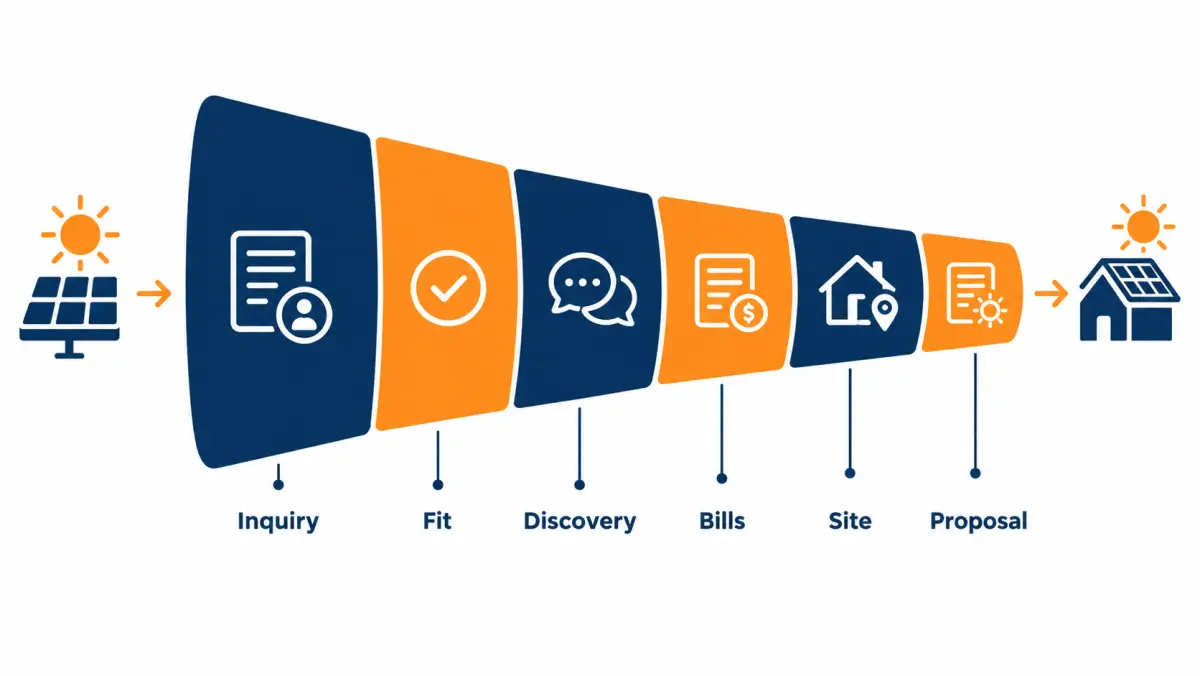
Gate order: why Authority and Site come first
You can collect the five answers in any order on a call, but you should judge them in a fixed order. Authority and Site come first because they are cheap to check and absolute when they fail. If the inquirer is a tenant with no lease term and no landlord contact, no amount of load data will save the deal. If the roof was installed in 1998 and nobody will fund a replacement, the account is a hold.
Load comes third because it costs real time: someone has to read bills, sometimes request interval data and model production. Money comes fourth because financing conversations go better once you can show the economics. Timing comes last because it is the most fluid; a strong account with no trigger is still worth a nurture track.
Light and full versions by project size
Not every account needs every question. Scale the framework to the project:
| Project band (illustrative) | Framework depth | Typical time spent before proposal |
|---|---|---|
| Small commercial (owner-operated, single meter) | Light: one discovery call, bills, desktop roof check | A few hours across one to two weeks |
| Mid-size C&I (multiple stakeholders, demand charges) | Full five gates, interval data, site visit | Several meetings across weeks |
| Large or multi-site | Full five gates plus written mutual plan, procurement review | Months, with several parallel workstreams |
The size bands are illustrative. Draw your own lines by system size or by contract value based on what your engineering team can handle. The point is to decide in advance which depth applies, so reps do not over-qualify a small shop or under-qualify a distribution center.
How do you prepare before the first commercial discovery call?
Before the first call, spend ten to fifteen minutes on desktop research: confirm the organization, look up the property, view the roof in satellite imagery, identify the likely utility and tariff, and check who else works there. Walk in with a hypothesis about fit, so the call confirms or kills it instead of starting from zero.
The commercial guide has a short five-minute prep list. For qualification work, go further. A rep who arrives with a hypothesis asks better questions and sounds like someone worth giving bills to.
The pre-call research checklist
| Check | Where to look | What you are trying to learn |
|---|---|---|
| Organization identity | Company website, state business registry | Legal name, entity type, how long in business |
| Property | County assessor or parcel viewer | Owner of record, parcel size, building age |
| Roof | Satellite imagery, street view | Roof type, rough usable area, obstructions, visible condition |
| Neighboring structures | Satellite imagery | Shading from taller buildings or trees |
| Utility | Utility service territory maps | Which utility, which commercial rate families apply |
| People | Company site, professional networks | Owner, CFO or controller, facilities lead |
| Operations | Company site, reviews, job postings | Hours, shifts, refrigeration, production equipment |
| Expansion signals | News, permits, job postings | New lines, added shifts, new buildings |
Do not quote any of this back to the prospect as fact. Use it to frame questions: "It looks like the building might be owned by a separate holding company. Is that right?"
Write a fit hypothesis before you dial
Write two or three sentences in the CRM before the call. For example:
Hypothesis: owner-occupied light manufacturer, single-story steel building, roof looks newer than 10 years from imagery. Likely on a demand-metered rate. Probably a cash or loan buyer if the owner is the signer. Risk: owner of record is an LLC with a different name, so confirm site control.
After the call, mark each sentence confirmed, wrong or unknown. Over a few months these notes show which hypotheses your team gets wrong most often, which is where training should go.
What to send before the call
For accounts that came in through a form, a short confirmation email before the first call improves the quality of the conversation. Ask the prospect to have a recent electric bill handy, and tell them the call will cover the building, the energy picture and who else should be involved. People who show up with a bill in hand are signaling intent. People who say "I'll have to find that" are telling you something too.
Using inquiry data you already have
If the lead came from a vendor, the record already carries self-reported role, owner or tenant status, monthly spend range and timeline. Read those fields as claims to verify, not facts. Our guide to working solar leads covers speed to contact and call cadence; for commercial accounts, the extra step is using these fields to pick which question bank you open first. A self-reported tenant gets the site-control bank before anything else. A self-reported owner with a high spend range gets the load bank early.
What questions should you ask on a commercial solar discovery call?
Ask open questions grouped by gate: context, authority, site, load, money and timing. You will not ask all of them on one call. Pick six to ten based on your fit hypothesis and the gaps in the inquiry data, then save the rest for follow-ups. The banks below are written to be copied into a call guide.

The commercial guide includes a timed call outline. This section is the question library behind it, sorted by what each question tells you and what a good or bad answer sounds like. For phrasing and objection language that applies across lead types, see our solar lead call scripts.
Context and motivation questions
Open with questions that let the prospect explain why they reached out. Their words become the language of your proposal.
- "What prompted you to look at solar now, rather than last year or next year?"
- "When you think about the building's energy costs, what bothers you most?"
- "Has anyone at the company looked at solar before? What happened?"
- "Is this coming from you, or did someone else ask you to look into it?"
- "If this went well, what would be different for the business a year from now?"
- "Are there other projects competing for attention or capital this year?"
- "Are there sustainability goals, customer requirements or reporting obligations behind this?"
- "What would make you decide this isn't worth pursuing?"
What good sounds like: a specific trigger (a rate increase, a new owner, a customer asking about emissions, a roof project, an expansion). What weak sounds like: "Just curious what it would cost." Curiosity is fine, but it moves the account toward a light track until a trigger appears.
Authority and decision-process questions
These questions find the signer and the process without making the champion feel small.
- "Besides you, who would want a say in a project like this?"
- "For a capital project of this kind, who gives the final yes?"
- "How have decisions on similar projects (a roof, HVAC, equipment) been made in the past?"
- "Is there a dollar threshold where something has to go to the owner, the board or a parent company?"
- "Does the building belong to the operating company, or to a separate entity?"
- "Is there a lender on the property who would need to know?"
- "Who would review a contract: in-house, an outside attorney, or the owner directly?"
- "If we brought you a proposal that made sense, what would the next three steps be on your side?"
- "Who in finance would look at the numbers?"
- "Is anyone likely to be skeptical? What would they worry about?"
Question 8 is the most useful in the bank. The answer is the decision process in the prospect's own words. Write it down and read it back at the end of the call.
Site and property questions
- "Do you own the building, lease it, or is it a mix?"
- "If leased, how many years are left, and are there renewal options?"
- "Who handles roof issues: you or the landlord?"
- "How old is the roof, and has it been repaired or recoated recently?"
- "Any roof replacement or major work planned in the next few years?"
- "Is there open land or a parking area that could host ground-mount or carport structures?"
- "Are there any plans to sell, refinance or expand the property?"
- "How many buildings and electric meters are on the site?"
- "Do you know where the main electrical service comes in, and roughly how large it is?"
- "Has the electrical service been upgraded in the last ten years?"
- "Are there any rooftop units, skylights or equipment being added soon?"
- "Is the property in an HOA, business park association or historic district with design rules?"
Load and energy-use questions
- "What does a normal day look like in the building: hours, shifts, weekends?"
- "What uses the most electricity: refrigeration, compressors, HVAC, lighting, production equipment?"
- "Is energy use seasonal? Which months are the worst?"
- "Are you planning anything that will add load: EV charging, electrified heating, new equipment?"
- "Do you see a separate demand charge on your bill? Do you know what drives it?"
- "Are you on a time-of-use rate, or a flat commercial rate?"
- "Have you done any efficiency work: LED lighting, controls, new HVAC?"
- "Do you have an online account with the utility where we could pull interval data with your permission?"
- "Are you buying power from a third-party supplier in a deregulated market?"
- "Have there been any big spikes or surprises on the bill in the last year?"
Money and ownership-preference questions
- "When the company makes a capital investment, how is it usually paid for: cash, a bank loan, an equipment lease?"
- "Is the business more interested in owning equipment, or in paying for the power it produces with no upfront cost?"
- "Does the company pay federal income tax, or is it a nonprofit or public entity?"
- "Is there a payback or return threshold that projects need to meet?"
- "Is there an existing banking relationship that typically funds equipment?"
- "Are there loan covenants or limits on new debt?"
- "Would a long-term agreement (fifteen to twenty-five years) be a concern for the owners or the board?"
- "Who would need to see the financial model before it goes to the signer?"
Avoid "what's your budget?" Commercial solar is usually paid from savings or financed, so a budget question shrinks the conversation to a number nobody has thought about yet.
Timing and trigger questions
- "Is there a date that matters: a fiscal year end, a board meeting, a lease renewal?"
- "When does the company set next year's capital budget?"
- "Is the roof work, expansion or refinance on a timeline we should align with?"
- "If the numbers worked, when would you want the system producing?"
- "What would push this to next year?"
- "Who else are you talking to about this, and where are they in their process?"
Questions to close the call with
- "Based on what you've shared, the next useful step is a bill review. Can you send the last twelve months?"
- "Who else should be on the next call?"
- "What date works to review findings together?"
- "What should I know that I haven't asked about?"
That last question is surprisingly productive. Prospects often mention the pending sale of the building or a parent company approval only when asked directly at the end.
How many questions to ask
A first discovery call should run thirty to forty-five minutes. In that time a good rep asks eight to twelve questions and listens for the rest. The banks above hold more than sixty questions; they are there so the rep can pick the right ones for this account, not to read in sequence.
How do you map decision-makers on a commercial solar account?
Map decision-makers by drawing every person and entity that can approve, block or influence the project: champion, signer, finance reviewer, property owner, lender, board and outside advisors. Record each one's role, stance and what they need to see. The map changes by organization type, so start from a template for that type.
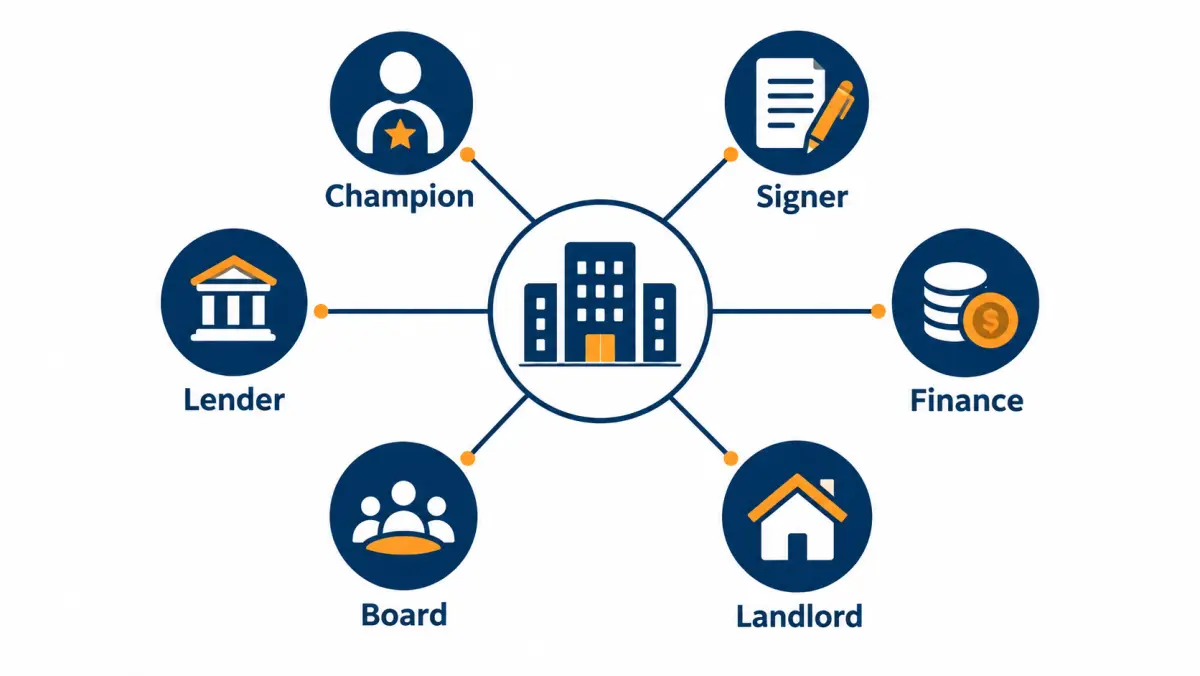
A stakeholder map is a one-page picture of the people around a deal. In commercial solar it also includes entities, because the building, the operating company and the lender may all be different legal parties. The commercial guide explains the champion and signer roles. This section goes further: who shows up by organization type, what each person cares about and how to reach them without going around your champion.
The roles that appear on most maps
| Role | Typical titles | What they care about | What they need from you |
|---|---|---|---|
| Champion | Facilities manager, operations manager, energy manager, office manager | Lower bills, fewer headaches, looking good internally | Simple materials they can forward, help answering internal questions |
| Signer (economic buyer) | Owner, president, CEO, CFO | Return, risk, cash, distraction from the core business | A one-page summary, clear risks, a clean contract |
| Finance reviewer | Controller, CFO, outside accountant | Cash flow, tax treatment, debt capacity | A model they can check, assumptions in writing |
| Property owner | Landlord, holding company, REIT asset manager | Roof warranty, building value, lease terms | Roof plan, insurance, removal terms, consent documents |
| Lender | Bank holding the mortgage | Collateral, lien position, fixture filings | Early notice, documents describing the equipment |
| Board or committee | Board of directors, finance committee, building committee | Governance, reputation, long-term commitment | Presentation materials, answers to predictable questions |
| Technical reviewer | Maintenance lead, plant engineer, outside engineer | Roof penetrations, electrical tie-in, operations disruption | Layouts, single-line diagrams, installation schedule |
| Outside advisor | Attorney, energy broker, consultant | Contract risk, competing bids | Contract drafts on time, a straight answer on scope |
| Blocker | Anyone with a reason to say no | Varies: workload, past bad experience, competing project | Acknowledgment and a direct answer to the concern |
Not every account has every role. A small owner-operated shop might have one person in four boxes. A regional distribution center might have twelve people across three companies.
Maps by organization type
Use these as starting templates. Copy the relevant one into the CRM on the first call and fill in names as you learn them.
Owner-operated private business (single location). Champion and signer are often the same person, or the champion is a spouse, partner or operations lead. The outside accountant is the hidden reviewer: many owners will not sign anything with tax consequences until their CPA looks at it. Ask early: "Do you usually run investments like this past your accountant?" If yes, offer to send the model directly.
Private company with a separate real estate entity. Very common. The operating company pays the electric bill; a related LLC owns the building. The same owners often control both, but the contract may need to be signed by one entity and the site access agreement by the other. Ask which entity's name is on the deed and which is on the utility account.
Tenant in a multi-tenant building. The champion works for the tenant, the bill is the tenant's, but the roof is the landlord's. You need landlord consent and probably a roof license or lease amendment. The tenant's remaining lease term limits financing. Map the landlord's property manager as a separate stakeholder with their own needs.
Landlord with tenants. The landlord controls the roof but usually not the bills. Solar here is either a landlord investment that sells power to tenants (where allowed), a community-solar-style arrangement, or a project that serves common-area meters only. Qualification focuses on whether the landlord has a reason to care: a tenant amenity, a sustainability requirement from an investor, or common-area load large enough on its own.
Multi-location company. A regional or corporate office may control decisions for all sites, while local managers control access and information. Map the corporate sponsor, the person who decides which sites go first and the local contact at each site. Read our commercial guide's portfolio section for how to sequence sites; for qualification, the extra step is confirming who decides site order.
Nonprofit or house of worship. The champion is often a volunteer or staff member. The signer is a board or committee, and decisions follow a meeting calendar. Elective pay may make direct ownership possible for tax-exempt entities; confirm eligibility with tax counsel and see the IRS elective pay and transferability guidance. Map the treasurer and committee chair, and get the meeting dates.
School district, municipality or public agency. Procurement rules govern the process. There may be a required public bid, a cooperative purchasing contract or an RFP. The champion may be a facilities director who cannot legally steer the process. Your qualification job is to learn the procurement path and timeline, not to close a private deal. Many teams treat public accounts as a separate motion with a separate scoring model.
Agricultural operation. Family members often share decisions, and a farm lender or agricultural credit association may hold liens on the land and equipment. Map every family member with a say and the lender early. Load is often spread across several meters (pumps, barns, homes), which changes how a single system can serve it.
Franchise location. The franchisee owns or leases the location, but the franchisor may have rules on building changes and approved vendors. Ask whether franchise agreements require approval for roof or electrical work.
Stance and influence: rating each person
For each person on the map, record two quick ratings:
| Rating | Scale | How to judge |
|---|---|---|
| Influence | High / medium / low | Can they approve, block, or only advise? |
| Stance | Supporter / neutral / skeptic / unknown | What they have said, or what your champion reports |
High-influence unknowns are the biggest risk. A deal with a supportive champion and an unknown signer is not qualified yet. Your next step is always the highest-influence person whose stance is unknown.
How to reach the signer without bypassing your champion
The worst way to reach the signer is to call around your champion. It damages trust and often backfires. Better approaches:
- Ask the champion to coach you. "When you take this to the owner, what will they ask first?" The answer tells you what the signer cares about and gives the champion ownership.
- Offer to share the load. "Would it help if I joined the conversation with the owner so you're not stuck answering technical questions?"
- Build the forwardable summary. A one-page document written for the signer, which the champion can send under their own name.
- Set the meeting as a milestone. Make "review with the signer" a named step in your mutual plan so it is expected, not a surprise.
- Use a natural trigger. The bill review results or the site visit summary are good reasons for the signer to join.
If after two or three attempts the champion will not involve the signer, that is information. Either the champion lacks influence or the project has lower priority than they suggested. Move the account to a lower score or a hold track.
Mapping entities, not just people
Draw the legal entities too. For each, record:
- Legal name and type (corporation, LLC, partnership, nonprofit, public body)
- Relationship to the site (owner of record, tenant, ground lessee, manager)
- Relationship to the bill (name on the utility account)
- Who signs for it
- Whether it pays federal income tax (relevant to ownership structures)
Mismatches between the entity on the utility bill, the entity on the deed and the entity that will sign the contract are the single most common source of late-stage delays in commercial solar. Finding them in qualification is cheap. Finding them at contract stage costs weeks.
A stakeholder map template
Paste this into your CRM notes for each account:
ACCOUNT: [Organization]          ENTITY TYPE: [type]
SITE OWNER OF RECORD: [entity]   UTILITY ACCOUNT NAME: [entity]
CONTRACT SIGNER (expected): [name, title, entity]

PEOPLE
Name | Title | Role on deal | Influence (H/M/L) | Stance | Last contact | What they need
-----|-------|--------------|-------------------|--------|--------------|---------------
     |       | Champion     |                   |        |              |
     |       | Signer       |                   |        |              |
     |       | Finance      |                   |        |              |
     |       | Property     |                   |        |              |
     |       | Lender       |                   |        |              |

DECISION PROCESS (in prospect's words):
1.
2.
3.

KNOWN APPROVAL DATES: [board meeting, budget cycle, fiscal year end]
OPEN RISK: [highest-influence person with unknown stance]
Signs the map is incomplete
- You cannot name the person who signs.
- You do not know whether the building owner and bill payer are the same entity.
- Nobody has mentioned finance, a CPA or a bank.
- The champion says "I make these decisions" but cannot describe a past capital project they approved.
- The decision process has one step.
- You have never spoken with anyone except the person who filled out the form.
Any one of these keeps the Authority gate open.
What site data do you need to qualify a commercial solar lead?
You need proof of site control, roof or land facts and electrical basics: who owns the property, lease terms if leased, roof type, age and condition, usable area, structural notes, main service size and any planned changes. Collect what the prospect knows on the call, verify with desktop tools, and save the site visit for accounts that pass the other gates.
The commercial guide has a site and roof check section focused on what happens before a proposal. This section is narrower: what site facts you need to make a qualification decision and how to get them without sending an engineer to every lead.
Site control: the first site question
Site control means the organization has the legal right to host a solar system on the property for the life of the agreement. In practice, check:
| Situation | What you need to confirm | Typical qualification outcome |
|---|---|---|
| Owner-occupied, owner is the operating company | Deed name matches, no plans to sell | Pass |
| Owner-occupied through a related entity | Both entities can sign, same control | Pass with paperwork note |
| Tenant with long remaining term | Lease length, landlord consent path, roof responsibility | Pass if consent is realistic |
| Tenant with short remaining term | Renewal likelihood, landlord interest | Hold, or pursue the landlord |
| Ground lease | Ground lease term, lessor consent | Needs legal review before proposal |
| Property for sale or being refinanced | Timeline, buyer or lender attitude | Hold until resolved |
| Public land or leased public facility | Procurement path, lease language | Separate public-sector track |
For tenants, ask early whether the lease allows roof use or alterations. Many leases are silent or restrictive. The tenant does not need to know the answer on the first call, but they should be willing to find the lease and ask the landlord.
Roof facts to collect
| Fact | Why it matters | How to get it |
|---|---|---|
| Roof type (membrane, metal, built-up, shingle) | Racking method, penetrations, warranty | Prospect, satellite, photos |
| Roof age | Whether it outlives the system | Prospect, permit history, invoice |
| Last major repair or recoat | Hidden condition issues | Prospect, roofer |
| Warranty and warrantor | Whether solar work voids it | Warranty document |
| Usable area | Rough system size ceiling | Satellite measurement, minus setbacks and equipment |
| Rooftop equipment | Shading, access, layout limits | Satellite, photos |
| Parapets and nearby tall structures | Shading | Satellite, street view |
| Known leaks or ponding | Condition risk | Prospect, photos |
| Structural concerns | Load capacity | Prospect, original drawings, engineer |

The roof-age decision rule
Write a rule your team follows so reps do not argue about every case. An example (adapt it to your own warranty terms and engineering advice):
If the roof is likely to need replacement during the expected life of the system, the account cannot pass the Site gate until the prospect has a plan: replace first, replace during the project, or choose ground-mount or carport instead.
Then let reps sort accounts into three groups: roof clearly fine, roof needs replacement planning, roof unknown. "Unknown" is acceptable at the discovery stage but must be resolved before a proposal.
Ground-mount and carport options
Some sites cannot use the roof but have land or parking. Qualify these separately:
- Ground-mount: land ownership, zoning, setbacks, distance to the point of interconnection, flood zone, soil or slope issues, and whether the land has other planned uses.
- Carports: parking layout, traffic flow, lighting, snow, the cost premium of structure, and whether the owner values covered parking for its own sake.
Carports in particular usually cost more per unit of capacity than rooftop. A carport account qualifies when the buyer values the canopy itself (shade, EV charging, visibility) or when the roof is not an option.
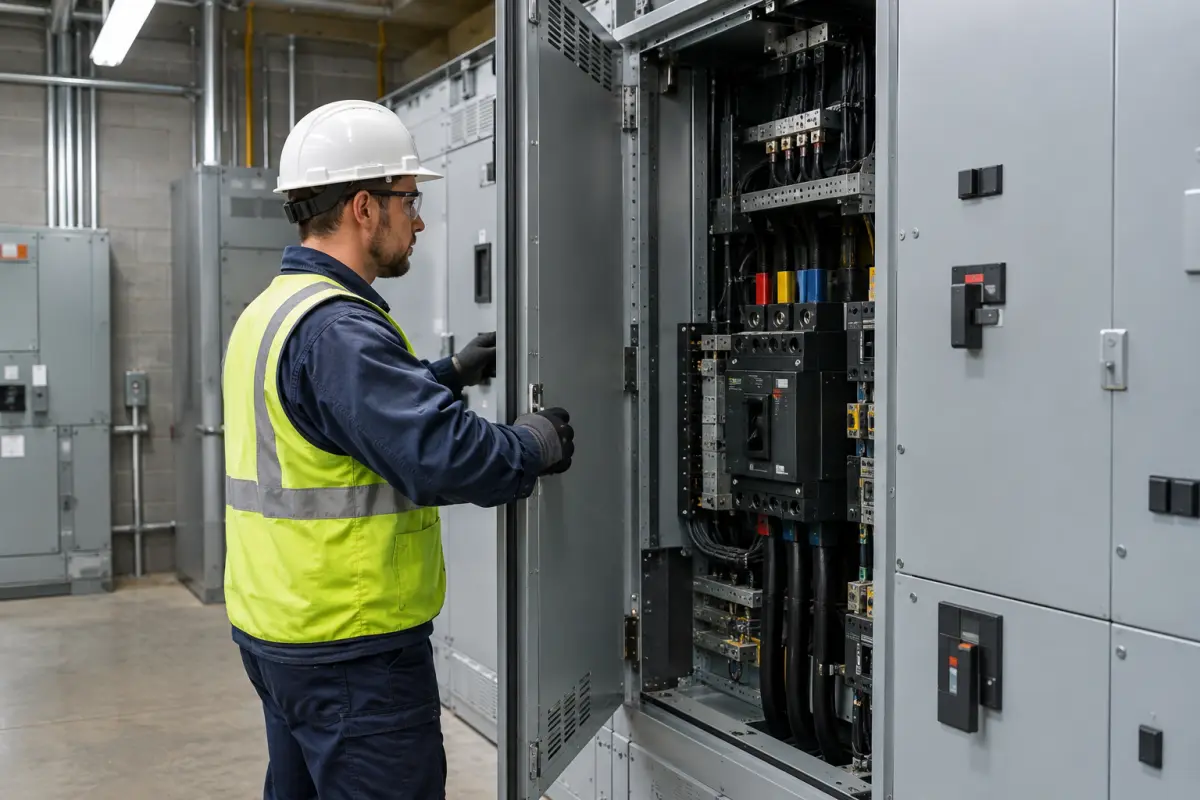
Electrical basics
You do not need an engineer on the first call, but you need enough to spot red flags:
- Main service size (amperage and voltage) if the prospect knows it
- Number of meters and what each serves
- Age of the switchgear and any recent upgrades
- Location of the main electrical room relative to the roof or array area
- Any known utility constraints mentioned by the prospect (for example, a previous request that needed upgrades)
A photo of the main panel nameplate and the meter is a good request after the first call. Many facilities managers can send these in minutes.
Interconnection risk at the qualification stage
Interconnection rules and queue times vary widely by utility. At the qualification stage, you are looking for warning signs, not answers:
- The utility or local feeder is known in your market for long study timelines
- The system would be large relative to the site's load (export-heavy designs often face more review)
- The prospect mentions that another project nearby was delayed for grid reasons
- The site is at the end of a rural line
None of these disqualify an account, but they belong in the qualification notes and should lower confidence in the timeline. Your engineering team should own a simple feeder or utility watch list for your territory.
The site photo request
After the first call, send one list and ask the prospect to reply with photos. A list that has worked well for many teams:
- The full roof, from the roof access point if possible
- Rooftop equipment and any visible damage
- The main electrical panel or switchgear, door open, showing the nameplate
- The utility meter(s)
- Any open land or parking area being considered
- The most recent roof invoice or warranty page, if they can find it
Prospects who send these quickly are telling you the project matters to them. That responsiveness is a qualification signal in its own right.
What load and utility data do you need, and how do you judge it?
You need twelve months of complete utility bills, the rate schedule name, and ideally fifteen-minute or hourly interval data. From those you judge three things: whether annual energy use is large enough for a system you sell, whether the load shape lines up with solar production, and whether the tariff rewards self-consumption or penalizes export.
Our commercial guide walks through the four parts of a commercial bill with worked examples. For qualification, the question is narrower and more decisive: does this account's energy picture support a proposal, and how confident are you? This section covers the data request, the quick-judgment tests and the warning signs.

The data request, in order of priority
| Priority | Data | Why | Typical source |
|---|---|---|---|
| 1 | Twelve months of bills, all pages, all meters | Annual energy, seasonal pattern, charges | Prospect, utility portal |
| 2 | Rate schedule name for each meter | Which tariff rules apply | Printed on the bill |
| 3 | Interval data (15-minute or hourly) | Load shape, demand peaks, self-consumption | Utility portal download or data request |
| 4 | Third-party supply contract (deregulated markets) | Energy price and contract term | Prospect, energy broker |
| 5 | Planned load changes | Future use (EV charging, electrification, expansion) | Prospect |
| 6 | Efficiency projects completed or planned | Load may drop | Prospect |
Ask for all meters. Commercial sites often have a main building meter plus separate meters for a warehouse, sign, well pump or parking lot. Missing meters is one of the most common reasons a first-pass estimate is wrong.
The bill request email
A short request with a reason works better than a form. A template:
Subject: Bills for your solar review
Hi [Name],
Thanks for the time today. To tell you whether solar makes sense for [site], we need to see how the building uses power through the year. Could you send the last twelve months of electric bills for every meter at the site? PDFs from the utility portal are perfect, and all pages help, since the rate details are usually on page two or three.
If it's easier, you can add us as a viewer on the utility account, or download the interval usage file from the portal. I can walk you through that in five minutes.
Once we have them, we'll come back within [X business days] with a first read on fit and a rough system size, and we'll set a time to go over it together.
Name your turnaround and keep it. A fast, useful bill review is the best evidence a commercial prospect has that you are worth more of their time.
Quick-judgment test 1: is there enough energy?
Before modeling anything, compare annual consumption with the smallest system your team wants to build. If the site's annual energy use would be covered by a system much smaller than your practical minimum, the account fails the Load gate unless there is a plan to add load.
Do not set this threshold from a blog post. Set it from your own cost structure: mobilization, engineering, permitting and interconnection have fixed costs that make very small commercial projects hard to price. Write the minimum down in the qualification standard so reps do not spend weeks on accounts below it.
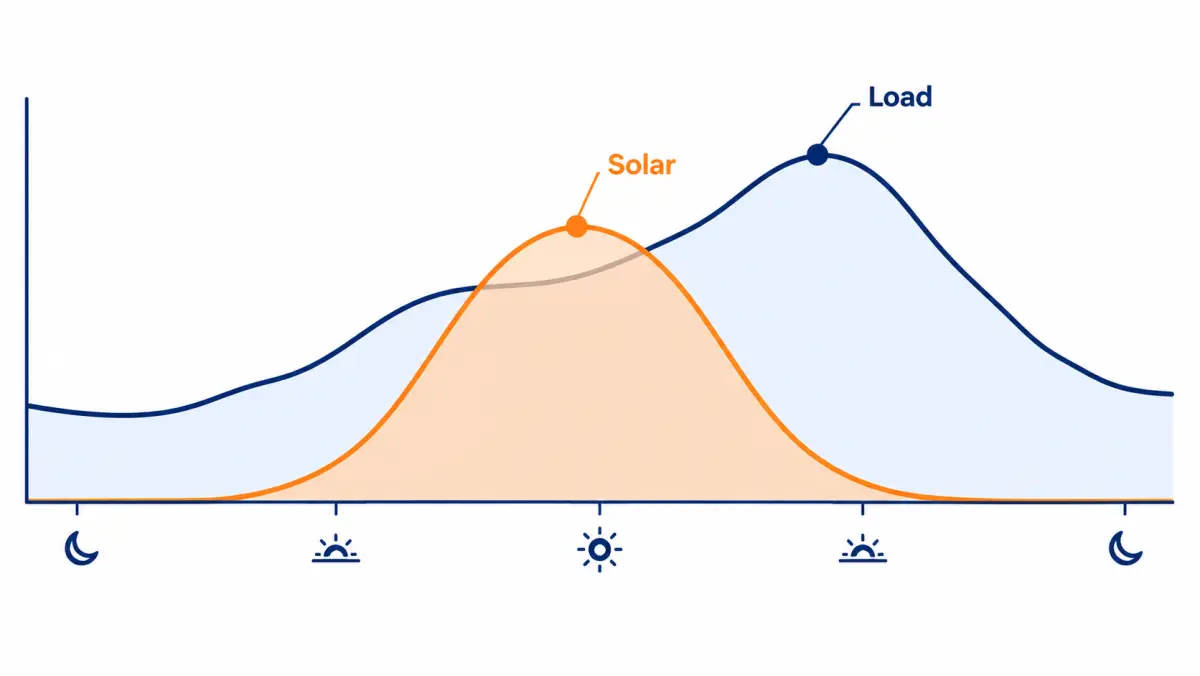
Quick-judgment test 2: does the load shape fit solar?
Solar produces in the middle of the day and more in summer than winter (in most of the country). Loads that line up with that pattern get more value from each kilowatt-hour produced, especially when export is credited at a low rate.
| Load pattern | Fit with solar | Notes |
|---|---|---|
| Daytime weekday operations, year-round | Strong | Offices, light manufacturing, most retail |
| Daytime operations with summer cooling peak | Strong | Peaks align with production |
| 24/7 steady load | Good | Refrigeration, data rooms; solar covers the daytime share |
| Evening and night-heavy | Weak without storage | Hospitality and some entertainment venues |
| Winter-peaking (electric heat) | Mixed | Depends on climate and tariff |
| Highly seasonal (agriculture, schools) | Depends on export credit | Summer irrigation can fit well; schools empty in summer may not |
| Weekend closures with large system | Watch export | Exports on weekends may be credited low |
Quick-judgment test 3: how does the tariff treat solar?
Read the rate schedule, not just the bill. Note:
- Energy charges: flat, tiered or time-of-use, and how the peak window aligns with solar hours
- Demand charges: how they are measured (highest fifteen-minute interval in the month, during peak only, or ratcheted from previous months)
- Export compensation: net metering, net billing at a lower rate, or avoided-cost credit
- Standby or reserve charges: some tariffs add charges for customers with on-site generation
- Fixed and minimum charges: these cannot be reduced by solar
- Rate switching: whether adding solar would require or allow a move to a different schedule
The tariff can turn a promising load profile into a weak project or the reverse. A building with a strong daytime load on a tariff with late-evening peak pricing may save less than its energy use suggests. The commercial guide explains why bills sometimes drop less than production suggests; the qualification action is to flag tariff risk before the proposal, not after.
Demand charges: qualification notes
Demand charges are often a large share of a commercial bill. Solar alone reduces them less reliably than it reduces energy charges, because a cloudy fifteen minutes can set the month's peak. For qualification:
- Note whether demand charges are a large part of the bill.
- Look at when the monthly peak happens if interval data is available. Peaks in late afternoon or evening reduce solar's effect on demand.
- If demand charges dominate, flag the account for a storage discussion if you sell storage, or set expectations that solar savings will come mainly from energy charges.
Never promise demand savings on a qualification call. Say the bill review will show how much of the bill solar can realistically affect.
Interval data: how to get it
Many utilities let commercial customers download interval data from an online portal. Others require a written data request or a third-party authorization form. Some sites lack interval meters altogether. Three practical steps:
- Ask the prospect whether they have an online utility account and who manages it.
- Offer a short screen-share to help them find and download the usage file.
- If the utility requires a formal authorization, send it the same day with the fields pre-filled except signature.
If interval data is not available, monthly bills are enough to pass a light qualification. For larger accounts or demand-heavy tariffs, push for interval data before a proposal. Our commercial guide covers what interval data shows; here the point is that missing interval data on a demand-heavy site should lower your confidence score.
Deregulated markets and third-party supply
In states with retail electricity choice, the bill may show a utility delivery portion and a separate supplier energy portion. Ask:
- Who is the supplier, and when does the contract end?
- Is the energy price fixed or indexed?
- Are there early termination or volume-change clauses?
A fixed-price supply contract with volume bands can be affected when on-site solar reduces purchases. That does not disqualify a project, but the supply contract belongs in the data request.
Load-change questions that reshape the account
Planned load changes can turn a weak account into a strong one, or the reverse:
| Planned change | Effect on qualification |
|---|---|
| Adding EV charging for fleet or customers | More load, often daytime; can strengthen fit |
| Electrifying heating or processes | More load; may shift seasonality |
| New production line or shift | More load; ask for a date |
| Major efficiency upgrade | Less load; size the system to the post-upgrade baseline |
| Planned move or consolidation | Possible disqualifier |
| Selling part of the operation | Possible disqualifier |
Ask about planned changes on every account. Sizing a system to last year's bills when a new shift starts next quarter, or when LED retrofits will cut load sharply, produces a proposal the finance reviewer will pick apart.
Data confidence levels
Record how confident you are in the load picture:
| Level | Data in hand | What you can say |
|---|---|---|
| Low | One or two bills, or spend range only | "Possibly a fit; need bills" |
| Medium | Twelve months of bills, rate schedule | "Fit looks likely; rough size range" |
| High | Twelve months of bills, rate schedule, interval data, planned changes | "Fit confirmed; ready to model a proposal" |
A rule that works for many teams: no proposal on less than medium confidence, and no proposal on a demand-heavy site at less than high confidence.
How do you check financing fit for a commercial solar prospect?
Check financing fit by matching the organization's tax position, cash, credit and ownership preference to the structures you can offer: cash purchase, loan, lease or PPA. Ask about past capital decisions, whether the entity pays federal income tax, and whether it prefers owning equipment or buying power. An account with no workable path fails the Money gate.
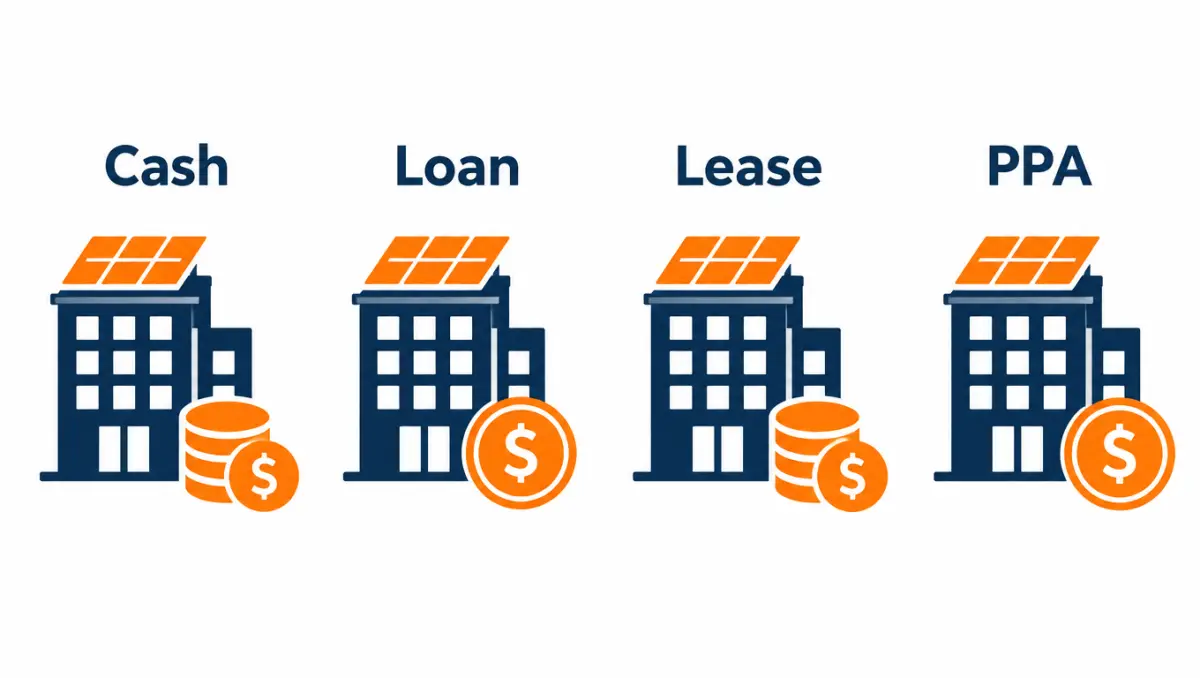
The commercial guide compares ownership options and walks through cash versus PPA and nonprofit elective pay examples. Qualification needs something different: a fast way to decide which structures are realistic for this account and whether you can offer one of them.
The financing-fit matrix
| Organization profile | Likely structures | Qualification questions |
|---|---|---|
| Profitable private business with tax appetite and cash | Cash, loan | Does the owner want to own equipment? Will the CPA support it? |
| Profitable business with limited cash | Loan, lease, PPA | Debt capacity? Existing bank relationship? |
| Business with little or no tax liability | PPA, lease, or transferability-based structures | Who would use the tax benefits? Does the buyer want to avoid ownership? |
| Nonprofit or house of worship | Cash or loan with elective pay, PPA | Board approval path? Elective pay eligibility (confirm with counsel)? |
| Public entity | Cash, PPA, procurement-driven structures | Procurement rules? Existing purchasing contracts? |
| Tenant | PPA or lease sized to lease term, or landlord-owned | Lease term? Landlord involvement? |
| Early-stage or thinly capitalized business | PPA if the financier approves credit | Credit profile? Years in business? |
Only offer structures you can deliver. If your company does not provide PPAs or have a financing partner that does, a no-tax-appetite account may not fit your business even if solar makes sense for it. That is a legitimate reason to close out or refer.
Tax position, without giving tax advice
Federal commercial solar incentives can be a large share of project value, and timing rules changed in 2025. As of October 2026, rules on when projects must begin construction or be placed in service matter for any new commercial deal. Our commercial solar leads guide summarizes the timing context. For qualification, you only need to learn enough to route the account:
- Does the entity pay federal income tax?
- Does it expect to have enough tax liability to use a credit?
- Is it tax-exempt or a public body that may be eligible for elective pay?
- Who is its tax advisor?
Do not tell a prospect what they qualify for. Say: "Tax treatment depends on your situation, so your CPA and our finance team should look at it together. Can we set that up?" Confirm all tax treatment with counsel or a tax professional.
Credit and approval signals
For financed structures, the financier will make the credit decision. You can still spot likely trouble early:
| Signal | What it suggests |
|---|---|
| Years in business at the site | Longer history usually helps approval |
| Audited or reviewed financial statements available | Smoother credit review for larger deals |
| Existing bank debt and covenants | May limit new debt; a PPA may be easier |
| Recent ownership change | Financiers may want more history |
| Property in a separate entity | Both entities may need to participate |
| Prospect reluctant to share any financials | Credit review will stall |
Ask: "If we went the financing route, would you be comfortable sharing financial statements with a lender?" A clear yes moves the Money gate. A hard no on a financing-dependent deal is a hold or a close.
Payback thresholds and decision criteria
Many organizations have an informal hurdle: "We only do projects that pay back in X years." Ask for it directly. Then ask who set it and whether it is firm. A threshold that your proposals cannot meet in this utility territory is a disqualifier for cash and loan structures, though a PPA that saves money from the first month might still fit.
Record the decision criteria in the buyer's words: payback, internal rate of return, monthly savings, avoided risk, sustainability goals. Your proposal should answer the criteria the buyer named, not the ones your proposal tool shows by default.
When money looks fine but isn't
Watch for these:
- The champion is enthusiastic, but the finance reviewer has never been mentioned.
- The prospect says "we'd pay cash," but the company is mid-expansion and short on working capital.
- The owner wants ownership for the tax benefits, but the CPA has not been asked.
- The organization is a nonprofit and assumes it can use credits the way a business does.
- The prospect expects "free solar" from a news story or a door-knocker.
Each of these is a conversation to have before the proposal, not a reason to close out. But until it is resolved, the Money gate is open.
How do you confirm timing and a real reason to act?
Confirm timing by finding a trigger the prospect controls or cannot avoid: a capital budget date, a roof project, a lease renewal, an expansion, a rate change, a customer requirement or an incentive deadline. Record the trigger and the date it bites. An account with a strong fit but no trigger belongs on a nurture track, not in the forecast.
Timing is the gate reps most often guess. A friendly prospect says "sometime this year," the rep writes "Q4," and the account sits in the forecast for three quarters. A written trigger with a date fixes that.
Common commercial solar triggers
| Trigger | How to find it | How strong |
|---|---|---|
| Capital budget cycle | "When do you set next year's capital budget?" | Strong if dated |
| Fiscal year end | Ask, or check public filings for larger firms | Medium; affects tax timing |
| Roof replacement scheduled | Site questions | Strong; solar can be bundled |
| Lease renewal or purchase of building | Site questions | Strong; changes who can sign |
| Expansion or new building | Load questions, news, permits | Strong |
| Utility rate change or new tariff | Utility announcements, prospect | Medium to strong |
| Customer or investor emissions requirement | Context questions | Strong when it has a deadline |
| Incentive or program deadline | Your own tracking | Strong, but confirm details |
| New owner, CFO or facilities lead | Context questions, professional networks | Medium; new leaders want wins |
| Board or committee meeting date | Authority questions | Strong for nonprofits and public bodies |
| Competing bid in progress | Timing questions | Strong; also a risk |
Turn the trigger into a date
For each account, write: "Trigger: [what]. Date: [when]. Source: [who said it or where you saw it]." If there is no date, the timing gate is not passed. If the date is past your sales horizon, the account goes to a hold track with a re-open date.
Working back from the trigger
Commercial projects have long lead times. If a prospect wants the system producing by a certain date, work backward through your typical stages: proposal, approval, contract, engineering, permitting, interconnection, procurement and construction. If the dates do not fit, say so early. Prospects respect a rep who says "that date is tight, here's what would have to happen" more than one who agrees to anything.
The commercial guide includes a stage-by-stage view of a typical C&I cycle. Use your own historical stage durations, not generic ones, when you work back from a prospect's date.
Urgency you cannot manufacture
Avoid inventing urgency. "Prices are going up next month" or "incentives are ending" said without a specific, accurate basis damages trust with commercial buyers, who often check. If an incentive deadline genuinely applies, point the prospect to the primary source and let their advisors confirm. Real triggers are more persuasive than invented ones.
What should disqualify a commercial solar lead?
Disqualify a commercial solar lead when a confirmed fact blocks the project for longer than your sales horizon: no site control and no landlord path, energy use below your minimum, a tariff that makes savings negligible, no workable financing structure, or a decision process you cannot reach. Write each disqualifier down so reps apply the same rules.

Closing out accounts quickly is a skill. Reps who keep every account alive look busy but forecast badly and miss the accounts that need their time. A written disqualifier list makes it easier to close out without guilt.
Hard disqualifiers
A hard disqualifier ends the opportunity for now. Close it with a reason code and, where it makes sense, a re-open date.
| Code | Disqualifier | Evidence needed |
|---|---|---|
| DQ-SITE-1 | No site control and no realistic landlord path | Tenant confirms landlord refuses, or lease term too short with no renewal |
| DQ-SITE-2 | Property being sold or vacated within the horizon | Prospect confirms |
| DQ-SITE-3 | Fatal site issue (no usable roof, ground or carport area) | Desktop review plus prospect confirmation |
| DQ-LOAD-1 | Annual energy use below your minimum project size | Twelve months of bills |
| DQ-LOAD-2 | Tariff makes savings negligible for any system you sell | Rate schedule review by your analyst |
| DQ-MONEY-1 | No financing structure you can offer fits the organization | Confirmed tax position, credit refusal or ownership preference |
| DQ-AUTH-1 | No path to the signer after repeated attempts | Documented attempts |
| DQ-AUTH-2 | Parent company or franchisor prohibits the project | Prospect confirms |
| DQ-FIT-1 | Project type you do not build (for example, utility-scale land, off-grid) | Inquiry details |
| DQ-FIT-2 | Outside your service territory | Address |
| DQ-PUB-1 | Public procurement you cannot or will not respond to | Procurement path confirmed |
Soft disqualifiers (hold, not close)
Soft disqualifiers mean "not now." Move the account to a nurture track with a named trigger:
| Code | Situation | Re-open trigger |
|---|---|---|
| HOLD-ROOF | Roof needs replacement within the system life | Roof project scheduled or completed |
| HOLD-LEASE | Lease renewal pending | Renewal signed |
| HOLD-BUDGET | No capital this year | Next budget cycle date |
| HOLD-EXPAND | Load will change significantly | New load in place or confirmed |
| HOLD-OWNER | Ownership or leadership change in progress | New owner or leader in place |
| HOLD-DATA | Prospect cannot get bills or interval data yet | Data received |
| HOLD-INTERCONNECT | Known grid constraints at the site | Utility update or study result |
Disqualifiers that are not real
Some common reasons for closing accounts are weak. Do not close on these alone:
- "They didn't answer twice." Commercial contacts are busy. Use a longer multi-channel sequence before closing for no response.
- "They asked about price first." Price questions show interest. Answer with the process for getting a real number.
- "They already got a quote." A competing quote means the account is real. Ask what they liked and did not like about it.
- "They said they're just exploring." Exploring prospects become buyers when a trigger arrives. Hold, don't close.
- "The roof looks old in imagery." Imagery misleads. Ask.
How to close out politely
A polite close-out keeps referrals open and protects your reputation in local business circles:
"Based on what you've shared, I don't think solar makes financial sense for this building right now. The main reason is [plain reason]. If [trigger] changes, I'd be glad to look again. Would it be all right if I checked back in [month]?"
Then do it. Accounts closed politely with a scheduled check-in often come back.
Track disqualifier rates
Count closed-out accounts by reason code each month. The pattern tells you something about lead sources and targeting. Many tenants failing DQ-SITE-1 suggests tightening the owner-or-tenant filter with your lead vendor. Many DQ-LOAD-1 closures suggest the spend-range filter is too low. Our solar lead ROI guide explains how to tie these rates back to cost per sale.
How do you build a lead scoring model for commercial solar?
Build a commercial solar lead scoring model by assigning weighted points to each of the five gates, adding a confidence adjustment for how much evidence you hold, and setting score bands that map to actions: propose, pursue, nurture or close. Calibrate the weights against your own closed-won and closed-lost accounts every quarter.
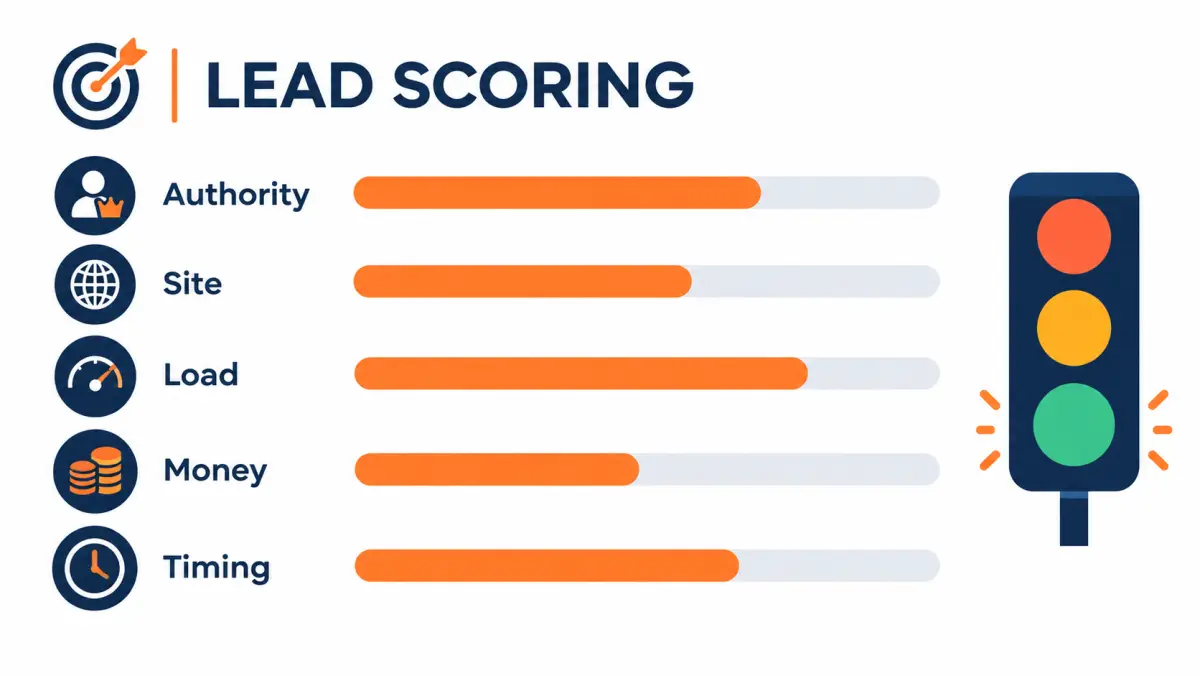
The commercial guide includes a simple priority score for deciding which new inquiries to call first. That score uses inquiry fields only. The scoring model here is different: it scores an account after discovery, using what you have learned and verified, to decide where engineering and proposal time should go.
Step 1: score each gate from 0 to 4
| Score | Authority | Site | Load | Money | Timing |
|---|---|---|---|---|---|
| 0 | No path to signer | No site control | Below minimum or unknown | No fitting structure | No trigger |
| 1 | Champion only, signer unknown | Tenant, landlord unknown | Spend range only | Preference unknown | "Someday" |
| 2 | Signer named, not engaged | Control likely, roof unknown | Some bills | Structure plausible | Trigger, no date |
| 3 | Signer engaged, process known | Control confirmed, roof acceptable or plan in place | Twelve months of bills, tariff reviewed | Structure agreed in principle | Trigger with date inside horizon |
| 4 | Signer engaged, process written and agreed | Control confirmed, roof and electrical reviewed | Interval data, load changes known | Finance reviewer engaged, approval path clear | Decision date set |
Step 2: weight the gates
Weights reflect how often each gate kills deals in your own history. An illustrative starting point:
| Gate | Illustrative weight |
|---|---|
| Authority | 25% |
| Site | 25% |
| Load | 20% |
| Money | 20% |
| Timing | 10% |
Timing gets the lowest weight because it changes most easily. Site and Authority get the highest because their failures are hardest to fix. These weights are illustrative: replace them after a quarter of data.
Step 3: calculate the weighted score
Multiply each gate score (0 to 4) by its weight, sum them, and multiply by 25 to get a 0 to 100 score.
Illustrative example: a manufacturer with Authority 3, Site 3, Load 2, Money 2, Timing 3.
| Gate | Score | Weight | Weighted |
|---|---|---|---|
| Authority | 3 | 0.25 | 0.75 |
| Site | 3 | 0.25 | 0.75 |
| Load | 2 | 0.20 | 0.40 |
| Money | 2 | 0.20 | 0.40 |
| Timing | 3 | 0.10 | 0.30 |
| Total | 2.60 × 25 = 65 |
Step 4: apply knockout rules
Weighted averages can hide fatal problems. Add knockouts: any gate scored 0 caps the total at a low band regardless of other scores. A site with no control and perfect load is not a 70; it is a close-out or a landlord pursuit.
Step 5: map score bands to actions
| Band (illustrative) | Action | Who works it |
|---|---|---|
| 75 to 100 | Build proposal; schedule signer meeting | Senior account executive plus engineering |
| 55 to 74 | Close the gaps: specific next step per low gate | Account executive |
| 35 to 54 | Nurture with a named trigger | Inside sales or nurture sequence |
| Below 35 or any knockout | Close out with reason code | Account executive closes, manager reviews monthly |
Step 6: add a confidence flag
Two accounts can both score 65, one on verified evidence and one on what the champion said. Add a confidence flag (high, medium or low) based on how many gate scores rest on documents or direct conversations with the right person, versus secondhand claims. Managers should challenge high scores with low confidence in pipeline reviews.
Step 7: calibrate quarterly
Each quarter, pull every closed account (won and lost) and compare their scores at the proposal stage with outcomes:
- Did accounts above your proposal band close at a meaningfully higher rate than those below?
- Which gate scores best predicted losses?
- Were any losses caused by something the model does not measure (a competitor, a key person leaving)?
Adjust weights in small steps. With a small number of closed accounts, avoid big swings; a few deals can mislead. Document every change so the team understands why scores moved.
A spreadsheet version
If your CRM cannot calculate scores, a shared spreadsheet works:
Columns:
Account | Rep | Auth(0-4) | Site(0-4) | Load(0-4) | Money(0-4) | Timing(0-4) |
Weighted = (Auth*0.25 + Site*0.25 + Load*0.20 + Money*0.20 + Timing*0.10) * 25 |
Knockout? (any gate = 0) | Band | Confidence (H/M/L) | Next step | Next step date
Keep the formula visible and the weights in a single cell row at the top so they can be changed in one place.
What the score is not
The score is a tool for allocating time, not a forecast. Do not multiply it into revenue. Forecasting belongs to stage-based probabilities calibrated on your own win rates. The score tells you which accounts deserve engineering hours this week.
How should a qualified commercial account be handed off?
Hand off a qualified commercial account with a written packet: stakeholder map, site facts and photos, all bills and interval data, tariff notes, financing preference, decision criteria, trigger and date, open risks and a list of what the prospect has been promised. Engineering and finance should never have to re-ask a question the rep already answered.
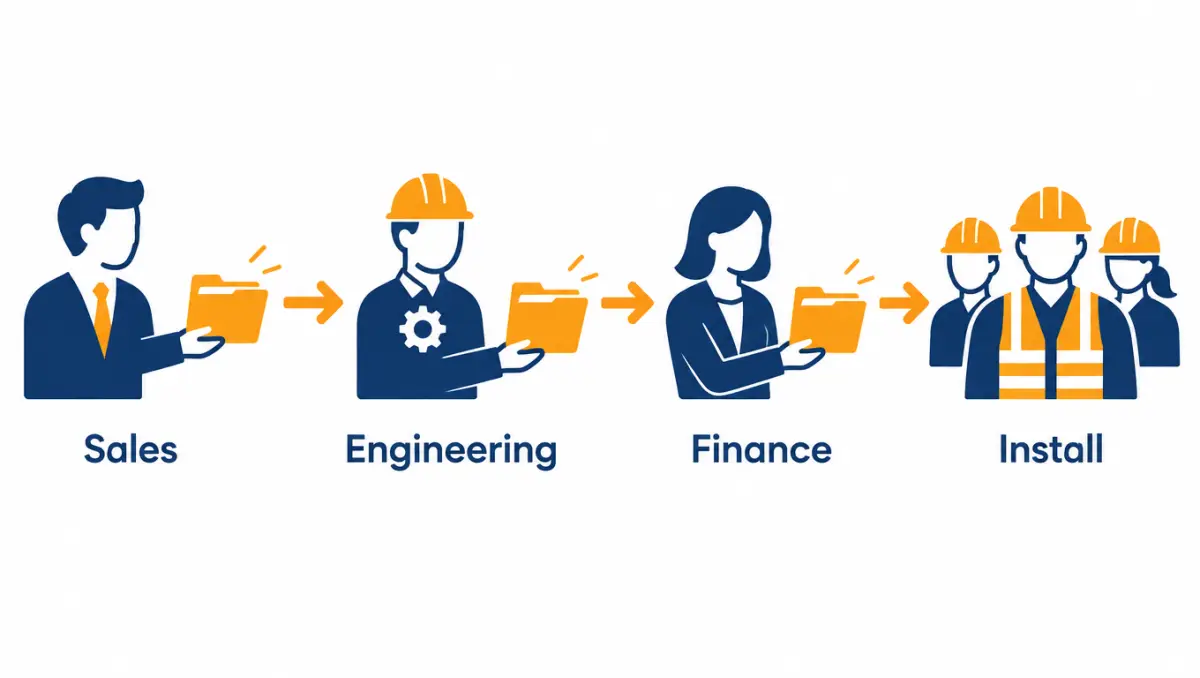
Handoffs are where commercial solar sales processes leak. A rep has three good calls, collects bills, then sends engineering a one-line email: "Can you size a system for this address?" Engineering re-asks for the roof age, finance re-asks about the tax position, and the prospect wonders why your company cannot keep track of what they already said. A standard packet fixes that.
Who hands off to whom
Most commercial teams have some version of these handoffs:
| Handoff | From | To | Trigger |
|---|---|---|---|
| Lead to discovery | Inside sales or appointment setter | Account executive | First call booked with a fit hypothesis |
| Discovery to design | Account executive | Design engineer or analyst | Score in proposal band; data at medium or high confidence |
| Design to finance | Account executive and engineer | Finance team or financing partner | Draft system size and production estimate ready |
| Proposal to contract | Account executive | Contracts or legal | Signer verbally approves |
| Contract to project | Account executive | Project manager | Contract signed |
Each handoff has a packet. The discovery-to-design packet is the one this playbook focuses on, because it is where qualification work turns into cost.
The discovery-to-design packet
ACCOUNT SUMMARY
- Organization, entity type, site address
- Score: [0-100]   Band: [ ]   Confidence: [H/M/L]
- Fit hypothesis and what has been confirmed

AUTHORITY
- Stakeholder map (attached)
- Decision process in the prospect's words
- Decision criteria (payback, savings, sustainability goal, etc.)

SITE
- Owner of record, utility account name, contract signer entity
- Lease terms (if tenant), landlord contact and consent status
- Roof type, age, condition notes, warranty holder
- Usable area estimate (desktop), shading notes
- Ground or carport options
- Photo set: roof, equipment, main panel nameplate, meter(s)

LOAD
- Twelve months of bills, all meters (attached)
- Rate schedule for each meter
- Interval data (attached or status)
- Operating hours and seasonality
- Planned load changes with dates

MONEY
- Preferred structure(s) and why
- Tax position (as stated by prospect; not verified advice)
- Financing questions raised by prospect or CPA

TIMING
- Trigger, date, source
- Prospect's target date for operation
- Competing bids and their stage

PROMISES MADE
- Everything the rep told the prospect they would receive, and when

OPEN RISKS
- [list]

REQUESTED OUTPUT
- What the rep needs from design, by when
The "promises made" section
This section prevents most handoff friction. List every commitment: "Told CFO we'd show a lease and a cash option," "Told facilities we would avoid work during the holiday shutdown," "Promised a draft by the 15th." The next person in the chain inherits those promises.
Handoff quality checks
Engineering or the design analyst should be allowed to reject a packet. A simple acceptance rule:
- All five gates scored, with evidence notes.
- Twelve months of bills for all meters, or a written reason why not.
- Site control confirmed or a documented path to it.
- Requested output and due date stated.
A rejected packet goes back to the rep with a list of what is missing. This feels slow at first and saves time within a month, because reps learn to collect the right information on the first calls.
The warm handoff call
For mid-size and larger accounts, introduce the engineer or analyst to the champion on a short call rather than by email alone. The introduction:
"This is [engineer], who'll be designing the system. I've shared everything we discussed, including [two specifics]. [Engineer] may have a few technical questions about the electrical room, but you won't need to repeat the basics."
The phrase "you won't need to repeat the basics" sets an expectation your team then has to meet. That is the point.
Handoff to finance and financing partners
When a financing partner is involved, send only what they need. Prospects are sensitive about financial information, and over-sharing creates risk. Agree internally on what goes to whom, and tell the prospect who will see their documents before you send them.
After the handoff: who owns the relationship
The account executive keeps ownership of the relationship through contract. Engineers and finance staff can talk to the prospect directly, but every contact should be logged on the account, and the account executive should know about it the same day. Prospects should never be surprised by who is calling them.
What stages and exit criteria should a commercial solar pipeline use?
Use stages that each end with a verifiable exit criterion, not an activity. Typical stages are new inquiry, discovery, data collection, site review, proposal, decision and contract. A deal moves forward only when the exit criterion is met in writing. This keeps the pipeline honest and makes qualification measurable at every step.
The commercial guide includes a pipeline stage table for CRM setup. This section adds the qualification tests that belong at each exit and the fields to require.
Stage exit criteria with qualification tests
| Stage | Exit criterion | Qualification test | Required CRM fields |
|---|---|---|---|
| New inquiry | First conversation held with the inquirer | Fit hypothesis written | Source, role, owner/tenant claim, spend range |
| Discovery | Five gates scored at least once | No knockout scores | Gate scores, stakeholder map started, trigger |
| Data collection | Bills received for all meters; site photos received | Load confidence medium or higher | Bills attached, rate schedule, photo set |
| Site review | Desktop and (if needed) on-site review complete | Site gate 3 or higher | Roof notes, electrical notes, site control status |
| Proposal | Proposal presented to signer | Authority gate 3 or higher | Proposal version, attendees, decision criteria |
| Decision | Signer's decision received | Money gate 3 or higher | Decision, reason, next steps |
| Contract | Contract signed | All gates 3 or higher | Contract date, signer, entity |
Stage-skipping rules
Some teams allow small accounts to skip stages. That is fine if written down. A small owner-operated account might combine discovery and data collection on one call and skip a physical site visit. Write the skip rules by project band so reps do not invent them case by case.
Aging rules by stage
Every stage should have a maximum age after which the account is reviewed. Set these from your own historical stage durations. An account that sits in data collection far past your normal time is usually a sign the champion lacks influence or the project has lost priority. Review it, move it to hold, or close it.
Fields that make qualification reportable
Require these fields so you can report on qualification quality later:
- Lead source and vendor (if bought)
- Self-reported role, ownership status and spend range at inquiry
- Verified role, ownership status and annual consumption after discovery
- Gate scores and date scored
- Disqualifier or hold code
- Days in each stage
Comparing self-reported fields with verified fields shows how accurate each lead source is. That feeds directly into vendor conversations and pilot reviews. Our guide on how to vet solar lead providers explains what to ask vendors when the numbers drift.
How do qualification priorities change by commercial segment?
Qualification priorities change by segment because each segment fails in a different place. Tenants fail on site control, nonprofits on authority timing, agriculture on load across meters, cold storage on demand charges and public entities on procurement. Open each discovery call with the gate most likely to fail for that segment.
The commercial guide covers how to sell to each segment. This section is narrower: which gate to test first in each segment and the qualification questions unique to it.
Segment qualification cheat sheet
| Segment | Gate to test first | Most common failure | Unique qualification question |
|---|---|---|---|
| Warehouse and distribution | Site | Tenant without landlord path | "Who owns the building, and what's left on your lease?" |
| Light manufacturing | Load | Demand-heavy tariff with evening peaks | "When does your heaviest equipment run?" |
| Cold storage and food processing | Load | Demand charges dominate | "Can we see interval data to find when your peaks happen?" |
| Agriculture | Load | Load split across many meters | "How many meters are on the operation, and what does each serve?" |
| Self-storage | Load | Very low on-site load | "Are you looking at selling power or serving only your own meters?" |
| Auto dealerships | Authority | Dealer group or manufacturer approvals | "Does the dealer group or manufacturer approve building changes?" |
| Owner-occupied offices | Load | Modest load relative to roof | "What share of the building is occupied, and what are the hours?" |
| Retail centers | Site | Landlord-tenant split | "Which meters does the landlord pay for?" |
| Hospitality | Load | Evening-heavy load | "What does your load look like at midday versus evening?" |
| Schools and municipalities | Authority | Procurement path | "How does the district purchase projects like this?" |
| Houses of worship and nonprofits | Authority | Committee timing | "When does the board meet, and what do they need to see?" |
| Multifamily | Site and Load | Tenant-paid meters | "Which meters are in the owner's name?" |
Segment notes for qualification
Warehouses. Big roofs and modest loads are common. A large roof does not mean a large project if the site uses little power and export credit is low. Qualify on load first once site control is confirmed.
Cold storage. Strong, steady loads make good solar candidates, but demand charges can dominate. Get interval data early. If you sell storage, qualify for it on the same call.
Agriculture. Ask about every meter and whether the utility allows aggregation across meters. Seasonal irrigation loads can align with summer production. Family decision-making and agricultural lenders belong on the stakeholder map from the first call.
Dealerships. Dealer groups often centralize decisions, and manufacturers sometimes have facility image programs. Learn who approves building changes before investing time in design.
Public and nonprofit. Learn the procurement path or the board calendar on the first call. These accounts can be excellent but follow rules you cannot shortcut.
What does commercial solar lead qualification look like in practice?
In practice, qualification is a series of short decisions recorded against the five gates. The illustrative walkthroughs below show four accounts scored after discovery, the gaps each one had, the next step chosen and the outcome category. None are real clients; they show how the framework handles common situations.
Each walkthrough uses the scoring model from earlier in this post with the illustrative weights. Read them for the reasoning, not the numbers.
Walkthrough A: owner-operated machine shop (illustrative)
Inquiry: Owner, self-reported building owner, high monthly spend range, timeline "this year."
Pre-call hypothesis: Owner-occupied, single-story metal building, demand-metered rate, likely cash or loan buyer.
What discovery found:
- The owner is the signer. His CPA reviews all large purchases.
- The building is owned by an LLC the owner controls. Same owner, different name.
- Metal roof, about twelve years old per the owner, no known leaks.
- Two shifts on weekdays, compressors and CNC machines; demand charges are a noticeable share of the bill.
- Prefers ownership. Has a bank line for equipment.
- Trigger: the owner wants to decide before the fiscal year ends, about five months away.
Gate scores: Authority 3 (signer engaged; CPA not yet), Site 3, Load 2 (bills promised, not received), Money 3, Timing 3.
Weighted score: (0.75 + 0.75 + 0.40 + 0.60 + 0.30) × 25 = 70.
Decision: Close the gaps. Next steps: receive bills and interval data within a week; set a joint call with the CPA after the bill review.
Outcome category: Moved to proposal band after bills arrived and the CPA call was booked.
Lesson: Small accounts can move fast when the owner is the signer. The CPA was the only hidden stakeholder, and naming them early prevented a stall later.
Walkthrough B: tenant in a distribution building (illustrative)
Inquiry: Operations manager, self-reported tenant, very high spend range, timeline "within six months."
What discovery found:
- The tenant pays all electricity. The building belongs to an institutional landlord.
- The lease has a little over four years remaining, with one renewal option.
- The operations manager has never contacted the landlord about roof use.
- The tenant's parent company approves capital projects at headquarters in another state.
- Strong daytime load, two shifts plus a weekend shift in peak season.
Gate scores: Authority 1 (champion only), Site 1 (tenant, landlord unknown), Load 3, Money 2, Timing 2.
Weighted score: (0.25 + 0.25 + 0.60 + 0.40 + 0.20) × 25 = 42.5.
Decision: Nurture with two named actions: the champion asks the landlord's property manager about a roof license, and identifies who at headquarters approves capital projects. Re-open when both are known.
Outcome category: Hold (HOLD-LEASE with an authority gap).
Lesson: The load was excellent, which tempts reps to keep pushing. The framework kept the rep from spending engineering time on a roof the tenant could not commit.
Walkthrough C: regional food processor (illustrative)
Inquiry: Energy manager, self-reported owner, very high spend, timeline "next budget cycle."
What discovery found:
- Owner-occupied by the operating company. The CFO is the signer, and the board approves projects above a threshold.
- Membrane roof replaced recently; large, mostly unobstructed.
- 24/7 refrigeration load plus daytime processing; high demand charges.
- The energy manager already has interval data.
- The CFO prefers a PPA to avoid tying up capital; the company has tax appetite but wants the balance sheet clean.
- Budget is set in a known month; the board meets the following month.
Gate scores: Authority 3, Site 4, Load 4, Money 3, Timing 3.
Weighted score: (0.75 + 1.00 + 0.80 + 0.60 + 0.30) × 25 = 86.25.
Decision: Build proposal, including a PPA option and a storage discussion for demand charges. Schedule a proposal meeting with the CFO before the budget month.
Outcome category: Proposal band.
Lesson: High scores still need structure. Because the board approves the project, the team wrote a mutual plan backward from the board date.
Walkthrough D: church with a building committee (illustrative)
Inquiry: Facilities volunteer, self-reported owner, moderate spend, timeline "exploring."
What discovery found:
- The congregation owns the building. The finance committee recommends and the board approves.
- Shingle roof, age unknown to the volunteer.
- Load peaks on weekends and some weekday evenings; modest overall.
- The committee assumes it can use tax credits like a business. Nobody has looked at elective pay.
- No trigger, but the board meets quarterly.
Gate scores: Authority 2, Site 2, Load 2, Money 1, Timing 1.
Weighted score: (0.50 + 0.50 + 0.40 + 0.20 + 0.10) × 25 = 42.5.
Decision: Nurture. Offer a short educational session for the finance committee, with a recommendation that they confirm tax treatment with their own advisor. Ask for roof records and twelve months of bills.
Outcome category: Hold (HOLD-DATA), with a re-open tied to the next committee meeting.
Lesson: Low scores for nonprofits often mean "early," not "bad." The framework turned "exploring" into a dated next step.
What the walkthroughs show
- The highest-load account (B) was not the best account.
- The most enthusiastic contact (B's operations manager) had the least authority.
- Small accounts (A) can reach the proposal band quickly when authority is simple.
- Holds with named triggers keep good accounts alive without clogging the forecast.
Applying the walkthroughs: a ten-minute post-call review checklist
The fastest way to make these walkthroughs useful is to run the same review after every commercial discovery call. Ten minutes, done the same day, catches most qualification errors before they reach the forecast. Use it as a written note in the CRM, not a mental check.
- Who did I actually speak with? Write their title and whether they can sign, influence or only gather information. If you only reached an influencer, the next step must include the signer or the finance lead.
- Who owns the building and the roof? Confirm owner-occupied, tenant or landlord. If the business leases, note whether the lease term outlasts a reasonable payback window and who would need to approve roof work.
- What data do I have in hand? List bills received (number of months), interval data, roof age and recent roof records. Missing data is not a disqualifier, but it sets the next step.
- What is the stated reason to act, and is it dated? A rate change, a capital budget cycle, a roof replacement or a sustainability commitment counts. "Saving money someday" does not.
- What financing path did they mention? Cash, loan, lease or PPA. Note any tax-appetite questions and record that tax treatment should be confirmed with their own advisor.
- What would make this a no? Write the single biggest risk in one sentence, such as an unclear owner or a roof that needs replacing first.
- What is the dated next step? A meeting, a document request or a site visit, with a calendar date both sides agreed to.
- What score and stage does this support? Update the score using only what you verified on this call. If the score went up without new evidence, roll it back.
How managers use it. In weekly pipeline review, ask reps to read items 6 and 7 aloud for every deal above the proposal band. Deals with no named risk or no dated next step go back to discovery. Over a quarter, the pattern of missing answers shows where your team needs coaching, whether that is reaching signers earlier or asking for interval data on the first call.
Who on your team should qualify commercial solar leads?
The right person depends on deal size and volume. Small teams usually have the owner or a senior seller qualify every commercial account. Growing teams split work: an inside rep confirms basic fit and books discovery, and an account executive runs the five gates. Larger teams add an analyst who reviews bills before engineering.
There is no single right org chart, but there are common patterns and common mistakes.
Model 1: one person does everything
Typical for residential installers adding light commercial work, or small dedicated C&I shops. The owner or a senior seller takes the first call, runs discovery, reviews bills and builds the proposal with an engineer or design service.
Works when: commercial volume is modest and accounts are mostly small, owner-operated businesses.
Breaks when: volume rises and response times slip. Commercial inquiries left for days lose momentum. Our speed-to-lead guide covers why first-contact time matters for every lead type.
Model 2: inside qualifier plus account executive
An inside rep makes first contact, confirms basic fit (role, ownership claim, rough spend, location, project type), and books a discovery call with an account executive. The account executive runs the five gates.
Works when: inquiry volume is steady and account executives' time is the bottleneck.
Breaks when: the inside rep "qualifies" too much. The inside rep's job is to confirm basic fit and book the meeting, not to run a full discovery. Keep their checklist short:
| Inside qualifier checklist | Pass condition |
|---|---|
| Contact confirmed | Right person, right company |
| Role | Any of your target roles, or can introduce one |
| Property | Address in territory, building type you serve |
| Ownership claim | Owner, or tenant willing to involve landlord |
| Rough energy picture | Spend or usage in your target range |
| Willing to meet | Discovery booked with a calendar invite |
Model 3: qualifier, account executive and analyst
Larger teams add an energy analyst who reviews bills and interval data before an engineer designs anything. The analyst scores the Load gate and flags tariff issues.
Works when: proposals are expensive to produce and engineering time is scarce.
Breaks when: the analyst becomes a queue. Set turnaround targets and track them.
Model 4: partner-assisted qualification
Some smaller installers partner with a C&I developer or EPC that runs design and financing. The installer qualifies and hands off, and the partner proposes and builds.
Works when: the installer has local relationships but not C&I engineering or financing.
Breaks when: the handoff packet is weak or the partner's criteria differ from the installer's. Agree on the five-gate standard and the minimum project size before you hand off the first account.
Training reps to qualify
The commercial guide includes a two-week ramp plan and role-play scenarios for working commercial leads generally. For qualification specifically, three exercises help:
- Score the recording. Managers play a recorded discovery call; each rep scores the five gates independently. Compare scores and discuss differences. Disagreements show where the standard is unclear.
- Find the missing stakeholder. Give reps an account summary with a hidden stakeholder (a CPA, a lender, a landlord). Ask them to find who is missing and draft the question that would surface them.
- Close one out. Each rep practices a polite close-out on a real account that has a hard disqualifier. Reps who never close accounts out need this most.
Compensation that rewards qualification
Pay plans that reward only booked meetings or only proposals produce over-qualification of weak accounts. Consider tying part of variable pay to stages that require verified evidence, such as proposals that reach a signer meeting, and reviewing disqualifier accuracy in one-on-ones. Avoid penalizing honest close-outs.
How is qualifying bought leads different from outbound commercial solar prospecting?
Bought inquiries start with a stated interest and a consent record, so qualification begins with confirming the claims in the record. Outbound commercial solar prospecting starts from a target list with no stated interest, so qualification begins with earning a conversation. The five gates are the same; the order of work and the evidence differ.
Inbound and bought inquiries
When a lead comes from your own website or a vendor, the record already includes self-reported fields. The first job is to verify them:
| Field in the record | First-call verification |
|---|---|
| Role | "Just so I understand your part in this, what's your role in decisions like these?" |
| Owner or tenant | "Does the company own the building, or lease it?" |
| Spend range | "Roughly what does the electric bill run in a typical month?" |
| Timeline | "What would need to happen for this to move this year?" |
| Reason for interest | "What prompted the inquiry?" |
Track how often each field turns out wrong by source. That number matters more than lead price when you compare vendors. If you buy commercial inquiries, our buy solar leads guide covers how to set filters and run a pilot. Pricing for commercial programs is confirmed on the call, by territory.
Outbound prospecting
Outbound commercial solar prospecting targets organizations that have not asked to hear from you. Qualification works differently:
- Pre-qualify with data before contact. Use property data, satellite imagery and business information to estimate Site and Load before you reach out. Only contact accounts likely to pass.
- Earn the conversation. The first contact is about relevance: why this building, why now.
- Expect more Authority work. Outbound contacts are often not the right person. Ask for referrals inside the organization.
- Mind the rules. Business-to-business calls and texts still fall under telemarketing rules in many cases, and some state rules are stricter than federal ones. Check the FCC's telemarketing and robocall guidance and confirm your outreach program with counsel. Our TCPA compliance guide covers consent basics.
Pre-qualification scoring for outbound lists
Build a simpler desktop score for outbound targets:
| Factor | Desktop source | Points (illustrative) |
|---|---|---|
| Owner-occupied (owner of record matches business, or related entity) | Assessor data | 0 to 3 |
| Usable roof or land area | Satellite | 0 to 3 |
| Likely load (segment, building size, operations) | Business data, imagery | 0 to 3 |
| Utility and tariff favorable | Service territory and rate knowledge | 0 to 2 |
| Trigger signals (expansion, new owner, roof permit) | News, permits | 0 to 2 |
Work the list from the top. After contact, switch to the five-gate model. The desktop score is a guess about fit; the five gates are evidence.
Mixing both
Many C&I teams run both motions. Keep them in separate pipelines or at least tag them by source, because conversion rates and cycle times differ. Blending them hides whether your bought leads or your outbound program is working.
How do you use a mutual action plan to keep qualification honest?
A mutual action plan is a short shared document listing every step between today and a signed contract, who owns each step and the target date. In commercial solar it turns vague interest into commitments the prospect makes in writing. A prospect who will not agree to a plan is telling you the account is less qualified than it looks.
Use mutual plans on mid-size and larger accounts. For small owner-operated deals, a short email recap with dates does the same job.
What goes in the plan
| Step | Owner | Target date | Status |
|---|---|---|---|
| Send twelve months of bills and interval data | Prospect (facilities) | ||
| Bill review and fit summary | Your analyst | ||
| Site visit | Your engineer, prospect facilities | ||
| Landlord consent request (if tenant) | Prospect | ||
| CPA or finance review call | Prospect (CFO), your finance lead | ||
| Proposal meeting with signer | Your account executive, prospect signer | ||
| Board or committee presentation (if needed) | Prospect, with your support | ||
| Contract review | Prospect counsel, your contracts lead | ||
| Signature | Prospect signer | ||
| Target operation date | Both |
How to introduce it
"Projects like this have a lot of steps, and some of them are on your side. Would it help if I wrote them down with rough dates so we can both see what's next? You can change anything that doesn't fit."
Most commercial buyers welcome this. It makes their internal job easier. Send it as a simple shared document, not a sales tool login.
Reading the response
| Response | What it tells you |
|---|---|
| Prospect edits dates and adds steps | Strong engagement; they are planning internally |
| Prospect agrees without changes | Moderate; confirm the signer has seen it |
| Prospect pushes all dates out | Timing gate weaker than scored; adjust |
| Prospect will not commit to any date | Hold, or the champion lacks influence |
| Prospect asks who else needs to see it | Good sign; add those people to the map |
Updating scores from the plan
When a prospect misses two steps in a row without explanation, lower the Timing score and review Authority. When they complete steps early, raise confidence. The plan becomes a running qualification check, not a one-time form.
How do you re-qualify a stalled commercial solar deal?
Re-qualify a stalled deal by re-scoring all five gates with fresh evidence, finding which gate changed, and asking the champion a direct question about priority. Then choose: re-engage with a new step, move to hold with a trigger, or close out. Stalls usually come from a hidden stakeholder, a lost trigger or a money problem nobody named.
Commercial pipelines fill with accounts that were once qualified and quietly stopped moving. Regular re-qualification keeps forecasts honest and frees reps for live accounts.

When to re-qualify
- The account has exceeded the aging limit for its stage.
- Two scheduled steps in the mutual plan were missed.
- The champion has gone quiet across several channels.
- A key person left or changed roles.
- A trigger date passed with no decision.
The re-qualification call
Be direct. Commercial buyers appreciate it:
"It's been a few weeks since we last spoke, and I want to make sure I'm not chasing something that's no longer a priority. Has anything changed on your side since we last talked?"
Then listen. Follow with gate-specific questions depending on what you hear:
| What you hear | Gate to re-check | Follow-up question |
|---|---|---|
| "The owner hasn't had time to look at it." | Authority | "What would make it worth thirty minutes of the owner's time?" |
| "We're dealing with a roof issue." | Site | "Would it help to look at the roof and solar together?" |
| "Our energy use changed." | Load | "Can you send the last three months so we can update the numbers?" |
| "Finance has questions." | Money | "Could we get on a call with finance to answer them directly?" |
| "Other priorities came up." | Timing | "When would be a better time to revisit, and what would need to be true?" |
| "We went with someone else." | All | "I appreciate you telling me. What made the difference?" |
Common stall causes and fixes
| Cause | Sign | Fix |
|---|---|---|
| Hidden stakeholder | "I need to check with someone" repeated | Map them; ask for an introduction |
| Lost trigger | Original date passed, no new date | Find a new trigger or hold |
| Proposal mismatch | Proposal answered the wrong criteria | Re-ask decision criteria; revise |
| Money ambiguity | Finance never engaged | Request a finance call as the next step |
| Champion left | Emails bounce or go unanswered | Find the replacement; restart Authority |
| Competing bid | Prospect slows to compare | Ask what they are comparing; clarify differences |
| Site surprise | Roof or electrical issue discovered | Present options: replace first, redesign, or ground-mount |
The re-qualification decision
After the call, re-score and choose one of three outcomes:
- Re-engage: new next step with a date, scores updated.
- Hold: reason code and re-open trigger.
- Close out: reason code and polite close-out message.
Do not leave an account in its old stage after re-qualification. The whole point is to make the pipeline reflect reality.
Monthly re-qualification review
Once a month, managers should list every account over its stage age limit and require one of the three outcomes for each. This takes less than an hour for most teams and does more for forecast accuracy than any reporting tool.
Which metrics show whether your commercial solar qualification works?
Track conversion between stages, time in each stage, disqualification rates by reason code and lead source, accuracy of self-reported inquiry fields, proposal-to-signer-meeting rate and win rate by score band. Good qualification shows up as fewer proposals that go nowhere and higher win rates in the top score band.
The commercial guide covers how to measure a lead pilot with a scorecard. These metrics are for ongoing qualification quality.
Core qualification metrics
| Metric | What it tells you | How to calculate |
|---|---|---|
| Discovery-to-data rate | How many discovery calls produce bills | Accounts reaching data collection ÷ accounts reaching discovery |
| Data-to-proposal rate | How many data reviews justify proposals | Proposals ÷ accounts reaching data collection |
| Proposal-to-signer rate | Whether proposals reach the person who decides | Proposals presented to signer ÷ proposals built |
| Win rate by score band | Whether the scoring model predicts outcomes | Wins ÷ decisions, grouped by score at proposal |
| Disqualification mix | Where accounts fail | Count of close-outs by reason code |
| Field accuracy by source | Lead vendor data quality | Verified matches ÷ records, per field, per source |
| Days per stage | Where accounts slow down | Median days per stage |
| Hold re-open rate | Whether holds come back | Re-opened holds ÷ total holds, over time |
| Proposals per engineer hour | Efficiency of design time | Proposals ÷ engineering hours logged |
Reading the metrics together
- High data-to-proposal rate but low proposal-to-signer rate: reps are qualifying load and site but not authority. Train on stakeholder mapping.
- Low discovery-to-data rate: prospects do not see value in sharing bills. Improve how reps explain the bill review and how fast it returns.
- Win rate flat across score bands: the scoring model is not predictive. Re-weight or add factors.
- Field accuracy low for one source: talk to the vendor about filters or definitions. Read our guide on how to vet solar lead providers.
- Hold re-open rate near zero: nurture is not working, or holds are disguised close-outs.
Sample sizes
Commercial teams often have few closed deals per quarter. Small samples make metrics noisy. Look at trends over several quarters, report counts next to rates, and resist redesigning the process because of a handful of deals.
Connecting qualification to cost per sale
Qualification metrics connect directly to what you can afford to pay for commercial inquiries or appointments. If better qualification raises the share of inquiries that become proposals that reach a signer, the cost per closed deal falls even at the same lead price. The solar lead cost calculator and the ROI guide show how to run that math with your own numbers.
What are the most common commercial solar qualification mistakes?
The most common mistakes are treating the inquirer as the decision-maker, proposing before bills arrive, ignoring site control for tenants, assuming tax treatment, skipping interval data on demand-heavy sites, letting accounts age without re-qualification and closing good accounts for weak reasons. Each has a simple process fix.
Mistake and fix table
| Mistake | Why it happens | Fix |
|---|---|---|
| Treating the champion as the signer | Champions sound confident | Require a named signer to pass Authority |
| Proposing on estimated usage | Reps want to show progress | No proposal below medium load confidence |
| Ignoring the landlord | Tenant pays the bill, so it feels like their decision | Site gate requires landlord path for tenants |
| Assuming tax position | Prospects assume, reps repeat | Route tax questions to the prospect's advisor; confirm with counsel |
| Skipping interval data | It takes effort to get | Required for demand-heavy tariffs before proposal |
| Sizing to last year's load | Planned changes not asked | Ask about load changes on every account |
| No written decision process | Feels awkward to ask | Use the "next three steps" question every time |
| Keeping dead accounts open | Fear of an empty pipeline | Monthly re-qualification review |
| Closing on "no answer" | Short follow-up sequences | Longer multi-channel sequence before close |
| Over-qualifying small accounts | One process for all sizes | Light and full versions by project band |
| Different reps, different standards | No written framework | Shared scorecard and calibration sessions |
| Handing off with a one-line email | Speed | Required handoff packet with acceptance rule |
A quick self-audit
Pick ten accounts currently in your proposal stage and answer for each:
- Can I name the signer, and has anyone on our team spoken with them?
- Do we have twelve months of bills for every meter?
- Is site control confirmed in writing or by the deed?
- Do we know which financing structure the signer prefers?
- Is there a trigger with a date?
If fewer than seven of the ten can answer yes to all five, your qualification standard needs work before you add more leads.
What templates make commercial solar qualification repeatable?
Four templates cover most of the work: a five-gate call notes form, a fit summary email that confirms what you learned, a bill review summary that reports the Load gate to the prospect, and a qualification decision memo for internal review. Keep them short so reps use them on every account.
Template 1: five-gate call notes
ACCOUNT:                     DATE:            REP:
CALL TYPE: [discovery / follow-up / re-qualification]
ATTENDEES (name, title, entity):

HYPOTHESIS BEFORE CALL:
RESULT: [confirmed / partly / wrong]

A - AUTHORITY
  Signer:                    Engaged? [Y/N]
  Decision process (their words):
  Other stakeholders named:
  Score (0-4):     Evidence:

S - SITE
  Owner of record:           Utility account name:
  Own / lease (term):        Landlord contact:
  Roof type / age / notes:
  Ground or carport option:
  Score (0-4):     Evidence:

L - LOAD
  Meters:                    Rate schedule(s):
  Hours / seasonality:
  Major loads:
  Planned changes:
  Data status: [none / some bills / 12 months / interval]
  Score (0-4):     Evidence:

M - MONEY
  Preferred structure:
  Tax position (as stated):
  Payback or return threshold:
  Finance reviewer:
  Score (0-4):     Evidence:

T - TIMING
  Trigger:                   Date:            Source:
  Target operation date:
  Competing bids:
  Score (0-4):     Evidence:

WEIGHTED SCORE:      BAND:       CONFIDENCE:
KNOCKOUTS:
NEXT STEP (owner, date):
PROMISES MADE:
Template 2: fit summary email to the prospect
Send within one business day of discovery. It confirms what you heard and gives the prospect a chance to correct it, which is itself a qualification check.
Subject: Summary of our call about [site]
Hi [Name],
Thanks for walking me through [site] today. Here's what I heard, so you can correct anything I got wrong:
- [Organization] owns the building through [entity], and [signer] would make the final decision, with [finance reviewer] reviewing the numbers.
- The roof is [type], about [age] years old, with [notes].
- The building runs [hours], and the biggest loads are [loads]. You mentioned [planned change].
- You'd prefer to [own the system / avoid upfront cost], and you'd want to see [criteria].
- The timing that matters is [trigger and date].
Next steps:
- You'll send twelve months of bills for all meters by [date].
- We'll return a first read on fit and a rough size range by [date].
- We'll review it together on [date], ideally with [signer].
If anything above is off, just reply and let me know.
Template 3: bill review summary
The bill review is often the first piece of work a commercial prospect sees from you. Keep it to one page:
BILL REVIEW: [site]          DATE:          PREPARED BY:

WHAT WE REVIEWED
- [X] months of bills for [Y] meters
- Rate schedule(s): [names]
- Interval data: [yes / no]

WHAT WE SEE
- Annual energy use: [from bills]
- When the building uses the most power: [seasonal and daily notes]
- What makes up the bill: [energy, demand, fixed charges — described, not over-precise]
- How the utility treats solar on this rate: [plain-language summary]

FIT READ
- [Strong / Possible / Weak] fit, because [one or two reasons]
- Rough system size range for further study: [range, labelled preliminary]

WHAT WE STILL NEED
- [items]

NEXT STEP
- [meeting, site visit, finance call]
Label everything preliminary until engineering confirms it. Avoid savings figures in the bill review unless your analyst has modeled them; a number shared early becomes the number the signer remembers.
Template 4: qualification decision memo (internal)
For accounts entering the proposal band, a short memo helps managers approve engineering time:
ACCOUNT:              SCORE:       CONFIDENCE:
WHY THIS ACCOUNT, WHY NOW (two sentences):
BIGGEST RISK AND HOW WE'LL TEST IT:
ENGINEERING ASK (scope, hours estimate, due date):
DECISION DATE ON PROSPECT SIDE:
APPROVED BY / DATE:
How should installers of different sizes approach commercial qualification?
Small installers should keep qualification light and focus on owner-operated accounts where authority is simple. Mid-size C&I teams need the full five-gate standard with a handoff packet. Larger developers need segment-specific scoring, analysts and procurement capabilities. Match the depth of qualification to the deals you can actually build and finance.
The commercial guide covers how a commercial lead program fits each company size. This section covers what qualification looks like at each size.
Residential installer adding light commercial
You have strong residential qualification habits and some of them carry over: speed, consent records, phone verification. What changes:
- Add the Authority and Site gates. Residential assumes the homeowner signs; commercial cannot.
- Set a clear upper project size you will take on alone, and a partner for anything larger.
- Prefer owner-operated businesses with a single meter and simple roofs.
- Use the light version of the framework: one discovery call, bills, desktop roof review, proposal.
- Build a relationship with a commercial structural engineer and an electrical engineer before you need them.
Disqualify faster. Residential teams are used to working every lead hard. In commercial, the cost of pursuing a bad fit is higher because design work is heavier. A tenant with no landlord path is a referral to a C&I partner, not a project.
Dedicated C&I EPC
You likely have engineering in-house and a pipeline across several segments. Qualification priorities:
- Write the five-gate standard and the disqualifier codes. Train every rep on them.
- Install the handoff packet and acceptance rule between sales and engineering.
- Add an analyst role or a bill review service if engineers are the bottleneck.
- Score accounts at every stage exit and review score bands monthly.
- Track field accuracy by lead source to manage vendors.
Multi-state developer or integrator
You may run separate teams by segment or region and handle larger, multi-site accounts. Qualification priorities:
- Segment-specific scoring models, especially for public entities and multi-site portfolios.
- A dedicated procurement response capability for public accounts.
- Portfolio qualification: confirm who decides site order and whether sites can be contracted together.
- Interconnection screening as part of the Site gate in constrained utility territories.
- Formal mutual action plans for every account above a size threshold.
Partnering across sizes
Some of the most efficient C&I programs pair a local installer that qualifies with a developer that designs, finances and builds. If you take this route, agree on:
- The five-gate minimum for handoff
- Who owns the customer relationship at each stage
- How compensation or referral fees are calculated (in writing)
- What happens when the partner declines an account
- How you share outcomes so both sides learn
Commercial solar qualification glossary
These terms appear throughout this playbook. The commercial guide has a broader glossary of C&I solar terms; this list covers qualification-specific language.
Champion. The person inside the prospect organization who wants the project to happen and helps you navigate internally. Often a facilities, operations or energy manager.
Signer (economic buyer). The person or body that can approve the contract and commit funds. Owner, CFO, CEO, board.
Gate. One of the five qualification checkpoints in this playbook: Authority, Site, Load, Money, Timing.
Knockout. A gate scored zero, which caps the overall score regardless of other gates.
Hold. A qualification outcome for accounts that fit but cannot move now. Always paired with a re-open trigger.
Close-out. A qualification outcome for accounts with a confirmed hard disqualifier. Always paired with a reason code.
Reason code. A short label recording why an account was held or closed, used for reporting.
Site control. The legal right to host a solar system on a property for the life of the agreement.
Owner of record. The entity named on the deed in public property records.
Load shape. The pattern of a building's electricity use over the day and year.
Interval data. Electricity use recorded in short intervals, often fifteen minutes or an hour, from the utility meter.
Rate schedule (tariff). The utility's published rules and prices for a class of customer.
Demand charge. A charge based on the highest rate of electricity use during a billing period, usually measured over a short interval.
Export compensation. How the utility credits electricity a solar system sends back to the grid.
Tax appetite. Whether an organization has enough federal tax liability to use tax credits directly.
Elective pay. A federal mechanism that allows certain tax-exempt and public entities to receive payments in place of some clean energy credits. Confirm eligibility with counsel.
Mutual action plan. A shared, dated list of steps both parties agree to complete before a decision.
Fit hypothesis. A short written guess about an account's fit, made before the first call and tested during it.
Confidence flag. A rating of how much of an account's score rests on verified evidence versus claims.
Handoff packet. The standard document set that moves with an account from sales to engineering, finance or project management.
Trigger. An event with a date that gives the prospect a reason to decide.
How does qualification change by commercial lead source?
Qualification changes by lead source because each source arrives with different evidence. A web inquiry carries self-reported fields to verify, a booked appointment carries a time commitment, a referral carries borrowed trust, a trade-show contact carries little data, and an older inquiry carries stale facts. Adjust your first questions to the gaps each source leaves.
Fresh web or vendor inquiry
The record holds role, ownership claim, spend range and timeline. Verify each on the first call and check the consent record if your process requires it. Speed matters most here: the prospect asked recently and is most likely to answer. Open with the gate the record suggests is weakest. A self-reported tenant gets the site-control questions first; a self-reported owner with a modest spend range gets the load questions first.
Booked commercial appointment
An appointment means the prospect agreed to a time, which is a signal of intent but not of authority. Confirm who will attend and whether the signer knows about the meeting. Before the call, send a short agenda and the bill request so the meeting produces data. If the person who shows up has no role in decisions, the appointment still has value as a path to the right person; ask for the introduction before the call ends.
Referral from a customer, partner or vendor
Referrals carry trust, which makes first calls easier and qualification easier to skip. Do not skip it. Referred prospects fail the same gates as anyone else, and a referral that turns into a stalled proposal can strain the referring relationship. Thank the referrer, then run the five gates as usual. If the account closes out, tell the referrer politely and briefly, without sharing the prospect's private details.
Trade show, association event or networking contact
These contacts often have a business card and a short conversation behind them. Treat them closer to outbound: pre-qualify from desktop data, send a short follow-up that references the conversation, and earn the discovery call. Check how you collected contact details and what the person agreed to before adding them to automated calling or texting sequences; confirm with counsel.
Older commercial inquiries
Commercial inquiries that went cold months ago can still be valuable, because commercial cycles are long and triggers come and go. But every fact in the record may have changed: the contact may have left, the lease may have been renewed, the roof may have been replaced. Re-qualify from scratch, starting with "Is this still something the company is looking at?" and then the Authority gate. If you buy aged leads for residential, our aged solar leads guide explains how that category works; for commercial, availability for your territory is confirmed on the call.
Inbound from your own website
Your own inbound leads often come with more context: the page they read, the form questions you chose, sometimes a downloaded resource. Use that context in your opening question. A prospect who read your page on carports should hear a carport question early. Make sure your form asks the questions your qualification standard needs most: role, ownership, building type and approximate spend.
Source-by-source first-question guide
| Source | First gate to test | Opening question |
|---|---|---|
| Fresh inquiry | Weakest field in the record | "You mentioned you [lease/own] the building. Can you tell me more?" |
| Booked appointment | Authority | "Who else from your side will join, and does [signer] know we're meeting?" |
| Referral | Timing | "What made [referrer] think now was a good time for us to talk?" |
| Event contact | Site | "Which building were you thinking about when we spoke?" |
| Older inquiry | Authority | "Are you still the right person to talk to about energy projects?" |
| Own website | Context | "I saw you were reading about [topic]. What got you interested?" |
Comparing sources fairly
Do not judge sources by first-call rates alone. Compare them on stage conversion through to proposals that reach a signer, and on field accuracy. A source with lower contact rates but higher accuracy and more signer-engaged proposals can be worth more than a cheaper, noisier one. Record the source on every account so the comparison is possible.
Partner and channel referrals
Some commercial accounts arrive through roofers, electrical contractors, energy brokers or equipment dealers. These partners often know the building better than the prospect does: roof age, panel size, past repairs. Ask the partner for what they know before your first call, with the prospect's permission, and treat it as a head start on the Site gate. Partners also have their own interests. A roofer may want the roof replaced first; an energy broker may hold a supply contract that solar affects. Note each partner on the stakeholder map with what they need from the project.
Re-scoring when the source was wrong
When verified facts contradict the lead record, update the record and the score on the same day. Do not leave the original self-reported values in place, because reports that compare sources depend on the difference between what was claimed and what was confirmed. A short "verified" field next to each self-reported field is enough. Over a quarter, those fields show which sources produce accounts that pass the gates and which produce accounts that only look qualified on paper.
How do you put this commercial qualification playbook into practice?
Start small: write your five-gate standard and disqualifier codes on one page, add gate-score fields to the CRM, and use the call notes template on every new commercial account for thirty days. Then add the handoff packet, run a calibration session and review metrics. Each step pays off before the next one starts.
A 30-60-90 day rollout
| Period | Actions | Output |
|---|---|---|
| Days 1 to 30 | Write the five-gate standard and disqualifier list. Add CRM fields. Use the call notes template on every new account. Hold one calibration session using recorded calls. | One-page standard; every new account scored |
| Days 31 to 60 | Introduce the handoff packet and acceptance rule. Start the monthly re-qualification review. Add the fit summary email. | Fewer rejected design requests; cleaner pipeline |
| Days 61 to 90 | Review first metrics: stage conversion, disqualification mix, field accuracy by source. Adjust score weights if evidence supports it. | First calibration of scoring model |
The one-page standard
Your one-page standard should state:
- The five gates and the minimum evidence for each
- The scoring scale and illustrative weights
- Knockout rules
- Score bands and actions
- Hard and soft disqualifier codes
- Light and full framework versions by project band
- The handoff acceptance rule
Print it. Put it next to every rep's desk. Update it quarterly.
Where bought leads fit
Bought commercial inquiries feed the top of this process. They arrive with a consent record naming your company, a validated phone number and self-reported role, ownership, spend and timeline fields, checked against leads already sent to you and scrubbed against the National Do Not Call Registry. Qualification turns those claims into verified facts. If you want to test how commercial inquiries perform with a qualification standard in place, the commercial solar leads page explains the program and pilot structure, and you can book a call to confirm territory availability by ZIP and pricing for your market. There are no long-term contracts; start with a test batch and scale when the numbers work.
For residential programs and appointment-setting options, see solar appointments and the main buy solar leads guide.
FAQ
How do you qualify commercial solar leads?
Qualify commercial solar leads by checking five gates in order: Authority (who signs), Site (who controls the property and whether it can host a system), Load (whether energy use and tariff make solar pay), Money (whether a financing structure you offer fits) and Timing (whether a dated trigger exists). Record evidence for each gate, score it, and choose to advance, hold or close.
What is C&I solar lead qualification?
C&I solar lead qualification is the process of confirming that a commercial or industrial inquiry has a reachable decision-maker, site control, enough suitable load, a workable financing path and a reason to act. It differs from residential qualification because the buyer is an organization with several stakeholders and more complex property and tariff situations.
What questions should I ask a commercial solar prospect?
Ask open questions grouped by gate: what prompted the inquiry, who else would have a say and who gives final approval, whether the company owns or leases the building, roof age and condition, operating hours and major loads, how capital projects are usually paid for, and what date matters for a decision. The question banks in this post list more than sixty options.
How do I find the decision-maker on a commercial solar deal?
Ask the champion how similar projects were approved in the past and what the next three steps would be on their side if a proposal made sense. Map every person and entity that can approve or block the project, including the property owner, lender and outside accountant. Reach the signer through the champion, not around them.
What data do I need to qualify a commercial solar lead?
At minimum, twelve months of utility bills for every meter, the rate schedule name, proof of site control and basic roof facts. For larger or demand-heavy sites, add interval data, electrical service details, photos of the main panel and meters, and any planned load changes.
What disqualifies a commercial solar lead?
Hard disqualifiers include no site control and no landlord path, energy use below your minimum project size, a tariff that makes savings negligible, no financing structure you can offer, no path to the signer, or a property being sold or vacated. Soft issues such as a roof needing replacement or a pending lease renewal mean hold, not close.
How do I score commercial solar leads?
Score each of the five gates from zero to four, weight them (an illustrative start is Authority and Site at 25% each, Load and Money at 20% each and Timing at 10%), sum and scale to 100. Apply knockouts for any zero score, map score bands to actions and calibrate the weights against your own won and lost accounts each quarter.
Should tenants be treated as qualified commercial solar leads?
Tenants can be qualified when the remaining lease term supports the project and there is a realistic path to landlord consent. Without both, treat the account as a hold or pursue the landlord directly. Always confirm who controls the roof before investing design time.
How long should commercial solar qualification take?
Small owner-operated accounts can often be qualified in one or two calls over a week or two once bills arrive. Mid-size and larger accounts usually need several conversations, a site review and a finance discussion across several weeks. Use your own stage history to set aging limits.
How is commercial solar prospecting different from working inbound leads?
Inbound and bought leads start with stated interest and a consent record, so the first job is verifying the claims in the record. Outbound prospecting starts with no stated interest, so you pre-qualify from property and business data, earn the conversation, then apply the same five gates. Outbound calling and texting are subject to telemarketing rules; confirm your program with counsel.
What should a sales-to-engineering handoff include?
A stakeholder map, the decision process, site control status, roof and electrical notes with photos, all bills and interval data, tariff notes, financing preference, trigger and date, open risks, everything promised to the prospect and the specific output requested with a due date.
Do I need interval data to qualify a commercial account?
Not always. Twelve months of bills are enough for a light qualification on small accounts with simple tariffs. For demand-heavy tariffs or larger projects, interval data should be in hand before a proposal, because it shows when peaks happen and how much load lines up with solar production.
How does the commercial sales process change after qualification?
After an account passes the gates, the commercial solar sales process shifts to design, financing, proposal and contract. A mutual action plan keeps both sides on dated steps, and regular re-qualification catches stalls early. The commercial solar leads guide covers proposal meetings, objections and follow-up in detail.
Can the federal commercial solar credit change whether a lead qualifies?
Yes. Tax position and federal timing rules affect project value and which structures fit. As of October 2026, commercial credit timing rules tightened in 2025 apply to new deals. Do not advise prospects on eligibility; route tax questions to their advisor and confirm treatment with counsel.